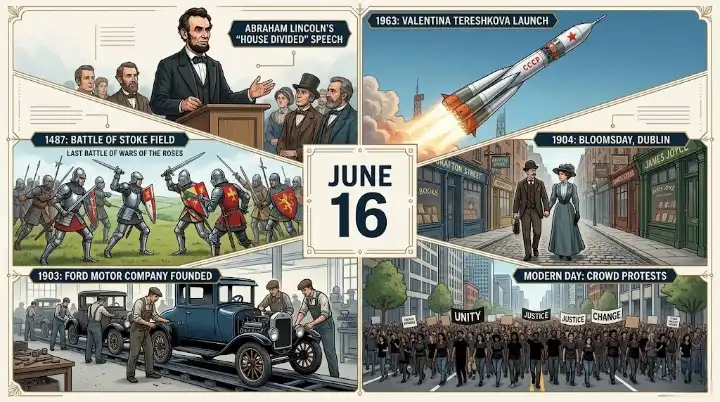
Abraham Lincoln stood before a packed Illinois State Capitol on June 16, 1858, carefully adjusting his glasses before delivering a warning that would define American destiny. Slavery was fracturing the nation, and Lincoln declared that a house divided against itself simply could not stand. His words sent shockwaves through political circles, setting up a ideological battleground that triggered the American Civil War three years later. This defining moment leads a packed calendar of major historical events June 16 that shaped politics, space exploration, and literature.
📅 Quick Facts — June 16 in History
| 📌 Category | 📖 Event / Detail |
|---|---|
| 🌟 Most Significant Event | Abraham Lincoln delivers the “House Divided” speech (1858) |
| 🏆 Top 10 Key Events | • Sasanian Empire leadership change (632) • Ming–Hồ War capture (1407) • Battle of Stoke Field (1487) • Siege of Gibraltar begins (1779) • Ford Motor Company incorporation (1903) • Amundsen’s polar voyage departure (1903) • IBM foundation (1911) • Soviet space milestone (1963) • Soweto student uprising (1976) • Donald Trump campaign announcement (2015) |
| ⚔️ Key Battles | Battle of Stoke Field (1487), Battle of Piacenza (1746), Battle of Ligny & Battle of Quatre Bras (1815) |
| 👤 Key Figures | King Henry VII, Valentina Tereshkova, James Joyce, Roald Amundsen |
| 🌍 Observances | Bloomsday, International Day of the African Child, Youth Day (South Africa) |
Story of the Day: Valentina Tereshkova Shatters the Space Ceiling
Strapped inside the cramped metal capsule of Vostok 6, 26-year-old Soviet cosmonaut Valentina Tereshkova listened to the countdown roaring through her headset on June 16, 1963. The engines ignited, launching a former textile worker into orbit and making her the first woman to reach outer space.
Cold War tensions meant the Soviet Union wanted a massive propaganda victory over the United States, but Tereshkova proved her mettle by logging more flight time than all previous American astronauts combined. Over three days, she orbited Earth 48 times, managing severe space sickness and mechanical glitches that nearly left her stranded in orbit. Her successful return shattered the misconception that space was an exclusively male domain.
Important Events That Happened On June 16 In History
632 – Yazdegerd III Secures the Persian Throne
Yazdegerd III accepted the royal crown of the Persian Empire amidst bitter internal betrayals and factional warfare. His ascent made him the final ruler of the storied Sasanian dynasty in modern-day Iran. Arab armies invaded almost immediately, capitalizing on the empire’s fractured state. The young king spent his entire reign fleeing from province to province before his eventual assassination.
1407 – Ming Armies Capture the Hồ Dynasty Kings
Chinese soldiers hidden along the muddy banks of the Red River ambushed the retreating entourage of the Vietnamese royal family. Retired King Hồ Quý Ly and his son, King Hồ Hán Thương, were bound in heavy wooden blocks by Ming Dynasty forces. This sudden capture brought an immediate, grinding halt to the short-lived Hồ dynasty. Imperial China annexed the region, plunging Vietnam back into a brutal period of foreign domination.
1487 – Henry VII Crushes Rebellion at Stoke Field
King Henry VII led his royal vanguard onto a bloody field near Nottinghamshire to confront a rebel army backing a young imposter to the throne. Swords clashed for hours in what became the final military engagement of the iconic Wars of the Roses. The German mercenaries hired by the Yorkist rebels disintegrated under heavy English longbow fire. Henry’s decisive victory permanently cemented the Tudor dynasty’s grip on the English crown.
1632 – Thomas Purchase Obtains Pejepscot Patent
Thomas Purchase stood before colonial authorities in New England to secure a formal land patent from the Plymouth Company. This legal document granted him ownership of the wild lands surrounding Pejepscot, Maine. He became the very first European settler to construct a homestead on the strategic site that later became Fort Andross. His trading post established an early, volatile economic foothold between English fishermen and the native Wabanaki tribes.
1745 – Pepperrell Captures Fortress of Louisbourg
William Pepperrell pointed his sword toward the stone ramparts of Cape Breton Island as French defenders lowered their white flags. A ragtag militia of New England colonial troops managed to capture the seemingly impregnable Fortress of Louisbourg. Heavy artillery bombardment over several weeks had reduced the French defenses to rubble. The victory stunned European capitals and proved that American colonists possessed serious, independent military capabilities.
1746 – Austrians Defeat Franco-Spanish Alliance at Piacenza
Prince Josef Wenzel deployed his Austrian regiments across the plains of Northern Italy to meet a combined Franco-Spanish offensive. The fierce Battle of Piacenza ended in a devastating tactical disaster for the invading Bourbon forces. Thousands of French and Spanish soldiers fell in futile charges against fortified Austrian artillery positions. This triumph secured Austrian dominance over the Italian peninsula for the remainder of the conflict.
1755 – British Forces Secure Fort Beauséjour
Colonel Robert Monckton watched British redcoats hoist their flag over the earthen ramparts of Fort Beauséjour after a brief siege. The French garrison surrendered the stronghold, ending their military presence on the Isthmus of Chignecto. This capitulation triggered a dark humanitarian disaster in the region. British authorities immediately used the victory to launch the forced, systematic expulsion of thousands of French-speaking Acadians from their homes.
1760 – Rogers’ Rangers Burn Fort Sainte Thérèse
Major Robert Rogers slipped through the dark shadows of the Richelieu River alongside a strike force of elite woodland scouts. His legendary Rangers launched a lightning-fast surprise assault against the French outpost of Fort Sainte Thérèse. The defenders scrambled in panic before being completely overwhelmed by the guerrilla tactics. Rogers’ men stripped the fort of supplies and burned the entire wooden structure to the ground before retreating into the forest.
1779 – Great Siege of Gibraltar Commences
Spanish diplomats officially declared war on Great Britain, triggering the immediate mobilization of a massive armada toward the Mediterranean. Spanish and French forces quickly surrounded the Rock of Gibraltar, beginning the longest continuous siege ever endured by the British Armed Forces. Starvation, disease, and relentless artillery bombardment tested the garrison for more than three years. British defenders held out, preserving a vital naval chokepoint for their empire.
1795 – Cornwallis Outmaneuvers French Fleet
Vice Admiral William Cornwallis paced the quarterdeck of HMS Royal Sovereign as a vastly superior French naval fleet closed in. His small squadron of five British warships formed a tight defensive line and offered fierce resistance during an action known as Cornwallis’s Retreat. The masterclass in naval discipline allowed the outnumbered British ships to escape completely intact. This tactical retreat humiliated the French Navy, setting up their catastrophic defeat at the Battle of Groix just six days later.
1811 – Crew Detonates the Powder Magazine of the Tonquin
Four desperate survivors of a native massacre hid below deck on the Pacific Fur Company ship Tonquin off Vancouver Island. As hundreds of Tla-o-qui-aht warriors swarmed the decks to plunder the vessel, the men intentionally dropped a burning torch into the ship’s powder magazine. A massive explosion obliterated the ship instantly, killing over one hundred attackers. The blast sent shockwaves through the North American fur trade and halted coastal expeditions for years.
1815 – Napoleon Fights Two Fronts Before Waterloo
Napoleon Bonaparte galloped onto the muddy fields of Ligny while Marshal Ney simultaneously launched an assault at Quatre Bras. These twin battles took place just two days before the cataclysmic showdown at Waterloo. Napoleon successfully smashed the Prussian line at Ligny, but Ney failed to clear the strategic crossroads at Quatre Bras. The tactical mess allowed the British and Prussian armies to later unite, sealing Napoleon’s ultimate downfall.
1819 – Killer Earthquake Alters the Kutch Landscape
A massive earthquake ripped through the Kutch district of western India with a violent roar, instantly claiming over 1,500 lives. The shifting tectonic plates violently forced open the earth, creating a massive six-meter-high ridge that stretched for eighty kilometers across the flat terrain. Local survivors gazed in awe at the newly formed wall of earth and dubbed it the Allah Bund, or “Dam of God.” The disaster permanently altered the flow of the Indus River.
1824 – Coffee House Meeting Establishes the RSPCA
Arthur Broome gathered a small group of passionate humanitarians inside the smoky rooms of Old Slaughter’s Coffee House in London. Their heated discussion led directly to the historic formation of what is today known as the Royal Society for the Prevention of Cruelty to Animals. This group became the world’s very first organized animal welfare charity. Their early efforts focused on prosecuting individuals who abused carriage horses and cattle in London markets.
1836 – Chartist Movement Born in London
William Lovett addressed a crowded room of urban laborers to organize the London Working Men’s Association. This political alliance drafted a radical document demanding universal male suffrage and secret ballots. Their organized push gave immediate rise to the Chartist Movement, the first mass working-class movement in Britain. Though Parliament repeatedly rejected their petitions, the agitation laid the groundwork for modern British democratic reforms.
1846 – Pius IX Wins the Papal Conclave
Cardinal Giovanni Maria Mastai-Ferretti emerged onto the balcony of the Quirinal Palace to the cheers of devout crowds. The Papal conclave selected him to become Pope Pius IX, beginning a historic era for the Catholic Church. His pontificate lasted over thirty-one years, marking the longest verified reign in the entire history of the papacy. He transitioned the papacy from a political, land-owning principality into a purely spiritual global institution.
1858 – Lincoln Delivers House Divided Speech
Abraham Lincoln faced a packed gallery of Illinois politicians to formally accept the Republican nomination for the United States Senate. He delivered his iconic “House Divided” speech, arguing that the American government could not endure permanently half-slave and half-free. Political allies feared the stark rhetoric was too radical for mainstream voters. The speech propelled Lincoln into the national spotlight, setting up his eventual march to the presidency.
1871 – Universities Tests Act Bans Religious Barriers
Prime Minister William Gladstone signed the Universities Tests Act into law after months of bitter parliamentary debate. This landmark legislation allowed students to enter Oxford, Cambridge, and Durham without taking Anglican religious oaths. Non-Conformist, Catholic, and Jewish scholars could finally pursue higher education degrees on equal footing. It stripped the Church of England of its ancient monopoly over academic life, except within the theology departments.
1883 – Victoria Hall Theatre Panic Kills 183 Children
A frantic announcer dropped a handful of free toys from the stage of the Victoria Hall theatre in Sunderland, England. Hundreds of excited children rushed down the gallery stairs, only to find a heavy exit door bolted nearly shut at the bottom. A horrific human crush ensued in the narrow stairwell, suffocating 183 children. The tragedy deeply shocked Victorian society and led directly to the invention of the push-bar emergency panic exit.
1884 – Switchback Railway Opens at Coney Island
LaMarcus Adna Thompson pulled the brake lever to send a wooden car rolling down a specialized track in New York. The famous “Switchback Railway” officially opened to the public as the first purpose-built roller coaster in America. Thrill-seekers paid a nickel to coast down the gentle hills at a modest six miles per hour. The immense popularity of the ride transformed Coney Island into the birthplace of the modern amusement park industry.
1897 – Treaty Annexes Hawaii to the United States
Secretary of State John Sherman sat with Hawaiian delegation leaders in Washington to sign a formal treaty of annexation. This document legally transferred sovereignty of the island republic to the United States government. Sugar tycoons who had overthrown the native Hawaiian monarchy engineered the deal to avoid high import tariffs. The republic was officially dissolved one year later, despite fierce, written protests from Queen Liliʻuokalani.
1903 – Henry Ford Incorporates the Ford Motor Company
Henry Ford huddled with a small group of eleven ambitious investors in a Detroit office to sign legal incorporation papers. Backed by just $28,000 in starting cash, the Ford Motor Company officially began commercial operations. Early manufacturing attempts were slow, plagued by design flaws and rapid cash burn. Within five years, the company introduced the Model T, pioneering the assembly line and changing global transportation.
1903 – Amundsen Departs to Conquer Northwest Passage
Roald Amundsen quietly steered his small, steel-reinforced fishing boat, the Gjøa, out of the Oslo harbor under the cover of a rainy midnight. The Norwegian explorer embarked on a perilous expedition to achieve the first east-to-west navigation of the treacherous Northwest Passage. He intentionally chose a tiny six-man crew and a shallow vessel to navigate the shallow, ice-choked arctic channels. The historic journey took three grueling years to complete.
1904 – Eugen Schauman Assassinates Nikolay Bobrikov
Eugen Schauman waited calmly in the grand hallway of the Senate House in Helsinki for the Governor-General of Finland to arrive. As Nikolay Bobrikov walked past, the young nationalist pulled a pistol and fired three shots into the Russian official before turning the weapon on himself. Bobrikov died the next day, ending his aggressive campaign to strip Finland of its traditional political autonomy. Schauman became an instant national hero.
1904 – James Joyce Takes Nora Barnacle on a First Date
James Joyce walked nervously along the crowded streets of Dublin to meet a young hotel chambermaid named Nora Barnacle for their very first date. The encounter sparked a passionate, lifelong relationship that completely transformed twentieth-century literature. Joyce loved the date so deeply that he chose this exact day to set all the wandering actions for his masterpiece novel, Ulysses. Millions of literary fans celebrate this date around the world.
1911 – Three Technology Firms Merge to Create IBM
Charles Flint brought together the executives of three distinct manufacturing businesses in Endicott, New York, to sign a major corporate merger. The newly formed enterprise was named the Computing-Tabulating-Recording Company. The business specialized in commercial butcher scales, industrial time clocks, and complex punch-card tabulators. Renamed International Business Machines in 1924, this company pioneered the foundation of global corporate computing.
1922 – Pro-Treaty Sinn Féin Wins Irish Election
Irish voters flocked to polling stations across the newly established Irish Free State to cast ballots in a highly tense general election. The pro-Treaty faction of the Sinn Féin party won a massive, decisive majority over their anti-Treaty rivals. The results showed clear public support for the controversial peace treaty signed with Great Britain. The political rift quickly worsened, plunging the fractured nation into a bloody civil war.
1925 – Soviet Union Opens Artek Pioneer Camp
Soviet youth officials hosted a grand opening ceremony along the sunny Black Sea coast of Crimea to establish Artek. This camp began as a modest tent city designed to treat children suffering from tuberculosis. It rapidly evolved into the most prestigious and famous Young Pioneer camp in the entire Soviet Union. Admission became a highly coveted reward for academic excellence and absolute loyalty to the Communist youth organization.
1930 – Soviet Government Enacts Decree Time
The Sovnarkom issued a sudden administrative order that advanced all clocks across the Soviet Union by exactly one hour. This measure established what became known as “decree time” throughout the vast country. The change was implemented to optimize electricity usage and boost industrial production across factories during the First Five-Year Plan. The government kept the clocks advanced for over sixty years, permanently altering the daily schedules of millions.
1933 – FDR Signs National Industrial Recovery Act
President Franklin D. Roosevelt put pen to paper to sign the sweeping National Industrial Recovery Act into law. This New Deal legislation allowed American business sectors to bypass antitrust laws if they adopted industry-wide regulations for wages and working conditions. The law also established the Public Works Administration to kickstart massive infrastructure projects. The Supreme Court eventually struck down the act, declaring it an unconstitutional overreach.
1940 – Marshal Pétain Takes Control of Vichy France
Marshal Henri Philippe Pétain stepped into the political vacuum of a collapsing French government to assume power as Chief of State. With German tanks entering Paris, the aging World War I hero signed an immediate armistice with Nazi Germany. He established an authoritarian, collaborationist regime headquartered in the spa town of Vichy. His government actively assisted Nazi forces, dismantling French democracy and hunting down members of the resistance.
1940 – Soviet Red Army Occupies Lithuania
General Dmitry Pavlov ordered thousands of Soviet troops and heavy tanks to cross the border into Lithuania. The Red Army rapidly occupied all major towns, meeting no organized military resistance from the overwhelmed Lithuanian forces. Moscow forced the local government to install a puppet regime that immediately requested incorporation into the USSR. This annexation triggered decades of mass deportations, harsh censorship, and armed partisan resistance.
1948 – Malayan Emergency Declared After Plantation Murders
Three armed members of the Malayan Communist Party slipped into a remote rubber plantation in Sungai Siput and executed three British managers. In direct response to the attack, British colonial authorities declared a state of emergency across Malaya. The assassinations marked the official beginning of a brutal twelve-year guerrilla war. British forces deployed controversial jungle relocation camps and counter-insurgency tactics to crush the communist insurgency.
1955 – Navy Pilots Bomb Unarmed Crowd in Buenos Aires
Rogue navy pilots sympathetic to a right-wing coup climbed into their cockpits and flew directly over the center of Buenos Aires. The pilots dropped tons of explosives onto a crowded public plaza filled with civilians demonstrating in support of President Juan Perón. The brutal bombardment killed 364 people and injured hundreds more on the ground. Loyal army forces eventually suppressed the accompanying ground coup, keeping Perón in power.
1958 – Hungary Executes Leaders of 1956 Uprising
Imre Nagy and Pál Maléter stood before a secret military tribunal in Budapest to receive their sentences for treason. The former leaders of the 1956 Hungarian Uprising were executed by hanging at dawn and buried in unmarked graves. The Soviet-backed regime carried out the executions to send a terrifying message to anyone dreaming of political independence from Moscow. The killings permanently silenced public dissent in Hungary for a generation.
1961 – Rudolf Nureyev Defects at Le Bourget Airport
Rudolf Nureyev broke away from his Soviet security handlers inside the crowded terminal of Le Bourget Airport in Paris. The legendary star of the Kirov Ballet ran directly toward French airport police, shouting a frantic plea for political asylum. The defection stunned the Soviet delegation, who were preparing to force him onto a plane back to Moscow for rule-breaking. Nureyev’s daring leap to freedom launched an iconic international career.
1972 – Canada Inaugurates Churchill Falls Power Station
Premier Joey Smallwood threw a giant master switch deep in the wilderness of Labrador to inaugurate the Churchill Falls Generating Station. This massive engineering project instantly became the largest single-site hydroelectric facility in North America. Workers spent years carving the massive powerhouse directly out of solid underground rock. The station provided massive amounts of renewable energy, though the long-term power contract triggered bitter political feuds.
1976 – Soweto Uprising Transforms South Africa
Thirteen-year-old Hector Pieterson joined a peaceful march of 15,000 students through the streets of Soweto to protest forced Afrikaans-language education. The peaceful demonstration turned into a bloody riot when apartheid police forces suddenly opened fire on the children. The image of a dying Pieterson being carried through the streets sparked massive global outrage. The uprising triggered months of violent anti-apartheid protests across South Africa.
1977 – Larry Ellison Founds Oracle Corporation
Larry Ellison sat with co-founders Bob Miner and Ed Oates in a small California office to incorporate Software Development Laboratories. Starting with a modest contract to build a relational database management system for the CIA, the company grew rapidly. They renamed the enterprise Oracle Corporation in 1977 after their flagship database software. The business grew to dominate the global corporate data and enterprise cloud computing markets.
1981 – Reagan Honors Ken Taylor for Canadian Caper
President Ronald Reagan stepped up to a podium in the White House to award the prestigious Congressional Gold Medal to Ken Taylor. The former Canadian Ambassador to Iran received the honor for risking his life to hide six American diplomats during the Tehran hostage crisis. His covert operation allowed the Americans to escape the country using fake Canadian passports. Taylor became the first foreign citizen to receive the medal.
1989 – Imre Nagy Reburied in Post-Communist Budapest
Hundreds of thousands of emotional citizens packed Hero’s Square in Budapest for the formal reburial of Imre Nagy. The former prime minister had been executed and thrown into an unmarked grave by communist authorities thirty-one years earlier. The massive public funeral occurred during the historic collapse of Soviet control across Eastern Europe. The event served as a symbolic burial for the communist regime itself.
1995 – NASA Launches Astronomy Picture of the Day
Robert Nemiroff and Jerry Bonnell uploaded a single, high-resolution image of a distant galaxy to an experimental website hosted by NASA. Their creation, the Astronomy Picture of the Day, quickly became one of the most popular pages on the early internet. The simple concept provided a daily, professionally captioned photograph of the cosmos. It introduced millions of everyday web users to the wonders of modern space exploration.
1997 – Guerrillas Kill Fifty in Daïat Labguer Massacre
Armed insurgents belonging to radical extremist factions surrounded the remote village of Daïat Labguer in Algeria under the cover of night. The attackers stormed through the settlement, killing fifty defenseless villagers and burning dozens of mud-brick homes to the ground. This brutal massacre was part of a broader, horrific wave of civilian targeting during the Algerian Civil War. The tragedy highlighted the immense difficulties government forces faced in protecting rural communities.
2000 – UN Confirms Complete Israeli Withdrawal from Lebanon
Secretary-General Kofi Annan issued a formal report confirming that Israeli defense forces had completely complied with Security Council Resolution 425. The announcement marked the official end of a bitter twenty-two-year military occupation of Southern Lebanon. Sweeping border patrols withdrew behind the newly established Blue Line within days. The agreement excluded the volatile Shebaa farms area, which remained a source of intense regional military tension.
2002 – Pope John Paul II Canonizes Padre Pio
Pope John Paul II stood before a massive crowd of over 300,000 faithful pilgrims in St. Peter’s Square to officially canonize Padre Pio. The humble Italian Capuchin friar became Saint Pio of Pietrelcina within the Roman Catholic Church. He gained international fame during his life for displaying the stigmata, the physical wounds of Christ, on his hands and feet. His canonization process was among the most popular in modern church history.
2010 – Bhutan Enacts Total National Tobacco Ban
The Parliament of Bhutan passed a historic public health law, making the Himalayan nation the first country in the world to institute a total ban on tobacco. The law strictly prohibited the cultivation, harvesting, manufacture, sale, and distribution of all tobacco products. Citizens caught selling cigarettes faced heavy prison sentences with no bail options. The policy aimed to promote public health and align with traditional Buddhist values.
2012 – Shenzhou 9 Launches First Chinese Female Astronaut
A Long March 2F rocket roared off the launchpad at the Jiuquan Satellite Launch Center, carrying three astronauts into orbit. The historic Shenzhou 9 mission carried Liu Yang, who became the first female Chinese astronaut sent into space. The crew successfully executed China’s first manual space docking maneuver with the experimental Tiangong-1 orbital module. The mission marked a massive leap forward for China’s independent space station program.
2012 – X-37B Spaceplane Completes 469-Day Secret Mission
The United States Air Force’s robotic Boeing X-37B spaceplane glided onto the runway at Vandenberg Air Force Base after a historic flight. The unmanned, top-secret military spacecraft returned to Earth after spending a staggering 469 days in low-Earth orbit. Pentagon officials kept the specific payloads and operational objectives of the mission completely classified. The extended flight proved the long-term endurance of reusable autonomous military spacecraft.
2013 – Himalayan Cloudburst Triggers Uttarakhand Disaster
A massive, multi-day cloudburst centered directly over the northern Indian state of Uttarakhand unleashed unprecedented torrents of rain. The sudden deluge triggered devastating flash floods and massive mudslides that completely swallowed ancient pilgrimage towns. The disaster claimed over 5,700 lives, making it the worst natural disaster in India since the 2004 tsunami. Destructive torrents washed away entire mountain highways, leaving thousands stranded for weeks.
2015 – Donald Trump Announces Presidential Campaign
Donald Trump stepped onto a golden escalator at Trump Tower in New York City to ride down into a crowded lobby of reporters and supporters. He delivered a controversial, unscripted speech to officially announce his campaign for President of the United States. His unorthodox platform focused on border security, trade reform, and anti-establishment politics. The announcement upended traditional American political systems, leading to a stunning victory in the 2016 election.
2016 – Shanghai Disneyland Welcomes First Guests
Chief Executive Officer Bob Iger cut a ceremonial ribbon to open the gates of Shanghai Disneyland Park to the public. The massive resort marked the very first Disney theme park built in mainland China. Designers spent years blending classic Disney characters with traditional Chinese architectural details and cultural themes. The multi-billion-dollar park drew millions of international visitors during its opening weeks of operation.
2019 – Two Million Protesters March in Hong Kong
A massive sea of citizens wearing black clothing packed the sweltering streets of Hong Kong, stretching for miles through the city center. Upwards of two million people participated in the historic demonstration, marking the single largest protest in Hong Kong’s history. The peaceful marchers demanded the complete withdrawal of a controversial extradition bill that threatened local legal autonomy. The massive turnout triggered months of historic pro-democracy demonstrations.
Wondering what came before today? Find out here.
Famous People Born On June 16
| Name | Description | Date (Birth – Death) |
|---|---|---|
| Emperor Konoe | Emperor of Japan | 1139 – 1155 |
| Axel Oxenstierna | Swedish statesman and chancellor | 1583 – 1654 |
| Adam Smith | Founder of modern economics | 1723 – 1790 |
| Geronimo | Apache leader | 1829 – 1909 |
| Gustaf V | King of Sweden | 1858 – 1950 |
| Mohammad Mosaddegh | Prime Minister of Iran | 1882 – 1967 |
| Alexander Friedmann | Cosmology pioneer | 1888 – 1925 |
| Stan Laurel | Comedian (Laurel & Hardy) | 1890 – 1965 |
| Barbara McClintock | Nobel Prize geneticist | 1902 – 1992 |
| George Gaylord Simpson | Evolutionary biologist | 1902 – 1984 |
| John Tukey | Statistician | 1915 – 2000 |
| Katharine Graham | Publisher (Washington Post) | 1917 – 2001 |
| Irving Penn | Photographer | 1917 – 2009 |
| José López Portillo | President of Mexico | 1920 – 2004 |
| Enoch Powell | British politician | 1912 – 1998 |
| Joyce Carol Oates | Writer | 1938 – Present |
| Giacomo Agostini | Motorcycle racer | 1942 – Present |
| Eddie Levert | Singer | 1942 – Present |
| Phil Mickelson | Golfer | 1970 – Present |
| Tupac Shakur | Rapper | 1971 – 1996 |
| John Cho | Actor | 1972 – Present |
| Andy Weir | Author | 1972 – Present |
| Daniel Brühl | Actor | 1978 – Present |
| Kerry Wood | Baseball player | 1977 – Present |
| Sibel Kekilli | Actress | 1980 – Present |
| Fernando Muslera | Footballer | 1986 – Present |
| Justin Jefferson | NFL player | 1999 – Present |
| Bianca Andreescu | Tennis player | 2000 – Present |
| Siya Kolisi | Rugby captain | 1991 – Present |
| Park Bo-gum | Actor | 1993 – Present |
Famous People Died On June 16
| Name | Description | Date (Birth – Death) |
|---|---|---|
| Hugh the Great | Medieval duke | 898 – 956 |
| John Churchill | British commander | 1650 – 1722 |
| Joseph Butler | Philosopher | 1692 – 1752 |
| John Snow | Epidemiologist | 1813 – 1858 |
| Marc Bloch | Historian | 1886 – 1944 |
| George Stinney | Wrongful execution case | 1929 – 1944 |
| Wernher von Braun | Rocket scientist | 1912 – 1977 |
| Harold Alexander | WWII commander | 1891 – 1969 |
| Imre Nagy | Reformer | 1896 – 1958 |
| Pál Maléter | Revolution leader | 1917 – 1958 |
| Mel Allen | Baseball announcer | 1913 – 1996 |
| Tony Gwynn | MLB legend | 1960 – 2014 |
| Helmut Kohl | German leader | 1930 – 2017 |
| Jo Cox | UK politician | 1974 – 2016 |
| Charles Correa | Architect | 1930 – 2015 |
| Ronald Neame | Director | 1911 – 2010 |
| Susan Tyrrell | Actress | 1945 – 2012 |
| Hans Hass | Marine biologist | 1919 – 2013 |
| Ottmar Walter | Footballer | 1924 – 2013 |
| Gino Mäder | Cyclist | 1997 – 2023 |
Observances on June 16
- Bloomsday (Dublin, Ireland): A literary celebration honoring James Joyce’s masterpiece novel Ulysses, where fans dress in Edwardian costumes and retrace the path taken by character Leopold Bloom across Dublin on this exact date in 1904.
- International Day of the African Child: Established by the Organisation of African Unity to honor the memory of the brave students who lost their lives during the 1976 Soweto Uprising, while raising global awareness about the ongoing educational needs of African children.
- Youth Day (South Africa): A national holiday dedicated to honoring the courage of the young people who fought against the brutal apartheid regime, reminding the nation of the power of youth activism.
- Father’s Day (Seychelles): A day dedicated to celebrating fathers and father figures across the island nation.
- Engineer’s Day (Argentina): An annual celebration honoring the contributions of engineers to national development, marking the anniversary of the creation of the first engineering department at the University of Buenos Aires.
🇺🇸 Frequently Asked Questions — June 16 in History
Abraham Lincoln delivered his famous “House Divided” speech in Springfield, Illinois. He warned that the United States could not survive if it remained split between slave states and free states. The speech gained nationwide attention and laid the groundwork for his eventual run for the presidency.
The most significant event is Abraham Lincoln’s “House Divided” speech in 1858, which clarified the political debate over slavery and set the nation on an inescapable path toward the Civil War. Another monumental event is Valentina Tereshkova’s 1963 flight, making her the first woman in space.
Apache tribal leader and legendary warrior Geronimo was born on June 16, 1829. He became famous for leading fierce resistance campaigns against Mexican and American military forces expansion into ancestral lands.
The Battle of Stoke Field took place on June 16, 1487. King Henry VII defeated a Yorkist rebel army in a bloody engagement that became the final battle of the Wars of the Roses, securing the Tudor family control over England.
Bloomsday is a global celebration of the Irish author James Joyce and his famous book Ulysses. It is remembered because Joyce chose June 16, 1904—the date of his first date with his wife Nora—as the exact setting for the entire novel.
Over two million people marched through the streets of Hong Kong on June 16, 2019, to protest an extradition bill. It was the largest political demonstration in the territory’s history and triggered months of pro-democracy rallies.