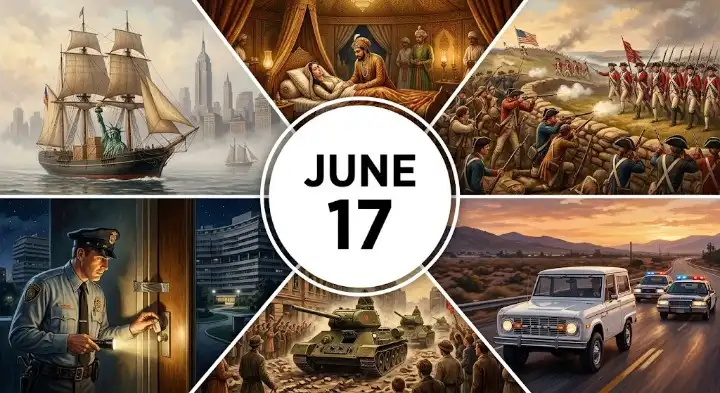
French sailors cheered as the jagged, dark rocks of New York Harbor rose from the Atlantic fog on the morning of June 17, 1885. Wrapped inside 214 heavy wooden crates aboard the French transport ship Isère lay the disassembled copper pieces of the Statue of Liberty. Crowds lined the Manhattan shoreline, waving flags and blowing steamboat whistles to welcome the massive diplomatic gift. This singular arrival transformed the American skyline forever, anchoring a day packed with massive geopolitical pivots, tragic disasters, and silent historic shifts. Understanding this day in history June 17 reveals how fragile empires truly are and how deeply human passion shapes our global landscape.
📅 Quick Facts — June 17 in History
| 📌 Category | 📖 Event / Detail |
|---|---|
| 🌟 Most Significant Event | The Watergate Break-In (1972) |
| 🏆 Top 10 Key Events | • 657 – Caliph Uthman assassinated in Medina • 1462 – Vlad the Impaler’s daring Night Attack on Ottoman forces • 1631 – Mumtaz Mahal dies, inspiring the Taj Mahal • 1775 – Battle of Bunker Hill rages outside Boston • 1789 – French Third Estate forms the National Assembly • 1885 – Statue of Liberty enters New York Harbor • 1939 – Last public guillotining in France • 1940 – Sinking of the troopship RMS Lancastria • 1944 – Iceland declares full independence as a republic • 1972 – Five men arrested at the Democratic National Committee headquarters |
| ⚔️ Key Battles | The Night Attack at Târgoviște (1462), Battle of Deptford Bridge (1497), Battle of Bunker Hill (1775), Battle of the Rosebud (1876), Battle of White Bird Canyon (1877), Attack on Fort Capuzzo (1940) |
| 👤 Key Figures | Shah Jahan I, Empress Matilda, Crazy Horse, Richard Nixon, O. J. Simpson |
| 🌍 Observances | Icelandic National Day, National Day of Remembrance for Forest Fires (Portugal), Occupation of the Latvian Republic Day, Father’s Day (Central America), World Day to Combat Desertification and Drought |
Story of the Day: The Birth of the Taj Mahal
Mumtaz Mahal lay exhausted in a decorated campaign tent in Burhanpur, gasping for breath after giving birth to her fourteenth child. Beside her sat Mughal Emperor Shah Jahan I, helpless as his empress and closest political advisor bled to death from postpartum hemorrhaging on June 17, 1631. Her final breaths shattered the emperor, causing his hair to turn snowy white with grief within months. Desolate but determined to keep his vow to build her a final resting place without equal, Shah Jahan channelled his agony into stone. He spent the next 17 years marshaling 20,000 artisans and building the gleaming white marble Taj Mahal, transforming a personal tragedy into an immortal monument of love.
Important Events That Happened On June 17 In History
653 – Pope Martin I Arrested
Byzantine soldiers burst into the Lateran Basilica in Rome, seizing a frail Pope Martin I right from his sickbed. Emperor Constans II ordered the kidnapping because the pope refused to adopt a state-sanctioned doctrine regarding the human and divine will of Christ. Dragged onto a ship heading for Constantinople, the elderly pontiff suffered public humiliation and brutal banishment. He died in exile in Crimea, remaining the last Roman pope to be martyred for defying imperial theology.
657 – Caliph Uthman Assassinated
Furious mutineers scaled the stone walls of Caliph Uthman’s palace in Medina, bursting into his private chambers with drawn swords. The aging leader of the Islamic world sat quietly reading the Quran, refusing to shed Muslim blood to protect his own life. A rebel blade struck him down, splattering dark blood across the sacred pages of the text. His death shattered the political unity of the early Muslim community, triggering a devastating civil war that permanently split the Islamic world into factions.
1128 – Empress Matilda Marries Geoffrey
Empress Matilda stood before the altar in Le Mans Cathedral, reluctantly joining hands with the teenage Geoffrey Plantagenet, Count of Anjou. As the daughter and chosen heir of King Henry I of England, the proud widow resented marrying a youth far below her imperial station. Yet, this strategic union joined the lands of Normandy and Anjou under a single aggressive bloodline. Their marriage secured the birth of King Henry II, planting the roots of the powerful Plantagenet dynasty that ruled England for three centuries.
1242 – Jewish Manuscripts Burned in Paris
Heavy wooden wagons rumbled into the Place de Grève in Paris, loaded to the brim with thousands of confiscated Jewish books. King Louis IX ordered the total destruction of the Talmud following a highly biased theological trial orchestrated by Church authorities. Black smoke filled the Parisian sky as 24 carriage loads of priceless hand-copied religious manuscripts turned to ash. The massive bonfire devastated medieval Jewish scholarship across Europe, signaling a dark new era of state-sponsored religious persecution.
1300 – Turku Cathedral Consecrated
Bishop Magnus I led a solemn procession through the wooden streets of Turku, raising his crucifix to consecrate the town’s brand-new brick cathedral. Built on a bluff overlooking the Aura River, this massive structure marked the permanent spiritual anchoring of Christianity in the Finnish frontier. The building grew alongside the town, absorbing decades of fires, wars, and architectural expansions. It remains the mother church of the Evangelical Lutheran Church of Finland, standing as the nation’s oldest urban monument.
1397 – The Kalmar Union Formed
Queen Margaret I of Denmark sat before the gathered nobility of Scandinavia at Kalmar Castle, orchestrating a diplomatic masterpiece. She united the three independent kingdoms of Denmark, Norway, and Sweden under a single crown to counter the rising economic threat of the German Hanseatic League. Her grand union created a massive northern superpower that dominated Baltic trade routes for over a century. The alliance held firm until Swedish resentment boiled over into open rebellion in the early 1500s.
1462 – The Night Attack at Târgoviște
Vlad the Impaler slipped through the dark Ottoman camp outside Târgoviște, his Wallachian cavalry disguised in Turkish uniforms. Seeking to assassinate Sultan Mehmed II in his tent, Vlad unleashed a chaotic midnight raid that left thousands of sleeping soldiers dead in their beds. Though the Sultan survived the frantic ambush, the psychological terror of the nighttime slaughter broke the will of his advancing army. The Ottomans pulled back from Wallachia, terrified by the ruthless guerilla tactics of the real-life Dracula.
1497 – Battle of Deptford Bridge
Michael An Gof led thousands of furious Cornish rebels onto the muddy banks of the Thames, armed only with bows and pitchforks. They marched on London to protest King Henry VII’s crippling war taxes, but met a lethal wall of professional royal artillery. The king’s elite troops trapped the Cornishmen at the bridge, cutting down hundreds in a merciless rout. An Gof was captured and executed as a traitor, ending the desperate peasant march but sealing Cornish resistance into folklore.
1579 – Francis Drake Claims California
Sir Francis Drake anchored the leaking Golden Hind in a foggy northern California bay, stepping onto the shore among cautious Coast Miwok people. Having traveled around South America on a daring global raiding voyage, the English privateer claimed the entire region for Queen Elizabeth I under the name Nova Albion. He nailed an engraved brass plate to a wooden post, declaring English sovereignty over the Pacific coast. The claim enraged Spanish authorities, who viewed the entire Western Hemisphere as their exclusive territory.
1596 – Barentsz Discovers Spitsbergen
Willem Barentsz strained his eyes through the Arctic mist, spotting jagged, snow-dusted mountains rising sharply out of the freezing Barents Sea. Looking for a elusive Northeast Passage to the wealthy trade hubs of Asia, the Dutch explorer map-marked this untouched archipelago as Spitsbergen, meaning “pointed mountains.” Though he failed to find a shortcut to the East, his discovery opened up rich new Arctic whaling grounds. The icy islands soon became a bustling, lawless frontier for European hunters chasing blubber and profit.
1665 – Battle of Montes Claros
The Marquis of Marialva ordered the Portuguese infantry to dig into the rocky heights of Montes Claros, bracing for a massive Spanish cavalry charge. This desperate clash marked the final, bloody showdown of the Portuguese Restoration War, which had dragged on for 25 bitter years. Portuguese musketeers shattered the Spanish lines with coordinated volleys, decisively ending Madrid’s dreams of reclaiming Lisbon. The crushing defeat forced Spain to sign a peace treaty recognizing Portugal’s absolute independence.
1673 – Marquette and Jolliet Reach the Mississippi
Jacques Marquette, a Jesuit missionary, paddled his birchbark canoe out of the Wisconsin River and floated into the vast current of the upper Mississippi. Alongside fur trader Louis Jolliet, he became part of the first European expedition to chart the great river’s southern course into mid-America. They mapped the wild waterways, opening up the interior of the continent to French fur traders, forts, and colonial expansion. Their journal accounts shattered old European myths about the American West.
1767 – Samuel Wallis Sights Tahiti
Captain Samuel Wallis looked through his spyglass from the deck of HMS Dolphin, spotting the lush volcanic peaks of Tahiti rising from the South Pacific. Weakened by scurvy after months at sea, his British crew dropped anchor in Matavai Bay to trade with the local islanders. This contact forever shattered the isolation of Polynesian society, introducing European tools and diseases to the island. It kicked off an intense era of Pacific empire-building as Britain and France raced to claim the region.
1773 – Cúcuta Founded
Juana Rangel de Cuéllar signed the official deed of donation, giving up a massive portion of her personal ranch to establish a new settlement. Located on a strategic trade crossroads near the modern Venezuelan border, the infant town of Cúcuta grew rapidly. It eventually became the cradle of Colombian independence, hosting the historic constituent assembly of 1821 where Simon Bolivar drafted the first constitution. Her simple real estate donation laid the foundation for a key South American political hub.
1775 – Battle of Bunker Hill
Colonel William Prescott ordered his raw American militia to hold their fire until they could see the whites of the British soldiers’ eyes on Breed’s Hill. Elite British redcoats marched up the slope in perfect formation, only to be cut down by devastating American volleys. Though the British eventually took the hill after the Americans ran out of gunpowder, the costly victory left over a thousand redcoats dead or wounded. The staggering loss proved to London that the colonial rebellion would not be easily crushed.
1789 – French National Assembly Formed
Abbé Sieyès stood before the frustrated delegates of the Third Estate in Versailles, urging them to take a radical step. Fed up with being constantly outvoted by the nobility and clergy, the commoner delegates declared themselves the true National Assembly of France. This bold political mutiny stripped King Louis XVI of his absolute legislative power in a single afternoon. It marked the point of no return for the French Revolution, turning a fiscal crisis into a total overthrow of the old feudal order.
1794 – Anglo-Corsican Kingdom Established
Pasquale Paoli met with British representatives in the rugged town of Corte, officially declaring Corsica a constitutional protectorate of the British Crown. Seeking a strong ally to protect his island from the chaotic armies of the French Revolution, the legendary freedom fighter offered George III the Corsican crown. The strange alliance turned the Mediterranean island into a vital British naval base for two tense years. It collapsed when French troops led by a young Napoleon Bonaparte forced the British fleet to evacuate.
1795 – Swellendam Republic Declared
Petrus Delport led a band of armed South African frontiersmen into the administrative offices of Swellendam, forcing the Dutch East India Company magistrate to step down. Frustrated by heavy trade monopolies and a total lack of frontier defense, the local burghers declared their independent republic. This short-lived rebellion marked the very first homegrown attempt at self-governance in South Africa. The Republic lasted only three months before British warships arrived at Cape Town, seizing the colony and absorbing the territories.
1831 – Best Friend of Charleston Explodes
An exasperated railway worker slammed down the safety valve of the Best Friend of Charleston locomotive, annoyed by the loud, escaping hiss of high-pressure steam. As pressure built up inside the iron boiler, the engine exploded on its South Carolina tracks, sending shrapnel through the air and injuring the crew. This terrifying accident marked the very first locomotive boiler explosion in American history. The disaster forced early railroad companies to redesign engine safety features and put protective cars between passengers and locomotives.
1839 – Hawaiian Edict of Toleration
King Kamehameha III issued a royal decree from his palace in Honolulu, granting Roman Catholics full freedom of worship across the Hawaiian Islands. The king acted under direct pressure from a French warship that threatened to shell the city if Catholic priests continued to face persecution from Protestant missionaries. The edict ended years of religious arrests and led to the founding of the Hawaii Catholic Church. It opened the islands to broader European cultural influences, balancing the dominant American presence.
1843 – The Wairau Affray
Te Rauparaha stood his ground in the Wairau Valley as armed British settlers tried to arrest him over a disputed land survey. A nervous settler’s gun fired accidentally, triggering a frantic, close-quarters battle that left 22 British and four Māori dead. This sudden bloodshed marked the very first serious military clash of the New Zealand Wars. The incident shattered the fragile illusion of peaceful coexistence under the Treaty of Waitangi, setting off decades of bitter conflict over indigenous land rights.
1861 – Battle of Vienna, Virginia
Captain James Schoonmaker ordered his Union troop train to steam cautiously down the tracks toward Vienna, Virginia, unaware of a Confederate trap. Out of the dense woods, a hidden rebel artillery battery opened fire on the exposed, open-topped rail cars, killing several soldiers. This chaotic skirmish became one of the earliest tactical uses of trains in the American Civil War. The encounter taught Union commanders that unarmored locomotives were highly vulnerable targets when moving through enemy territory.
1863 – Battle of Aldie
General Kilpatrick led a furious Union cavalry charge down the dusty Turnpike near Aldie, Virginia, crashing directly into J.E.B. Stuart’s Confederate horsemen. The two forces engaged in four hours of brutal hand-to-hand combat, fighting over snaking stone walls and haystacks in the summer heat. Stuart’s men successfully held the gaps, preventing the Union army from discovering Robert E. Lee’s infantry movements toward Pennsylvania. This sharp engagement set the stage for the massive clash at Gettysburg just weeks later.
1876 – Battle of the Rosebud
Crazy Horse surged over the ridges of Rosebud Creek with 1,500 Sioux and Cheyenne warriors, ambushing General George Crook’s advancing column. The indigenous fighters used brilliant hit-and-run charges, forcing the army regulars into a desperate, day-long defensive struggle. Crook’s battered forces withdrew from the field, running low on ammunition and supplies. This strategic indigenous victory knocked Crook’s column completely out of the summer campaign, leaving General Custer isolated and vulnerable just eight days before his defeat at the Little Bighorn.
1877 – Battle of White Bird Canyon
Chief Joseph watched from the cliffs of Idaho as a troop of U.S. Cavalry rode into White Bird Canyon, ignoring a white flag of truce. The Nez Perce warriors opened fire from hidden ravines, routing the soldiers and killing a third of the cavalry column. This humiliating military defeat shocked the American public and launched the epic Nez Perce War. It began a tragic, 1,100-mile fighting retreat across the American West as the tribe tried to escape to Canada.
1898 – Navy Hospital Corps Established
President William McKinley signed a bill into law that officially created the United States Navy Hospital Corps, recognizing the need for structured medical care on warships. This act turned ship doctors and field medics into a permanent, highly trained branch of naval medicine. These corpsmen went on to serve on the front lines of every major American conflict, earning a legendary reputation for bravery under fire while treating wounded soldiers. They became the most decorated unit in the history of the Navy.
1900 – Allied Forces Capture Taku Forts
Naval guns from an international alliance of Western and Japanese warships opened fire on the heavy stone walls of the Taku Forts in northern China. The Boxers and imperial Chinese troops fought back fiercely, but allied landing parties scaled the mud walls and captured the strategic fortifications. Taking these coastal forts opened up the river route to Beijing, allowing the international relief force to march inland. This advance broke the bloody Siege of the Legations, deeply humiliating the Qing Dynasty.
1910 – First Flight of Aurel Vlaicu
Aurel Vlaicu climbed into the cockpit of his homemade, wood-and-canvas flying machine, roaring down an open airfield in Bucharest. The fragile A. Vlaicu nr. 1 lifted off the grass, flying beautifully at an altitude of several meters. This successful flight made Romania one of the earliest nations to possess an indigenous, state-funded military aircraft. Vlaicu’s brilliant aerodynamic designs earned him international acclaim before his tragic crash while attempting to fly over the Carpathian Mountains a few years later.
1922 – First South Atlantic Aerial Crossing
Gago Coutinho and Sacadura Cabral guided their Fairey floatplane down into the waters of Rio de Janeiro’s harbor, completing a grueling, multi-stage flight from Lisbon. The Portuguese aviators flew over 5,000 miles of open ocean, relying on a newly invented precision sextant to navigate without landmarks. Their historic flight marked the very first aerial crossing of the South Atlantic Ocean, proving that long-range overwater navigation was possible. They returned home as national heroes, celebrated across Europe and Brazil.
1929 – Murchison Earthquake
A deafening roar echoed through the valleys of the South Island as a massive 7.8 magnitude earthquake ripped across Murchison, New Zealand. The violent tremors triggered colossal landslides that buried entire homesteads and blocked rivers, killing 17 people. The disaster completely reshaped the local geography, raising the ground by several meters in some areas and flattening the town. It stood as New Zealand’s worst natural disaster of its era, forcing authorities to overhaul building codes for earthquake safety.
1930 – Smoot-Hawley Tariff Act Signed
President Herbert Hoover ignored warnings from over a thousand economists, signing the controversial Smoot-Hawley Tariff Act into law. The act raised American import duties to historic highs, intending to protect struggling domestic farmers and factories from foreign competition. Instead, the aggressive policy triggered immediate retaliatory tariffs from European trading partners, choking out international trade. The resulting economic freeze deepened the Great Depression, turning an American downturn into a global economic disaster.
1932 – Bonus Army Amasses at Capitol
Over a thousand penniless World War I veterans camped out on the steps of the United States Capitol, watching anxiously as the Senate debated a critical benefits bill. Destitute from the Great Depression, the veterans demanded immediate cash payments for bonus certificates scheduled for redemption in 1945. When the Senate voted down the bill, the desperate men refused to leave their makeshift shantytowns. The protest ended weeks later when the army used tanks and tear gas to forcibly clear the veterans out.
1933 – Union Station Massacre
Gangster Vernon Miller opened fire with a submachine gun outside Kansas City’s Union Station, ambushing law enforcement officers who were escorting a captured fugitive. Within minutes, four federal agents and police officers lay dead on the blood-soaked pavement in a failed attempt to free bank robber Frank Nash. The shocking brutality of the public shootout outraged the nation. It led Congress to grant the FBI new authority to carry firearms and make arrests, turning the small agency into a powerful federal weapon against organized crime.
1939 – Last Public Guillotining in France
Eugen Weidmann stood outside the walls of Saint-Pierre prison in Versailles, facing a hostile crowd that gathered to watch his execution. The convicted serial killer was forced onto the wooden plank, and the heavy steel blade of the guillotine fell for the last time in public. The crowd’s rowdy, hysterical behavior disgusted government officials, who realized public executions had become cheap spectacles. President Albert Lebrun immediately banned public executions, ordering all future guillotining to take place inside closed prison walls.
1940 – Sinking of the RMS Lancastria
A German Junkers dive-bomber targeted the overcrowded hull of the ocean liner RMS Lancastria off the coast of Saint-Nazaire, France. Searing explosions ripped through the ship, which sank in less than twenty minutes while carrying thousands of fleeing British troops and civilians. Over 3,000 people drowned or burned in the oily water, making it the deadliest maritime disaster in British history. Prime Minister Winston Churchill suppressed the horrific news to protect British public morale during the dark days of Dunkirk.
1940 – British Troops Take Fort Capuzzo
The desert scouts of the British Army’s 11th Hussars raced across the Libyan border in armored cars, launching a surprise assault on Fort Capuzzo. They overwhelmed the Italian garrison, capturing the strategic desert outpost just days after Italy entered World War II. This lightning strike disrupted Italian border defenses and signaled the start of the Western Desert Campaign. The fort changed hands multiple times over the next three years as armies fought across North Africa.
1940 – Soviet Occupation of the Baltic States
Soviet tanks crossed the borders into Estonia, Latvia, and Lithuania, enforcing a series of ultimatums issued by Joseph Stalin. The Red Army rapidly occupied key cities, arrested local political leaders, and installed puppet communist governments. This sudden takeover ended two decades of independence for the Baltic nations, absorbing them into the Soviet Union. The illegal annexation sparked decades of underground resistance and remained a deep historical scar until the states finally reclaimed independence in 1991.
1944 – Iceland Declares Independence
Thousands of cheering citizens gathered in the rain at Þingvellir, celebrating as Iceland officially severed its remaining ties with the Kingdom of Denmark. While Denmark sat occupied by Nazi forces, Icelanders voted overwhelmingly to dissolve the union and establish a sovereign republic. Sveinn Björnsson took the oath of office as the nation’s very first president, completing a decades-long journey toward full self-rule. The peaceful transition turned the ancient parliament site into a symbol of modern democratic resilience.
1948 – United Air Lines Flight 624 Crash
The crew of United Air Lines Flight 624 mistakenly discharged carbon dioxide fire extinguishers in the cockpit, blinding themselves and losing consciousness due to the thick gas fumes. Left without a pilot, the Douglas DC-6 airliner dropped out of the sky, clipping power lines before crashing into a hillside near Mount Carmel, Pennsylvania. All 43 passengers and crew died instantly in the fiery wreck. The tragedy forced airlines to change cockpit ventilation procedures and add distinct warning labels to emergency systems.
1952 – Guatemala Passes Decree 900
President Jacobo Árbenz signed Decree 900 into law, launching a sweeping land reform program that expropriated uncultivated land from major plantations and redistributed it to poor Mayan peasants. The radical law hit the American-owned United Fruit Company hard, as the corporation held vast tracts of idle land across the country. The company lobbied Washington for help, framing the land reform as a dangerous communist threat. This confrontation led directly to a CIA-backed coup that overthrew Guatemala’s democratic government two years later.
1953 – East German Workers Uprising
Soviet T-34 tanks rolled down the streets of East Berlin, crushing a massive workers’ strike that had erupted against the communist government’s grueling production quotas. Over a million citizens took to the streets across East Germany, demanding free elections and the removal of the regime. The brutal military intervention left dozens of protesters dead and thousands imprisoned, ending the open rebellion. The crackdown proved to the world that the Soviet bloc would use absolute military force to maintain its grip on Eastern Europe.
1958 – Second Narrows Bridge Collapse
A sharp, metallic snap echoed across Vancouver’s Burrard Inlet as a massive structural span of the incomplete Ironworkers Memorial Bridge suddenly twisted and collapsed. Tons of steel and concrete plunged into the deep water below, dragging dozens of workers down with it. The disaster killed 18 ironworkers and a rescue diver, leaving the city in deep mourning. A subsequent investigation revealed a simple engineering miscalculation in the temporary support stilts, changing bridge engineering safety standards worldwide.
1960 – Nez Perce Tribe Awarded $4 Million
The Indian Claims Commission ordered the U.S. government to pay $4 million to the Nez Perce tribe, compensating them for 7 million acres of ancestral Idaho land taken in an 1863 treaty. The historical commission found that the government had valued the land at a mere four cents per acre during the post-Civil War gold rush. While the financial ruling acknowledged a historical injustice, tribal leaders noted that no amount of money could replace their sacred valleys or heal the scars of their forced exile.
1963 – Supreme Court Rules Against School Prayer
Justice Tom C. Clark delivered an 8–1 majority opinion in Abington School District v. Schempp, ruling that public schools could no longer require students to recite Bible verses or the Lord’s Prayer. The landmark Supreme Court decision declared that state-mandated religious exercises violated the Establishment Clause of the First Amendment. The ruling ignited a fierce national debate over the place of religion in public life, fundamentally reshaping the boundaries between church and state in American education.
1963 – Saigon Buddhist Riot
A furious crowd of 2,000 protesters clashed with police in the streets of Saigon, defying a joint peace agreement meant to end South Vietnam’s Buddhist crisis. Rioters hurled stones at government forces, who responded with tear gas and baton charges, leaving one protester dead on the pavement. The public violence shattered hopes for a diplomatic solution between the Catholic regime of Ngo Dinh Diem and the Buddhist majority. The escalating instability led directly to a military coup that overthrew Diem later that year.
1967 – China’s First Thermonuclear Test
A lone Chinese bomber dropped a multi-megaton device over the Lop Nur test site, unleashing a blinding flash that signaled China’s first successful hydrogen bomb test. The explosion catapulted China into the elite club of thermonuclear powers, just 32 months after its first atomic test. The rapid scientific leap shocked Western intelligence agencies and heightened Cold War anxieties across Asia. It cemented China’s position as a major military superpower, independent of both Washington and Moscow.
1971 – Nixon Starts War on Drugs
President Richard Nixon stood before a packed press room at the White House, declaring drug abuse to be “America’s public enemy number one.” In his televised address, Nixon demanded hundreds of millions of dollars from Congress to launch an aggressive, global anti-drug offensive. This speech marked the official start of the War on Drugs, shifting federal resources away from treatment and heavily toward criminal enforcement and mass incarceration. The policy went on to dominate American domestic and foreign policy for decades.
1972 – The Watergate Break-In
An alert security guard noticed a piece of duct tape covering a door lock at the Watergate office complex in Washington, quickly calling local police to investigate. Officers caught five men inside the Democratic National Committee headquarters, holding wiretapping equipment and sequential hundred-dollar bills. This arrest exposed a covert campaign of political espionage directed by members of President Richard Nixon’s administration. The resulting cover-up exploded into the Watergate scandal, shattering public trust and forcing Nixon to resign.
1985 – First Arab and Muslim in Space
The Space Shuttle Discovery lifted off from its Florida launchpad on mission STS-51-G, carrying Sultan bin Salman bin Abdulaziz Al Saud into orbit as a payload specialist. The young Saudi prince became the first Arab, the first Muslim, and the first member of a royal family to travel into space. During the seven-day flight, he helped deploy an international communications satellite, inspiring an entire generation across the Middle East and opening up new opportunities for international cooperation in space exploration.
1987 – Dusky Seaside Sparrow Extinct
The last known dusky seaside sparrow died in his cage at Walt Disney World, bringing a quiet end to a species that once thrived in the salt marshes of Florida. The dark songbirds lost their nesting grounds to real estate development and flood control projects associated with the Kennedy Space Center. Despite eleventh-hour breeding efforts, the loss of this single bird marked the permanent extinction of the species. The quiet death became a tragic warning about the high environmental cost of rapid human expansion.
1989 – Interflug Flight 102 Crashes
The pilot of an Interflug Soviet-built jetliner slammed on the brakes during a rejected takeoff from East Berlin’s Schönefeld Airport, but the plane failed to slow down. The aircraft careened off the end of the runway, smashing through a water tank and a concrete wall before bursting into flames in a nearby field. The horrific crash killed 21 people on board. Investigators discovered that a mechanical locking mechanism in the tail control systems had caused the fatal runway overrun.
1991 – Apartheid Law Repealed
President F.W. de Klerk looked on as the South African Parliament voted to repeal the Population Registration Act, a foundational law of the brutal apartheid system. Since 1950, the act had forced the state to racially classify every South African at birth, dictating where they could live, work, and go to school. Stripping this law from the books marked a massive step toward ending white minority rule. It paved the way for the nation’s historic, fully democratic elections three years later.
1992 – Bush and Yeltsin Sign Arms Reduction
President George H.W. Bush and Russian President Boris Yeltsin sat side by side at a polished White House table, signing a historic “joint understanding” on nuclear arms reduction. The two leaders agreed to slash their nuclear arsenals by two-thirds, completely eliminating all multiple-warhead land-based missiles. This landmark post-Cold War agreement was later codified as the START II treaty. It signaled a major thawing of relations between the former superpowers, bringing relief to a world that had lived for decades under the shadow of nuclear war.
1994 – The O. J. Simpson Highway Chase
Millions of viewers tuned in to live television broadcasts as a white Ford Bronco crawled along a deserted Los Angeles highway, trailed by a slow caravan of police cruisers. Inside, football star O. J. Simpson held a gun to his head while his friend drove him toward his home. The bizarre, low-speed pursuit ended in Simpson’s driveway, where officers arrested him for the brutal murders of his ex-wife, Nicole Brown Simpson, and her friend Ronald Goldman. The televised chase launched a media obsession that dominated global headlines for over a year.
2015 – Charleston Church Shooting
A white supremacist walked into the historic Emanuel African Methodist Episcopal Church in Charleston, South Carolina, sitting quietly through an evening Bible study before drawing a handgun. He opened fire on the tight-knit congregation, killing nine Black parishioners, including the senior pastor. The horrific hate crime devastated the community and shocked the nation. The tragedy ignited a fierce national conversation about systemic racism, domestic terrorism, and the public display of Confederate symbols across the American South.
2017 – Portugal Wildfires
Dry lightning struck the parched forests of central Portugal, igniting a ferocious wall of fire that ripped across the Pedrógão Grande region within hours. The fast-moving flames trapped dozens of terrified motorists on a local highway, engulfing cars before drivers could escape. The disaster killed 64 people and injured over 200 others, making it the deadliest wildfire in the nation’s history. The tragedy forced European authorities to overhaul rural forest management and emergency evacuation procedures.
2021 – Juneteenth Made Federal Holiday
President Joe Biden signed a historic bill into law in the East Room of the White House, officially making Juneteenth a federal holiday. The new holiday commemorates June 19, 1865, the day Union soldiers arrived in Galveston, Texas, to ensure all enslaved people were freed—over two years after the Emancipation Proclamation. This act marked the very first new federal holiday created in the United States since 1983. It honored generations of Black resilience and institutionalized a national day of reflection on slavery’s lasting legacy.
Click here to browse our collection of previous daily facts.
Famous People Born On June 17
| Name | Description | Date (Birth – Death) |
|---|---|---|
| Edward I | King of England | 1239 – 1307 |
| Thomas Mun | Economist and writer | 1571 – 1641 |
| Joseph of Cupertino | Italian saint and mystic | 1603 – 1663 |
| Charles XII | King of Sweden | 1682 – 1718 |
| John Kay | Flying shuttle inventor | 1704 – 1780 |
| William Parsons | Built Leviathan telescope | 1800 – 1867 |
| Henrik Wergeland | Norwegian poet | 1808 – 1845 |
| Jón Sigurðsson | Iceland independence leader | 1811 – 1879 |
| Charles Gounod | Composer of Faust | 1818 – 1893 |
| William Crookes | Chemist & physicist | 1832 – 1919 |
| Susan La Flesche Picotte | First Native American doctor | 1865 – 1915 |
| Henry Lawson | Australian writer | 1867 – 1922 |
| James Weldon Johnson | Civil rights writer | 1871 – 1938 |
| Igor Stravinsky | Composer | 1882 – 1971 |
| Heinz Guderian | Military strategist | 1888 – 1954 |
| M. C. Escher | Graphic artist | 1898 – 1972 |
| Ruth Wakefield | Chocolate chip cookie inventor | 1903 – 1977 |
| John Hersey | Author | 1914 – 1993 |
| Ajahn Chah | Buddhist monk | 1918 – 1992 |
| François Jacob | Nobel biologist | 1920 – 2013 |
| Alexander Shulgin | Chemist | 1925 – 2014 |
| Tigran Petrosian | Chess champion | 1929 – 1984 |
| Ken Loach | Film director | 1936 – Present |
| George Akerlof | Economist | 1940 – Present |
| Mohamed ElBaradei | Nobel laureate | 1942 – Present |
| Barry Manilow | Singer | 1943 – Present |
| Eddy Merckx | Cyclist | 1945 – Present |
| Greg Kinnear | Actor | 1963 – Present |
| Venus Williams | Tennis star | 1980 – Present |
| Kendrick Lamar | Rapper | 1987 – Present |
Famous People Died On June 17
| Name | Description | Date (Birth – Death) |
|---|---|---|
| Uthman ibn Affan | Third Caliph | 579 – 656 |
| Bolesław I | King of Poland | 967 – 1025 |
| John I Albert | King of Poland | 1459 – 1501 |
| Ashikaga Yoshiteru | Shogun | 1536 – 1565 |
| Mumtaz Mahal | Mughal empress | 1593 – 1631 |
| Jijabai | Mother of Shivaji | 1598 – 1674 |
| John III Sobieski | King of Poland | 1629 – 1696 |
| Joseph Addison | Essayist | 1672 – 1719 |
| Daskalogiannis | Rebel leader | 1722 – 1771 |
| Lord William Bentinck | Governor-General of India | 1774 – 1839 |
| Martín de Güemes | Argentine leader | 1785 – 1821 |
| Lozen | Apache warrior | 1840 – 1889 |
| Edward Burne-Jones | Painter | 1833 – 1898 |
| Arthur Harden | Biochemist | 1865 – 1940 |
| Jack Parsons | Rocket pioneer | 1914 – 1952 |
| Jeff Chandler | Actor | 1918 – 1961 |
| José Nasazzi | Footballer | 1901 – 1968 |
| Roberto Calvi | Banker | 1920 – 1982 |
| Kate Smith | Singer | 1907 – 1986 |
| Dick Howser | Baseball manager | 1936 – 1987 |
| Thomas Kuhn | Philosopher | 1922 – 1996 |
| Curt Swan | Comic artist | 1920 – 1996 |
| Basil Hume | Cardinal | 1923 – 1999 |
| Donald J. Cram | Chemist | 1919 – 2001 |
| Fritz Walter | Football legend | 1920 – 2002 |
| Rodney King | Civil rights figure | 1965 – 2012 |
| Süleyman Demirel | Turkish president | 1924 – 2015 |
| Gloria Vanderbilt | Designer | 1924 – 2019 |
| Mohamed Morsi | Egyptian president | 1951 – 2019 |
| Kenneth Kaunda | Zambian leader | 1924 – 2021 |
Observances on June 17
- Icelandic National Day: Celebrates the nation’s declaration of independence from Denmark in 1944 on the birthday of freedom pioneer Jón Sigurðsson.
- National Day of Remembrance for the Victims of Forest Fires (Portugal): Honors the dozens of citizens who lost their lives in the tragic 2017 Pedrógão Grande blazes.
- Occupation of the Latvian Republic Day: A solemn day of remembrance marking the tragic 1940 entry of Soviet tanks into Riga.
- Father’s Day (El Salvador, Guatemala): A traditional family holiday honoring paternal bonds across Central America.
- World Day to Combat Desertification and Drought: An international United Nations day promoting public awareness of land degradation and global water scarcity solutions.
- Zemla Intifada Day: Commemorates the 1970 Sahrawi uprising against Spanish colonial rule in Western Sahara.
🏛️ Frequently Asked Questions — June 17 in History
Five White House operatives were caught and arrested while burgling the Democratic National Committee headquarters at the Watergate complex. This botched break-in exposed a massive political espionage campaign run by the Nixon administration. The resulting cover-up exploded into the Watergate scandal, ending Nixon’s presidency.
The Watergate break-in stands out as the day’s most significant event due to its massive impact on American democracy and public trust in government. It remains the ultimate modern political scandal, establishing a template for how investigative journalism and constitutional oversight can hold the highest office accountable.
King Charles XII of Sweden, a brilliant and controversial military strategist who led his nation through the Great Northern War, was born on this day in 1682. This date also marks the 1882 birth of Igor Stravinsky, the revolutionary Russian composer whose avant-garde ballet The Rite of Spring fundamentally transformed twentieth-century classical music.
The Battle of Bunker Hill raged outside Boston on this day in 1775, marking the first major pitched battle of the American Revolutionary War. Although British forces eventually took the hill, they suffered over a thousand casualties. This staggering loss proved that the untrained American militia could stand up to professional redcoats.
Icelandic National Day commemorates June 17, 1944, the historic day Iceland dissolved its union with Denmark and officially became an independent republic. The date was chosen to honor Jón Sigurðsson, the iconic leader of the nineteenth-century Icelandic independence movement, who was born on this day.
President Joe Biden signed a bill into law on June 17, 2021, establishing Juneteenth National Independence Day as an official U.S. federal holiday. This historic legislation marked the first time the United States created a new federal holiday since Martin Lincoln King Jr. Day was institutionalized in 1983.