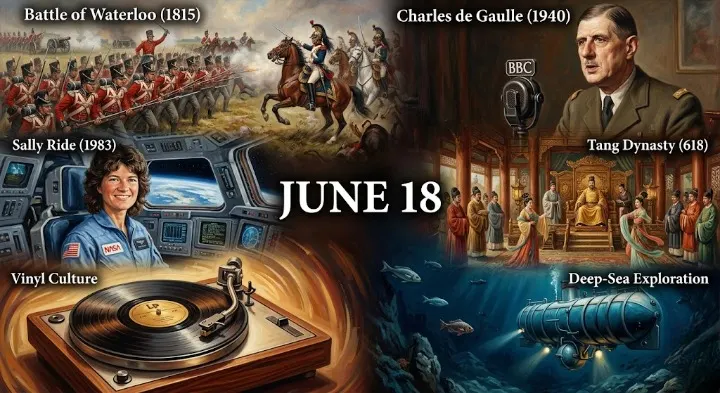
Napoleon Bonaparte stood on a muddy Belgian field on June 18, 1815, watching his imperial dreams shatter against British and Prussian lines. This day in history June 18 marks the definitive end of the Napoleonic era, but it also anchors an incredibly dense framework of world-altering events across centuries. From ancient imperial shifts in China to a modern deep-sea catastrophe, this particular calendar date repeatedly acts as a flashpoint for tectonic political changes and dramatic human endeavors.
📅 Quick Facts — June 18 in History
| 📌 Category | 📖 Event / Detail |
|---|---|
| 🌟 Most Significant Event | The Battle of Waterloo (1815) |
| 🏆 Top 10 Key Events | • Tang Dynasty founding (618) • Battle of Patay (1429) • US declares war on Britain (1812) • Waterloo (1815) • Darwin receives Wallace’s paper (1858) • De Gaulle’s Appeal (1940) • Churchill’s “Finest Hour” speech (1940) • LP record introduced (1948) • Sally Ride enters space (1983) • Titan submersible implodes (2023) |
| ⚔️ Key Battles | Battle of Civitate (1053), Battle of the Kondurcha River (1391), Battle of Patay (1429), Battle of Kolín (1757), Battle of Waterloo (1815), Battle of Orgreave (1984) |
| 👤 Key Figures | Napoleon Bonaparte, Charles de Gaulle, Winston Churchill, Sally Ride |
| 🌍 Observances | Waterloo Day (UK), Autistic Pride Day, National Day (Seychelles), Human Rights Day (Azerbaijan), Queen Mother’s Birthday (Cambodia) |
Story of the Day: The Muddy Downfall at Waterloo
Rain lashed the Belgian countryside all through the night of June 17, soaking the fields and forcing Napoleon Bonaparte to delay his infantry assault the following morning. He waited for the ground to dry so his heavy artillery could maneuver, giving the Duke of Wellington time to solidify defenses and allowing Prussian reinforcements to arrive. When the French cavalry finally charged, they threw themselves against unbreakable British infantry squares. By evening, Napoleon’s grand army had brokenly retreated, ending the Hundred Days reign and permanently reshaping the balance of power across Europe.
Important Events That Happened On June 18 In History
618 – Li Yuan Becomes Emperor Gaozu
Li Yuan stepped onto the imperial dais in Chang’an, declaring himself the supreme ruler of a new dynasty after the collapse of the Sui. Bloodshed and chaotic rebellions had fractured China, but his administrative reforms laid the groundwork for an era of immense cultural wealth. The Tang Dynasty took flight at this exact moment, beginning three centuries of unprecedented golden-age prosperity. East Asia would feel the cultural, economic, and political ripples of this day for generations.
656 – Ali Becomes Fourth Rashidun Caliph
Muslim community leaders gathered in Medina to pledge their allegiance to Ali ibn Abi Talib following the assassination of Caliph Uthman. The Islamic state was reeling from internal factional trauma, and Ali inherited a leadership seat ringed by immediate rebellion. Civil war erupted almost instantly, splitting the early Islamic community into enduring theological factions. His ascension altered the trajectory of the Islamic world, setting the stage for the Sunni-Shia divide.
860 – Rus Fleet Invades Constantinople
Two hundred heavy Rus vessels glided silently into the Bosphorus, catching the sentries of the Byzantine capital completely unprepared. Emperor Michael III was away fighting Arab forces, leaving the affluent suburbs of Constantinople utterly defenseless against immediate pillaging. Flaming villas and terrorized citizens marked the sudden appearance of this new northern power on the Mediterranean stage. The siege eventually lifted, but it forced the Byzantine Empire to permanently reassess its northern borders.
1053 – Normans Rout Pope at Civitate
Three thousand heavily armored Norman horsemen charged across the Italian plains, slamming directly into the mixed army of Pope Leo IX. The papal coalition broke under the sheer weight of the Norman cavalry tactic, leaving the pontiff trapped inside the walls of Civitate. Norman hands captured the spiritual leader of Western Christendom, holding him in honorable captivity for months. This victory cemented Norman territorial dominance in Southern Italy, altering papal politics forever.
1155 – Frederick Barbarossa Crowned Holy Roman Emperor
Pope Adrian IV placed the imperial crown upon the brow of Frederick I inside the old walls of St. Peter’s Basilica. Local Roman citizens, furious at being excluded from the ceremony, launched an immediate armed riot in the streets outside. German knights cut down the protestors, staining the coronation day with the blood of hundreds of locals. Barbarossa secured his legal title, beginning a legendary, decades-long struggle to dominate both Italy and Germany.
1156 – Treaty of Benevento Signed
Pope Adrian IV signed a sweeping diplomatic agreement with King William I of Sicily after facing military isolation. The document recognized the Norman king’s sovereign rights over vast swathes of Southern Italy and Sicily, ending years of open warfare. Papal authorities swallowed their pride, trading theoretical supremacy for real-world political security against external threats. The treaty stabilized the region, defining Italian geopolitics for the remainder of the twelfth century.
1264 – First Irish Parliament Meets
Anglo-Norman lords and high-ranking churchmen gathered at Castledermot in County Kildare to formally debate the governance of the lordship. King Henry III’s representatives needed structured colonial taxation and legal order, prompting this first definitively recorded legislative assembly. The meeting established a formal framework for statutory law on the island, distinct from local Gaelic legal traditions. This assembly planted the institutional seeds of what evolved into the modern Irish legislature.
1265 – Byzantine-Venetian Draft Treaty Created
Venetian envoys and Byzantine Emperor Michael VIII Palaiologos finalized a complex commercial agreement in the restored capital of Constantinople. The Greeks offered trade privileges to check the power of Genoa, attempting to balance rival maritime republics against each other. Doge Reniero Zeno ultimately refused to ratify the document, keeping the naval powers in a state of volatile competition. The negotiations highlighted the desperate diplomatic maneuvering required to keep the fading Byzantine Empire alive.
1391 – Timur Defeats Golden Horde at Kondurcha
Timur unleashed his massive Central Asian army along the banks of the Kondurcha River, trapping the forces of his former protege Tokhtamysh. The initial shock of the Mongol horse archers nearly broke the Chagatai lines, but Timur’s superior tactical discipline carried the day. Hundreds of thousands of soldiers clashed in a brutal war of attrition that shattered the Golden Horde’s military hegemony. The defeat loosened the Mongol grip on the Russian principalities, shifting regional dominance toward Moscow.
1429 – French Army Crushes English at Patay
Joan of Arc’s vanguard commanders caught the retreating English army completely unprepared in the open fields near Patay. French heavy cavalry charged before the legendary English longbowmen could dig their defensive wooden stakes into the turf. John Talbot was captured as his vanguard collapsed, losing over two thousand veteran longbowmen in a matter of hours. This stunning disaster crippled English offensive capability, clearing Charles VII’s path to his royal coronation.
1633 – Charles I Crowned in Scotland
Charles I stood inside the historic walls of St. Giles’ Cathedral in Edinburgh to receive the ancient Scottish crown. The king insisted on using elaborate Anglican liturgical rites, deeply offending the strict Presbyterian sensibilities of his Scottish subjects. Local nobles watched in simmering anger as their traditional religious simplicity was openly flouted by royal decree. This cultural friction sowed the seeds of the Covenanter rebellion, which eventually triggered the English Civil War.
1684 – Massachusetts Bay Colony Charter Revoked
An English court issued a formal writ of scire facias, abruptly canceling the legal charter of the Massachusetts Bay Colony. King Charles II grew tired of colonial resistance to imperial trade laws and Puritan intolerance toward religious minorities. The ruling stripped the colony of its legal self-governance, placing power directly back into the hands of the crown. This judicial stroke united the New England colonies under an unpopular, royal governor.
1757 – Austrians Stop Frederick Great at Kolín
Prussian battalions under Frederick the Great marched directly into a well-entrenched Austrian army commanded by Field Marshal Daun. Frederick’s brilliant flank attack strategy disintegrated against the stubborn defense of Austrian troops holding the high ground. The Prussian king lost fourteen thousand veteran soldiers, forcing him to abandon his costly siege of Prague. This bloody check proved that the Prussian war machine was not entirely invincible.
1778 – British Army Abandons Philadelphia
General Henry Clinton ordered his entire British garrison to quietly march out of Philadelphia, ending a nine-month occupation. Royal strategists feared the arrival of a powerful French fleet, forcing a rapid retreat toward the safety of New York. Continental soldiers entered the city hours later, finding it intact but stripped of vital supplies. The evacuation showed that holding American cities was useless without controlling the vast countryside.
1799 – British Fleet Captures French Squadron
Rear-Admiral Perrée found his small frigate squadron completely surrounded by a massive British fleet under Lord Keith in the Mediterranean. The French ships tried to run, but superior British seamanship brought them to battle one by one. Every single French vessel surrendered after a brief, one-sided exchange of heavy cannon fire. The capture stripped the French army in Egypt of its final maritime supply line.
1803 – Royal Navy Blockades Saint-Domingue
Rear-Admiral John Thomas Duckworth ordered British warships to seal off the ports of Saint-Domingue from the open sea. The naval net trapped the remaining French troops who were desperately fighting the Haitian revolutionary armies on land. Starved of reinforcements and ammunition, the French military position collapsed completely within a few months. This maritime intervention guaranteed the final victory of the historic Haitian Revolution.
1812 – United States Declares War on Britain
President James Madison put his signature to a formal declaration of war against the United Kingdom, opening the War of 1812. American politicians lashed out over the forced impressment of US sailors and British interference with international trade. The young republic challenged the world’s greatest naval empire with a tiny navy and a divided public. The conflict solidified American national identity, ensuring permanent independence from British interference.
1822 – Kanaris Blows Up Ottoman Flagship
Konstantinos Kanaris steered a small, explosive-laden fire ship directly into the massive Ottoman flagship anchored off Chios. The Greek captain ignited the fuses and leaped into a boat just before the explosion reached the ship’s powder magazine. The resulting blast killed Kapudan Pasha Ali Pasha along with two thousand Ottoman sailors in a single moment. This daring act avenged the Chios massacre, galvanizing international support for Greek independence.
1837 – Daaga Leads St. Joseph Mutiny
African soldiers of the British West India Regiment turned their weapons on their officers in the Trinidadian garrison of St. Joseph. Led by a captured slave trader named Daaga, the mutineers fought to win their freedom and return to Africa. British colonial troops moved quickly to surround the barracks, crushing the uprising after a brief firefight. Daaga and his top co-conspirators faced a military firing squad, highlighting colonial military instability.
1858 – Darwin Receives Wallace’s Evolution Paper
Charles Darwin opened a letter from the remote East Indies containing a short scientific paper written by Alfred Russel Wallace. The text outlined a theory of natural selection that was virtually identical to the work Darwin had kept secret for twenty years. Terrified of losing his scientific legacy, Darwin rushed his own notes into public print alongside Wallace’s ideas. This letter shattered Darwin’s hesitation, changing biological science forever.
1859 – First Ascent of the Aletschhorn
Francis Fox Tuckett stepped onto the snowy, wind-blasted summit of the Aletschhorn alongside his local Swiss mountain guides. The party navigated treacherous crevasses and steep ice walls to conquer the second-highest peak in the Bernese Alps. Their success proved the viability of modern alpine mountaineering techniques on technical glacial routes. The climb marked a golden age of exploration across the high peaks of Europe.
1873 – Susan B. Anthony Fined for Voting
A male judge ordered Susan B. Anthony to pay a fine of one hundred dollars for casting a ballot in the 1872 presidential election. Anthony boldly refused to pay a single penny of the penalty, calling the law an unconstitutional outrage against women. The court declined to jail her, intentionally blocking her ability to appeal the case to the Supreme Court. Her public trial gave the early women’s suffrage movement a powerful national spotlight.
1887 – Germany and Russia Sign Reinsurance Treaty
Chancellor Otto von Bismarck finalized a secret diplomatic pact between the German Empire and the Russian autocracy. Both nations promised to remain strictly neutral if either found themselves at war with a third great European power. Bismarck designed this complex alliance network to keep France completely isolated and prevent a catastrophic two-front war. The treaty’s eventual collapse years later cleared the path toward the outbreak of World War I.
1906 – Sultan Abdelaziz Ratifies Algeciras Agreement
Sultan Abdelaziz signed a royal decree approving the international terms of the Algeciras Conference in Morocco. The European powers formally guaranteed Moroccan independence while quietly granting France and Spain control over the local police force. The Sultan surrendered real sovereignty to avoid an immediate, full-scale military invasion of his country. This political compromise only deepened European imperial rivalries ahead of the Great War.
1908 – Japanese Immigration to Brazil Begins
Seven hundred eighty-one Japanese passengers walked down the gangway of the Kasato-Maru into the bustling port of Santos. Faced with economic hardship at home, these families traveled across the globe to work on the expanding coffee plantations of São Paulo. They endured harsh labor conditions and cultural isolation, eventually building a thriving immigrant community. This single voyage planted the roots of the largest ethnic Japanese population outside of Japan.
1908 – University of the Philippines Established
The American colonial government passed Act 1870, formally founding the University of the Philippines in Manila. The institution aimed to provide advanced higher education in literature, philosophy, and the sciences to a new generation of Filipinos. It quickly became an intellectual incubator for nationalist thought and political leadership during the twentieth century. The university remains a premier institution of higher learning in the country today.
1920 – Ulster Troubles Explode in Derry
Sectarian gunfire erupted across the streets of Derry, marking the violent beginning of the Troubles in Ulster. Armed loyalist and republican groups fought bitter street battles as British troops struggled to restore public order. A week of intense violence left dozens of civilians dead and hundreds of families displaced from their homes. The clashes hardened the political borders that eventually led to the partition of Ireland.
1928 – Amelia Earhart Crosses Atlantic
Amelia Earhart climbed out of a pontoon plane in Wales, completing an historic transatlantic flight as a passenger. Pilot Wilmer Stultz handled the controls through heavy fog, but Earhart’s presence captured the immediate attention of the global media. The journey transformed her into an international celebrity and a powerful icon for women in aviation. She used this fame to launch her own legendary solo flights across the globe.
1935 – Vancouver Longshoremen Riot at Ballantyne Pier
Clubs swung and tear gas filled the air as police charged a crowd of one thousand striking dockworkers in Vancouver. The longshoremen were marching toward Ballantyne Pier to protest the employment of non-union strikebreakers on the docks. The ensuing street battle left sixty people injured and led to the immediate arrest of dozens of union leaders. This clash became a landmark moment in the history of Canadian labor struggles.
1940 – Charles de Gaulle Airs Historic Appeal
General Charles de Gaulle spoke into a BBC microphone in London, broadcasting a desperate message across the English Channel to occupied France. He urged French soldiers and citizens to resist the Nazi invaders, declaring that the flame of French resistance must not die. The broadcast went largely unheard that evening, but it laid the emotional cornerstone for the Free French military forces. It transformed an obscure general into the symbolic leader of a captive nation.
1940 – Churchill Delivers Finest Hour Speech
Prime Minister Winston Churchill stood before the House of Commons, warning his colleagues that the Battle of Britain was about to begin. He urged the British public to brace for the German onslaught, saying that a thousand years from now, men would call this their finest hour. His roaring prose rallied a terrified population facing total isolation in a collapsing Europe. The speech galvanized British resolve during the darkest days of World War II.
1945 – William Joyce Charged with Treason
British authorities formally indicted William Joyce, known to millions as “Lord Haw-Haw,” for high treason at Bow Street Magistrates’ Court. Joyce had spent the war broadcasting pro-German propaganda from Berlin, mockingly deriding the Allied military effort over the radio. His defense argued that his American birth and German naturalization made him immune to British treason laws. The court rejected the argument, eventually sentencing him to death by hanging.
1946 – Lohia Demands Direct Action in Goa
Dr. Ram Manohar Lohia arrived in Margao, defying a strict Portuguese ban on public assembly to launch a civil disobedience campaign. The Indian socialist leader called for immediate direct action to end centuries of European colonial rule in Goa. Portuguese colonial police arrested him on the spot, sparking massive protests across the territory. His defiance energized the local freedom movement, leading to eventual liberation.
1948 – Columbia Demonstrates LP Record
Music executives gathered inside the Waldorf-Astoria Hotel as Columbia Records publicly introduced the long-playing microgroove record. The new vinyl disc rotated at 33 and a third RPM, playing a full twenty-three minutes of high-fidelity audio per side. This technology replaced the fragile 78 RPM shellac discs, which could hold only a few minutes of audio. The invention completely changed the music industry, giving rise to the concept of the album.
1948 – Western Allies Announce Deutsche Mark
Britain, France, and the United States made a joint announcement introducing the new Deutsche Mark currency to stabilized Western Germany. Soviet authorities saw this monetary reform as an aggressive attempt to control the economic future of the divided nation. In retaliation, communist forces immediately began restricting all road and rail access to the isolated city of Berlin. This monetary policy dispute triggered the start of the historic Berlin Blockade.
1953 – Egypt Declared a Republic
The Egyptian military command officially abolished the century-old Muhammad Ali dynasty and declared Egypt a sovereign republic. General Mohamed Naguib took the oath of office as the country’s first president, ending British-backed royal rule. The coup swept away the old aristocratic order, initiating a new era of Arab nationalist politics across the Middle East. The political shift fundamentally altered the regional balance of power.
1953 – USAF Globemaster Crashes Near Tachikawa
A United States Air Force C-124 Globemaster lost power shortly after takeoff and plunged into an alfalfa field near Tachikawa, Japan. The massive transport plane burst into a violent fireball upon impact, instantly killing all one hundred twenty-nine servicemen on board. It stood as the deadliest aviation disaster in history at that time, shocking military planners. The tragedy prompted an immediate investigation into the heavy transport fleet’s engine reliability.
1954 – Castillo Armas Invades Guatemala
Colonel Carlos Castillo Armas led a mercenary invasion force across the Honduran border into Guatemala. Backed by clandestine US intelligence funding, his forces aimed to overthrow the democratically elected government of President Jacobo Árbenz. The invasion triggered a wave of military panic that led to Árbenz’s resignation and decades of brutal military dictatorship. This coup defined US Cold War policy toward Latin American reform movements.
1958 – Britten’s Noye’s Fludde Premieres
Benjamin Britten’s innovative one-act opera Noye’s Fludde premiered before a packed audience at the Aldeburgh Festival. The production featured a mix of professional musicians and local children playing the roles of the animals entering Noah’s Ark. Britten designed the piece to be performed in local community churches rather than elite, formal opera houses. The debut set a new standard for accessible, community-focused classical music.
1965 – USAF Deploys B-52s in Vietnam
The United States Air Force launched twenty-eight B-52 Stratofortress bombers from Guam to strike communist guerrilla bases in South Vietnam. Operating under the code name Arc Light, the high-altitude bombers dropped hundreds of tons of explosives onto jungle strongholds. The mission marked the first operational deployment of these massive strategic bombers in a conventional counter-insurgency war. The strikes became a controversial staple of US military strategy.
1972 – Staines Air Disaster Kills 118
A British European Airways Hawker Siddeley Trident stalled and crashed into a field near Staines just minutes after departing Heathrow Airport. The impact killed all one hundred eighteen people on board, making it the worst air disaster in British history. Investigators discovered a combination of mechanical pilot error and underlying heart disease in the captain. The tragedy led to strict new regulations regarding cockpit crew communication and health screenings.
1979 – Carter and Brezhnev Sign SALT II
President Jimmy Carter and Soviet Premier Leonid Brezhnev signed the SALT II strategic arms limitation treaty in Vienna. The agreement set strict caps on the number of nuclear delivery vehicles and multiple-warhead missiles each superpower could possess. The treaty aimed to slow the dangerous momentum of the Cold War arms race, though the US Senate later refused to ratify it following the Soviet invasion of Afghanistan. Both sides still largely respected its limits.
1981 – Stealth Fighter Makes First Flight
The Lockheed F-117 Nighthawk lifted off the tarmac at a secret desert test site, completing its maiden flight. Designed with sharp, angular facets to deflect radar waves, it was the world’s first operational aircraft built entirely around stealth technology. The successful flight proved that a plane could be engineered to be virtually invisible to modern air defense networks. This engineering breakthrough revolutionized tactical air doctrine for decades to come.
1982 – Roberto Calvi Found Hanging in London
Passersby discovered the body of Italian banker Roberto Calvi hanging beneath the dark framework of Blackfriars Bridge in London. Known as “God’s Banker” due to his close financial ties to the Vatican, Calvi had fled Italy following the multi-billion-dollar collapse of Banco Ambrosiano. His pockets were stuffed with bricks and thousands of dollars in cash, pointing to a staged suicide. The death exposed dark connections between finance, politics, and organized crime.
1983 – Sally Ride Becomes First American Woman in Space
Astronaut Sally Ride strapped into the Space Shuttle Challenger, blasting off into orbit on the historic STS-7 mission. She monitored the shuttle’s complex robotic arm and launched communications satellites during her groundbreaking six-day flight. Her trip broke a persistent gender barrier within the American space program, inspiring a generation of female scientists. Ride’s journey proved that space exploration belonged to all of humanity.
1983 – Iran Hangs Mona Mahmudnizhad
Iranian authorities executed seventeen-year-old Mona Mahmudnizhad alongside nine other women of the Baháʼí Faith in the city of Shiraz. Her sole crime was teaching children’s classes and refusing to recant her religious beliefs under intense prison interrogation. Her youth and quiet courage captured immediate international attention, drawing global condemnation of Iran’s human rights record. The executions highlighted the regime’s campaign against religious minorities.
1984 – Battle of Orgreave Explodes
Five thousand striking coal miners clashed with an equal number of riot police outside a coking plant in Orgreave, South Yorkshire. Mounted police charges and flying bricks turned the industrial site into a war zone during the UK miners’ strike. Dozens of miners and police officers sustained severe injuries in the most violent labor confrontation of modern British history. The clash deepened the political divide between industrial workers and Margaret Thatcher’s government.
1994 – UVF Gunmen Attack Loughinisland Pub
Ulster Volunteer Force gunmen burst into a crowded pub in Loughinisland, Northern Ireland, spraying the room with automatic rifle fire. The patrons were sitting together watching the Republic of Ireland play in the 1994 FIFA World Cup when the shooting started. The sectarian attack killed six Catholic civilians and left five others severely wounded. The tragedy shocked the public, accelerating political momentum toward a permanent ceasefire.
1998 – Propair Flight 420 Crashes in Montreal
A Fairchild Metroliner operating as Propair Flight 420 crashed short of the runway at Montréal-Mirabel International Airport, killing all eleven people on board. A severe brake fire had erupted during takeoff, destroying the aircraft’s vital hydraulic control lines as the pilots tried to return for an emergency landing. The accident report forced immediate modifications to aircraft brake temperature warning systems to prevent similar mid-air fires.
2006 – Kazakhstan Launches First Space Satellite
A Russian carrier rocket roared off the pad at the Baikonur Cosmodrome, carrying KazSat-1 into geostationary orbit. The launch marked the official entry of Kazakhstan into the global space faring community, reducing its reliance on foreign communications satellites. The satellite provided vital television and data transmission services across the Central Asian nation. This technological milestone boosted national pride and regional space industrialization.
2007 – Charleston Sofa Super Store Fire Kills Nine
A fast-moving fire swept through a massive furniture warehouse in Charleston, South Carolina, trapping crews inside a collapsing roof structure. Nine veteran firefighters lost their lives when a sudden flashover filled the showrooms with toxic smoke and intense flame. It marked the single deadliest day for American firefighting since the September 11 attacks. The tragedy forced national reforms in radio communications and warehouse fire inspection codes.
2009 – NASA Launches Lunar Reconnaissance Orbiter
An Atlas V rocket blasted off from Cape Canaveral, sending the Lunar Reconnaissance Orbiter hurtling toward the moon. The robotic spacecraft designed its mission around mapping the lunar surface in unprecedented high-definition detail to identify safe landing sites for future human explorers. It discovered deep, icy craters near the lunar poles, changing our understanding of water resources in space. The orbiter continues to send valuable scientific data back to Earth.
2018 – Magnitude 6.1 Earthquake Strikes Osaka
A powerful magnitude 6.1 earthquake rattled the northern suburbs of Osaka during the busy morning commuter hour. The shallow tremor cracked concrete building walls, ruptured underground water mains, and caused scattered fires across the metropolitan area. The disaster claimed four lives and injured over four hundred people, temporarily halting major factory assembly lines. The event prompted city planners to reinforce aging masonry structures near public walkways.
2023 – Titan Submersible Suffers Catastrophic Implosion
A deep-sea research craft operated by OceanGate Expeditions suddenly lost contact with its surface support ship in the North Atlantic Ocean. The carbon-fiber hull suffered a catastrophic implosion under thousands of pounds of ocean pressure, instantly killing all five passengers on board, including CEO Stockton Rush. The group was attempting to view the historic, deep-sea wreck of the Titanic. The disaster sparked a massive international search and a global debate over commercial exploration safety rules.
Ready for more? Discover what happened on the previous day.
Famous People Born On June 18
| Name | Description | Date |
|---|---|---|
| Eleanor of England | Countess of Bar | 1269 – 1298 |
| Eleanor of Woodstock | English princess | 1318 – 1355 |
| John V Palaiologos | Byzantine Emperor | 1332 – 1391 |
| Ottaviano Petrucci | Italian music printer | 1466 – 1539 |
| Emperor Ōgimachi | Emperor of Japan | 1517 – 1593 |
| Bartolomeo Ammannati | Italian architect & sculptor | 1511 – 1592 |
| Maria of Portugal | Duchess of Viseu | 1521 – 1577 |
| Ivan Trubetskoy | Russian field marshal | 1667 – 1750 |
| Antonio de Literes | Spanish composer | 1673 – 1747 |
| Johann Stamitz | Composer & violinist | 1717 – 1757 |
| Joseph-Marie Vien | French painter | 1716 – 1809 |
| Ignaz Pleyel | Composer & pianist | 1757 – 1831 |
| Robert Stewart (Castlereagh) | British foreign secretary | 1769 – 1822 |
| Ivan Goncharov | Russian novelist | 1812 – 1891 |
| Charles Gounod | French composer | 1818 – 1893 |
| William Crookes | Chemist & physicist | 1832 – 1919 |
| E. W. Scripps | Newspaper publisher | 1854 – 1926 |
| Henry Clay Folger | Founder of Folger Library | 1857 – 1930 |
| Miklós Horthy | Hungarian admiral & ruler | 1868 – 1957 |
| James Montgomery Flagg | American illustrator | 1877 – 1960 |
| Jeanette MacDonald | Actress & singer | 1903 – 1965 |
| Kay Kyser | Band leader | 1906 – 1985 |
| Bud Collyer | Game show host | 1908 – 1969 |
| E. G. Marshall | American actor | 1914 – 1998 |
| Françoise Loranger | Canadian playwright | 1913 – 1995 |
| Igor Stravinsky | Composer | 1882 – 1971 |
| M. C. Escher | Graphic artist | 1898 – 1972 |
Famous People Died On June 18
| Name | Description | Date |
|---|---|---|
| Leo III the Isaurian | Byzantine Emperor | 685 – 741 |
| Sophia of Hungary | Royal figure | c.1050 – 1095 |
| Alfonso III of Aragon | King of Aragon | 1265 – 1291 |
| Rogier van der Weyden | Flemish painter | 1400 – 1464 |
| John III Sobieski | King of Poland | 1629 – 1696 |
| Joseph Addison | Writer & essayist | 1672 – 1719 |
| James Murray | Governor of Quebec | 1721 – 1794 |
| Thomas Picton | British general | 1758 – 1815 |
| William Cobbett | Journalist & reformer | 1763 – 1835 |
| Roald Amundsen | Polar explorer | 1872 – 1928 |
| Maxim Gorky | Russian writer | 1868 – 1936 |
| Florence Bascom | Geologist | 1862 – 1945 |
| Ethel Barrymore | Actress | 1879 – 1959 |
| Paul Karrer | Nobel chemist | 1889 – 1971 |
| Georgy Zhukov | Soviet marshal | 1896 – 1974 |
| John Cheever | American writer | 1912 – 1982 |
| Djuna Barnes | Modernist writer | 1892 – 1982 |
| John Boulting | Film director | 1913 – 1985 |
| Kate Smith | Singer | 1907 – 1986 |
| Thomas Kuhn | Philosopher of science | 1922 – 1996 |
| Curt Swan | Superman comic artist | 1920 – 1996 |
| Basil Hume | Cardinal | 1923 – 1999 |
| Donald J. Cram | Nobel chemist | 1919 – 2001 |
| Willie Davenport | Olympic athlete | 1943 – 2002 |
| Larry Doby | Baseball pioneer | 1923 – 2003 |
| José Saramago | Nobel writer | 1922 – 2010 |
| Clarence Clemons | Saxophonist | 1942 – 2011 |
| Rodney King | Civil rights figure | 1965 – 2012 |
| Stephanie Kwolek | Inventor (Kevlar) | 1923 – 2014 |
| Willie Mays | Baseball legend | 1931 – 2024 |
Observances on June 18
- Waterloo Day (United Kingdom): Commemorates the historic British and allied victory over Napoleon Bonaparte’s forces in 1815.
- Autistic Pride Day (International): Celebrates neurodiversity and recognizes the inherent human rights of autistic individuals worldwide.
- National Day (Seychelles): Marks the historic adoption of the new democratic constitution in the island nation in 1993.
- Human Rights Day (Azerbaijan): Commemorates the official state protection of basic civil liberties and human rights.
- Queen Mother’s Birthday (Cambodia): Honors Norodom Monineath Sihanouk with public celebrations and national holiday events.
⚔️ Frequently Asked Questions — June 18 in History
The allied armies under the Duke of Wellington and Field Marshal Blücher completely defeated Napoleon Bonaparte at the Battle of Waterloo. This decisive military clash ended the Napoleonic Wars and forced the French emperor into his final, permanent exile on the remote island of Saint Helena.
The Battle of Waterloo in 1815 stands out as the most historically significant event of this date. It brought an end to over two decades of total European warfare, re-established traditional monarchies, and paved the way for a century of British imperial dominance.
Legendary musician and Beatles co-founder Paul McCartney was born on June 18, 1942, in Liverpool, England. His innovative songwriting and musical compositions transformed global pop culture and redefined modern rock music.
The United States officially declared war against Great Britain on June 18, 1812, initiating the War of 1812. The conflict arose from tense disputes regarding international maritime trade rights and the forced impressment of American merchant sailors.
Waterloo Day is an annual British commemoration honoring the soldiers who fought and died in Belgium during the 1815 victory over Napoleon. The anniversary underscores the definitive end of French imperial expansion and the dawn of a lasting European peace framework.
The OceanGate Titan submersible suffered a fatal hull implosion in the deep waters of the North Atlantic Ocean on June 18, 2023. The accident killed all five passengers during an experiential dive down to the deep-sea resting place of the Titanic.