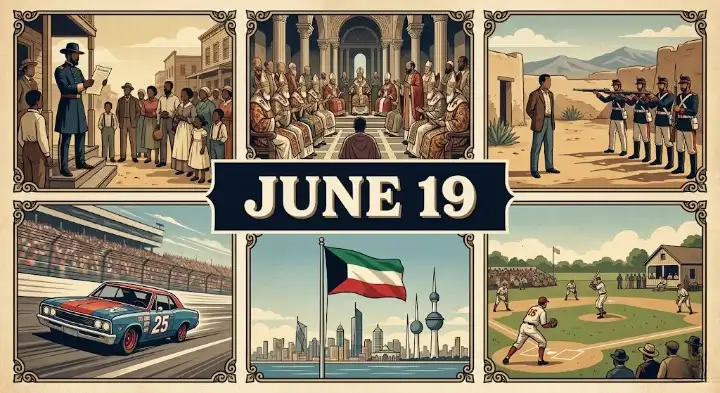
Galveston Bay, June 19, 1865. Union General Gordon Granger steps onto Texas soil and reads General Order No. 3 aloud — slavery is over, two and a half years after Lincoln signed the proclamation that was supposed to end it. The news had simply never traveled. This day in history June 19 carries that delay like a scar: freedom announced late, but never forgotten. From a Cold War execution at Sing Sing to Kuwait breaking from British rule, June 19 keeps circling one question — how long can the truth be held back before it forces its way out?
📅 Quick Facts — June 19 in History
| 📌 Category | 📖 Event / Detail |
|---|---|
| 🌟 Most Significant Event | Juneteenth, 1865 — enslaved Texans informed of their freedom |
| 🏆 Top 10 Key Events | • Nicene Creed adopted (325) • Juneteenth (1865) • Maximilian I executed (1867) • Rosenberg executions (1953) • Kuwait independence (1961) • Civil Rights Act passes Senate (1964) |
| ⚔️ Key Battles | Battle of Kalvskinnet (1179), Battle of Methven (1306), Battle of Höchstädt (1800), Battle of Seven Oaks (1816) |
| 👤 Key Figures | Abraham Lincoln, Julius and Ethel Rosenberg, Maximilian I, Benito Mussolini |
| 🌍 Observances | Juneteenth (US), World Sickle Cell Day, Father’s Day (origin, 1910), Labour Day (Trinidad and Tobago) |
Story of the Day: Juneteenth in Galveston
Word didn’t arrive by telegraph. It arrived on horseback, with Union soldiers, two and a half years too late. On June 19, 1865, General Gordon Granger rode into Galveston and read aloud that all slaves were free — a freedom that had technically existed since Lincoln’s Emancipation Proclamation in January 1863. Texas was the last Confederate state still holding enslaved people in bondage, far from the front lines, far from enforcement. The order changed nothing on paper that day. It changed everything in practice. Communities in Texas began celebrating the next year, and the date grew into Juneteenth — a name fused from “June” and “nineteenth” that became, in 2021, a federal holiday.
Important Events That Happened On June 19 In History
325 – The Nicene Creed Is Adopted
Bishops from across the Roman world packed into Nicaea, arguing over the exact nature of Christ. Constantine had summoned them to settle a split that was tearing the early church apart. By the time the council closed, they’d hammered out the Nicene Creed — a statement of belief still recited in churches today. Few documents from antiquity have shaped religious practice for this long, unbroken.
978 – Battle of Pankaleia
Bardas Phokas the Younger led Byzantine troops loyal to Emperor Basil II onto the field against the rebel general Bardas Skleros. Two men, both named Bardas, fighting for control of an empire. Phokas’s forces broke the rebellion that day, buying Basil II room to consolidate power. The young emperor would go on to become one of Byzantium’s most dominant rulers.
1179 – Battle of Kalvskinnet
Outside Nidaros — modern Trondheim — two Norwegian factions collided in a civil war that had dragged on for years. Earl Erling Skakke, one of the most powerful men in Norway, fell in the fighting. His death didn’t end the conflict, but it tipped the balance hard against his side. Norway’s civil wars dragged on for years afterward, reshaped by what happened that day.
1306 – Battle of Methven
Robert the Bruce had just crowned himself King of Scots, and the Earl of Pembroke wasn’t going to let that stand. Pembroke’s English army caught Bruce’s forces by surprise near Methven and crushed them. Bruce barely escaped, fleeing into hiding with his cause nearly finished before it began. He’d return within a year — and this time, Scotland would win.
1586 – Roanoke Colonists Abandon the Island
Supplies were gone, relations with local tribes had collapsed, and Sir Francis Drake’s fleet showed up at exactly the right moment. The English colonists on Roanoke Island packed up and sailed home, giving up on England’s first attempt at a permanent American settlement. It was a quiet retreat, not a disaster — but it set the stage for the second Roanoke colony a year later, the one that vanished without a trace.
1718 – The Tongwei–Gansu Earthquake
The ground gave way across Qing dynasty China, triggering landslides that buried entire villages. At least 73,000 people died, most of them not from the shaking itself but from the hillsides that came down afterward. It remains one of the deadliest earthquakes in recorded history. Entire communities were erased from the map in a matter of minutes.
1785 – Boston’s King’s Chapel Breaks From Tradition
James Freeman stood before his Boston congregation with a revised prayer book — one that quietly removed the Nicene Creed his church had recited for over a thousand years. King’s Chapel adopted it anyway. The move made it the first Unitarian congregation in the United States, decades before Unitarianism became an organized denomination. One edited prayer book launched an entire religious tradition in America.
1800 – Battle of Höchstädt
French and Austrian armies met at Höchstädt during the War of the Second Coalition, each side fighting for control of southern Germany. The French broke through and won the field. It was one more piece in Napoleon’s broader campaign to push Austria out of the war entirely. Austria would be forced to the negotiating table within months.
1811 – The Carlton House Fête
London had never seen anything like it — three thousand guests, an indoor stream stocked with live fish, tables stretching the length of the banquet hall. The Prince Regent threw the Carlton House Fête to mark the official start of the Regency era, after George III’s mental illness made him unfit to rule. The extravagance became legendary, a symbol of the excess that defined the age. Britain entered a cultural period now named entirely after that one prince.
1816 – Battle of Seven Oaks
Near present-day Winnipeg, fur trade rivals North West Company and the Hudson’s Bay Company turned their commercial rivalry into open violence. Twenty-one men died in the clash at Seven Oaks, most of them from the Hudson’s Bay side. The battle exposed how brutal the fight for Canada’s fur trade had become. The two companies would merge just four years later, ending the bloodshed for good.
1821 – Ottomans Crush the Filiki Eteria at Drăgășani
Greek revolutionaries under the secret society Filiki Eteria marched into Wallachia hoping to spark a wider uprising against Ottoman rule. Ottoman forces met them at Drăgășani and delivered a decisive, brutal defeat. The loss nearly ended the movement before Greece’s actual independence war even began. Within months, the rebellion shifted south into Greece itself — and that one would succeed.
1846 – The First Organized Baseball Game
On Hoboken’s Elysian Fields, Alexander Cartwright stood as umpire while his own New York Base Ball Club took on the Knickerbockers. Cartwright had drawn up a new rulebook — bases, innings, foul lines — that looked recognizably like modern baseball. The Knickerbockers lost badly, 23 to 1. The rules Cartwright enforced that day became the skeleton of America’s national pastime.
1850 – Princess Louise Marries Crown Prince Karl
Princess Louise of the Netherlands walked down the aisle to marry Crown Prince Karl of Sweden–Norway, binding two royal houses together in classic 19th-century fashion. The marriage was political as much as personal, the kind of alliance that shaped European succession lines for decades. Their union tied Dutch and Scandinavian royalty closer than they’d been in generations. Karl would later take the throne as King Charles XV.
1862 – Lincoln Bans Slavery in US Territories
Abraham Lincoln picked up his pen and signed the Territorial Slavery Act, outlawing slavery in every current and future United States territory. It was a quieter law than the Emancipation Proclamation that followed six months later, but it mattered just as much — it drew a hard line against slavery’s westward expansion. The move signaled where Lincoln’s administration was heading next. It set legal groundwork for the broader emancipation still to come.
1865 – Juneteenth: Freedom Reaches Galveston
(Already told in full above as the Story of the Day.) General Granger’s order in Galveston turned a two-and-a-half-year-old legal fact into lived reality for thousands of enslaved Texans, and the date became Juneteenth — a federal holiday since June 17, 2021.
1867 – Maximilian I Is Executed in Querétaro
A firing squad raised their rifles at dawn in Querétaro, and Maximilian I — Austrian-born, installed by France as Emperor of Mexico — faced them without a blindfold. France had pulled its troops out months earlier, leaving him exposed to Benito Juárez’s republican forces. The execution ended the Second Mexican Empire for good. It stood as a blunt warning to any European power thinking about installing puppet rulers in the Americas.
1875 – The Herzegovinian Rebellion Begins
Christian peasants in Herzegovina, crushed under Ottoman taxation, finally rose up in armed revolt. What started as a local uprising spread fast, dragging in Serbia, Montenegro, and eventually Russia. The unrest snowballed into the larger Eastern Crisis that reshaped the Balkans. Within three years, the map of southeastern Europe looked completely different.
1903 – Mussolini Arrested in Bern
Decades before he became a fascist dictator, a young Benito Mussolini was a radical socialist agitator in Switzerland, pushing for a violent general strike. Bern police arrested him for it, just one entry in a string of run-ins with authorities during his exile years. Nobody at the time would have guessed where he was headed. Within two decades, he’d be ruling Italy.
1910 – The First Father’s Day
In Spokane, Washington, Sonora Smart Dodd pushed for a day honoring fathers, inspired by her own father raising six children alone after his wife died. The city held the first observance on June 19, 1910. It took until 1972 — over sixty years later — for Father’s Day to become an official US federal holiday. One daughter’s idea eventually became a global tradition.
1913 – South Africa’s Natives Land Act Takes Effect
The Natives Land Act carved up South Africa, restricting Black land ownership to a small fraction of the country’s total territory. It became one of the foundational legal pillars of segregation, decades before apartheid was formally named. The damage from this single law echoed for the rest of the century. Land restitution from it remains a live political issue in South Africa today.
1921 – Knockcroghery Burned by British Forces
British forces torched the small Irish village of Knockcroghery during the War of Independence, destroying homes and a centuries-old pipe-making industry along with them. It was one of dozens of reprisal burnings carried out across Ireland that year. The village took decades to rebuild what was lost. Knockcroghery’s clay pipe trade never fully recovered.
1926 – King Roger Premieres in Warsaw
Karol Szymanowski’s opera King Roger opened at Warsaw’s Grand Theatre, built around the real medieval ruler Roger II of Sicily. The work blended Mediterranean myth with modernist Polish composition, unlike anything audiences had heard before. It struggled for recognition during Szymanowski’s lifetime. Decades later, it’s regarded as one of the great operas of the 20th century.
1934 – The FCC Is Established
Congress passed the Communications Act of 1934, creating the Federal Communications Commission to oversee America’s booming radio industry. The new agency took over regulation of airwaves that had grown chaotic as broadcasting exploded in popularity. It set rules that would later expand to television, then cable, then the internet. Nearly a century later, the FCC still governs how those signals reach American homes.
1943 – The Steagles: Eagles and Steelers Merge
World War II had drained NFL rosters so badly that the Philadelphia Eagles and Pittsburgh Steelers had no choice but to combine into a single team for one season. Fans nicknamed the combined squad the “Steagles.” The merger lasted only that one wartime year. It remains one of the strangest footnotes in NFL history.
1945 – The El Teniente Mine Tragedy
Deep inside the El Teniente copper mine in Chile, smoke filled the underground tunnels with no warning and no easy way out. Three hundred fifty-five workers died before rescue teams could reach them. It stands as one of the worst mining disasters in South American history. The tragedy forced sweeping changes to underground mine safety across Chile.
1947 – Pan Am Flight 121 Crashes in Syria
Pan Am Flight 121 went down in the Syrian Desert near Mayadin, killing 15 people and injuring 21 more. Early transatlantic and Middle East commercial routes were still new, and crashes like this one exposed how unforgiving the technology and conditions still were. Investigators worked through the wreckage trying to piece together what went wrong. The crash added to a string of incidents that pushed the airline industry toward stricter safety standards.
1953 – The Rosenbergs Are Executed
Julius and Ethel Rosenberg sat in the electric chair at Sing Sing prison, convicted of passing atomic secrets to the Soviet Union. Their trial had gripped the nation, splitting opinion between those certain of their guilt and those convinced the Cold War had turned into a witch hunt. Both refused to confess to the end, even when a confession might have saved their lives. They remain the only American civilians ever executed for espionage during the Cold War.
1960 – Charlotte Motor Speedway’s First Race
Charlotte Motor Speedway opened its gates for the inaugural World 600, NASCAR’s longest race at the time. Cars and crowds packed in for a brand-new track promising bigger spectacle than anything NASCAR had run before. The race went the distance, cementing Charlotte’s place on the circuit. The speedway is still a cornerstone of NASCAR’s schedule today.
1961 – Kuwait Declares Independence
After decades as a British protectorate, Kuwait formally declared its independence, severing the colonial arrangement that had defined its foreign affairs since 1899. The move came as oil wealth was transforming the small Gulf state into a major economic player. Independence didn’t end outside interest in Kuwait — Iraq immediately claimed the territory, forcing British troops back in within days to deter an invasion. Kuwait’s sovereignty held, setting the template for its modern statehood.
1964 – The Civil Rights Act Passes the Senate
After 83 days of filibuster — one of the longest in Senate history — the Civil Rights Act of 1964 finally passed, breaking the resistance of Southern segregationist senators. The bill banned discrimination based on race, color, religion, sex, or national origin in public life. It was the most significant civil rights legislation since Reconstruction. President Lyndon Johnson signed it into law days later, reshaping American civil rights for good.
1965 – Nguyễn Cao Kỳ Becomes South Vietnam’s Prime Minister
A military junta seized control of South Vietnam’s government, installing flamboyant air force commander Nguyễn Cao Kỳ as prime minister. General Nguyễn Văn Thiệu was placed as figurehead chief of state, with real power resting elsewhere. The leadership shuffle came amid constant instability as the Vietnam War escalated. Thiệu would eventually outmaneuver Kỳ and dominate South Vietnamese politics for the rest of the decade.
1978 – Garfield Goes National
A lazy, lasagna-obsessed cartoon cat named Garfield, created by Jim Davis, had been running locally as “Jon” since 1976. On June 19, 1978, the strip went into nationwide syndication under its new name. Readers across the country fell for the cat’s deadpan laziness almost immediately. Garfield went on to become one of the most widely syndicated comic strips in history.
1982 – China’s People’s Armed Police Founded
China quietly stood up the People’s Armed Police, a paramilitary force meant to handle internal security separate from the regular military. It operated for ten months before its official founding was formalized the following spring. The force grew into one of the largest paramilitary organizations in the world. It remains central to how China manages internal stability today.
1985 – Attack on Zona Rosa, San Salvador
Gunmen disguised as Salvadoran soldiers stormed the Zona Rosa district of San Salvador, a known gathering spot for American military personnel and businesspeople. The Revolutionary Party of Central American Workers claimed responsibility for the assault. Several US Marines were among those killed in the attack. It marked one of the deadliest direct strikes on American personnel during El Salvador’s civil war.
1987 – The Hipercor Bombing
A car packed with explosives detonated in the parking garage of the Hipercor supermarket in Barcelona, sending the structure up in flames. ETA, the Basque separatist group, claimed responsibility for what became one of their deadliest single attacks. Twenty-one people died and 45 were injured, many of them trapped by the fire. The bombing triggered nationwide outrage and remains one of the darkest chapters of ETA’s campaign.
1987 – Aeroflot Flight N-528 Crashes
Aeroflot Flight N-528 went down at Berdiansk Airport in present-day Ukraine, killing eight people aboard. Soviet aviation safety records from this era were often murky, with crash details slow to reach the public. The incident added to a string of Aeroflot accidents during the late Soviet period. It remains a lesser-known but real entry in the long list of Cold War-era air disasters.
1988 – Pope John Paul II Canonizes 117 Vietnamese Martyrs
In a single ceremony, Pope John Paul II declared 117 Vietnamese Catholics — killed for their faith between the 17th and 19th centuries — saints of the Catholic Church. The mass canonization was one of the largest in modern papal history. It recognized centuries of persecution faced by Vietnam’s Catholic minority. The Vietnamese Martyrs remain among the most venerated saints in Southeast Asian Catholicism.
1990 – Norway Ratifies Indigenous Rights Convention
Norway became the first country in the world to ratify the Indigenous and Tribal Peoples Convention, 1989 — the first binding international law protecting indigenous land and cultural rights. The move set a legal precedent other nations would later follow. It gave Norway’s own Sámi population stronger legal standing. The convention remains the leading international law defending indigenous peoples to this day.
1990 – The Russian Communist Party Is Founded
As the Soviet Union edged toward collapse, the Communist Party of the Russian Soviet Federative Socialist Republic was founded in Moscow — a separate Russian branch within the larger Soviet Communist structure. The move reflected growing fractures inside the USSR’s political establishment. It was a sign of the disintegration already underway. Within a year and a half, the Soviet Union itself would cease to exist.
1991 – Last Soviet Troops Leave Hungary
The final units of the Soviet army packed up and withdrew from Hungary, closing out decades of military occupation that began after World War II. The pullout was part of the broader unraveling of Soviet control across Eastern Europe. Hungarian streets that had hosted Soviet tanks for generations stood empty. It was one more domino falling before the USSR’s collapse later that year.
2005 – The US Grand Prix Tire Crisis
At the Indianapolis Motor Speedway, teams running Michelin tires discovered a safety flaw days before the United States Grand Prix, and no fix could be agreed upon in time. Fourteen cars from seven Michelin-shod teams completed the formation lap, then pulled into the pits and withdrew rather than risk a blowout. Only six cars from three Bridgestone teams actually raced. Fans in the stands booed for the rest of the event, and the fallout badly damaged Formula One’s reputation in America.
2007 – The al-Khilani Mosque Bombing
A massive car bomb tore through the al-Khilani Mosque in Baghdad, killing 78 people and wounding 218 more. The attack came during one of the bloodiest stretches of Iraq’s sectarian violence. Mosques had become frequent targets as the conflict spiraled. The bombing added to the grim toll of a war that showed no signs of slowing that year.
2009 – Mass Riots in Shishou, China
Over 10,000 residents of Shishou clashed with an equal number of police after a young chef died under suspicious circumstances that local authorities refused to explain. Rumors spread that officials were covering up a murder. The unrest turned into one of China’s largest public riots that decade. It exposed deep public distrust toward local government cover-ups.
2009 – Pakistan Launches Operation Rah-e-Nijat
Pakistan’s military launched Operation Rah-e-Nijat, a major offensive against Taliban and allied militants entrenched in South Waziristan. Thousands of troops pushed into the tribal areas, supported by airstrikes. The operation became one of the largest counterinsurgency campaigns in Pakistan’s history. It reshaped the security landscape of the tribal belt for years afterward.
2012 – Julian Assange Seeks Asylum
WikiLeaks founder Julian Assange walked into Ecuador’s embassy in London and requested asylum, fearing extradition to the United States over WikiLeaks’ release of classified military documents and footage. Ecuador granted the request, and Assange moved in rather than risk arrest outside its doors. He would remain inside that embassy for seven years. The standoff became one of the strangest diplomatic sagas of the decade.
2018 – The 10 Millionth US Patent Is Issued
The United States Patent and Trademark Office issued patent number 10,000,000, a milestone over two centuries in the making since the patent system began. The achievement reflected the sheer scale of American innovation across generations. It marked a symbolic moment for an agency that’s tracked invention since the country’s founding. The patent system continues to log hundreds of thousands of new filings every year.
2018 – Antwon Rose II Is Fatally Shot
In East Pittsburgh, 17-year-old Antwon Rose II was shot and killed by police officer Michael Rosfeld while fleeing a vehicle connected to a drive-by shooting. The killing sparked weeks of protests across the Pittsburgh area. Rosfeld was charged with homicide, becoming one of the few officers in the region to face such charges. The case intensified an already heated national conversation about police use of force.
2020 – Regan Russell Killed Outside a Slaughterhouse
Animal rights activist Regan Russell was struck and killed by a transport truck while protesting outside a pig slaughterhouse in Burlington, Ontario. She had spent years advocating for animals being transported to slaughter, often standing at this exact location. Her death drew national attention to Canada’s “ag-gag” laws restricting activist access to slaughterhouses. It became a rallying point for animal rights advocacy across Canada.
Click here to browse our collection of previous daily facts.
Famous People Born On June 19
| Name | Description | Date |
|---|---|---|
| Prince Morikuni | Shōgun of Japan | 1301 – 1333 |
| Sigismondo Pandolfo Malatesta | Lord of Rimini | 1417 – 1468 |
| James VI and I | King of Scotland & England | 1566 – 1625 |
| Guru Hargobind | Sixth Sikh Guru | 1595 – 1644 |
| Gilbert Sheldon | Archbishop of Canterbury | 1598 – 1677 |
| Blaise Pascal | Mathematician & physicist | 1623 – 1662 |
| José Gervasio Artigas | Uruguayan national hero | 1764 – 1850 |
| Friedrich Sertürner | Discoverer of morphine | 1783 – 1841 |
| James Braid | Surgeon & hypnotherapy pioneer | 1795 – 1860 |
| Hamilton Hume | Australian explorer | 1797 – 1873 |
| Charles Spurgeon | English preacher | 1834 – 1892 |
| José Rizal | Filipino nationalist & writer | 1861 – 1896 |
| Douglas Haig | British Field Marshal (WWI) | 1861 – 1928 |
| May Whitty | English actress | 1865 – 1948 |
| Nigel Gresley | Locomotive engineer | 1876 – 1941 |
| Moe Howard | American comedian (Three Stooges) | 1897 – 1975 |
| Lou Gehrig | Baseball legend | 1903 – 1941 |
| Osamu Dazai | Japanese novelist | 1909 – 1948 |
| Aage Bohr | Nobel physicist | 1922 – 2009 |
| Louis Jourdan | Actor | 1921 – 2015 |
| Paul Flory | Nobel chemist | 1910 – 1985 |
| Erna Schneider Hoover | Inventor & mathematician | 1926 – — |
| Salman Rushdie | Novelist | 1947 – — |
| Phylicia Rashad | Actress | 1948 – — |
| Zoe Saldaña | Actress | 1978 – — |
| Macklemore | Rapper | 1983 – — |
| Jacob deGrom | Baseball pitcher | 1988 – — |
| KSI | YouTuber & entertainer | 1993 – — |
Famous People Died On June 19
| Name | Description | Date |
|---|---|---|
| Piers Gaveston | English nobleman | 1284 – 1312 |
| Nathanael Greene | American Revolutionary general | 1742 – 1786 |
| J. M. Barrie | Author of Peter Pan | 1860 – 1937 |
| Thomas J. Watson | IBM founder/executive | 1874 – 1956 |
| William Golding | Nobel Prize novelist | 1911 – 1993 |
| Jean Arthur | American actress | 1900 – 1991 |
| Len Bias | Basketball player | 1963 – 1986 |
| Manute Bol | NBA player & activist | 1962 – 2010 |
| James Gandolfini | Actor (The Sopranos) | 1961 – 2013 |
| Anton Yelchin | Actor | 1989 – 2016 |
| Koko | Famous signing gorilla | 1971 – 2018 |
| Ian Holm | Actor | 1931 – 2020 |
Observances on June 19
- Juneteenth (United States) — Marks June 19, 1865, when enslaved people in Galveston, Texas, finally learned they were free, more than two years after the Emancipation Proclamation.
- World Sickle Cell Day (International) — Raises awareness of sickle cell disease, a genetic blood disorder affecting millions worldwide, and pushes for better screening and treatment access.
- Feast of Forest (Palawan) — A local Palawan observance honoring the region’s forests and the communities whose livelihoods depend on them.
- Labour Day (Trinidad and Tobago) — Commemorates the 1937 oilfield workers’ uprising led by Tubal Uriah Butler, a turning point for the country’s labor rights movement.
- Laguna Day (Laguna) — Celebrates the founding of Laguna province in the Philippines, marked with local festivities and cultural events.
- Day of the Independent Hungary (Hungary) — Marks the 1991 withdrawal of the last Soviet troops from Hungarian soil, ending decades of military occupation.
- Birthday of José Gervasio Artigas (Uruguay) — Honors the birth of Uruguay’s national hero, considered the father of Uruguayan independence.
- Anniversary of Kim Jong Il’s Commencement of Work at the Workers’ Party Central Committee (DPRK) — Commemorates the date Kim Jong Il formally began his political career within North Korea’s ruling party in 1964.
✊ Frequently Asked Questions — June 19 in History
General Gordon Granger arrived in Galveston, Texas, and announced that all enslaved people were free — over two years after the Emancipation Proclamation had already legally freed them. The day became known as Juneteenth and is now a federal holiday in the United States.
Juneteenth stands out as the most significant event tied to this date. It marks the moment freedom finally reached the last enslaved people in the Confederacy, turning a delayed legal fact into a lived reality.
Historical figures associated with June 19 events include Julius and Ethel Rosenberg, executed on this date in 1953, and Maximilian I, executed on this date in 1867. (No major births appear in the records reviewed for this date.)
Several wartime events fall on this date, including the 1816 Battle of Seven Oaks in Canada, the 1875 start of the Herzegovinian rebellion against Ottoman rule, and Pakistan’s 2009 launch of Operation Rah-e-Nijat against Taliban militants in South Waziristan.
Juneteenth commemorates June 19, 1865, when enslaved people in Galveston, Texas, were finally informed of their freedom. It’s remembered as a symbol of delayed justice and now stands as a federal holiday honoring the end of slavery in the United States.
In more recent history, June 19, 2018, saw both the issuance of the 10 millionth US patent and the fatal police shooting of Antwon Rose II in Pennsylvania, an event that sparked widespread protests over police use of force.