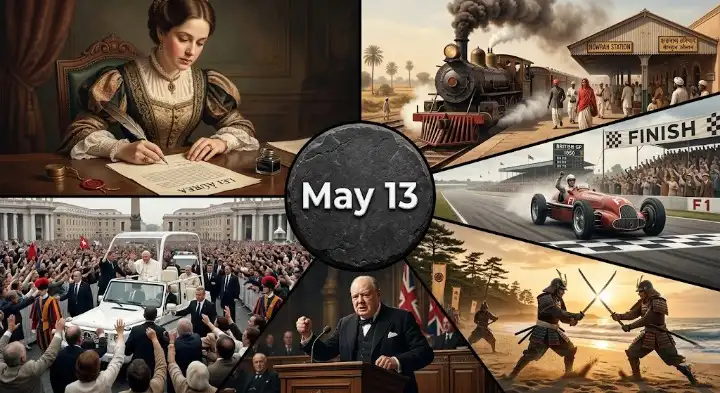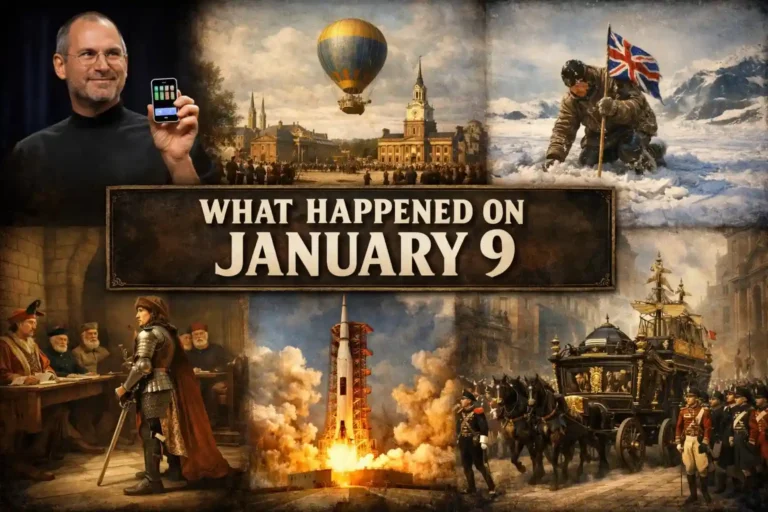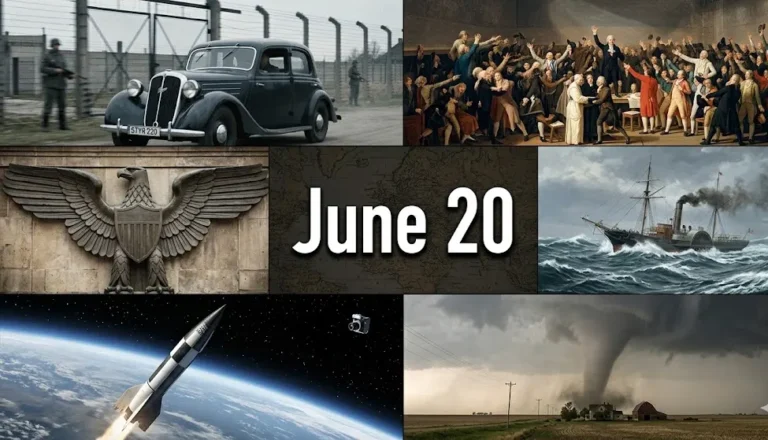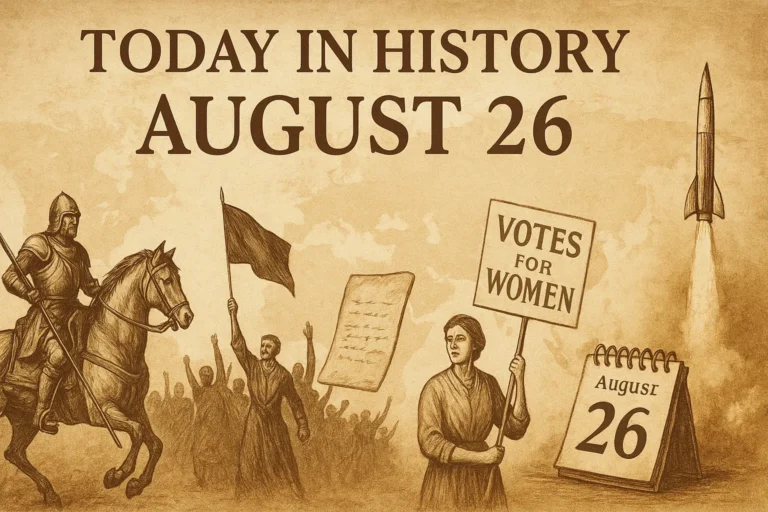
📅 Quick Facts — June 29 in History
| 📌 Category | 📖 Event / Detail |
|---|---|
| 🌟 Most Significant Event | The world’s first space fatalities occur as Soyuz 11 depressurizes during atmospheric re-entry (1971). |
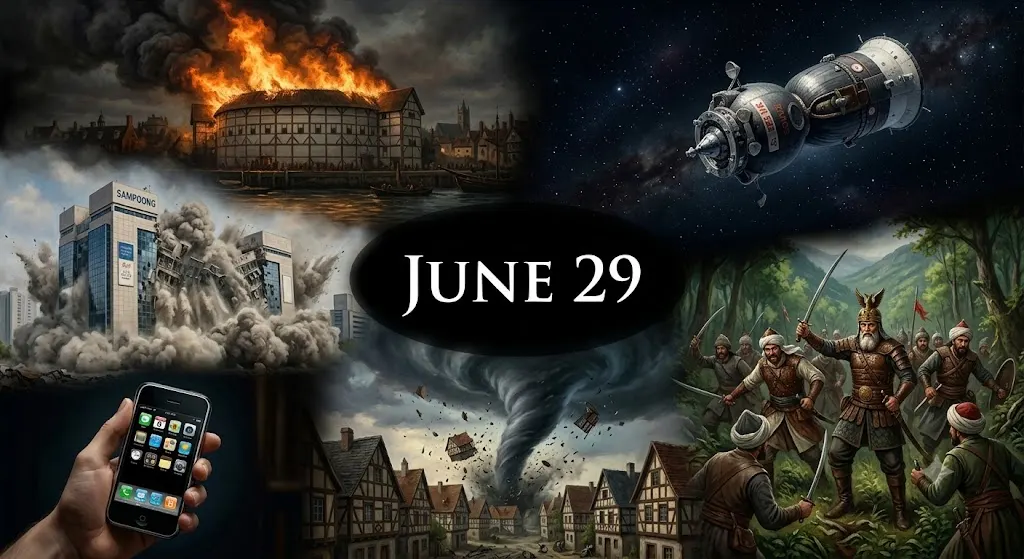
| 🏆 Top 10 Key Events | • Cao Rui assumes the throne of Wei (226) • Joint forces lay siege to Constantinople (626) • Raymond of Poitiers falls at Inab (1149) • Shakespeare’s Globe Theatre burns down (1613) • The horrific St-Hilaire train disaster in Canada (1864) • The tragic Soyuz 11 capsule depressurization (1971) • Ballet star Mikhail Baryshnikov defects to the West (1974) • The deadly Sampoong Department Store collapse (1995) • Inter-Korean naval forces clash in the Yellow Sea (2002) • Apple releases the revolutionary first iPhone (2007) |
| ⚔️ Key Battles | The Battle of Inab (1149), The Battle of Cropredy Bridge (1644), The Battle of Konotop (1659), The Battle of Athos (1807), The Second Battle of Yeonpyeong (2002) |
| 👤 Key Figures | Emperor Cao Rui, King Charles I, Cosmonaut Georgy Dobrovolsky, Mikhail Baryshnikov, Steve Jobs |
| 🌍 Observances | Independence Day (Seychelles), Veterans’ Day (Netherlands), National Statistics Day (India), Engineer’s Day (Ecuador) |
Story of the Day: Three Men Dying in the Silence of Space
Three Soviet cosmonauts buckled into their seats inside the Soyuz 11 capsule, preparing to return to Earth after a triumphant, record-breaking three weeks aboard the Salyut 1 space station. Georgy Dobrovolsky, Vladislav Volkov, and Viktor Patsayev were national heroes before they even touched the ground. But as the capsule separated from the station, a faulty ventilation valve jerked open, venting their oxygen into the cold vacuum of space. Within seconds, the cabin pressure plummeted to zero.
The crew tried desperately to find and plug the leak by hand, but hypoxia claimed them before they could seal the breach. When the automated retrieval team opened the hatch on the Kazakh steppes, they found the three men sitting still, their faces covered in dark blue blotches, looking as though they were asleep. This terrible tragedy forced both the Soviet and American space programs to mandate that all astronauts wear pressurized spacesuits during launch and landing, saving countless lives in the decades that followed.
Important Events That Happened On June 29 In History
226 – Cao Rui Claims the Throne of Wei
Emperor Cao Pi passed away after a brief illness, leaving the massive kingdom of Wei to his twenty-one-year-old son. Cao Rui stepped into a world of intense political backstabbing and military threats from rival states during the legendary Three Kingdoms period. The young ruler surprised his older ministers by demonstrating sharp military instinct and picking excellent commanders to defend his borders. His reign kept the empire stable, preventing a total collapse during a highly unstable era of civil war.
626 – Constantinople Surrounded by Hostile Armies
A massive host of Avars and Sassanid Persians choked off the land and sea approaches to the heavily fortified capital of the Byzantine Empire. Patrician Bonus took charge of the defensive walls while the reigning emperor was away on a foreign campaign, rallying the terrified citizens. The defenders held firm against wave after wave of siege engines, eventually destroying the enemy fleet. This successful defense saved the empire from destruction and changed the political balance of the Mediterranean for generations.
1072 – Romanos IV Diogenes Blinded by Rivals
The deposed Byzantine Emperor surrendered to his political enemies after receiving absolute guarantees of personal safety and a peaceful retirement. Caesar John Doukas ignored those holy oaths, ordering his guards to violently gouge out the fallen ruler’s eyes with a hot iron. The brutal operation was botched so badly that Romanos developed a severe infection and died in agonizing pain days later on a remote island. This gruesome act left the empire deeply divided, vulnerable, and completely unable to stop advancing foreign armies.
1149 – Raymond of Poitiers Falls at Inab
Prince Raymond charged his outnumbered cavalry directly into the surrounding forces of Nur ad-Din Zangi in a desperate attempt to break a siege. The military gamble failed spectacularly when a violent sandstorm blinded the Christian knights, splitting their ranks. Nur ad-Din personally oversaw the battle, ending with Raymond being decapitated by an elite soldier. The defeat left Antioch completely exposed and sent shockwaves through the Crusader states, altering the balance of power in the region.
1170 – Great Syrian Earthquake Demolishes Cities
A massive fault line ruptured beneath the Levant, sending violent shockwaves tearing through ancient cities and fortified strongholds. Stone walls cracked open like eggshells in Hama and Shaizar, crushing thousands of sleeping residents beneath heavy masonry. The legendary Krak des Chevalier fortress sustained heavy damage, while the great cathedral of St. Peter in Antioch collapsed into rubble. This natural disaster forced a temporary halt to regional warfare as both sides struggled to rebuild their ruined towns.
1194 – King Sverre Defies the Catholic Church
Archbishop Eirik stood before a packed congregation and crowned Sverre Sigurdsson as the undisputed King of Norway despite fierce opposition from Rome. Pope Celestine III responded with absolute fury, issuing a decree of excommunication that banned the new monarch from holy sacraments. The royal crowning plunged Norway into a brutal, multi-year civil war as religious factions tried to unseat the king. Sverre held onto his throne until his death, permanently weakening church control over the Norwegian monarchy.
1444 – Skanderbeg Routs the Ottoman Army
George Kastrioti, famously known as Skanderbeg, lured a massive Ottoman invasion force deep into the narrow, heavily wooded valley of Torvioll. The Albanian commander hid his elite troops in the thick forests, ambushing the enemy flanks just as they advanced. The trap worked perfectly, turning the Ottoman advance into a chaotic retreat that left thousands of enemy soldiers dead on the field. This stunning victory proved the Ottoman Empire could be beaten, sparking decades of European resistance against their expansion.
1457 – The Great Fire of Dordrecht
A small kitchen fire broke out in a wooden house and spread out of control across the dry, packed streets of the Dutch trading hub. Strong winds pushed the flames from roof to roof, jumping across canals and trapping hundreds of citizens inside their burning neighborhoods. By the time the embers cooled, more than half of the prosperous medieval city lay in smoking ruins. The disaster forced city leaders to ban thatched roofs, permanently changing Dutch architecture toward brick construction.
1534 – Jacques Cartier Reaches Prince Edward Island
French explorer Jacques Cartier anchored his wooden ships off a lush, red-soiled coastline, becoming the first European to set foot on the island. He noted the rich soil and vast meadows in his ship log, believing he had found a paradise on the edge of the known world. The French captain encountered Mi’kmaq fishermen, initiating some of the earliest fur trades in northern North America. This landing laid the groundwork for French colonial claims over Eastern Canada.
1613 – The Original Globe Theatre Burns Down
A theatrical cannon loaded with real gunpowder fired during a lavish performance of Shakespeare’s Henry VIII, accidentally igniting the theater’s dry thatch roof. Spectators watched in horror as flames raced across the circular wooden galleries, consuming the stage where Hamlet and Macbeth were born. Remarkably, the entire crowd of two thousand people escaped through two narrow exit doors with only one man’s trousers catching fire. The company rebuilt the theater with a tile roof the following year, but a piece of theatrical history was lost forever.
1620 – King James I Bans English Tobacco Farming
King James I signed a royal decree outlawing all commercial tobacco cultivation within the borders of England to protect import revenues. This strict law handed an absolute monopoly to the struggling Virginia Company in North America in exchange for a hefty tax on every pound brought into port. English farmers protested furiously, but royal guards destroyed their crops to enforce the new economic policy. This decision secured the economic survival of the early American colonies, tying their futures to tobacco production.
1644 – Charles I Triumphs at Cropredy Bridge
King Charles I spotted a Parliamentarian detachment crossing a narrow stone bridge over the River Cherwell and ordered a swift cavalry strike. Royalist forces cut through the enemy lines, capturing the roundhead artillery pieces and forcing a chaotic retreat across the water. The victory provided a massive morale boost to the royal cause during a dark period of the English Civil War. This success delayed the ultimate defeat of the King’s forces for several critical months.
1659 – Ivan Vyhovsky Routs the Russian Army
Hetman Ivan Vyhovsky led a combined force of Cossacks and Crimean Tatars against Prince Trubetskoy’s elite Russian cavalry near the town of Konotop. The Cossacks feigned a clumsy retreat, tempting the heavy Russian forces into crossing a swampy river basin. Once the Russians were trapped in the deep mud, Vyhovsky’s hidden forces sprang an ambush that decimated the elite imperial regiment. This crushing defeat halted the Russian advance into Ukraine, securing Ukrainian autonomy for a generation.
1764 – Monstrous F5 Tornado Levels Woldegk
An incredibly rare, violent tornado touched down in northern Germany, generating winds estimated at over three hundred miles per hour. The massive vortex tore through the countryside, completely leveling grand stone mansions and snapping ancient oak trees like toothpicks. One resident was killed when the storm lifted them into the air and threw them hundreds of yards into a field. The sheer destruction remains one of the most intense meteorological events ever recorded in European history.
1786 – Highland Catholics Flee to Ontario
Father Alexander Macdonell led over five hundred Scottish highlanders onto transport ships, leaving their ancestral homes behind forever. The mass migration was triggered by the brutal Highland Clearances, which saw traditional tenant farmers evicted by wealthy landlords to make room for sheep. The displaced Scots settled in Glengarry County, Ontario, clearing the thick wilderness to build a vibrant new community. This arrival established a deeply rooted Scottish-Gaelic culture in eastern Canada that survives to this day.
1807 – Admiral Senyavin Destroys the Ottoman Fleet
Russian Admiral Dmitry Senyavin trapped the Ottoman fleet near the holy peninsula of Mount Athos, ordering an immediate all-out assault. The Russian ships maneuvered brilliantly, using superior firepower to smash through the enemy line and set their flagship ablaze. The intense naval battle ended with the complete destruction of the Ottoman naval force, shifting control of the Aegean Sea to Russia. This victory forced the Sultan to sign an armistice, ending a bloody phase of the war.
1850 – Greek Church Achieves Autocephaly
The Ecumenical Patriarchate of Constantinople issued a sacred decree granting complete self-governing independence to the Church of Greece. This religious split came after decades of political tension following the bloody Greek War of Independence from the Ottoman Empire. Greek bishops no longer had to answer to a patriarch living inside Ottoman territory, securing the young nation’s spiritual sovereignty. This move tied national identity directly to the Orthodox faith, shaping modern Greek politics.
1864 – The St-Hilaire Train Disaster Kills 99
An immigrant passenger train carrying hundreds of German and Polish families failed to see a red warning signal near St-Hilaire, Quebec. The heavy locomotive plunged off an open drawbridge, dropping straight into the deep, dark waters of the Rivière Richelieu. The wooden passenger cars smashed on top of each other, trapping the occupants in a horrific tangle of splintered wood and rising water. This remains Canada’s worst rail disaster, forcing major upgrades to railway safety laws.
1874 – Charilaos Trikoupis Publishes “Who’s to Blame?”
Greek politician Charilaos Trikoupis published a scathing, anonymous manifesto in the Athens daily paper Kairoi, taking direct aim at King George. The article accused the monarchy of bypassing the will of the people by appointing weak, minority governments to maintain royal control. The public outcry was so intense that the King was forced to concede, electing Trikoupis as Prime Minister the following year. This political shift established the principle that the leader of the majority party must form the government.
1880 – France Forcefully Annexes Tahiti
French officials officially ended the independence of the Kingdom of Tahiti, forcing Queen Pōmare V to sign away her sovereign territory. The tropical paradise was renamed as part of the French Settlements in Oceania, integrating the islands into the global French colonial empire. Tahitian culture faced intense pressure as French laws, schools, and institutions replaced traditional island governance. This annexation turned the island into a strategic French military and economic outpost in the Pacific.
1881 – Muhammad Ahmad Proclaims Himself the Mahdi
An Islamic ascetic named Muhammad Ahmad declared to his followers on Aba Island that he was the long-awaited messianic redeemer of Islam. He called for a holy war to overthrow the corrupt Anglo-Egyptian rulers of Sudan, attracting thousands of desperate tribesmen to his banner. This religious uprising triggered the bloody Mahdist War, which eventually led to the famous siege of Khartoum. His movement reshaped the geopolitics of East Africa, defying British imperial power for nearly two decades.
1888 – World’s Oldest Music Recording Captured
Colonel George Edward Gouraud stood before a massive choir performing Handel’s Israel in Egypt inside London’s Crystal Palace, holding a blank phonograph cylinder. He lowered the stylus, capturing the faint, scratchy audio of thousands of voices singing in unison across the vast glass hall. This fragile wax cylinder survived for over a century, providing modern historians with the oldest surviving recording of a musical performance. It marked a massive leap forward in human technology, proving sound could be preserved forever.
1889 – Chicago Annexes Five Neighboring Townships
Residents of Hyde Park, Lake View, and three other suburban townships cast their ballots to merge with the rapidly growing city of Chicago. This historic vote instantly transformed Chicago into the largest United States city by land area and the second-largest by population. The expansion allowed the city to coordinate its massive water, sewage, and transit systems just in time for the famous 1893 World’s Fair. This decision established Chicago as the dominant economic powerhouse of the American Midwest.
1913 – Second Balkan War Explodes into Conflict
The Bulgarian army launched a surprise, unprovoked attack against Serbian and Greek defensive positions, shattering a fragile peace alliance. Bulgaria’s leadership believed they could quickly seize disputed territory in Macedonia before their former allies could coordinate a response. The gamble failed as Serbia, Greece, Romania, and the Ottoman Empire all declared war on Bulgaria simultaneously. This short, bloody conflict left Bulgaria isolated and deeply bitter, setting the stage for the outbreak of World War I.
1915 – North Saskatchewan River Swallows Edmonton
Heavy summer rains caused the North Saskatchewan River to rise over thirty feet, sending a massive wall of muddy water crashing through Edmonton’s low-lying neighborhoods. The raging current ripped lumber mills from their foundations, sending millions of floating logs smashing into the city’s vital railway bridges. Hundreds of families lost everything as their wooden homes floated down the river, though miracle rescues kept the death toll to zero. It remains the worst natural disaster in the city’s history.
1916 – Roger Casement Sentenced to Death
A British judge donned a black cap and sentenced famed diplomat turned Irish nationalist Roger Casement to hang for high treason. Casement had been captured by British forces just days before the Easter Rising while trying to smuggle thousands of German rifles into Ireland. Despite international pleas for clemency based on his humanitarian work in Africa, the British government executed him a few weeks later. His death provided the Irish republican movement with a powerful martyr, accelerating the push for independence.
1922 – France Gifts Vimy Ridge to Canada
The government of France signed a historic treaty granting one square kilometer of blood-stained land at Vimy Ridge freely and for all time to Canada. This sovereign gift was a tribute to the thousands of Canadian soldiers who died storming the heavily fortified German lines on the ridge during World War I. Canada built a towering white limestone monument on the site, preserving the trenches and craters exactly as they were left in 1917. The park remains official Canadian territory deep inside the French countryside.
1927 – First Transpacific Flight Completed
U.S. Army Air Corps pilots Lester Maitland and Albert Hegenberger landed their Fokker tri-motor aircraft, The Bird of Paradise, safely on a runway in Hawaii. The aviators had flown non-stop from the California mainland, spending twenty-five agonizing hours navigating over open ocean using experimental instruments. This flight proved that long-range military and commercial aviation across the Pacific was entirely possible. It shattered the geographic isolation of the Hawaiian Islands, tying them to the American mainland.
1945 – Soviet Union Annexes Carpathian Ruthenia
The government of Czechoslovakia signed a forced treaty ceding the strategic border province of Carpathian Ruthenia to the Soviet Union. Joseph Stalin wanted the territory to secure a direct rail link into Central Europe, expanding Soviet influence westward after World War II. The local population was integrated into the Ukrainian Soviet Socialist Republic, facing immediate collectivization and political crackdowns. This border shift permanently altered the map of Eastern Europe, pushing the Soviet frontier directly against Hungary and Romania.
1950 – Truman Orders Naval Blockade of Korea
U.S. President Harry S. Truman authorized a complete sea blockade of the Korean peninsula, ordering American warships to intercept all shipping traffic bound for the North. This major escalation came just days after North Korean tanks smashed across the border into South Korea, triggering the Korean War. The naval blockade cut off vital sea routes, preventing Soviet and Chinese supply ships from easily reinforcing the North Korean military. This move marked the true beginning of the United States’ long, bloody involvement in the conflict.
1952 – The First Miss Universe Pageant Held
Seventeen-year-old Armi Kuusela from Finland stood before a packed crowd in Long Beach, California, and was crowned the first-ever Miss Universe. The global competition was created by a clothing company to promote swimwear, but it quickly evolved into an international media sensation. Kuusela received a valuable crown made from royal Russian jewels and a sports car, returning home to Finland as a massive celebrity. The event marked the birth of modern international beauty pageants as a staple of global pop culture.
1956 – Eisenhower Signs the Interstate Highway Act
President Dwight D. Eisenhower signed the Federal Aid Highway Act into law from his hospital room, allocating billions of dollars to build a massive national road network. Eisenhower had been impressed by the German Autobahn during World War II, realizing America needed a similar system to move troops quickly during a nuclear war. The construction project redesigned the American landscape, fueling suburban growth, destroying historic city centers, and creating modern car culture. It remains the largest public works project in United States history.
1972 – Supreme Court Halts the Death Penalty
The United States Supreme Court issued a ruling in Furman v. Georgia, declaring that the death penalty was being applied arbitrarily and inconsistently across the country. The justices ruled that the random implementation of executions constituted cruel and unusual punishment, violating the Eighth and Fourteenth Amendments. This historic decision instantly commuted the death sentences of over six hundred inmates, placing a temporary halt on all executions nationwide. It forced states to rewrite their criminal laws to ensure fairer trial procedures.
1972 – Tragic Mid-Air Collision Over Wisconsin
A Convair CV-580 passenger airliner and a small twin-engine commuter plane collided in mid-air over the calm waters of Lake Winnebago. The impact tore the wings off both aircraft, sending the flaming wreckage plunging into the water below and killing all thirteen people on board. Investigators discovered that neither pilot saw the other plane due to blind spots in their cockpits and inadequate radar tracking from local air traffic control. The disaster forced aviation authorities to tighten radar monitoring for small aircraft near busy flight paths.
1974 – Isabel Perón Steps into the Argentine Presidency
Vice President Isabel Perón took the official oath of office as Acting President of Argentina while her iconic husband, Juan Perón, lay on his deathbed. She became the first female president in the Western Hemisphere, inheriting a country on the brink of economic collapse and political violence. Lacking her husband’s charisma and political backing, she struggled to maintain control over competing military and guerrilla factions. Her chaotic presidency ended less than two years later when a military junta overthrew her government.
1974 – Mikhail Baryshnikov Defects to the West
Soviet ballet superstar Mikhail Baryshnikov slipped away from his handlers following a performance with the Kirov Ballet in Toronto, Canada. He ran down a dark street, diving into a waiting getaway car driven by friends who took him to a safe house to claim political asylum. Baryshnikov felt creatively suffocated by the rigid, state-controlled artistic rules of the Soviet Union, longing to perform modern Western choreography. His defection was a massive embarrassment for the Kremlin and a historic triumph for the international dance world.
1975 – Pope Paul VI Sets Ordination Record
Pope Paul VI stood before a massive crowd of over one hundred thousand people in St. Peter’s Square and ordained three hundred and fifty priests simultaneously. The massive ceremony was the centerpiece of the Catholic Church’s Holy Year, designed to combat a worrying global decline in religious vocations. Young men from every continent knelt on the stone plaza to receive the papal blessing in the largest single ordination in church history. The event was broadcast worldwide, projecting a powerful image of Catholic unity.
1976 – The Seychelles Gains Independence
The tropical archipelago of the Seychelles officially declared its independence from Great Britain after more than a century of colonial rule. James Mancham was sworn in as the first president of the new nation during a midnight ceremony in the capital city of Victoria as the Union Jack was lowered. The new government faced immediate challenges balancing Cold War rivalries due to its strategic position in the Indian Ocean. This independence day marked the end of British administrative control over the islands.
1976 – European Communist Leaders Gather in East Berlin
Top officials from twenty-nine European communist parties convened in East Berlin for a rare summit to debate the future of their political movement. Italian and Spanish leaders openly challenged Moscow’s absolute authority, demanding the right to pursue a democratic path to socialism known as Eurocommunism. Soviet leader Leonid Brezhnev was forced to sign a document acknowledging that each communist nation had the right to chart its own course without outside interference. This meeting exposed deep, permanent cracks in Soviet control over Eastern Europe.
1987 – Van Gogh Painting Fetches Record $20.4 Million
An anonymous buyer won a frantic bidding war at a London auction house, purchasing Vincent van Gogh’s Le Pont de Trinquetaille for a staggering twenty point four million dollars. The selling price shattered all previous records for the artist, who had famously died penniless after selling only one painting during his entire lifetime. This sale confirmed a massive shift in the global art market, turning impressionist masterpieces into highly speculative financial assets for the ultra-wealthy. It ignited a global boom in art prices that lasted for decades.
1995 – Space Shuttle Atlantis Docks with Mir
The Space Shuttle Atlantis fired its thrusters and gently locked into a docking port on the Russian space station Mir, orbiting nearly two hundred miles above Earth. This historic orbital link-up was the first time an American spacecraft had connected with a Russian station, bringing a symbolic end to the old Space Race. Astronauts and cosmonauts met at the hatch, exchanging flags, gifts, and handshakes in front of live television cameras. This mission laid the groundwork for the construction of the International Space Station.
1995 – Sampoong Department Store Collapses in Seoul
A five-story luxury department store in Seoul, South Korea, collapsed into a mountain of rubble in less than twenty seconds, trapping thousands of afternoon shoppers inside. Greedy executives had ignored repeated structural warnings, adding an unauthorized fifth floor with heavy concrete flooring that the support pillars could not handle. Rescue workers spent days digging through the wreckage, pulling survivors from tiny air pockets while the nation watched in horror. The disaster killed five hundred and two people, exposing massive corporate corruption and weak building safety enforcement.
2002 – Inter-Korean Naval Clashes Turn Deadly
Two North Korean patrol boats crossed the disputed maritime border in the Yellow Sea and opened fire on a South Korean vessel patrolling near Yeonpyeong Island. The surprise attack sparked a fierce, close-range artillery duel that lasted for over twenty minutes before the North Korean ships retreated in flames. The clash resulted in the tragic deaths of six South Korean sailors and the sinking of their high-speed patrol boat. This battle shattered a period of relative peace, escalating military tensions along the border.
2007 – Apple Launches the First iPhone
Thousands of excited tech fans stood in massive lines outside Apple stores across the United States, waiting to purchase the very first iPhone. CEO Steve Jobs had spent months teasing the device, which combined a widescreen iPod, a revolutionary mobile phone, and a breakthrough internet communicator into a single touch-screen device. Critics initially laughed at the high price and lack of a physical keyboard, but consumers fell in love with the sleek design. The launch changed global communication, destroying old tech giants and birthing the modern smartphone era.
2012 – Historic Derecho Devastates Eastern US
A fast-moving, long-lived line of severe thunderstorms known as a derecho swept across the eastern United States with hurricane-force winds. The storm front ripped down high-voltage power lines and uprooted millions of trees, leaving over four million homes in total darkness during a dangerous heatwave. At least twenty-two people were killed by falling trees and flying debris as the storm traveled hundreds of miles in a single afternoon. It remains one of the costliest and most destructive weather events in American history.
2014 – ISIS Declares a Global Caliphate
Abu Bakr al-Baghdadi released an audio recording declaring the establishment of a global Islamic caliphate across the vast territories his militant forces had seized in Syria and northern Iraq. The terrorist group ordered Muslims worldwide to swear absolute loyalty to their new regime, erasing international borders at gunpoint. This declaration triggered years of brutal regional conflict, mass migrations, and international military interventions to dismantle the group’s territory. It altered the modern geopolitical landscape of the Middle East.
Ready for more historical context? Visit our previous posts.
🎂 Famous People Born on June 29
| Name | Role / Description | Birth – Death |
|---|---|---|
| Petronilla of Aragon | Queen of Aragon | 1136–1173 |
| Murad I | Ottoman Sultan | 1326–1389 |
| John II of Aragon | King of Aragon and Navarre | 1398–1479 |
| Rembert Dodoens | Flemish physician and botanist | 1517–1585 |
| Frédéric Bastiat | French economist and political theorist | 1801–1850 |
| Angelo Secchi | Italian astronomer and pioneer of astrophysics | 1818–1878 |
| Peter I of Serbia | King of Serbia | 1844–1921 |
| George Washington Goethals | American engineer; co-designed the Panama Canal | 1858–1928 |
| William James Mayo | American surgeon; co-founder of Mayo Clinic | 1861–1939 |
| Robert Schuman | French statesman; founding father of the European Union | 1886–1963 |
| Prasanta Chandra Mahalanobis | Indian statistician and economist | 1893–1972 |
| Antoine de Saint-Exupéry | French author of The Little Prince | 1900–1944 |
| Bernard Herrmann | American film composer | 1911–1975 |
| Ray Harryhausen | American visual effects pioneer and animator | 1920–2013 |
| Giorgio Napolitano | 11th President of Italy | 1925–2023 |
| Harmon Killebrew | American Baseball Hall of Famer | 1936–2011 |
| Gary Busey | American actor | 1944–Present |
| Chandrika Kumaratunga | 5th President of Sri Lanka | 1945–Present |
| Don Moen | American Christian singer-songwriter | 1950–Present |
| Colin Hay | Scottish-Australian singer-songwriter | 1953–Present |
| María Conchita Alonso | Cuban-Venezuelan singer and actress | 1957–Present |
| Rosa Mota | Portuguese Olympic marathon champion | 1958–Present |
| Anne-Sophie Mutter | German violin virtuoso | 1963–Present |
| Melora Hardin | American actress (The Office) | 1967–Present |
| Nicole Scherzinger | American singer, actress, and television personality | 1978–Present |
| Katherine Jenkins | Welsh classical singer | 1980–Present |
| Colin Jost | American comedian and writer | 1982–Present |
| Camila Mendes | American actress (Riverdale) | 1994–Present |
| Michael Porter Jr. | American professional basketball player | 1998–Present |
| Jude Bellingham | English professional footballer | 2003–Present |
🕊️ Famous People Who Died on June 29
| Name | Role / Description | Birth – Death |
|---|---|---|
| Cao Pi | First emperor of the Cao Wei dynasty | 187–226 |
| Margaret Beaufort | Mother of King Henry VII of England | 1443–1509 |
| Moctezuma II | Ninth Aztec emperor | 1466–1520 |
| Henry Clay | American statesman and U.S. Secretary of State | 1777–1852 |
| Thomas Addison | English physician; discovered Addison’s disease | 1793–1860 |
| Elizabeth Barrett Browning | English poet | 1806–1861 |
| Michael Madhusudan Dutt | Bengali poet and dramatist | 1824–1873 |
| Thomas Henry Huxley | English biologist; “Darwin’s Bulldog” | 1825–1895 |
| Roscoe Arbuckle | American silent film actor and director | 1887–1933 |
| Paul Klee | Swiss-German painter | 1879–1940 |
| Ignacy Jan Paderewski | Polish pianist, composer, and Prime Minister | 1860–1941 |
| Eric Dolphy | American jazz saxophonist and composer | 1928–1964 |
| Jayne Mansfield | American actress and model | 1933–1967 |
| Tim Buckley | American singer-songwriter | 1947–1975 |
| Bob Crane | American actor (Hogan’s Heroes) | 1928–1978 |
| Pierre Balmain | French fashion designer; founder of Balmain | 1914–1982 |
| Héctor Lavoe | Puerto Rican salsa singer | 1946–1993 |
| Lana Turner | American actress | 1921–1995 |
| Rosemary Clooney | American singer and actress | 1928–2002 |
| Katharine Hepburn | American actress; four-time Academy Award winner | 1907–2003 |
| Margherita Hack | Italian astrophysicist | 1922–2013 |
| Josef Masopust | Czech football legend | 1931–2015 |
| Steve Ditko | American comic book artist; co-creator of Spider-Man | 1927–2018 |
| Carl Reiner | American actor, comedian, director, and writer | 1922–2020 |
| Hachalu Hundessa | Ethiopian singer and activist | 1986–2020 |
| Donald Rumsfeld | American politician; U.S. Secretary of Defense | 1932–2021 |
| Hershel W. Williams | Last surviving WWII Medal of Honor recipient | 1923–2022 |
| Alan Arkin | American Academy Award-winning actor | 1934–2023 |
| Princess Lalla Latifa | Princess Dowager of Morocco | 1946–2024 |
| Sandy Gall | Scottish journalist and war correspondent | 1927–2025 |
Observances on June 29
Independence Day (Seychelles)
This vibrant national holiday celebrates the day the island nation broke free from British colonial administration in 1976. Citizens across the archipelago mark the date with colorful beach parties, traditional Creole music performances, and military parades through the streets of Victoria.
Veterans’ Day (Netherlands)
The Dutch nation pauses to honor its military veterans, ranging from World War II survivors to modern international peacekeepers. The main event takes place in The Hague, featuring a royal military parade, flyovers by historic aircraft, and public gatherings to thank service members.
National Statistics Day (India)
India celebrates this day to mark the birth anniversary of Professor Prasanta Chandra Mahalanobis, the legendary father of modern Indian statistics. The government hosts seminars and educational workshops to highlight how data and economic planning shape public policy.
Engineer’s Day (Ecuador)
Ecuador dedicates this day to acknowledging the vital contributions of professional engineers to the nation’s infrastructure and technological growth. Universities and professional associations host awards ceremonies to honor outstanding engineering achievements.
🎭 Frequently Asked Questions — June 29 in History
Shakespeare’s original Globe Theatre burned to the ground during a live performance of Henry VIII. A theatrical cannon accidentally ignited the dry thatch roof, destroying the playhouse in less than two hours.
The tragic depressurization of the Soviet Soyuz 11 capsule in 1971 remains the most significant event on this date. It resulted in the first three human fatalities in outer space and changed spaceflight safety protocols forever.
French author and aviator Antoine de Saint-Exupéry, who wrote the classic masterpiece The Little Prince, was born on this day in 1900.
The Second Balkan War exploded on this day in 1913 when the Bulgarian army launched a surprise attack against Serbian and Greek forces.
This holiday marks the nation’s peaceful separation from British colonial rule on June 29, 1976. It is remembered to honor the birth of the sovereign island republic.
The Islamic State of Iraq and the Levant declared a global caliphate across their captured territories in Syria and Iraq on this day in 2014.