In the damp woods near Hopewell, New Jersey, a truck driver stepped into the underbrush on May 12, 1932, and stumbled upon a shallow grave containing the body of Charles Lindbergh Jr. The discovery of the kidnapped toddler shattered any remaining hope for the aviation hero’s family and instantly gripped a grieving nation. This harrowing moment is just one chapter of what happened on May 12 in history. Across centuries, this exact date has witnessed the brutal collapses of empires, the foundational shifts of modern warfare, and catastrophic natural disasters that reshaped human communities overnight.
👶 Quick Facts — May 12 in History
| 📌 Category | 📖 Event / Detail |
|---|---|
| 🌟 Most Significant Event | Discovery of the deceased Lindbergh baby (1932) |
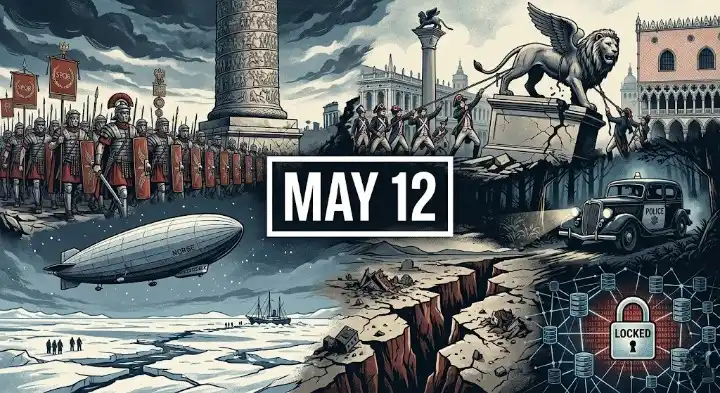
| 🏆 Top 10 Key Events | • Rome dedicates Trajan’s Column (113) • Tang Dynasty collapses (907) • King Richard I marries in Cyprus (1191) • British seize Charleston (1780) • Napoleon conquers Venice (1797) • Donner Party sets out (1846) • Airship Norge flies over North Pole (1926) • Soviet Union lifts Berlin Blockade (1949) • Massive Sichuan earthquake strikes (2008) • WannaCry ransomware paralyzes global networks (2017) |
| ⚔️ Key Battles | Battle of Charleston (1780), Battle of Oporto (1809), Battle of Valtetsi (1821), Battle of Spotsylvania Court House / The Bloody Angle (1864), Second Battle of Kharkov (1942) |
| 👤 Key Figures | Emperor Trajan, King George VI, Charles Lindbergh, President Franklin D. Roosevelt}- |
| 🌍 Observances | International Nurses Day, International ME/CFS and Fibromyalgia Awareness Day, Finnish Heritage Day}- |
Story of the Day: The Day the Music Stopped in Venice
Napoleon Bonaparte stood on the edge of the Venetian lagoon on May 12, 1797, staring down a republic that had survived for over a millennium. Ludovico Manin, the final Doge of Venice, gathered his frantic grand council inside the magnificent Doge’s Palace as French cannons loomed across the water. Fearing a bloody slaughter of his people, Manin formally abdicated his throne and dissolved the ancient republic without firing a single defensive shot.
The French army marched into the floating city, tearing down the winged lions of Saint Mark and burning the golden book of nobility. Centuries of independent artistic mastery, maritime dominance, and political intrigue evaporated into the spring air as French troops looted priceless treasures. Venice never regained its sovereignty, transitioning directly from an independent global merchant powerhouse into a mere chip traded on the chessboard of European empires.
Important Events That Happened On May 12 In History
113 – Dedication of Trajan’s Column
Emperor Trajan stood before a roaring Roman crowd to unveil a towering, intricately carved marble column in the heart of his new forum. The massive monument depicted every brutal detail of his victorious military campaigns against the fierce warriors of Dacia. Roman citizens cheered as they looked up at the spiraling stone narrative that physically cemented Rome’s imperial dominance and immense wealth. The column still stands tall in Rome today, acting as a vital blueprint for understanding ancient Roman military tactics and propaganda.
254 – Pope Stephen I Assumes the Papacy
Pope Stephen I accepted the bishopric of Rome during a time of intense theological fracturing and took the mantle as the 23rd leader of the Catholic Church. He immediately locked horns with Novatianist factions who refused to readmit Christians who had renounced their faith under Roman persecution. His stubborn defense of traditional baptism rules created a deep structural rift between Rome and the powerful North African churches. His short, turbulent reign solidified the absolute judicial authority of the Roman chair over global Christian disputes.
907 – The Fall of the Tang Dynasty
Warlord Zhu Wen forced the teenage Emperor Ai to hand over the imperial seal, bringing a violent end to the glorious Tang Dynasty after three centuries of rule. The usurper immediately slaughtered the imperial princes and declared himself the founder of the Later Liang Dynasty. China fractured instantly into a chaotic patchwork of warring factions known to history as the Five Dynasties and Ten Kingdoms period. This dark day closed the curtain on what many historians still consider the golden age of Chinese poetry, cosmopolitan culture, and global trade.
1157 – The Heresy Trial at Blachernae
Emperor Manuel I Komnenos sat upon his throne in the grand Palace of Blachernae to personally oversee a tense, high-stakes church council. Clerics gathered to dissect the theological writings of Soterichos Panteugenos, the patriarch-elect of Antioch, whose interpretation of the holy liturgy seemed dangerously unorthodox. The council condemned Soterichos, stripping him of his religious titles before he could ever be officially consecrated. The trial proved to the empire that the Byzantine crown held absolute, unquestioned power over the orthodoxy of the Eastern Orthodox Church.
1191 – King Richard the Lionheart Marries Berengaria
King Richard I of England stood beside Berengaria of Navarre inside the Chapel of Saint George in Limassol, Cyprus, to exchange wedding vows. The Spanish princess was crowned Queen of England that very same afternoon, despite never having set foot on English soil. This political union secured a crucial alliance for Richard as he led his massive crusading army toward the Holy Land. The marriage remained notoriously strained and childless, meaning Berengaria entered history as the only English queen who never physically visited her own kingdom.
1328 – The Consecration of Antipope Nicholas V
Pietro Rainalducci knelt before the Bishop of Venice in Rome to be consecrated as Antipope Nicholas V in direct defiance of the legitimate Pope John XXII. Holy Roman Emperor Louis IV arranged the entire elaborate ceremony to install a puppet religious leader who would bless his own imperial crown. The Roman populace cheered the new pontiff, but the religious rebellion quickly lost momentum when the emperor fled Italy. Nicholas eventually confessed his sins to the true pope in Avignon, spending his final years locked away in a comfortable papal apartment.
1364 – Foundation of Jagiellonian University
King Casimir III the Great signed the official royal charter in Kraków to establish the very first university in the Kingdom of Poland. The institution began training students in medicine, law, and liberal arts, turning Poland into a major European intellectual hub. The school was later revitalized by the Jagiellonian dynasty and educated global luminaries like Nicolaus Copernicus, who eventually rewrote humanity’s understanding of the universe. It survives today as one of the oldest and most prestigious continuously operating universities in the world.
1497 – Girolamo Savonarola Excommunicated
Pope Alexander VI issued a fierce papal bull that officially excommunicated the radical, fiery Dominican friar Girolamo Savonarola from the Catholic Church. The puritanical monk had turned Florence upside down, burning secular books and priceless artwork in his famous Bonfires of the Vanities while openly blasting papal corruption. Savonarola ignored the pope’s decree and continued preaching to packed crowds, but public support in Florence rapidly decayed. Within a year, the citizens turned on him, leading to his public hanging and burning in the main city square.
1510 – The Prince of Anhua Rebellion
Zhu Zhifan raised his glass at a lavish banquet in Shaanxi before his hidden soldiers rushed into the hall, slaughtering every loyal Ming dynasty official in the room. The rebel prince declared an open revolution, claiming his violence was necessary to overthrow Liu Jin, the corrupt eunuch pulling the emperor’s strings. The imperial court responded with overwhelming military force, crushing the poorly organized rebel forces in less than three weeks. Zhu Zhifan was captured and executed, while the event convinced the emperor to finally execute the treacherous Liu Jin by slow slicing.
1551 – Birth of the Americas’ Oldest University
Emperor Charles V signed a royal decree in Spain that officially chartered the National University of San Marcos in Lima, Peru. The Dominican friars who ran the school wanted to provide a rigorous European-style education to young scholars in the expanding Spanish Empire. The institution survived earthquakes, political revolutions, and foreign occupations, constantly acting as the intellectual heart of South America. It holds the proud record of being the oldest continuously operating university anywhere in the Americas.
1588 – The Day of the Barricades
King Henry III of France fled his own capital city in terror after the Duke of Guise entered Paris and sparked a massive, spontaneous Catholic uprising. Angry citizens choked the narrow streets with heavy wooden barrels, chains, and paving stones to block the royal Swiss Guards. The radical Catholic League took total control of the city, forcing the humiliated king to concede to their extreme religious demands. This chaotic revolt pushed France even deeper into the bloody quagmire of the French Wars of Religion.
1593 – Thomas Kyd Arrested and Tortured
Royal agents of the Privy Council broke down the door of London playwright Thomas Kyd, arresting him on suspicion of writing treasonous, anti-immigrant libels. While ransacking his room, searchers uncovered a collection of papers deemed heretical, sealing his fate in the dark cells of Bridewell Prison. Guards tortured Kyd on the rack, forcing him to shift the blame onto his former roommate and fellow playwright, Christopher Marlowe. Kyd was eventually released from prison a broken, ruined man, and he died in total poverty just over a year later.
1743 – Maria Theresa Crowned Queen of Bohemia
Maria Theresa of Austria walked down the aisle of Saint Vitus Cathedral in Prague to receive the ancient crown of Bohemia. The grand coronation took place after her loyal troops successfully drove out her bitter rival, Holy Roman Emperor Charles VII, who had briefly stolen the territory. Her triumphant crown placement proved to all of Europe that she possessed the military might and political staying power to defend her vast Habsburg inheritance. The event marked a turning point in the War of the Austrian Succession, cementing her status as a formidable ruler.
1778 – The Elevation of Reuss-Greiz
Count Heinrich XI of Reuss-Greiz received an official imperial decree from Holy Roman Emperor Joseph II that elevated him to the rank of a sovereign Prince. The tiny, mountainous German territory celebrated its new prestige, which granted the family a permanent seat among the elite rulers of the Holy Roman Empire. The small principality maintained its distinct independence through the Napoleonic era and the unification of Germany, lasting all the way until the global collapse of European monarchies at the end of World War I.
1780 – The Disaster at Charleston
General Benjamin Lincoln looked out over his crumbling defenses as British artillery shells battered the strategic port city of Charleston, South Carolina. Outnumbered and completely surrounded, the American general surrendered his entire force of over 5,000 soldiers to British General Henry Clinton. This catastrophic capitulation stands as the single largest military defeat suffered by the Continental Army during the entire Revolutionary War. The loss stripped the American rebels of their main southern stronghold and handed the British absolute control over the regional coastline.
1808 – The Battle of Kuopio
Captain Karl Wilhelm Malmi led a fierce, unexpected charge of Swedish-Finnish soldiers against Russian imperial positions occupying the strategic city of Kuopio. The tactical assault caught the Russian garrison completely off guard, forcing them into a chaotic, hasty retreat through the dense Finnish wilderness. This dramatic victory boosted Finnish morale during the wider, exhausting Finnish War, proving that Russian armies were not completely invincible. The success was short-lived, however, as overwhelming Russian reinforcements eventually forced the Swedish-Finnish forces back.
1809 – Arthur Wellesley Crosses the Douro
General Arthur Wellesley ordered a daring, surprise daylight crossing of the wide Douro River to strike French forces holding the city of Oporto, Portugal. British soldiers slipped across the water in ordinary wine barges, catching the unsuspecting French Marshal Soult completely by surprise. The sudden attack forced the French army into a disorganized, disastrous retreat through the rough mountain passes, abandoning their heavy artillery and wounded men. This brilliant tactical victory restored British prestige and set the stage for the grueling Peninsular War.
1821 – The Battle of Valtetsi
Greek revolutionary fighters dug deep trenches into the rocky hillsides of Valtetsi to face a massive Ottoman army marching to crush their rebellion. Kyriakoulis Mavromichalis and his fellow Greek captains successfully repelled repeated, bloody infantry charges over nearly twenty-four hours of nonstop combat. The Ottoman forces finally broke and fled the field, leaving behind vital ammunition, weapons, and supplies for the poorly equipped rebels. This crucial victory marked the first major conventional battlefield success of the Greek War of Independence.
1846 – The Donner Party Departs
George Donner led a optimistic caravan of eighty-seven American pioneers out of Independence, Missouri, setting off toward the promise of California. The group made the fateful decision to use an untested, unproven shortcut known as Hastings Cutoff, which added critical weeks to their arduous journey. This delay trapped the families in the freezing, impassable snowdrifts of the Sierra Nevada mountains with absolutely no food supplies left. Only forty-seven members of the party survived the winter, forced into committing acts of cannibalism to stay alive.
1862 – Union Troops Occupy Baton Rouge
Union gunboats anchored in the muddy Mississippi River and trained their heavy cannons directly on the streets of Baton Rouge, Louisiana. Union Army infantry marched ashore and took total possession of the state capital without facing any organized Confederate military resistance. The bloodless capture secured a vital strategic staging ground for the Union military along the lower Mississippi River valley. This occupation dealt a severe economic and psychological blow to the Confederacy, severing critical regional supply lines.
1863 – The Battle of Raymond
Major General James B. McPherson ordered his Union divisions to launch a fierce counterattack against Confederate forces dug in along Fourteen Mile Creek in Mississippi. The intense, bloody combat forced the Confederate brigade to abandon its defensive positions and retreat toward the capital of Jackson. This victory allowed the Union Army to completely slice open the interior of the state during the historic Vicksburg Campaign. The tactical success effectively cut off the vital rail lines leading directly into the besieged fortress city of Vicksburg.
1864 – The Bloody Angle at Spotsylvania
Union infantry surged forward at dawn through a thick fog to storm a massive Confederate earthen wall known as the Mule Shoe salient. The assault triggered twenty hours of horrific, hand-to-hand combat at a specific bend that soldiers quickly renamed “The Bloody Angle.” Men stabbed each other through log walls and fired blindly into the dense, rain-soaked mud until the trenches literally overflowed with dead bodies. The sheer intensity of the flying bullets completely severed an oak tree that was nearly two feet thick.
1865 – The Battle of Palmito Ranch Begins
Private John J. Williams fell mortally wounded near the Rio Grande in Texas during a sharp clash between Union and Confederate patrol units. This skirmish marked the opening day of the Battle of Palmito Ranch, which took place more than a month after Robert E. Lee’s formal surrender at Appomattox. The Confederate forces won this final engagement, but the tactical victory changed absolutely nothing about the war’s outcome. Williams is remembered by historians as the very last soldier killed in action during the American Civil War.
1870 – The Manitoba Act Receives Royal Assent
Queen Victoria gave her formal royal approval to the Manitoba Act, creating a legal framework for Manitoba to join the Canadian Confederation as a distinct province. The legislation emerged from intense negotiations with Louis Riel and his Métis rebels, who demanded protections for their land and French language rights. This act expanded Canada’s territory westward, though the government quickly broke many of its promises to the indigenous inhabitants. The political move triggered decades of tense cultural friction across the Canadian prairies.
1881 – Tunisia Becomes a French Protectorate
Sadok Bey signed the Treaty of Bardo inside his palace under direct threat from French bayonets, surrendering his nation’s independence to France. The treaty transformed Tunisia into a French protectorate, handing Paris total control over Tunisian foreign policy, military defense, and internal finances. France launched the military invasion under the pretext of stopping cross-border raids into colonial Algeria. This aggressive expansion deepened the scramble for Africa and heightened imperial tensions across the Mediterranean.
1885 – The Fall of Batoche
Canadian government troops launched a final, overwhelming charge against the dirt trenches of the Métis rebels at the Battle of Batoche. Out of ammunition and exhausted after four days of non-stop fighting, Louis Riel’s rebel forces completely collapsed and scattered into the woods. The decisive defeat effectively crushed the North-West Rebellion and solidified Ottawa’s absolute federal authority over the western territories. Riel was captured days later, tried for treason, and hanged, becoming a legendary martyr for French-Canadian rights.
1926 – The Norge Flies Over the North Pole
Italian engineer Umberto Nobile steered the massive semi-rigid airship Norge through freezing fog directly over the geographic North Pole. Roald Amundsen and American explorer Lincoln Ellsworth dropped Norwegian, Italian, and American flags onto the ice below from the open cabin window. This historic voyage marked the very first universally verified flight to reach the absolute top of the world. The expedition proved that lighter-than-air craft could survive long journeys across the brutal, uncharted Arctic environment.
1926 – The Great British Strike Ends
Arthur Pugh stood before reporters to announce that the Trades Union Congress was calling an unconditional end to the massive nine-day United Kingdom general strike. Nearly two million workers had walked off the job, completely paralyzing the nation’s transport, printing, and heavy industrial networks to support struggling coal miners. The sudden surrender left the miners entirely alone to fight against deep wage cuts and longer working hours. The strike’s failure crippled the British trade union movement for an entire generation.
1932 – Discovery of the Lindbergh Baby
A truck driver stepped off a highway into the woods outside Hopewell, New Jersey, and accidentally uncovered the decomposing body of Charles Lindbergh Jr. The tragic find ended a massive ten-week national search for the kidnapped son of the famous transatlantic aviator. A medical examination revealed the child had died from a fractured skull on the very night he was stolen from his crib. The discovery transformed the case into the trial of the century and prompted Congress to pass the Federal Kidnapping Act.
1933 – The Agricultural Adjustment Act Signed
President Franklin D. Roosevelt signed the sweeping Agricultural Adjustment Act into law as part of his emergency New Deal program. The legislation paid American farmers direct government subsidies to deliberately leave portions of their fields empty and slaughter millions of pigs. This artificial reduction of supply aimed to rescue the agricultural economy by forcing crop prices back up during the Great Depression. The controversial law expanded federal control over the American food supply chain.
1933 – Creation of the FERA
President Franklin D. Roosevelt authorized a massive relief program by signing the law that created the Federal Emergency Relief Administration. The new agency distributed billions of dollars in direct federal aid to broke state governments to fund public work programs for millions of unemployed citizens. Harry Hopkins ran the agency with incredible speed, focusing on getting cash into the pockets of starving families as quickly as possible. This crucial safety net laid the organizational groundwork for modern American disaster response systems.
1937 – The Coronation of King George VI
King George VI sat upon the ancient Coronation Chair inside Westminster Abbey to receive the crown of the United Kingdom. The grand ceremony took place on the exact date originally chosen for his older brother, Edward VIII, who had abdicated the throne to marry Wallis Simpson. Millions of citizens cheered in the rainy London streets, celebrating a new monarch who symbolized stability after a deep constitutional crisis. The event was the first major papal-style coronation recorded by modern television cameras.
1941 – The Unveiling of the Z3 Computer
Konrad Zuse gathered a small group of scientists in a Berlin laboratory to demonstrate the Z3, the world’s very first working programmable, fully automatic computer. The machine used thousands of electrical relays to perform complex calculations using binary code, operating completely independently of human intervention. The German government largely ignored the invention’s military potential, and the original machine was destroyed by Allied bombing raids a few years later. Zuse’s design proved that automated computing machines were entirely possible.
1942 – The Second Battle of Kharkov Begins
Marshal Semyon Timoshenko unleashed a massive Red Army offensive from the Izium bridgehead to recapture the strategic city of Kharkov in eastern Ukraine. Hundreds of Soviet tanks smashed through German front lines, creating panic and forcing initial German retreats across the open steppe. The initial success turned into a disaster when German forces launched a pincer counteroffensive that surrounded the entire Soviet advance. Within two weeks, the Red Army lost over 200,000 men and hundreds of tanks in a catastrophic encirclement defeat.
1942 – The Torpedoing of the SS Virginia
A German U-boat captain spotted the unarmed American oil tanker SS Virginia steering through the mouth of the Mississippi River. The submarine U-507 fired three torpedoes in quick succession, triggering a massive explosion that wrapped the ship in flames within seconds. Twenty-six American sailors died in the blazing water, while fourteen survivors managed to escape on life rafts. The bold attack brought the horrors of World War II directly to the American coastline, shocking naval commanders in Washington.
1949 – The Lifting of the Berlin Blockade
Soviet border guards threw open the wooden barricades on the highways leading into West Berlin at exactly one minute after midnight. The Soviet Union officially ended its eleven-month land blockade of the city, admitting defeat against the Allied Berlin Airlift. For nearly a year, American and British cargo planes flew nonstop to deliver food and coal to two million isolated citizens. The lifting of the blockade cemented the deep division of Germany and marked the first major Western victory of the Cold War.
1965 – Luna 5 Crashes on the Moon
Soviet scientists watched their tracking monitors in silence as the automated spacecraft Luna 5 smashed directly into the lunar surface at high speed. A failure in the main retro-rocket guidance system prevented the craft from slowing down for its scheduled soft landing in the Sea of Clouds. The mission intended to take close-up photographs of the moon to prepare for future human landings. The crash handed the Soviet space program a public setback in its intense race against NASA.
1968 – The Assault on Fire Support Base Coral
North Vietnamese infantry rushed out of the dark jungle to launch a massive mortar and ground assault against Australian soldiers defending Fire Support Base Coral. The sudden, overwhelming attack overran an American artillery position stationed inside the perimeter, triggering hours of desperate hand-to-hand fighting. Australian troops held the line using point-blank artillery fire to beat back the waves of enemy soldiers before dawn. This brutal engagement opened the four-week Battle of Coral–Balmoral, the largest unit battle fought by Australians in the Vietnam War.
1975 – The Capture of the SS Mayaguez
Democratic Kampuchea Khmer Rouge naval gunboats intercepted and boarded the American container ship SS Mayaguez in international waters off the coast of Cambodia. Khmer soldiers forced the merchant crew at gunpoint to anchor near Koh Tang island, claiming the ship was spying inside Cambodian territory. President Gerald Ford viewed the seizure as an act of international piracy and immediately organized a high-risk military rescue operation. This tense incident marked the final conventional combat engagement fought by American armed forces during the Indochina Wars.
1878 – Rebels Occupy Kolwezi
Armed Katangan rebels swept into the vital mining city of Kolwezi, Zaire, seizing hostages and taking total control of the regional copper industry. The local government panicked and issued an urgent plea to the United States, France, and Belgium to send elite troops to restore order. The occupation threatened the economic survival of the Congolese government and put hundreds of European mining engineers in immediate danger. The crisis triggered a rapid combat drop by French Foreign Legion paratroopers to retake the city days later.
1982 – The Assassination Attempt on John Paul II
Security guards tackled a conservative Spanish priest named Juan María Fernández y Krohn just feet away from Pope John Paul II in Fátima, Portugal. The attacker rushed the pontiff with a long bayonet, shouting criticisms against the modernizing religious reforms of the Second Vatican Council. The pope sustained a minor wound during the scuffle but calmly completed his scheduled mass without alerting the massive crowd. This shocking assault took place exactly one year after the pope survived a near-fatal shooting in Rome.
1889 – The San Bernardino Train Disaster
A runaway Southern Pacific freight train jumped the tracks at over one hundred miles per hour, plowing directly into a residential neighborhood in San Bernardino, California. The spectacular derailment killed four people and crushed a row of homes beneath a mountain of twisted steel and buried cargo. A week later, recovery crews working at the wreckage site accidentally punctured an underground gasoline pipeline, triggering a massive fireball that killed two more residents. The double tragedy forced federal regulators to implement much stricter safety rules for train braking systems.
2002 – Jimmy Carter Arrives in Cuba
Former US President Jimmy Carter stepped off a plane in Havana to begin a historic five-day diplomatic visit with Cuban leader Fidel Castro. The arrival made Carter the very first American president, in or out of office, to visit the island since the Cuban Revolution of 1959. During his trip, Carter openly toured scientific laboratories and delivered a live, uncensored speech on Cuban television advocating for democracy and human rights. The visit aimed to ease decades of bitter Cold War trade embargoes and diplomatic silence.
2003 – The Riyadh Compound Bombings
Al-Qaeda terrorists drove three vehicles packed with heavy explosives into several foreign residential compounds across Riyadh, Saudi Arabia. The synchronized, massive blasts ripped through apartment buildings, killing thirty-nine people and wounding over a hundred international businessmen and families. The coordinated attack marked a major escalation in al-Qaeda’s violent campaign to destabilize the Saudi monarchy. The tragedy forced the Saudi government to launch an aggressive, nationwide counter-terrorism crackdown against domestic extremist cells.
2006 – The São Paulo Uprising
Members of the powerful Primeiro Comando da Capital prison gang launched a massive, coordinated revolt inside dozens of prisons across São Paulo, Brazil. The violence quickly spilled onto the city streets, as gang members ambushed police patrols, burned city buses, and attacked bank buildings using automatic weapons. The police responded with overwhelming force, triggering days of urban warfare that left at least 150 people dead. The uprising exposed the immense power of organized crime syndicates over Brazil’s public safety systems.
2006 – The Iranian Cartoon Riots
Thousands of Iranian Azeris took to the streets in violent protest after a national magazine published a controversial cartoon depicting a cockroach speaking the Azeri language. Demonstrators burned government buildings and clashed with riot police in several major cities across northwestern Iran, claiming the drawing was a deliberate ethnic insult. Security forces used live ammunition to disperse the crowds, resulting in multiple deaths and hundreds of arrests. The unrest revealed deep ethnic tensions bubbling just beneath the surface of Iranian society.
2008 – The Great Sichuan Earthquake
A massive 8.0-magnitude earthquake tore along the Longmenshan fault line, devastating towns and cities across Sichuan province, China. The violent shaking triggered catastrophic landslides that completely buried thousands of poorly built rural schools, killing over 69,000 people in a matter of minutes. Millions of citizens lost their homes, and entire mountain valleys were completely cut off from rescue workers for days. The tragedy prompted a massive national rescue mobilization and sparked widespread public anger over shoddy construction quality.
2008 – The Postville Immigration Raid
Hundreds of federal immigration agents surrounded the Agriprocessors meatpacking plant in Postville, Iowa, executing the largest single-workplace immigration raid in American history. Authorities arrested nearly 400 undocumented workers on criminal charges of identity theft and document fraud, processing them in a makeshift courtroom erected inside a nearby cattle pavilion. The sudden raid devastated the small rural community’s economy and triggered intense national debates over federal immigration enforcement tactics.
2010 – The Crash of Afriqiyah Airways Flight 771
Afriqiyah Airways Flight 771 smashed into the ground just short of the runway while attempting a morning landing at Tripoli International Airport in Libya. The violent impact completely pulverized the Airbus A330, killing 103 passengers and crew members instantly. Investigators uncovered a miracle amid the smoking wreckage: a nine-year-old Dutch boy survived the crash with fractured legs but no life-threatening injuries. The final accident investigation report blamed the tragedy on pilot spatial disorientation during a rushed approach.
2015 – The Philadelphia Train Derailment
An Amtrak passenger train barreled into a sharp curve at over one hundred miles per hour—twice the posted speed limit—and flew off the tracks in Philadelphia, Pennsylvania. The violent crash crumpled several passenger cars against trackside poles, killing eight people and injuring more than two hundred travelers. Investigators determined the engineer lost situational awareness after listening to radio chatter about a nearby train being struck by rocks. The disaster led to federal mandates forcing railroads to speed up installation of automated speed-control systems.
2015 – The Second Nepal Earthquake
A powerful 7.3-magnitude earthquake struck eastern Nepal, sent panicked citizens fleeing into the streets of Kathmandu just weeks after a previous catastrophic tremor. The new quake triggered massive mudslides across vulnerable mountain villages, killing 218 people and injuring more than 3,500 survivors who were already living in temporary shelters. The shaking brought down hundreds of damaged historic buildings and crippled ongoing international relief efforts, deepening the humanitarian crisis across the Himalayan nation.
2017 – The WannaCry Ransomware Attack
A malicious cyberattack known as WannaCry swept across the globe, infecting over 400,000 computers in more than 150 countries within hours. The ransomware locked users out of their data and demanded bitcoin payments, crippling emergency rooms across the United Kingdom’s National Health Service and freezing corporate networks at Telefónica. Security experts traced the exploit to a stolen vulnerability originally developed by the National Security Agency. The global digital crisis ended only when a young British researcher discovered a hidden kill-switch in the malware’s code.
2018 – The Paris Knife Attack
A knife-wielding attacker lunged at pedestrians in the busy central theater district of Paris, killing one person and wounding several others. Police officers responded to the scene within minutes, fatally shooting the assailant after he refused to drop his weapon and shouted extremist slogans. The sudden attack triggered panic across crowded restaurants and bars, reminding residents of previous mass casualty assaults. Intelligence officials later identified the killer as a French citizen born in Chechnya who was on a domestic radical watch list.
2024 – The Great Solar Storms
A series of extreme solar flares slammed directly into Earth’s magnetic field, triggering the most powerful geomagnetic storms observed since 2003. The massive solar eruptions warped Earth’s magnetosphere, painting the night skies with vibrant northern lights that were visible as far south as Florida and southern Europe. Power grid operators and satellite communications companies worked around the clock to prevent widespread system failures. The event offered scientists a unique opportunity to collect real-time data on how solar weather impacts modern technological infrastructure.
Click here to keep scrolling through our historical archives.
Famous People Born On May 12
| Name | Description | Date |
|---|---|---|
| Ibn al-Athīr | Influential Arab historian | May 12, 1160 – 1233 |
| Cosimo II | Fourth grand duke of Tuscany (1609–20) | May 12, 1590 – February 28, 1621 |
| Augustus II | King of Poland and elector of Saxony | May 12, 1670 – February 1, 1733 |
| Louis-Philippe, duke d’Orléans | French duke, lieutenant general | May 12, 1725 – November 18, 1785 |
| Giovanni Battista Viotti | Italian violinist and composer, founder of 19th-century violin school | May 12, 1755 – March 3, 1824 |
| Manuel de Godoy | Prime minister of Spain, royal favourite | May 12, 1767 – October 4, 1851 |
| Johannes Carsten Hauch | Danish poet, dramatist, and novelist | May 12, 1790 – March 4, 1872 |
| Henri Lacordaire | French Roman Catholic priest, revival leader | May 12, 1802 – November 21, 1861 |
| William Howe | American inventor, truss bridges | May 12, 1803 – September 19, 1852 |
| Johan Vilhelm Snellman | Finnish nationalist philosopher and statesman | May 12, 1806 – July 4, 1881 |
| Edward Lear | English painter, nonsense poet, popularized limerick | May 12, 1812 – January 29, 1888 |
| Jules Massenet | French opera composer | May 12, 1842 – August 13, 1912 |
| Peter Taylor Forsyth | Scottish Congregational minister and theologian | May 12, 1848 – November 11, 1921 |
| Matilda Coxe Stevenson | American ethnologist, Zuni religion studies | May 12, 1849 – June 24, 1915 |
| Henry Cabot Lodge | U.S. senator, opposed League of Nations | May 12, 1850 – November 9, 1924 |
| Lillian Nordica | American operatic soprano, Wagnerian roles | May 12, 1857 – May 10, 1914 |
| Oskar Bolza | German mathematician, calculus of variations | May 12, 1857 – July 5, 1942 |
| Charles Bordes | French composer, revived Renaissance choral music | May 12, 1863 – November 8, 1909 |
| George William Forbes | Prime minister of New Zealand (1930–35) | May 12, 1869 – May 17, 1947 |
| Anton Korošec | Slovene political leader, helped found Yugoslavia | May 12, 1872 – December 14, 1940 |
| Clemens, baron von Pirquet | Austrian physician, tuberculin skin test | May 12, 1874 – February 28, 1929 |
| Percy Bates | British shipowner, Queen Mary and Queen Elizabeth | May 12, 1879 – October 16, 1946 |
| Lincoln Ellsworth | American explorer, first trans-Arctic and trans-Antarctic flights | May 12, 1880 – May 26, 1951 |
| Mushanokōji Saneatsu | Japanese writer and painter | May 12, 1885 – April 9, 1976 |
| Sir Francis Meynell | English book designer, Nonesuch Press | May 12, 1891 – July 10, 1975 |
| Fritz Kortner | Austrian actor and director | May 12, 1892 – July 22, 1970 |
| Sir Lennox Berkeley | British composer | May 12, 1903 – December 26, 1989 |
| Maurice Ewing | American geophysicist, ocean basins | May 12, 1906 – May 4, 1974 |
| Leslie Charteris | British-American author, creator of “The Saint” | May 12, 1907 – April 15, 1993 |
| William Yarborough | U.S. Army officer, “father of the Green Berets” | May 12, 1912 – December 7, 2005 |
Famous People Died On May 12
| Name | Description | Date |
|---|---|---|
| Sergius IV | Pope (1009–12) | Unknown – May 12, 1012 |
| Sylvester II | Pope (999–1003), scholar, first French pope | c.945 – May 12, 1003 |
| Valdemar I | King of Denmark (1157–82) | January 14, 1131 – May 12, 1182 |
| George Chapman | English poet and dramatist, translator of Homer | 1559? – May 12, 1634 |
| Edme Mariotte | French physicist, Boyle’s law discoverer (independently) | c.1620 – May 12, 1684 |
| John Rushworth | English historian, Historical Collections | c.1612 – May 12, 1690 |
| Antoine Court de Gébelin | French scholar and philologist | January 25, 1725 – May 12, 1784 |
| Charles-Simon Favart | French dramatist, creator of opéra comique | November 13, 1710 – May 12, 1792 |
| János Batsányi | Hungarian political poet | May 9, 1763 – May 12, 1845 |
| August Wilhelm von Schlegel | German scholar and critic, Romantic disseminator | September 8, 1767 – May 12, 1845 |
| John Richardson | Canadian writer of historical novels | October 4, 1796 – May 12, 1852 |
| Sergey Timofeyevich Aksakov | Russian novelist | October 1, 1791 – May 12, 1859 |
| Anselme Payen | French chemist, discovered cellulose | January 6, 1795 – May 12, 1871 |
| Daniel-François-Esprit Auber | French composer of comic opera | January 29, 1782 – May 12, 1871 |
| Catharine Beecher | American educator and author | September 6, 1800 – May 12, 1878 |
| Bedřich Smetana | Bohemian composer, founder of Czech national music | March 2, 1824 – May 12, 1884 |
| Minna Canth | Finnish novelist and dramatist, Realist leader | March 19, 1844 – May 12, 1897 |
| Henry-François Becque | French dramatist and critic | April 18, 1837 – May 12, 1899 |
| Marie Elizabeth Zakrzewska | German-born American physician | September 6, 1829 – May 12, 1902 |
| Richard Henry Stoddard | American poet, critic, and editor | July 2, 1825 – May 12, 1903 |
| Joris-Karl Huysmans | French novelist, À rebours | February 5, 1848 – May 12, 1907 |
| Jeb Stuart | Confederate cavalry officer | February 6, 1833 – May 12, 1864 |
| Emilia, condesa de Pardo Bazán | Spanish author and literary critic | September 16, 1852 – May 12, 1921 |
| Pieter Jelles Troelstra | Dutch socialist statesman and poet | April 20, 1860 – May 12, 1930 |
| John Wheatley | British Labour politician | May 24, 1869 – May 12, 1930 |
| Hu Hanmin | Chinese Nationalist leader | December 9, 1879 – May 12, 1936 |
| Peter Henry Emerson | English photographer, naturalistic photography | May 13, 1856 – May 12, 1936 |
| Sir Arthur Thomas Quiller-Couch | English poet and anthologist | November 21, 1863 – May 12, 1944 |
| Henry Wheeler Robinson | English Baptist theologian | February 7, 1872 – May 12, 1945 |
| Neysa McMein | American commercial artist | January 24, 1888 – May 12, 1949 |
Observances on May 12
International Nurses Day
Hospitals and healthcare organizations around the world pause on this date to celebrate the vital contributions of nursing professionals to human health. The event takes place on the birth anniversary of Florence Nightingale, the legendary reformer who revolutionized modern sanitary medicine during the Crimean War.
International ME/CFS and Fibromyalgia Awareness Day
Advocates wear purple ribbons on this date to raise public awareness and funding for Myalgic Encephalomyelitis, Chronic Fatigue Syndrome, and Fibromyalgia. The campaign educates communities about the daily challenges faced by millions of people living with these poorly understood, invisible chronic pain illnesses.
Finnish Heritage Day
Citizens across Finland hoist the national flag to honor Johan Vilhelm Snellman, an influential nineteenth-century philosopher and statesman. His dedicated political work helped elevate the Finnish language to official national status and led to the creation of the country’s independent currency.
👶 Frequently Asked Questions — May 12 in History
Truck driver William Allen discovered the body of the kidnapped Lindbergh baby in the woods near Hopewell, New Jersey. The tragic find proved the infant had been killed shortly after his abduction ten weeks earlier, ending one of the largest missing person searches in American history.
The discovery of the Lindbergh baby in 1932 and the massive 8.0-magnitude Sichuan earthquake in 2008 stand out as deeply impactful events. Both moments redefined national safety laws and gripped the global public consciousness through tragedy.
Florence Nightingale, the founder of modern professional nursing, was born on May 12, 1820. Her pioneering work using sanitation statistics transformed battlefield medicine and saved thousands of lives during the Crimean War.
The Union Army suffered one of its most brutal engagements at “The Bloody Angle” during the Battle of Spotsylvania Court House in 1864. Soldiers fought hand-to-hand in torrential rain for twenty hours inside mud-filled trenches.
International Nurses Day honors the tireless work of medical nurses and marks the birth of Florence Nightingale. It reminds communities of the essential role nursing staff play in global healthcare systems and patient survival.
The Earth experienced its most powerful geomagnetic solar storm in over twenty years in 2024, pushing spectacular auroras toward the equator. The storm tested the resilience of global power grids and communication satellites without causing major blackouts.