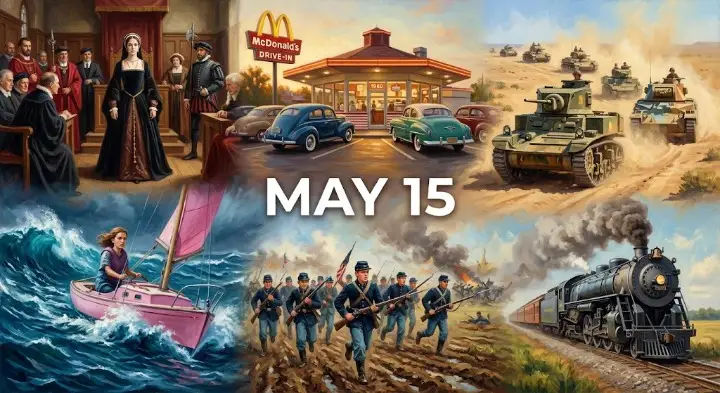
In the chilly morning light of May 15, 1536, Anne Boleyn walked into the Great Hall of the Tower of London to face a rigged jury of her peers, including her own uncle. Accused of treason, adultery, and incest by a husband desperate for a male heir, the Queen of England held her head high as the death sentence was pronounced. It was a dark, calculated spectacle that forever altered the course of the English Reformation. Centuries later on that exact same date, the world watched a completely different kind of revolution when two brothers opened a tiny drive-in burger joint in San Bernardino, California.
May 15 contains both the brutal collapse of royal dynasties and the humble beginnings of modern global culture. This daily chronicle uncovers the raw human choices that shaped our world on this specific date.
👶 Quick Facts — May 15 in History
| 📌 Category | 📖 Event / Detail |
|---|---|
| 🌟 Most Significant Event | The Trial and Condemnation of Queen Anne Boleyn (1536) |
| 🏆 Top 10 Key Events |
• Liu Bei claims Chinese imperial throne (221) • Valentinian II murdered (392) • Pope authorizes Inquisition torture (1252) • Anne Boleyn condemned (1536) • Mary Queen of Scots remarries (1567) • VMI cadets fight at New Market (1864) • First McDonald’s opens (1940) • Arab-Israeli War begins (1948) • Soviet withdrawal from Afghanistan starts (1988) • Slovakian PM Robert Fico shot (2024) |
| ⚔️ Key Battles | Battle of Frankenhausen (1525); Battle of New Market (1864); Battle of the Netherlands ends (1940); Battle of Poljana (1945) |
| 👤 Key Figures | Anne Boleyn, King Henry VIII, Richard and Maurice McDonald, Joseph Stalin, Prime Minister Robert Fico |
| 🌍 Observances | Nakba Day (Palestine); Peace Officers Memorial Day (USA); Independence Day (Paraguay); International Day of Families |
Story of the Day: The Downfall of Anne Boleyn
King Henry VIII wanted a son, and he wanted his second wife gone. On May 15, 1536, Anne Boleyn sat before a courtroom packed with over two thousand spectators inside the Tower of London. The charges against her were wildly fabricated—adultery with five men, including her own brother, and plotting to murder the king. Despite defending herself with sharp, calm eloquence that moved many in the crowd to tears, her fate had been sealed long before she entered the room. Her uncle, the Duke of Norfolk, wept as he delivered the verdict: burning or decapitation at the King’s pleasure.
Four days later, an expert French swordsman took her head with a single stroke. This single, terrifying day fractured England’s religious landscape forever, cementing Henry’s absolute power and setting the stage for their daughter, Elizabeth I, to eventually take the throne.
Important Events That Happened On May 15 In History
221 – Liu Bei Claims the Dragon Throne
Liu Bei, the legendary Chinese warlord, stood before his loyal generals and declared himself emperor of Shu Han. His announcement sought to directly preserve the fallen Han Dynasty during a fracturing era of chaos. Three rival kingdoms were now locked in a bloody struggle for the ultimate control of China. The declaration ignited decades of legendary warfare that inspired centuries of epic Asian literature.
392 – Emperor Valentinian II Dies in Vienne
Servants entered the royal residence in Gaul and found 21-year-old Roman Emperor Valentinian II hanging from a noose. His powerful Frankish general, Arbogast, claimed it was a tragic suicide, but the court suspected cold-blooded murder. The young ruler had been desperately trying to reclaim his actual authority from his military handlers. His sudden death triggered a massive civil war that further cracked the crumbling Western Roman Empire.
589 – King Authari Marries Theodelinda
Lombard King Authari celebrated his royal wedding to the Bavarian princess Theodelinda amid great political fanfare. As a devout Catholic marrying into a heavily Arian kingdom, she brought immense religious change to her new home. Her intelligence and diplomacy won over the skeptical Lombard nobility across northern Italy. She successfully steered her people toward orthodox Christianity, permanently reshaping the religious future of the region.
756 – Abd al-Rahman I Secures Cordova
Abd al-Rahman I marched into the Spanish city of Cordova and officially claimed the title of emir. Having escaped the total slaughter of his family in Damascus, the lone Umayyad prince had crossed North Africa as a desperate fugitive. His victory established a powerful new independent Muslim dynasty in the Iberian Peninsula. The realm he founded would flourish as a global center of science and culture for nearly three hundred years.
908 – Constantine VII Crowned Co-Emperor
Constantine VII, a mere toddler of two years old, felt the heavy crown of the Byzantine Empire placed on his head inside the Hagia Sophia. His father, Leo VI, forced this coronation to ensure his controversial son’s political survival. The boy was born out of a scandalous fourth marriage that the Church vehemently opposed. Despite the shaky start, the child grew up to become one of Byzantium’s most famous scholar-emperors.
1194 – Michael the Syrian Triumphs at Mor Bar Sauma
Michael the Syrian led a solemn procession to reconsecrate the grand Mor Bar Sauma Monastery. A devastating fire had reduced the holy site to ash, prompting a massive, years-long rebuilding effort. His dedication restored a vital cultural heartbeat for the region’s scattered Christians. The impressive complex remained the safe, central home of the Syriac Orthodox Church for another full century.
1252 – Pope Innocent IV Condones Torture
Pope Innocent IV put his seal on the papal bull Ad extirpanda, forever darkening the history of the Medieval Inquisition. The document gave secular authorities the official green light to use physical torture on suspected heretics. While the decree placed theoretical limits on mutilation and death during interrogation, the floodgates of systemic cruelty were opened. The ruling created a terrifying legal precedent that echoed across European courts for generations.
1525 – The Slaughter at Frankenhausen
Thomas Müntzer, a radical Anabaptist pastor, stood before thousands of poorly armed German peasants as princely armies surrounded their camp. He promised them divine protection, but the professional mercenary soldiers showed absolute mercy to the rebels. The crushing defeat at the Battle of Frankenhausen brought a bloody, definitive end to the German Peasants’ War. Over five thousand peasants died in a single afternoon, cementing the rule of the aristocracy.
1532 – The English Church Submits to the Crown
English bishops gathered in London and formally surrendered their ancient right to draft independent church laws. This historic convocation passed absolute legislative control directly into the hands of King Henry VIII. The clergy could no longer look to Rome for protection or judicial autonomy. The submissive vote marked the structural birth of the Church of England, severing ties with the Pope.
1567 – Mary Queen of Scots Weds Bothwell
Mary, Queen of Scots, walked down the aisle to marry James Hepburn, the Earl of Bothwell, in a deeply unpopular Protestant ceremony. Only three months earlier, Bothwell had been the chief suspect in the gunpowder murder of Mary’s previous husband, Lord Darnley. The scandalous union outraged the Scottish nobility and deeply shocked the public. Within weeks, the lords rebelled, imprisoned Mary, and forced her to give up her crown.
1571 – The Holy League Unites Against the Ottomans
Envoys from Venice, Spain, Naples, and the Papal States signed a grand alliance in Rome to halt Ottoman naval expansion. Driven by intense mutual fear, these fiercely competitive Mediterranean powers finally agreed to pool their massive fleets. The resulting alliance created a colossal armada of warships. Later that same year, this combined force won the legendary Battle of Lepanto, altering global naval balance.
1602 – Bartholomew Gosnold Names Cape Cod
Bartholomew Gosnold peered from the deck of the Concord and sighted a massive, hook-shaped sandy peninsula. Noticing the incredible abundance of fish in the surrounding waters, the English navigator noted the name “Cape Cod” in his logbook. His crew became the first recorded Europeans to set foot on the future Massachusetts shoreline. The brief voyage charted a vital path for the historic Puritan migrations that followed.
1648 – The Peace of Münster Is Born
Spanish and Dutch diplomats gathered in Münster to solemnly ratify a historic peace treaty. The signing forced Spain to officially recognize the absolute independence of the Dutch Republic. The historic moment brought an end to the brutal Eighty Years’ War, a conflict that had devastated generations. The tiny Dutch nation emerged from the shadow of an empire to become a dominant global power.
1725 – Bach Debuts a New Masterpiece
Johann Sebastian Bach stood before his congregation in Leipzig to direct the very first performance of his cantata Ich bin ein guter Hirt. The delicate music brought the pastoral imagery of Jesus as the Good Shepherd to life through soaring oboes and strings. Written during an intensely creative period, the piece showed Bach’s absolute mastery of spiritual storytelling. The complex composition remains a celebrated treasure of classical music.
1791 – Robespierre Pushes the Self-Denying Ordinance
Maximilien Robespierre stepped up to the podium of the National Assembly and delivered a calculated political speech. He proposed that no current member of the assembly could run for the upcoming legislature. The brilliant maneuver cleared out his moderate rivals while framing Robespierre as a man of pure revolutionary virtue. The new law radicalized French politics, paving the direct path toward the Reign of Terror.
1836 – Baily’s Beads Witnessed in the Skies
Francis Baily looked through his telescope during a brilliant annular eclipse and caught sight of a strange phenomenon. As the moon slid directly over the sun, the solar edge fractured into a glowing string of bright diamonds. The English astronomer correctly deduced that sunlight was beaming through deep lunar valleys and mountains. His discovery gave scientists their very first accurate understanding of the rugged lunar topography.
1849 – The Sicilian Revolution Dies Out
Bourbon troops marched into Palermo, crushing the final remnants of the Sicilian Revolution of 1848. For sixteen glorious months, the island had tasted true independence, even drafting its own progressive constitution. The royalist counter-offensive brought a swift, heavy hand of military oppression back to the population. Though the uprising failed, the deep desire for liberty fueled the eventual unification of Italy.
1850 – The Arana-Southern Treaty Settles Differences
British and Argentine officials exchanged ratified copies of a vital peace treaty in Buenos Aires. The agreement settled a long, tense naval dispute involving the blockade of the Río de la Plata. Great Britain agreed to withdraw its warships and recognized Argentina’s absolute sovereignty over its internal rivers. The diplomatic breakthrough restored vital trade lines and stabilized South American politics.
1851 – The Australian Gold Rush Begins
Government officials in New South Wales officially proclaimed the discovery of rich goldfields near Bathurst. A prospector had found the glittering flakes three months earlier, but authorities kept it quiet to prevent total panic. The official announcement triggered an immediate, massive wave of global immigration. Within a decade, the rugged colony transformed into a wealthy, modern society.
1864 – Young Cadets Charge at New Market
Over two hundred teenage students from the Virginia Military Institute advanced into heavy Union gunfire at New Market, Virginia. Desperate for reinforcements, Confederate commanders ordered the young boys directly into the muddy, blood-soaked battlefield. The cadets broke through the enemy lines, forcing Union General Franz Sigel to retreat from the vital Shenandoah Valley. Ten young students lost their lives in the desperate defense of their home.
1891 – Pope Leo XIII Defends the Working Class
Pope Leo XIII published his landmark encyclical Rerum novarum directly from the Vatican. The document openly condemned the cruelties of unchecked capitalism while simultaneously rejecting the rise of radical socialism. The Pope demanded fair wages, safe conditions, and the legal right for workers to form protective unions. The historic letter marked the official birth of modern Catholic social teaching.
1911 – The Breakup of Standard Oil
The United States Supreme Court delivered a devastating blow to John D. Rockefeller by declaring Standard Oil an illegal monopoly. Chief Justice Edward White ruled that the massive trust used predatory tactics to crush all competition. The court ordered the corporate giant to permanently splinter into 34 independent companies. The landmark antitrust ruling forever changed how the American government regulates mega-corporations.
1911 – The Horrific Torreón Massacre
Revolutionary forces under Emilio Madero stormed the northern Mexican city of Torreón, driving out the defending federal troops. In the chaotic aftermath, the rebel soldiers turned their weapons on the city’s prosperous Chinese immigrant community. Over three hundred innocent Chinese civilians were systematically hunted down and murdered in the streets. The horrific hate crime remains one of the darkest, forgotten atrocities of the Mexican Revolution.
1916 – The Lynching of Jesse Washington
A furious mob of thousands dragged seventeen-year-old African American farmworker Jesse Washington out of a Waco, Texas courtroom. Just minutes earlier, an all-white jury had found the teenager guilty of rape and murder after a brief trial. The crowd tortured, mutilated, and burned the young man alive in the public square. Graphic photographs of the horrific event sparked intense international outrage and fueled the early civil rights movement.
1918 – The Finnish Civil War Comes to an End
White Guards advanced on Fort Ino, taking control of the strategic Russian coastal artillery base on the Karelian Isthmus. The retreat of the remaining Russian soldiers marked the definitive conclusion of the bloody Finnish Civil War. The brutal conflict had pitted brother against brother, leaving deep social scars across the new nation. The victory firmly secured Finland’s independence from a crumbling Russia.
1919 – Winnipeg Workers Walk Off the Job
Precisely at eleven o’clock in the morning, nearly thirty thousand workers across Winnipeg walked out on strike. Factory men, firemen, and postal employees united to demand fair wages and the right to collective bargaining. The massive walkout completely paralyzed Canada’s third-largest city within a few hours. The historic action became the largest, most influential general strike in Canadian history.
1919 – Greek Troops Occupy Smyrna
Greek soldiers marched off their transport ships and onto the docks of the historic Ottoman port of Smyrna. The landing quickly devolved into chaos, resulting in the tragic deaths of over three hundred Turkish civilians. Greek commander Aristides Stergiades immediately punished the soldiers responsible, trying to maintain order. The controversial occupation lit the fuse for the bloody Greco-Turkish War.
1929 – Tragedy Strikes the Cleveland Clinic
A massive explosion ripped through the basement of the Cleveland Clinic, sending toxic yellow gas swirling into the upper floors. The fire started when highly flammable nitrocellulose X-ray films ignited near a faulty light bulb. Lack of proper ventilation trapped the deadly fumes inside the building, suffocating patients and doctors alike. The disaster claimed 123 lives, forcing hospitals worldwide to adopt strict safety film standards.
1932 – Assassination of Prime Minister Inukai Tsuyoshi
Eleven young, idealistic Japanese naval officers burst into the Tokyo residence of Prime Minister Inukai Tsuyoshi and shot him at point-blank range. The radical assassins believed that killing the peaceful leader would end corruption and restore true military rule. The dying Prime Minister’s final words were an attempt to discuss their grievances. The shocking murder marked the death of democratic government in pre-war Japan.
1933 – The Secret Birth of the Luftwaffe
German officials quietly gathered in Berlin to merge all military aviation groups into the Reich Aviation Ministry. Operating under absolute secrecy to avoid violating the Treaty of Versailles, this shadow organization began building a formidable air arm. Pilots trained in hidden civilian camps and gliders, preparing for a future war. This covert network grew into the terrifying Luftwaffe, Germany’s modern air force.
1934 – Kārlis Ulmanis Seizes Power in Latvia
Prime Minister Kārlis Ulmanis staged a sudden, bloodless coup d’état across the capital city of Riga. Backed by the loyal army, he immediately suspended the constitution and dissolved the parliament. The popular politician claimed the drastic move was necessary to save the country from political chaos. His authoritarian regime ruled Latvia until the dark Soviet occupation of World War II.
1940 – The Squalus Returns as the Sailfish
Naval officers stood on the deck of the newly christened USS Sailfish as the submarine officially rejoined the American fleet. Just a year earlier, the vessel had sunk during a test dive as the USS Squalus, taking 26 brave sailors to the ocean floor. Engineers pulled the sunken hull from the Atlantic mud and completely rebuilt the ship. The revived submarine went on to earn nine battle stars during the Pacific War.
1940 – Nazi Occupation of the Netherlands Begins
Dutch military commanders signed an official surrender document, ending five days of ferocious fighting against invading German forces. Outgunned and devastated by the brutal bombing of Rotterdam, the small nation had no choice but to capitulate. Queen Wilhelmina fled to London to establish a government-in-exile. The signing marked the grim beginning of five long years of Nazi oppression.
1940 – The First McDonald’s Opens Its Doors
Brothers Richard and Maurice McDonald welcomed their very first customers to a modest, octagonal drive-in restaurant in San Bernardino, California. The menu featured slow-cooked barbecue pit meats and simple, affordable carhop service. Years later, they streamlined the entire kitchen into a fast, assembly-line system for cooking burgers and fries. That single restaurant started a global fast-food empire that changed the world’s diet forever.
1941 – Britain’s First Jet Aircraft Takes Flight
Test pilot Gerry Sayer climbed into the experimental Gloster E.28/39 and roared down the runway at Cranwell. Powered by Frank Whittle’s innovative turbojet engine, the sleek aircraft climbed smoothly into the morning sky. The successful fifteen-minute flight proved that jet propulsion was the future of military aviation. The breakthrough gave the Allied forces a vital technological edge during World War II.
1942 – Women’s Army Auxiliary Corps Created
President Franklin D. Roosevelt put his signature on a historic bill creating the Women’s Army Auxiliary Corps. The new law allowed thousands of American women to enlist for non-combat military service, freeing up men for the front lines. Volunteers worked as typists, mechanics, and radio operators across the globe. The dedicated service of these trailblazers forever changed the role of women in the military.
1943 – Stalin Dissolves the Comintern
Soviet leader Joseph Stalin surprised the international community by officially dissolving the Comintern, the global communist organization. The calculated political move aimed to reassure his wartime allies, Great Britain and the United States, that Moscow had no immediate plans to subvert their governments. The decision fostered better cooperation during the final push against Nazi Germany.
1945 – The Final Skirmish in Europe
Fierce gunfire echoed near Prevalje, Slovenia, as a chaotic mix of German soldiers, Axis collaborators, and Yugoslav partisans collided at the Battle of Poljana. Though the official Nazi surrender had occurred days earlier, these desperate forces fought bitterly to escape Soviet captivity. Over a hundred soldiers died before the remaining Axis troops finally laid down their weapons. It was the absolute final battlefield clash of World War II in Europe.
1948 – The Outbreak of the Arab-Israeli War
Armies from Egypt, Transjordan, Lebanon, Syria, and Iraq crossed the borders into the newly declared State of Israel. The massive military invasion began just hours after the official expiration of the British Mandate for Palestine. The intervention aimed to defend Palestinian lands and crush the infant Jewish state. The invasion ignited a bloody, year-long war that permanently reshaped the modern Middle East.
1957 – Britain Joins the Hydrogen Bomb Club
A high-altitude British bomber dropped a massive thermonuclear device over the remote waters of Malden Island in the Pacific Ocean. Code-named Operation Grapple, the successful test unleashed a terrifying flash of light and a massive mushroom cloud. The explosion made Great Britain the world’s third certified thermonuclear power. The achievement secured the nation’s independent nuclear deterrent during the height of the Cold War.
1963 – Gordon Cooper’s Lonely Space Odyssey
Astronaut Gordon Cooper blasted off from Cape Canaveral inside his tiny Faith 7 spacecraft, bound for orbit. He spent a record-breaking 34 hours circling the Earth, becoming the first American to spend a full day in space. When his automatic capsule systems failed, he manually guided his ship through a fiery re-entry. His successful splashdown marked the triumphant end of the historic Project Mercury.
1970 – First Female Generals in US Army History
President Richard Nixon stepped forward to pin gleaming star insignia onto the uniforms of Anna Mae Hays and Elizabeth P. Hoisington. The historic promotion made them the very first women to achieve the rank of brigadier general in the United States Army. Hays led the Army Nurse Corps during the Vietnam War, while Hoisington commanded the Women’s Army Corps. Their promotions smashed a massive glass ceiling in the military.
1972 – The Ryukyu Islands Return to Japan
United States military officials lowered the American flag over Okinawa, formally returning the Ryukyu Islands to Japanese control. The strategic island chain had been under strict US governance since its bloody capture in 1945. The historic reversion followed years of intense diplomatic negotiations and passionate local protests. The agreement allowed the US to maintain its massive, controversial military bases on the islands.
1974 – The Horrific Ma’alot Massacre
Heavily armed members of the Democratic Front for the Liberation of Palestine crossed the border and seized an Israeli school in Ma’alot. They took over a hundred schoolchildren hostage, demanding the release of imprisoned comrades. When an elite Israeli military unit stormed the building, the terrorists opened fire on the classroom. The raid ended with 31 tragic deaths, including 22 innocent children.
1976 – Fatal Crash of Aeroflot Flight 1802
An Antonov An-24 passenger turboprop plane experienced a sudden, violent loss of control while cruising over the Ukrainian Soviet Socialist Republic. The aircraft entered a steep dive and slammed into a field near Viktorivka, killing all 52 people on board. Investigators discovered that a severe aerodynamic disturbance had completely disabled the plane’s tail control systems. The tragedy led to immediate engineering modifications across the fleet.
1988 – Soviet Troops Pack Up in Afghanistan
A long column of dusty Soviet armored vehicles rolled out of their base in Kabul, heading north toward the border. After more than eight years of brutal, stalemated warfare against the Mujahideen, the Soviet Army began withdrawing its 115,000 troops. The costly conflict had claimed the lives of fifteen thousand Soviet soldiers and devastated the Afghan nation. The retreat signaled the approaching collapse of the Soviet Union.
1991 – Édith Cresson Becomes France’s First Female PM
President François Mitterrand made history by appointing the outspoken socialist politician Édith Cresson as Prime Minister of France. A seasoned diplomat and veteran minister, she shattered a century-old political barrier in Paris. Her brief, turbulent tenure was marked by fierce debates over economic reforms and trade policies. Though she served for less than a year, her appointment paved the path for future female leaders.
1997 – America Recognizes the Secret War in Laos
Government officials gathered at Arlington National Cemetery to officially dedicate the Laos Memorial. For decades, Washington had kept its massive, covert military operations in Laos during the Vietnam War a strict secret. The new monument finally honored the thousands of brave Hmong and Lao veterans who fought and died alongside American forces. The moving ceremony brought long-awaited closure to a forgotten generation of heroes.
1997 – Atlantis Blasts Off on STS-84
The Space Shuttle Atlantis roared off the launchpad at Kennedy Space Center, lighting up the morning sky. The shuttle carried a crew of seven astronauts on a vital mission to dock with the aging Russian space station Mir. The flight delivered thousands of pounds of crucial supplies, water, and scientific experiments to the orbital outpost. The smooth mission showcased a rare era of peaceful space cooperation between former Cold War rivals.
2001 – The Real-Life Unstoppable Train
An unmanned CSX freight train rolled out of a rail yard in Walbridge, Ohio, and began accelerating down the main line. The engineer had mistakenly hopped off to throw a switch, leaving the locomotive running under full power. The driverless train traveled 66 miles through Ohio towns, carrying hazardous, highly flammable chemicals. A brave crew finally managed to chase it down in another engine, inspiring the Hollywood movie Unstoppable.
2004 – Arsenal F.C. Achieves Immortality
Arsenal Football Club defeated Leicester City at Highbury to complete an entire English Premier League season without a single defeat. Under the brilliant leadership of manager Arsène Wenger, the team won 26 games and drew 12. The historic achievement earned the legendary squad the permanent nickname “The Invincibles.” They became the first English team in over a century to claim a top-flight title undefeated.
2008 – Same-Sex Marriage Legalized in California
The California Supreme Court issued a historic ruling declaring the state’s existing ban on same-sex marriage unconstitutional. Chief Justice Ronald George wrote that the fundamental right to marry belongs to all citizens, regardless of sexual orientation. The landmark decision made California the second US state to legalize same-sex unions. The ruling triggered a massive wave of joyful weddings across the state.
2010 – Jessica Watson Sails Into the Record Books
Sixteen-year-old Australian sailor Jessica Watson guided her bright pink yacht into Sydney Harbour to a roaring crowd of thousands. She had just spent 210 grueling days at sea, sailing completely non-stop and unassisted around the world solo. Facing terrifying waves and intense loneliness, the teenager defied all skeptical critics who said she wouldn’t survive. Her incredible voyage made her the youngest person to accomplish the feat.
2013 – A Deadly Wave of Violence Across Iraq
Car bombs and targeted shootings tore through busy marketplaces and residential neighborhoods across Iraq. The coordinated attacks left over 389 people dead and hundreds wounded in just three days of intense bloodshed. The sudden upsurge in sectarian violence marked the country’s bloodiest period in years. The coordinated attacks signaled the tragic resurgence of extremist groups capitalizing on political instability.
2024 – Slovakian Prime Minister Robert Fico Shot
Slovakian Prime Minister Robert Fico walked out to greet a small crowd of supporters after a meeting in Handlová when an elderly gunman stepped forward and fired five shots at point-blank range. The controversial leader collapsed to the ground with critical abdomen injuries as security guards tackled the shooter. The shocking assassination attempt sent shockwaves through Europe, highlighting deep political divisions.
Revisit our recent historical highlights by clicking here.
Famous People Born On May 15
| Name | Description | Date |
|---|---|---|
| Baccio d’Agnolo | Italian wood-carver, sculptor, and Renaissance architect | May 15, 1462 – March 6, 1543 |
| Hendrick de Keyser | Dutch sculptor and architect, transition to Classicism | May 15, 1565 – May 15, 1621 |
| Carlo Maratta | Italian Baroque classicist painter | May 15, 1625 – December 15, 1713 |
| Carlo Cignani | Italian Bolognese Baroque painter | May 15, 1628 – September 6, 1719 |
| Sébastien Le Prestre de Vauban | French military engineer, revolutionized fortifications | May 15, 1633 – March 30, 1707 |
| George Jeffreys, 1st Baron Jeffreys | English judge, “Bloody Assizes” | May 15, 1645? – April 18, 1689 |
| Melchiorre Cesarotti | Italian poet, translator of Ossian | May 15, 1730 – November 4, 1808 |
| James Gadsden | U.S. diplomat, Gadsden Purchase | May 15, 1788 – December 26, 1858 |
| Sir Arthur Thomas Cotton | British irrigation engineer in India | May 15, 1803 – July 14, 1899 |
| Michael William Balfe | Irish composer, The Bohemian Girl | May 15, 1808 – October 20, 1870 |
| Alfred Rethel | German historical painter and woodcut artist | May 15, 1816 – December 1, 1859 |
| Joseph Loschmidt | Austrian chemist, aromatic hydrocarbons | May 15, 1821 – July 8, 1895 |
| Henri Mouhot | French explorer, revealed Angkor Wat to the West | May 15, 1826 – November 10, 1861 |
| Clarence Edward Dutton | American geologist, isostasy theory | May 15, 1841 – January 4, 1912 |
| Carl Wernicke | German neurologist, Wernicke’s aphasia | May 15, 1848 – June 15, 1905 |
| Viktor Mikhaylovich Vasnetsov | Russian painter, Tretyakov Gallery facade | May 15, 1848 – July 23, 1926 |
| Williamina Paton Stevens Fleming | American astronomer, stellar spectra classification | May 15, 1857 – May 21, 1911 |
| Arthur Schnitzler | Austrian playwright, Viennese psychological drama | May 15, 1862 – October 21, 1931 |
| Albert Verwey | Dutch poet and literary historian | May 15, 1865 – March 8, 1937 |
| Henry L. Doherty | American businessman, Cities Service Company | May 15, 1870 – December 26, 1939 |
| Nikolay Tcherepnin | Russian composer of ballets | May 15, 1873 – June 26, 1945 |
| Matheson Lang | Canadian-born English actor | May 15, 1879 – April 11, 1948 |
| Celâl Bayar | Third president of Turkey (1950–60) | May 15, 1882 – August 22, 1986 |
| Edwin Muir | Scottish poet and literary critic | May 15, 1887 – January 3, 1959 |
| Mikhail Bulgakov | Russian novelist and playwright, The Master and Margarita | May 15, 1891 – March 10, 1940 |
| Murano Tōgo | Japanese architect, department store designer | May 15, 1891 – November 26, 1984 |
| Jimmy Wilde | Welsh world flyweight boxing champion | May 15, 1892 – March 10, 1969 |
| Arletty | French actress | May 15, 1898 – July 24, 1992 |
| William Hume-Rothery | British founder of scientific metallurgy | May 15, 1899 – September 27, 1968 |
| Nikolay Pavlovich Okhlopkov | Soviet experimental theatre director | May 15, 1900 – January 8, 1967 |
Famous People Died On May 15
| Name | Description | Date |
|---|---|---|
| Hatto I | Archbishop of Mainz (891–913) | c.850 – May 15, 913 |
| Boris I | Khan of Bulgaria (852–889), converted Bulgarians to Christianity | Unknown – May 15, 907 |
| Nicholas I | Byzantine patriarch of Constantinople (901–907, 912–925) | 852 – May 15, 925 |
| Nūr al-Dīn | Muslim ruler, laid foundations for Saladin’s success | February 1118 – May 15, 1174 |
| Héloïse | French nun, wife of Peter Abelard | c.1098 – May 15, 1164 |
| Marinus I | Pope (882–84) | Unknown – May 15, 884 |
| Giovanni Croce | Italian Venetian composer | c.1557 – May 15, 1609 |
| Hendrick de Keyser | Dutch sculptor and architect | May 15, 1565 – May 15, 1621 |
| Marie Champmeslé | French tragedienne, created Racine’s heroines | February 18, 1642 – May 15, 1698 |
| Sir Edward Petre, 2nd Baronet | English Jesuit, favourite of James II | 1631 – May 15, 1699 |
| Ephraim Chambers | British encyclopaedist | c.1680 – May 15, 1740 |
| Jakob Christof Le Blon | German-born painter, colour printing pioneer | May 23, 1667 – May 15, 1741 |
| Alban Butler | English Roman Catholic priest, Lives of the Saints | October 24, 1710 – May 15, 1773 |
| Richard Wilson | British landscape painter | August 1, 1713 – May 15, 1782 |
| Carl Friedrich Zelter | German composer, teacher of Mendelssohn | December 11, 1758 – May 15, 1832 |
| Edmund Kean | English tragic actor | March 17, 1789? – May 15, 1833 |
| Emmanuel, count de las Cases | French historian, recorder of Napoleon’s last conversations | June 21, 1766 – May 15, 1842 |
| Daniel O’Connell | Irish nationalist leader | August 6, 1775 – May 15, 1847 |
| Louisa Adams | American first lady, wife of John Quincy Adams | February 12, 1775 – May 15, 1852 |
| Alexander Dyce | Scottish Shakespearean editor | June 30, 1798 – May 15, 1869 |
| Alexandru Ioan Cuza | First prince of united Romania | March 20, 1820 – May 15, 1873 |
| Gottfried Semper | German architect, Neo-Renaissance style | November 29, 1803 – May 15, 1879 |
| Josiah Gorgas | Confederate chief of ordnance | July 1, 1818 – May 15, 1883 |
| Jakob Stämpfli | Swiss president (three terms) | February 23, 1820 – May 15, 1879 |
| Sir Leslie Ward | English caricaturist for Vanity Fair | November 21, 1851 – May 15, 1922 |
| Richard Theodore Greener | First African American Harvard graduate | January 30, 1844 – May 15, 1922 |
| Charles-Louis de Saulces de Freycinet | French premier (four terms) | November 14, 1828 – May 15, 1923 |
| Sir Owen Morgan Edwards | Welsh writer and educator | December 25, 1858 – May 15, 1920 |
| Inukai Tsuyoshi | Prime minister of Japan (1931–32) | May 5, 1855 – May 15, 1932 |
| Philip Snowden, Viscount Snowden | British Labour chancellor of the Exchequer | July 18, 1864 – May 15, 1937 |
Observances on May 15
Nakba Day
Palestinian communities worldwide observe Nakba Day to remember the mass displacement of over seven hundred thousand Palestinians during the 1948 war. The day features somber rallies, speeches, and the raising of keys that symbolize the homes left behind.
Peace Officers Memorial Day
Established by the United States government, this solemn day honors local, state, and federal law enforcement officers who have been killed or disabled in the line of duty. Flags across the country are lowered to half-staff as families gather for memorial services in Washington, D.C.
Independence Day and Mother’s Day in Paraguay
Paraguay bursts into vibrant street parades and traditional dances to celebrate its successful 1811 liberation from Spanish colonial rule. The nation simultaneously honors Mother’s Day, paying tribute to the brave women who helped defend the country throughout its history.
📅 Frequently Asked Questions — May 15 in History
Queen Anne Boleyn of England stood trial inside the Tower of London on fabricated charges of treason, adultery, and incest. A specially selected jury of lords, including her own uncle, found her guilty and condemned her to death. Her execution took place four days later, paving the way for Henry VIII to marry his third wife.
The trial of Anne Boleyn in 1536 stands out because it fundamentally altered the English monarchy and accelerated the English Reformation. This single day broke England’s ties with the Catholic Church, shaping the future of European politics. It also allowed her daughter, the future Queen Elizabeth I, to eventually claim the throne.
The brilliant French physicist Pierre Curie was born on this day in 1859. He pioneered the study of radioactivity alongside his famous wife, Marie Curie, discovering radium and polonium. Their groundbreaking work earned them a Nobel Prize and laid the foundation for modern nuclear physics.
The Arab-Israeli War officially erupted on this day in 1848 when a coalition of Arab nations invaded the newly declared State of Israel. The military offensive began immediately after the British Mandate for Palestine expired. The conflict initiated decades of territorial disputes that continue to impact the Middle East today.
Nakba Day is observed by Palestinian communities to remember the displacement of hundreds of thousands of Palestinians during the 1948 war. The word “Nakba” means catastrophe in Arabic, reflecting the loss of ancestral homes and villages. It is a day of remembrance focused on national identity and the ongoing struggle for refugee rights.
Slovakian Prime Minister Robert Fico survived a shocking assassination attempt when an armed assailant shot him multiple times at an event in Handlová. The leader suffered critical wounds but survived after emergency surgery. The attack intensified discussions regarding political polarization across the European continent.