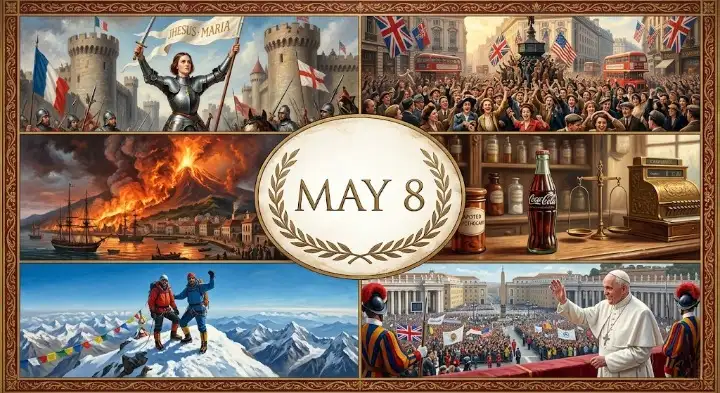
Joan of Arc stood on the battered ramparts of Orléans on May 8, 1429, raising her banner as the English army retreated in panic. A teenage peasant girl had done what French generals deemed impossible, fundamentally altering the course of western civilization. Centuries later on that exact same day, sirens fell silent across Europe as the German war machine signed its total surrender, sparking wild celebrations in streets that had known only terror for six straight years. May 8 tracks the bizarre swing of human fortune, holding moments where single voices turned the tide of empires and days where nature completely erased entire cities.
🎉 Quick Facts — May 8 in History
| 📌 Category | 📖 Event / Detail |
|---|---|
| 🌟 Most Significant Event | Germany surrenders unconditionally to Allied forces, ending World War II in Europe (1945) |
| 🏆 Top 10 Key Events | • Siege of Orléans lifted (1429) • Antoine Lavoisier guillotined (1794) • Coca-Cola goes on sale (1886) • Mount Pelée erupts (1902) • Mount Everest climbed without oxygen (1978) • Smallpox officially eradicated (1980) • Soviet Union boycotts LA Olympics (1984) • The Beatles release Let It Be (1970) • First steel coaster with a vertical loop opens (1976) • Cardinal Robert Francis Prevost elected Pope Leo XIV (2025) |
| ⚔️ Key Battles | Battle of Jinyang (453 BC), Siege of Orléans (1429), Battle of Gravia Inn (1821), Battle of Palo Alto (1846), Battle of the Coral Sea (1942), Operation Trappenjagd (1942) |
| 👤 Key Figures | Joan of Arc, John Pemberton, Reinhold Messner, Pope Innocent XIII}- |
| 🌍 Observances | World Red Cross and Red Crescent Day, Liberation Day (Czech Republic), Veterans Day (Norway) |
Story of the Day: The Miracle of Orléans
Joan of Arc pushed through the pain of an arrow wound to the shoulder on May 8, 1429, rallying French troops who had spent months losing hope. The English army had surrounded the strategic city of Orléans for half a year, threatening to consume the rest of France. This illiterate teenage peasant girl convinced the French prince to let her lead an army, bringing an aggressive, spiritual ferocity that stunned the occupiers. Her presence broke the siege in mere days, forcing an English retreat that saved France from total collapse. It began the unstoppable momentum that secured French independence and guaranteed her legacy as an immortal icon of resistance.
Important Events That Happened On May 8 In History
453 BC – The Fall of Zhi
Zhi Yao looked across the flooded landscape of Jinyang as his own allies secretly turned their water channels against his camp. The three powerful clans of Jin had spent months locked in bitter rivalry, but the sudden betrayal by the Zhao house caught the dominant Zhi forces completely off guard. A swift nighttime assault shattered the Zhi defenses, resulting in the execution of Zhi Yao and the total erasure of his family line. This single bloody morning dissolved the old power structures, slicing the State of Jin into three new factions and kicking off the chaotic Spring and Autumn period.
413 – The Imperial Tax Forgiveness
Emperor Honorius stared at the ruined revenue ledgers of Rome and signed a desperate imperial decree to stop a total economic collapse. Visigoth armies had spent months pillaging their way through the Italian countryside, leaving the provinces of Tuscia, Campania, and Apulia utterly stripped of wealth. Realizing the starving peasantry had absolutely nothing left to give, the palace granted massive tax relief to seven devastated regions. The edict kept the local populations from open rebellion but signaled to the world that the Western Roman Empire was losing its grip on its own backyard.
589 – The Great Spanish Conversion
King Reccared I stepped up to the altar at the Third Council of Toledo and publicly renounced the Arian beliefs of his Visigothic ancestors. His kingdom had long been deeply fractured along religious lines, with the ruling elite holding separate beliefs from their Hispano-Roman subjects. By demanding that his entire court embrace Catholicism alongside him, the king unified Spain under a single legal and religious banner. The assembly forever shifted the cultural landscape of the Iberian Peninsula, binding the Spanish monarchy to the authority of Rome for the next thousand years.
1360 – The Peace of Brétigny
King John II of France sat in English captivity as diplomats in a small French village scrawled out the terms of his release. Decades of brutal conflict during the Hundred Years War had bankrupt both nations, leaving fields burned and populations decimated. The newly drafted Treaty of Brétigny forced France to cede massive territories to King Edward III in exchange for the French king’s freedom. While the heavy ransom and territorial shifts paused the open slaughter for nine years, the unresolved royal grudges ensured the war would eventually flare back to life.
1373 – The Deathbed Revelations
Julian of Norwich lay in a stone room, paralyzed and watching the parish priest hold a crucifix above her face as her family prepared for her final breath. The thirty-year-old anchoress suddenly felt her physical pain vanish as a sequence of intense spiritual visions flooded her mind over several hours. She survived the illness and spent the next twenty years writing down these experiences, producing the first book in the English language known to be authored by a woman. Her writings offered a radical message of divine love and optimism during an era defined by the horrors of the Black Death.
1429 – The Breaking of the Siege
Joan of Arc rode out to the abandoned English fortresses around Orléans as the final enemy columns marched away into the morning mist. The English forces had spent half a year choking the life out of the city, confident that French resistance was entirely dead. A teenage girl dressed in armor broke that psychological stranglehold in just four days of fierce fighting. The sudden retreat saved the French crown, fundamentally shifted the momentum of the Hundred Years War, and started the peasant girl’s journey toward martyrdom.
1516 – The Capital Abandoned
Trịnh Duy Sản led his elite imperial guards into the royal palace chambers of Thăng Long, cornering and murdering Emperor Lê Tương Dực in cold blood. The emperor had spent years draining the national treasury on massive luxury projects while ignoring a growing wave of peasant rebellions. The assassins fled into the countryside immediately after the killing, leaving the royal palaces empty and completely exposed to advancing rebel armies. The sudden power vacuum plunged Vietnam into decades of vicious civil war as rival warlords scrambled to claim the vacant throne.
1541 – The Discovery of the Great River
Hernando de Soto hacked through the dense thickets near present-day Walls, Mississippi, and stood on the muddy banks of a massive, rushing waterway. The Spanish expedition had spent two grueling years wandering the American southeast, losing men to disease and constant skirmishes with indigenous tribes. The explorers dubbed the massive current the Río de Espíritu Santo, viewing it primarily as a massive logistical obstacle that required them to build barges. The crossing marked the first documented European contact with the Mississippi River, opening the American interior to centuries of colonial expansion.
1608 – The Scottish Silver Rush
Bevis Bulmer stood over the rocky pits of Hilderston, watching miners hoist the first loads of ore from a newly nationalized silver mine. The West Lothian site had been discovered by a local peasant just two years prior, prompting King James VI to seize the land for the crown. Bulmer used advanced machinery to drain the deep shafts, extracting precious metal that was rushed straight to the royal mint. The frantic boom proved short-lived as the silver veins dried up within a few years, leaving behind deep tunnels and tales of sudden wealth.
1639 – The Birth of Newport
William Coddington stood on the southern shores of Aquidneck Island and signed a compact with eight fellow settlers to establish a new wilderness community. The group had fled religious persecution in Massachusetts, only to find themselves locked in bitter political disputes with fellow dissidents in northern Rhode Island. They chose a deep, protected natural harbor that was perfectly suited for maritime trade and immediately began laying out property lines. The settlement grew into Newport, a thriving colonial seaport built on seafaring commerce, religious tolerance, and a highly lucrative shipping industry.
1721 – The Rise of Innocent XIII
Cardinal Michelangelo dei Conti listened to the final tally of paper ballots inside the locked chapel and bowed his head as his fellow cardinals chose him to lead the Catholic Church. The papal conclave had dragged on for weeks, deadlocked by bitter political rivalries between the royal houses of France, Spain, and Austria. The electors ultimately selected the frail, aristocratic Italian as a compromise candidate who could steady the church’s administration without upsetting the European balance of power. Taking the name Innocent XIII, his brief papacy focused heavily on curbing internal corruption and managing the growing threat of religious dissent.
1788 – The Abolition of the Parlements
King Louis XVI signed a royal decree in Versailles that stripped the powerful regional courts of France of their ancient political privileges. The independent magistrates had spent months blocking the financial reforms proposed by minister Étienne Charles de Loménie de Brienne, paralyzing the bankrupt government. By attempting to crush the parlements and replace them with a single royal court, the king triggered furious riots across the country. The heavy-handed move backfired spectacularly, destroying the monarchy’s remaining legitimacy and forcing the king to call the fateful Estates-General.
1794 – The Execution of Lavoisier
Antoine Lavoisier walked up the steps of the guillotine at the Place de la Révolution as a revolutionary tribunal official declared that France had no need for scientists. The brilliant chemist had revolutionized science by identifying oxygen and writing the first modern list of elements, but his day job as a royal tax collector made him a target for the mob. Revolutionary authorities arrested, tried, and convicted him in a span of just twenty-four hours during the height of the Reign of Terror. His execution silenced one of the greatest minds of the Enlightenment, prompting fellow scientists to lament that his head was taken in a second, but a century might not produce another like it.
1821 – The Stand at Gravia Inn
Odysseas Androutsos barricaded the doors of a mud-brick roadside inn with just a hundred and twenty Greek fighters as thousands of Ottoman troops advanced down the road. The Turkish army was marching south to crush the growing Greek rebellion, confident that their overwhelming numbers would easily sweep the road clear. The small band of rebels held the building for hours, repelling repeated infantry charges and killing hundreds of attackers before slipping away into the mountains under cover of darkness. The improbable defense saved the Greek revolution from early annihilation, proving to the local population that the occupying empire could be beaten.
1842 – The Versailles Train Disaster
A crowded passenger train bound for Paris jumped the tracks in Meudon, crumpling its wooden carriages together as the heavy steam locomotives overturned and caught fire. The passengers were trapped inside their locked compartments, a standard safety practice of the era that turned the derailed coaches into inescapable wooden incinerators. Between 52 and 200 people burned to death in the chaos, including the famous polar explorer Jules Dumont d’Urville. The horrific disaster shocked the public, forcing railway companies worldwide to abandon the practice of locking passenger doors during transit.
1846 – The Battle of Palo Alto
General Zachary Taylor ordered his American artillery batteries to open fire across the dusty prairie grass north of the Rio Grande. A large Mexican force had blocked the road to cut off an American supply base, marking the first major clash of the Mexican-American War. The superior range and mobility of the American tactical cannons ripped through the dense Mexican infantry lines, forcing a bloody retreat before the armies could even engage in hand-to-hand combat. The decisive engagement set the stage for an American invasion of northern Mexico and secured Taylor’s path toward the presidency.
1877 – The First Westminster Dog Show
Thousands of affluent New Yorkers crowded into Gilmore’s Gardens to watch thirty-five distinct breeds of dogs parade before a panel of expert judges. The event was organized by a group of wealthy hunting enthusiasts who wanted to compare their pointing and retrieving dogs in a structured environment. The public interest was so overwhelming that the show had to be extended to four days, with a portion of the ticket proceeds going to animal welfare charities. The gathering established the Westminster Kennel Club Dog Show as an annual cultural institution, making it one of the longest-running sporting events in American history.
1886 – The Invention of Coca-Cola
John Pemberton carried a brass kettle filled with a thick, aromatic brown syrup down the street to Jacob’s Pharmacy in downtown Atlanta. The wounded Confederate veteran and pharmacist had spent months mixing coca leaves and kola nuts to create a non-alcoholic beverage that could cure headaches and ease anxiety. Clerks mixed the experimental concoction with carbonated water, selling the very first glass of “Coca-Cola” to a customer for five cents. The refreshing patent medicine evolved into the world’s most recognizable beverage brand, transforming global pop culture and marketing.
1898 – The First Italian Football Matches
Four regional football clubs gathered in Turin to play three short matches on a single afternoon, deciding the first official championship of Italy. The newly formed Italian Football Federation organized the tournament, which was played in front of a few hundred curious spectators on a simple athletic field. Genoa Cricket & Athletic Club defeated Internazionale Torino in the final match, taking home a modest trophy to celebrate their victory. This brief, quiet afternoon of amateur sports launched the Italian football league system, laying the foundations for Serie A and a national obsession.
1902 – The Erasing of Saint-Pierre
Mount Pelée tore itself open in a deafening roar, sending a superheated black cloud of ash and toxic gas rushing down its slopes toward the coast of Martinique. The local governor had downplayed the volcano’s recent rumbles to ensure an upcoming election proceeded smoothly, preventing the terrified townspeople from evacuating. Within ninety seconds, the pyroclastic flow struck the harbor city of Saint-Pierre, vaporizing every building and killing over 30,000 residents instantly. Only a handful of people survived the blast, including a prisoner locked deep in a poorly ventilated stone dungeon, leaving behind a scarred landscape and a warning about political complacency.
1919 – The Proposal for the Silence
Edward George Honey sat in a London flat, haunted by the memories of the trenches, and penned a letter to the editor of the London Evening News. The Australian journalist argued that the anniversary of the Armistice should not be celebrated with loud cheers and drunken parties, but with quiet reflection. He proposed a nationwide five-minute period of complete silence to properly honor the millions of soldiers who died in the mud of the Western Front. The heartfelt letter caught the eye of King George V, who adopted the practice later that year, creating a universal tradition of remembrance that is still observed around the world.
1921 – The Birth of Romanian Communism
A group of radical left-wing delegates broke away from the Socialist Party during a congress in Bucharest, voting to affiliate themselves directly with the Communist International. The political faction sought to overthrow the traditional monarchy and completely restructure Romanian society along Soviet lines. The government viewed the group as an immediate threat to national security, launching a wave of arrests that forced the party underground within years. Despite decades of political exile and suppression, this small gathering planted the seeds for the regime that would dominate post-war Romania for forty years.
1924 – The Klaipėda Agreement
Diplomats from Lithuania and the major European powers gathered in Paris to sign a convention that handed over the strategic Memel Territory to Lithuanian control. The Baltic coastal region had been managed by the League of Nations since the end of the Great War, leaving its cultural identity heavily contested between local Germans and Lithuanians. The treaty granted the territory a highly autonomous government, its own legislature, and a distinct judicial framework to protect the local population. The fragile political compromise lasted until 1939, when Adolf Hitler issued an ultimatum that forced Lithuania to hand the port back to Nazi Germany.
1927 – The Disappearance of The White Bird
Charles Nungesser and François Coli waved to a cheering crowd at Le Bourget airport as their white biplane lifted off into the morning skies over Paris. The decorated French fighter aces were attempting to claim the Orteig Prize by making the first non-stop transatlantic flight from Paris to New York. Coastal lookouts spotted the aircraft passing over the cliffs of Normandy, but the plane vanished into the thick Atlantic fog banks shortly after. Despite massive international search efforts, no trace of the aviators or their aircraft was ever found, leaving their fate one of the great mysteries of aviation.
1933 – The Fast of the Mahatma
Mohandas Gandhi sipped a small glass of water at a prison clinic and began a strict 21-day fast of spiritual self-purification. The independence leader wanted to shock his own followers into changing their behavior, protesting the systemic discrimination faced by the lowest caste of Indian society, whom he called the Harijans. The British government quickly released him from custody, terrified that his potential death in their prison would spark uncontrollable national riots. His prolonged starvation forced the public to confront the deep injustices of the caste system, re-energizing his social reform movement across the subcontinent.
1941 – The Blitz on the Midlands
Dozens of German Luftwaffe bombers droned through the night skies over England, dropping hundreds of high-explosive bombs on the industrial centers of Nottingham and Derby. The midnight air raid targeted the critical railway yards and aircraft engine factories that supplied the Royal Air Force with its fighters. The falling bombs missed many of the primary industrial facilities, smashing into surrounding residential neighborhoods, killing over a hundred civilians, and destroying hundreds of homes. The resilience of the local factory workers kept production moving, ensuring the industrial output of the Midlands never faltered during the darkest days of the war.
1942 – Operation Trappenjagd Begins
General Erich von Manstein ordered the German 11th Army to launch a massive artillery bombardment against the Soviet defense lines on the Kerch Peninsula. The surprise offensive utilized concentrated air support and amphibious landings behind the defensive trenches to catch the Red Army off guard. Within days, the rapid German armored thrusts encircled and completely destroyed three entire Soviet armies that were dug into the Crimean coast. The devastating defeat cost the Soviet military over 170,000 men captured, clearing the way for the German forces to launch their summer assault on Sevastopol.
1942 – The Sinking of the Lady Lex
A massive explosion ripped through the lower decks of the USS Lexington, forcing the captain to order his crew to abandon the burning aircraft carrier in the Coral Sea. The American warship had taken multiple torpedo hits during a fierce battle with Imperial Japanese Navy carrier planes, but secondary fuel vapors ultimately sealed its doom. Sailors slid down ropes into the warm Pacific waters as escort ships rushed in to rescue nearly three thousand survivors before scuttling the vessel. The loss of the iconic carrier marked the end of the battle, which successfully halted the Japanese naval advance toward Australia.
1942 – The Cocos Islands Mutiny
Gunners of the Ceylon Garrison Artillery on Horsburgh Island turned their heavy defensive cannons inward, firing on their own officers in a desperate bid to seize the remote military outpost. The rebellious soldiers believed the false rumors that a Japanese invasion fleet was arriving and planned to hand the island over to the advancing empire. Loyal troops quickly rallied, crushing the disorganized uprising within hours before the mutineers could signal any enemy ships. A military court convicted the ringleaders, resulting in three executions that marked the only instance of British Commonwealth soldiers being executed for mutiny during the conflict.
1945 – Victory in Europe
Winston Churchill stepped onto a balcony in London before a sea of cheering citizens, declaring that the war in Europe was finally over. The German Instrument of Surrender, signed in Berlin the previous night, officially went into effect, ordering all Nazi forces to lay down their weapons permanently. Millions of people flooded into the streets of cities worldwide, dancing, weeping, and lighting bonfires to celebrate Victory in Europe Day. The formal surrender brought an end to six years of unprecedented slaughter across the continent, though the global conflict still raged in the Pacific.
1945 – The Liberation of Prague
Soviet tanks rolled into the smoke-filled streets of Prague as the local resistance fighters successfully brought an end to their four-day armed uprising against the remaining Nazi garrison. The citizens of the city had risen up to prevent the retreating German army from destroying their historic capital before the Allied forces arrived. The local combatants held the barricades at a terrible cost, losing thousands of lives in fierce street fighting before the final German units agreed to a ceasefire and withdrew. The costly victory saved the city from total destruction and is celebrated today as a national holiday of liberation.
1945 – The Sétif Massacre
French colonial soldiers and local settlers opened fire on a crowd of Algerian demonstrators who had gathered in the market town of Sétif to celebrate the end of World War II. The peaceful parade turned violent when a young man refused to lower an Algerian nationalist flag, prompting a panic that left several French police officers dead. The colonial authorities responded with a brutal pacification campaign, using aircraft and naval artillery to shell surrounding villages and kill thousands of Arab civilians over several weeks. The horrific slaughter severed any lingering hopes for peaceful coexistence, setting the stage for the Algerian War of Independence.
1945 – The Halifax Riot
Thousands of off-duty Canadian sailors and rowdy civilians smashed the display windows of downtown businesses, triggering a massive, uncontrollable riot across the streets of Halifax. The local naval authorities had failed to provide adequate celebrations for Victory in Europe Day, leaving tens of thousands of servicemen stranded on the crowded waterfront without entertainment. The frustrated crowds looted liquor stores, overturned streetcars, and ransacked clothing shops, causing hundreds of thousands of dollars in property damage before the police could restore order. The embarrassing incident led to a major government inquiry into the military administration of the port city.
1946 – The Tallinn Monument Bombing
Two Estonian schoolgirls, Aili Jõgi and Ageeda Paavel, sneaked past Soviet patrols in the dark and planted a homemade explosive device beneath a wooden monument in Tallinn. The occupying Soviet authorities had erected the memorial to celebrate their capture of the city, an act the local population viewed as a brutal imperial annexation. The blast completely destroyed the wooden structure, serving as a dangerous act of defiance against the Stalinist regime that ruled their homeland. The authorities arrested both girls and sent them to Siberian labor camps, but their secret act of rebellion made them legends among the underground resistance movement.
1950 – The Discovery of Tollund Man
Peat cutters working in a quiet bog near Silkeborg, Denmark, stopped their shovels in horror when they uncovered the perfectly preserved face of a man buried in the mud. The body looked so fresh, with its hair, skin, and an intact leather noose still wrapped tight around its neck, that the workers assumed they had stumbled upon a recent murder. Archaeologists rushed to the site and revealed that the individual had actually lived and died during the Iron Age, over two thousand years before. The unique chemistry of the peat bog had completely mummified his body, offering researchers an unprecedented look at prehistoric human life and sacrificial rituals.
1957 – Ngo Dinh Diem’s State Visit
South Vietnamese President Ngo Dinh Diem stepped off an airplane in Washington, D.C., where President Dwight D. Eisenhower waited on the tarmac to welcome him with full military honors. The American government was eager to showcase the anti-communist leader as a model democratic reformer in Southeast Asia, pouring millions of dollars into his autocratic regime. Diem used the high-profile tour to secure further military aid and political backing, despite growing warnings that his heavy-handed policies were alienating his own people. The warm reception deepened the political commitment of the United States to the survival of South Vietnam, a policy that led directly to the Vietnam War.
1963 – The Buddhist Crisis Begins
South Vietnamese government troops opened fire on a crowd of peaceful Buddhist demonstrators in Hue who were defying a state ban on the flying of religious flags. The authoritarian regime of President Ngo Dinh Diem, which heavily favored the Catholic minority, had used force to suppress the celebration of Vesak, the birthday of the Buddha. The shooting killed nine unarmed civilians, including several children, sparking immediate national outrage and massive anti-government protests across the country. The tragic incident shattered the regime’s political stability and led to the iconic self-immolation of Buddhist monks that shocked the world.
1967 – The Splitting of Davao
Philippine lawmakers signed a republic act that officially divided the massive, sprawling province of Davao into three separate administrative territories. The region had grown too large and populated for a single provincial government to manage effectively, slowing down economic development and infrastructure projects. The division created the distinct provinces of Davao del Norte, Davao del Sur, and Davao Oriental, each with its own capital city and local leadership. The political reorganization allowed local officials to focus directly on regional economic growth, transforming the southern island of Mindanao into a booming agricultural powerhouse.
1970 – Let It Be Released
Millions of music fans rushed to record stores to buy copies of Let It Be, the twelfth and final studio album released by The Beatles. The tracks had been recorded more than a year earlier during a tense, miserable session that pushed the band members to the brink of emotional collapse. Producer Phil Spector was brought in to assemble the fragmented recordings, adding his signature orchestral arrangements to the raw studio tracks without the band’s full consensus. The album hit the market just weeks after Paul McCartney publicly announced the group had broken up, serving as a beautiful, melancholic epitaph for the most influential band in rock history.
1972 – Mining the Ports of Vietnam
President Richard Nixon went on national television to announce that he had ordered the United States Navy to drop thousands of underwater explosives into the major harbors of North Vietnam. The military operation, dubbed Operation Pocket Money, aimed to block the flow of Soviet weaponry and supplies that fueled the ongoing North Vietnamese spring offensive. American fighter jets dropped the mines into the strategic waters of Haiphong harbor, preventing foreign cargo ships from delivering critical war materials for months. The aggressive escalation raised global tensions but successfully forced North Vietnamese diplomats back to the negotiating table in Paris.
1973 – The Surrender at Wounded Knee
Armed members of the American Indian Movement walked out of the pine-forested hamlet of Wounded Knee, South Dakota, and handed their weapons over to waiting federal marshals. The native activists had spent 71 days occupying the historic site to protest systemic tribal corruption, treaty violations, and federal neglect of indigenous rights. The intense standoff had resulted in several heavy firefights, the deaths of two activists, and a complete blockade of the reservation by federal authorities. The formal surrender brought an end to the armed confrontation, drawing national attention to the ongoing struggles for native sovereignty and civil rights.
1976 – The First Vertical Loop Steel Coaster
Thrills seekers strapped themselves into the sleek cars of The New Revolution as it opened to the public at Six Flags Magic Mountain in California. The innovative ride utilized a continuous tubular steel track designed by German engineers, which allowed for a smooth ride that traditional wooden coasters could never replicate. The highlight of the ride was a massive, 360-degree vertical loop that flipped riders completely upside down using centrifugal force. The successful launch of the ride revolutionized amusement park engineering, kicking off a global arms race to build faster, taller, and more extreme rollercoasters.
1978 – Everest Without Oxygen
Reinhold Messner and Peter Habeler collapsed onto the snowy crest of Mount Everest, gasping for breath on the highest point on Earth without using supplemental oxygen tanks. The medical establishment had warned the European mountaineers that climbing above 8,000 meters without gas would cause permanent brain damage or death due to the thin air. The duo relied on a grueling schedule of rapid acclimation and sheer physical endurance to push through the death zone, reaching the summit in a state of absolute physical exhaustion. Their historic ascent rewrote the rules of extreme mountaineering, proving that the human body could endure the ultimate limits of altitude.
1980 – Smallpox Eradicated
Officials at the World Health Organization assembly in Geneva stood up and cheered as doctors formally declared that smallpox had been completely wiped off the face of the Earth. The ancient, disfiguring virus had plagued humanity for thousands of years, killing hundreds of millions of people and blinding countless others. A decades-long, coordinated global vaccination campaign had tracked down every single outbreak in the most remote corners of the world, isolating the sick and vaccinating their neighbors. The historic declaration marked the first time in human history that our species had completely eliminated an infectious disease through a conscious global effort.
1984 – A Sergeant’s Courage
Corporal Denis Lortie stormed through the main doors of the Quebec National Assembly building, firing a submachine gun and killing three government employees in a confused political rage. The heavily armed soldier intended to assassinate the premier and cabinet ministers, but he entered the legislative chamber before the scheduled meeting began. René Jalbert, the veteran Sergeant-at-Arms of the Assembly, stepped directly into the line of fire, calmly engaging Lortie in conversation and offering him a cigarette to de-escalate the situation. Jalbert spent four tense hours talking the gunman down, eventually persuading him to surrender peacefully to the military police.
1984 – The Soviet Olympic Boycott
The Soviet Olympic Committee issued an official statement announcing that its athletes would not participate in the upcoming Summer Olympics in Los Angeles. Moscow claimed that a wave of anti-Soviet chauvinism and a lack of security guarantees in the United States made participation completely impossible for their team. The announcement was widely viewed as a direct political retaliation for the American-led boycott of the 1980 Moscow Olympics following the invasion of Afghanistan. Fourteen other communist nations joined the boycott, stripping the games of half their top athletic competitors and deepening the bitter cultural divisions of the late Cold War.
1984 – Opening the Thames Barrier
Queen Elizabeth II stepped onto a river vessel to officially inaugurate the Thames Barrier, a massive line of silver steel gates spanning the river at Woolwich. The engineering project had spent years under construction following a catastrophic 1953 flood that killed hundreds of residents along the eastern coast of England. The massive steel gates can be rotated upright into place during extreme North Sea storm surges, preventing the tidal waters from rushing upriver and flooding the low-lying neighborhoods of Greater London. The opening secured the economic heart of the British capital against the rising threats of catastrophic tidal flooding.
1987 – The Loughgall Ambush
Eight volunteers of the Provisional Irish Republican Army drove a stolen digger loaded with a massive bomb through the gates of a police station in Loughgall, Northern Ireland. As the explosives detonated, elite soldiers of the British Special Air Service opened fire from hidden positions around the compound, having received an intelligence tip about the attack. The intense ambush lasted only a few minutes, resulting in the deaths of all eight IRA attackers and an innocent civilian motorist who had accidentally driven into the crossfire. The deadly encounter marked the IRA’s single heaviest loss of life in a single engagement during the entire course of the Troubles.
1988 – The Hinsdale Central Office Fire
A small electrical fire broke out in an unmanned telephone switching station in Hinsdale, Illinois, melting through thousands of critical fiber-optic cables before emergency crews could extinguish the flames. The facility was a vital hub for Illinois Bell, routing telephone traffic for millions of residents and handling communication links for nearby airports and hospitals. The resulting network outage cut off communication for over thirty communities, grounded hundreds of flights, and paralyzed local business operations for more than two weeks. The massive system collapse was dubbed the worst telecommunications disaster in US industry history, forcing phone companies to build redundant networks.
1997 – The Crash of Flight 3456
A China Southern Airlines Boeing 737 slammed into the runway at Bao’an International Airport during a fierce thunderstorm, breaking its landing gear and damaging its flight controls. The pilots rejected the initial landing and attempted to climb back into the dark skies, but the severely damaged aircraft stalled and plunged into the muddy fields near the airport perimeter. The violent impact and subsequent fire killed 35 people on board, while several passengers managed to survive the wreckage. Investigation teams later blamed the tragedy on poor weather conditions and critical pilot errors during the treacherous approach.
2019 – The Phage Therapy Miracle
Doctors at Great Ormond Street Hospital in London announced that 17-year-old Isabelle Holdaway had been successfully cured of a deadly, drug-resistant bacterial infection using a cocktail of genetically modified viruses. The young cystic fibrosis patient was close to death after standard antibiotics completely failed to stop a rampant infection following a double lung transplant. Researchers in the United States engineered specific bacteriophages to hunt down and destroy the precise strain of bacteria consuming her body. Her dramatic recovery marked the first time a genetically engineered phage therapy had successfully treated a drug-resistant infection, offering a revolutionary weapon against superbugs.
2021 – The Kabul School Bombing
A powerful car bomb detonated directly in front of the entrance of Sayed al-Shuhada school in Kabul as hundreds of young students were leaving their afternoon classes. The initial blast was followed immediately by two secondary improvised explosive devices that targeted the panicked survivors as they fled down the narrow street. The coordinated terrorist attack killed at least 55 people, the majority of them young girls from the local Hazara Shia minority community, and left over 150 others severely wounded. The horrific bombing drew international condemnation, highlighting the escalating campaign of violence targeting minority educational institutions across Afghanistan.
2025 – The Election of Leo XIV
White smoke billowed from the chimney of the Sistine Chapel as the assembled college of cardinals selected Cardinal Robert Francis Prevost to lead the global Catholic Church. The 2025 papal conclave had gathered in Rome following the passing of the previous pontiff, with factions debating the future ideological direction of the church’s global ministries. The American-born prelate, who had spent decades serving in Peru, emerged as a unifying leader capable of bridging the gap between traditional hierarchies and developing parishes. Taking the name Leo XIV, he stepped onto the balcony of St. Peter’s Basilica as the 267th Pope, promising a renewed focus on global poverty and institutional transparency.
Dig deeper into our timeline of past events right here.
Famous People Born On May 8
| Name | Description | Date |
|---|---|---|
| Muzio Attendolo Sforza | Italian condottiere, founder of the Sforza dynasty | May 8, 1369 – January 4, 1424 |
| Charles Beauclerk, 1st duke of Saint Albans | Illegitimate son of King Charles II and Nell Gwyn | May 8, 1670 – May 10, 1726 |
| Claude-Louis-Hector, duke de Villars | French general, Louis XIV’s most successful commander | May 8, 1653 – June 17, 1734 |
| Niels Juel | Danish admiral, victorious over Sweden in Scanian War | May 8, 1629 – April 8, 1697 |
| Maria Aurora, countess von Königsmark | German noblewoman, mistress of Augustus II of Poland | May 8, 1662 – February 16, 1728 |
| Victor Amadeus I | Duke of Savoy (1630–37) | May 8, 1587 – October 7, 1637 |
| Antônio José da Silva | Portuguese playwright, “the Jew” | May 8, 1705 – October 18, 1739 |
| Nikolay Ivanovich Novikov | Russian writer and philanthropist, Freemason | May 8, 1744 – August 12, 1818 |
| Grand Duke Konstantin Pavlovich | Russian grand duke, son of Paul I | May 8, 1779 – June 27, 1831 |
| Pedro de Sousa Holstein, duque de Palmela | Portuguese liberal statesman | May 8, 1781 – October 12, 1850 |
| Thomas Hancock | English inventor, founded British rubber industry | May 8, 1786 – March 26, 1865 |
| William Lovett | Chartist leader, drafted People’s Charter (1838) | May 8, 1800 – August 8, 1877 |
| John Scott Russell | British civil engineer, ship design | May 8, 1808 – June 8, 1882 |
| Sir Samuel Leonard Tilley | Canadian politician, advocate of confederation | May 8, 1818 – June 25, 1896 |
| William Walker | American adventurer, became president of Nicaragua | May 8, 1824 – September 12, 1860 |
| Louis Moreau Gottschalk | American pianist and composer, first international recognition | May 8, 1829 – December 18, 1869 |
| Alphonse Legros | French-born British painter and etcher | May 8, 1837 – December 8, 1911 |
| Emile Christian Hansen | Danish botanist, revolutionized brewing with pure yeast | May 8, 1842 – August 27, 1909 |
| Émile Gallé | French glass designer, Art Nouveau pioneer | May 8, 1846 – September 23, 1904 |
| John Warne Gates | American financier, steel magnate | May 8, 1855 – August 9, 1911 |
| James Rowland Angell | American psychologist, Yale president | May 8, 1869 – March 4, 1949 |
| Nevil Vincent Sidgwick | English chemist, chemical bonding | May 8, 1873 – March 15, 1952 |
| Thomas B. Costain | Canadian-born American historical novelist | May 8, 1885 – October 8, 1965 |
| Francis Ouimet | American amateur golfer, popularized golf in U.S. | May 8, 1893 – September 2, 1967 |
| Joselito | Spanish matador, revolutionized bullfighting | May 8, 1895 – May 16, 1920 |
| André Lwoff | French biologist, Nobel Prize for lysogeny | May 8, 1902 – September 30, 1994 |
| Fernandel | French comedian, iconic toothy grin | May 8, 1903 – February 26, 1971 |
| Mary Lou Williams | American jazz pianist and composer | May 8, 1910 – May 28, 1981 |
| George Woodcock | Canadian poet and critic | May 8, 1912 – January 28, 1995 |
| Romain Gary | Lithuanian-born French novelist | May 8, 1914 – December 2, 1980 |
Famous People Died On May 8
| Name | Description | Date |
|---|---|---|
| Saint Benedict II | Pope (684–85) | Unknown – May 8, 685 |
| Sanjar | Seljuq sultan of Khorāsān (c.1096–1157) | 1084/1086 – May 8, 1157 |
| Haakon V Magnusson | King of Norway (1299–1319) | 1270 – May 8, 1319 |
| Sébastien Bourdon | French painter of landscapes and history | February 2, 1616 – May 8, 1671 |
| Sir George Mackenzie | Scottish lawyer, “Bloody Mackenzie” | 1636 – May 8, 1691 |
| Oberto Pelavicino | Italian Ghibelline leader | 1197 – May 8, 1269 |
| Edward Winslow | English founder of Plymouth colony | October 18, 1595 – May 8, 1655 |
| Pietro Longhi | Venetian Rococo painter of domestic scenes | 1702 – May 8, 1785 |
| Étienne-François de Choiseul, duke de Choiseul | French foreign minister under Louis XV | June 28, 1719 – May 8, 1785 |
| Augustin Pajou | French Neoclassical sculptor | September 19, 1730 – May 8, 1809 |
| John Stark | American general, Revolutionary War hero | August 28, 1728 – May 8, 1822 |
| Dixon Denham | English explorer of western Africa | January 1, 1786 – May 8, 1828 |
| Jules-Sébastien-César Dumont d’Urville | French explorer of South Pacific and Antarctic | May 23, 1790 – May 8, 1842 |
| Midhat Pasha | Ottoman grand vizier, initiated first constitution | October 1822 – May 8, 1883 |
| Jones Very | American Transcendentalist poet and mystic | August 28, 1813 – May 8, 1880 |
| Oakes Ames | American businessman, Crédit Mobilier scandal | January 10, 1804 – May 8, 1873 |
| Manuel González | President of Mexico (1880–84) | 1833 – May 8, 1893 |
| Vera Ivanovna Zasulich | Russian revolutionary | August 8, 1849 – May 8, 1919 |
| William Augustus Brevoort Coolidge | American-born British historian and mountaineer | August 28, 1850 – May 8, 1926 |
| Charles Horton Cooley | American sociologist, “looking-glass self” | August 17, 1864 – May 8, 1929 |
| Ellen Churchill Semple | American geographer, environmental determinism | January 8, 1863 – May 8, 1932 |
| Victor Mordechai Goldschmidt | German crystallographer | February 10, 1853 – May 8, 1933 |
| Mordecai Anielewicz | Leader of Warsaw Ghetto Uprising | 1919 – May 8, 1943 |
| Alcides Arguedas | Bolivian novelist and sociologist | July 15, 1879 – May 8, 1946 |
| U Saw | Burmese political leader, assassinated Aung San | 1900 – May 8, 1948 |
| Gilbert Ames Bliss | American mathematician, calculus of variations | May 9, 1876 – May 8, 1951 |
| Rollin Kirby | American political cartoonist | September 4, 1875 – May 8, 1952 |
| Norman Bel Geddes | American theatrical and industrial designer | April 27, 1893 – May 8, 1958 |
| Henry Whitehead | British mathematician, homotopy theory | November 11, 1904 – May 8, 1960 |
| Elmer Rice | American playwright and director | September 28, 1892 – May 8, 1967 |
Observances on May 8
- Emancipation Day (Columbus, Mississippi): A local holiday that honors the exact day in 1865 when African American residents learned of their freedom following the arrival of Union troops.
- Furry Dance (Helston, UK): An ancient spring festival where townspeople dress in formal attire and dance through the streets and houses to celebrate the return of warmth and greenery.
- White Lotus Day (Theosophy): An international day of remembrance observed by theosophists to mark the passing of Helena Blavatsky, the founder of the movement.
- Liberation Day (Czech Republic): A national holiday that celebrates the end of the Nazi occupation of Czechoslovakia following the arrival of Allied forces in 1945.
- World Red Cross and Red Crescent Day (International): A global day of recognition that honors the humanitarian work of volunteers and marks the birthday of movement founder Henry Dunant.
- Parents’ Day (South Korea): A traditional family holiday dedicated to showing gratitude and respect to mothers and fathers through gifts of carnations and family gatherings.
- Miguel Hidalgo’s birthday (Mexico): A civic holiday that honors the birth of the Catholic priest who launched the Mexican War of Independence with his famous cry of rebellion.
- Truman Day (Missouri): A state holiday that honors the birthday of Harry S. Truman, the 333rd president of the United States who guided the nation through the end of World War II.
- Veterans Day (Norway): A national day of remembrance that honors the sacrifices of Norwegian military veterans and commemorates the liberation of the nation from Nazi occupation in 1945.
🎉 Frequently Asked Questions — May 8 in History
Germany signed an unconditional surrender to Allied forces, bringing a formal end to the European theater of World War II. Millions of citizens flooded the streets of London, Paris, and New York to celebrate Victory in Europe Day, marking the conclusion of six years of devastating conflict across the continent.
The unconditional surrender of Nazi Germany in 1945 stands as the most transformative event on this date due to its global geopolitical consequences. This single day brought an end to unprecedented systematic slaughter, redrew the borders of Europe, and launched the modern post-war global alliance system.
Harry S. Truman, the 33rd president of the United States, was born on this date in 1884 in Lamar, Missouri. He assumed the presidency during the final months of World War II, making the historic decision to use atomic weapons and shaping Western foreign policy during the early years of the Cold War.
Joan of Arc successfully forced the English army to lift the grueling Siege of Orléans in 1429, turning the tide of the Hundred Years War. Her battlefield victory saved the French monarchy from collapse and transformed her into a legendary national hero.
World Red Cross and Red Crescent Day is observed globally to honor the humanitarian efforts of volunteers who assist populations affected by conflict and natural disasters. The date was selected to celebrate the birthday of Henry Dunant, the Swiss visionary who founded the international humanitarian movement in 1863.
The papal conclave of 2025 elected Cardinal Robert Francis Prevost to lead the Catholic Church as its 267th pontiff. The newly elected Pope emerged from the Sistine Chapel and assumed the name Leo XIV, signaling a new era of administrative reform and pastoral focus for millions of believers worldwide.