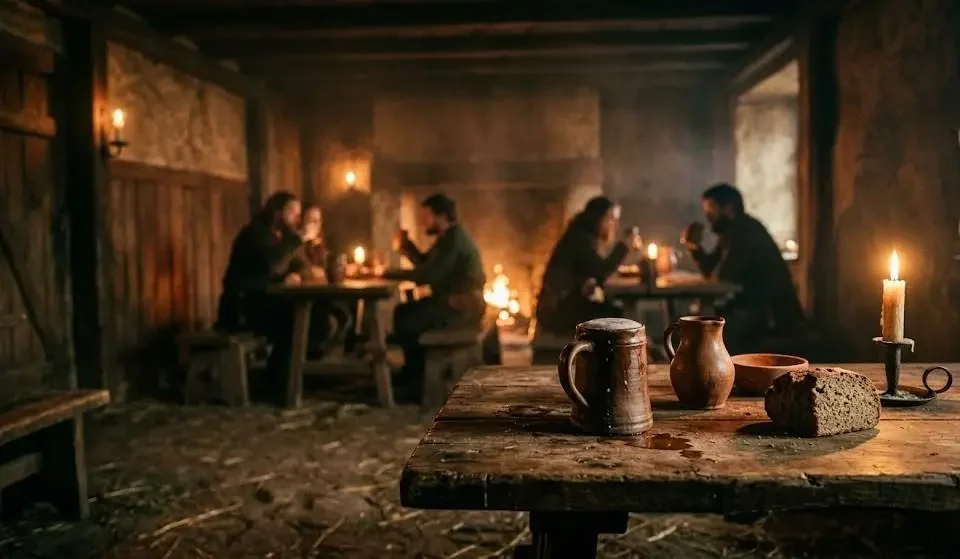
Imagine standing by a muddy English river in 1348, your throat parched after a long day in the fields. You look at the brown, sluggish water rippling past, knowing that a single cup of it could bring a agonizing death by dysentery or cholera. Turning on a kitchen tap to fill a clean, cold glass of water is a modern miracle you completely take for granted. Before industrial filtration and germ theory changed everything, liquid survival was a daily high-stakes gamble. So, what did people drink before clean water was readily available at the turn of a handle?
The Problem with Water Nobody Talks About
Here’s the part that surprises most people: our ancestors weren’t ignorant about water. They knew perfectly well that drinking from rivers or wells near populated areas could kill you. They just didn’t have the science to explain why — they only had the experience of watching people die.
Ancient writers documented the connection between bad water and illness as far back as 400 BCE, when the Greek physician Hippocrates wrote about the link between stagnant water sources and disease. Populations in Rome, Constantinople, and ancient India all developed complex theories about “bad air” and “corrupt water” centuries before germ theory arrived in the 1800s.
The practical solution was simple: if water couldn’t be trusted, you drank something else. And the something else was, almost universally, alcohol.
Why Ale Was the Everyday Drink of Medieval Europe
Walk into any English village in the year 1300 and you’d find ale being consumed at breakfast, with lunch, and at dinner. Not in the way we think of drinking today — not to get drunk, but because ale was genuinely safer than water and contained real calories.
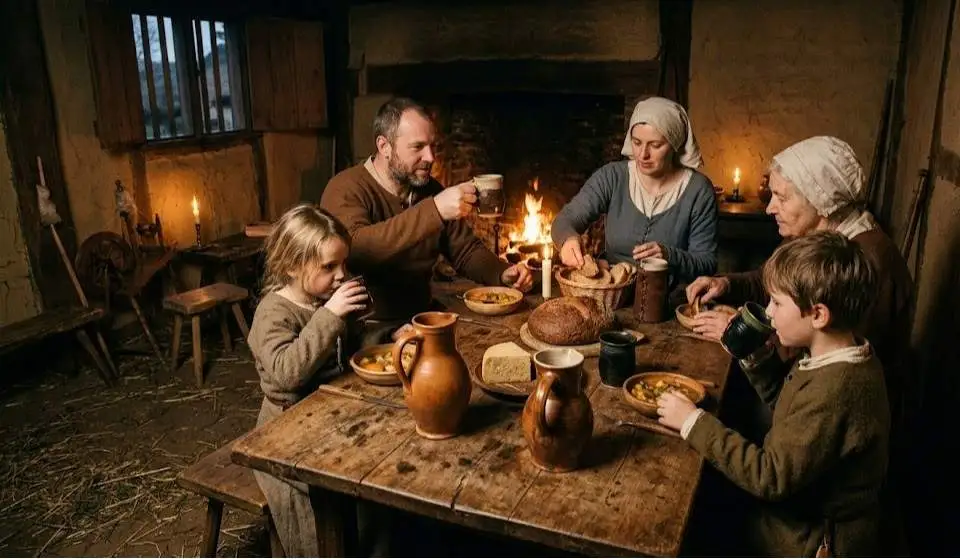
Medieval ale was typically weak by modern standards. It was brewed to around 1–2% alcohol, just enough to kill off dangerous bacteria during the brewing process. Children drank it. Monks brewed it. Hospital patients were given it. Even workers building the great cathedrals of Europe were paid partly in ale rations — records from the construction of Westminster Abbey in the 13th century show workers receiving about a gallon of ale per day.
This wasn’t reckless. It was survival. The brewing process — boiling water, adding grain, fermenting — made the water safe through heat and alcohol content. Nobody knew about bacteria, but the results spoke for themselves.
How Ancient Civilizations Handled the Same Problem
The medieval Europeans weren’t alone. Every major civilisation figured out some version of the same trick: ferment, boil, or flavour your water until it was safe enough to drink.
In ancient Egypt, workers who built the pyramids at Giza were given daily rations of beer — roughly four to five litres per person per day, according to ration records uncovered by archaeologist Mark Lehner’s excavations in the 1990s. The beer was thick, almost like a liquid porridge, and heavy with grain solids. It was food and drink combined.
In ancient China, tea had been drunk since at least 2700 BCE — and while the Chinese valued it for its taste and medicinal properties, the boiling required to make it had the same germ-killing effect. In South Asia, boiling water with spices and herbs created drinks that served a similar protective purpose. The Islamic world developed sophisticated systems of water purification and storage, including qanats — underground aqueducts that kept water cool, clean, and away from surface contamination — dating back to ancient Persia.
Wine, Status, and the Roman Empire
In the Roman world, wine was the drink of choice — but with an important twist: it was almost always diluted with water. Pure wine was considered the habit of barbarians. A civilised Roman mixed their wine at a ratio of around three parts water to one part wine, sometimes more.
That might sound like it defeats the purpose, but even small amounts of wine were enough to acidify the water and kill many harmful microbes. Romans also added vinegar-based drinks called posca — a mixture of water, wine vinegar, and herbs — which served as a standard ration for soldiers stationed across the empire.
The Romans also built extraordinary infrastructure. The aqueduct system, completed under various emperors between 312 BCE and 226 CE, brought clean mountain spring water into cities and allowed wealthy Romans to access safer drinking water than almost anyone else on earth at the time. But the poor, as always, made do with whatever was nearby.
Boiled, Flavoured, and Fermented: The Drinks People Actually Had
Across cultures and centuries, a clear pattern emerges. People who had no access to fresh spring water or stored rainwater developed drinks that were created through a boiling or fermentation process that conveniently made them safer.
In England, “small beer” — a very low-alcohol brew — was consumed by virtually everyone from the 1300s through the 1800s. In Germany and much of northern Europe, variations of ale and beer did the same job. In warmer climates, fermented grain drinks like the African sorghum beer, known as opaque beer or umqombothi, played an identical role in communities across sub-Saharan Africa for thousands of years.
There was also a massive trade in spring water for those who could afford it. In 17th and 18th century London, water sellers walked the streets hawking water from known clean springs at a premium price — a luxury entirely out of reach for ordinary working people.
Milk, Whey, and Fermented Dairy Across the Ancient World
Not every alternative to water involved grain. Across Central Asia, the Middle East, and Europe, fermented dairy products served as safe and nutritious drinks for populations that kept livestock.
Kumiss — fermented mare’s milk — was the primary drink of nomadic peoples across the Eurasian steppe for thousands of years. At around 2% alcohol, it kept travellers and warriors alive and hydrated across journeys of thousands of miles. The Mongol Empire, which at its height in the 13th century stretched from China to Hungary, ran substantially on kumiss.
In Europe, whey — the liquid left over from making cheese — was consumed by peasants who had access to nothing better. It wasn’t glamorous, but it was relatively safe, mildly acidic, and contained useful proteins and minerals.
The Moment Everything Changed
The turning point came shockingly late. Even by the mid-1800s, millions of people in cities like London still had no reliable access to clean drinking water — and they were dying in enormous numbers because of it.
The London cholera epidemic of 1854 killed over 600 people in just ten days in the Soho district alone. It was this outbreak that allowed physician John Snow to trace the source of the disease to a single contaminated water pump on Broad Street — an event often cited as the founding moment of modern epidemiology.
But the real change took decades. London didn’t complete its main sewer system, designed by engineer Joseph Bazalgette, until 1875. The United States didn’t see widespread municipal water chlorination until after 1908, when Jersey City, New Jersey became the first city to permanently chlorinate its public water supply. Safe water at the turn of a tap — something billions of us take for granted today — is barely a hundred years old in most of the world.
🍺 A Quick Before and After Comparison
| 🏛️ Civilisation / Era | 🍷 Primary Drink | 🛡️ Why It Was Safer | 👥 Who Drank It |
|---|---|---|---|
| Ancient Egypt (2700–1000 BCE) | Thick grain beer | Fermentation killed pathogens | Workers, soldiers, all classes |
| Ancient China (2700 BCE+) | Boiled tea | Boiling killed waterborne bacteria | All classes; tea later a luxury |
| Roman Empire (500 BCE–476 CE) | Diluted wine / posca | Acidity inhibited microbial growth | Wine for wealthy; posca for soldiers & poor |
| Medieval Europe (900–1400 CE) | Small ale (1–2% ABV) | Boiling during brewing + low alcohol | Everyone, including children |
| Eurasian Steppe (500–1300 CE) | Kumiss (fermented mare’s milk) | Fermentation + mild acidity | Nomadic peoples, Mongol armies |
| Islamic World (700–1500 CE) | Qanat spring water, herbal infusions | Controlled underground water systems | Urban populations |
| Sub-Saharan Africa (ancient–present) | Sorghum beer (umqombothi) | Fermentation process | Community-wide; ceremonial and daily |
🍺 Frequently Asked Questions
Not in the way we might imagine. Most everyday drinks like small ale in medieval Europe or ancient Egyptian beer were very low in alcohol — typically 1–3% ABV. The goal was hydration and safety, not intoxication. People did drink stronger ales and wines on special occasions, but daily working life required people to be functional.
Sailors stored water in wooden barrels, but it turned green with algae and grew slimy within a few weeks of leaving port. To keep it drinkable, navies mixed the stagnant water with rum or brandy to create a ration called grog, using the alcohol to kill off bacteria.
Yes — spring water, collected rainwater, and water from fast-moving mountain streams was generally safer than water from rivers running through cities. Wealthy Romans accessed clean spring water through their aqueduct system. Rural populations living near good springs were often better off than city dwellers. The problem was scale: cities made water unsafe.
People had noticed the connection between dirty water and illness for thousands of years — Hippocrates wrote about it around 400 BCE. But without germ theory, nobody could explain the mechanism. It wasn’t until John Snow’s work during the 1854 London cholera outbreak that the waterborne transmission of disease was conclusively demonstrated. Louis Pasteur’s germ theory, developed in the 1860s, finally explained why.
Yes, children routinely drank a beverage called small beer, which had a very low alcohol content similar to modern kombucha. It provided hydration and essential B vitamins without making the children intoxicated, making it far safer than the local river water.
Access to safe, treated municipal water developed in stages through the late 19th and early 20th centuries. London’s modern sewer system was completed in 1875 after decades of epidemic deaths. Jersey City, New Jersey introduced the first permanent municipal water chlorination in the US in 1908. Many parts of the world didn’t gain reliable access to clean water until well into the 20th century — and hundreds of millions of people still lack it today.
The Strange Gift of Safe Water
There’s something humbling about looking back at what people drank for most of human history. Not because our ancestors were foolish — they were solving the same basic problem we solve today, with the tools they had. They fermented grain, boiled their water into tea, diluted their wine, and trekked miles for spring water when they could afford it. They found a way.
What changed everything wasn’t just one discovery — it was the slow accumulation of knowledge, infrastructure, and political will that turned clean water from a luxury into a right. The fact that you can walk to your kitchen right now and fill a glass with water that won’t kill you is, in the full sweep of human history, an extraordinary achievement. One that took most of the world until the 20th century to reach — and that billions of people still don’t have.
If this made you curious about the texture of daily life in the past, you might also enjoy reading about What Did People Do for Fun Before Modern Technology?, or exploring The Fascinating History of Tea: From Ancient Legends to Modern Cups