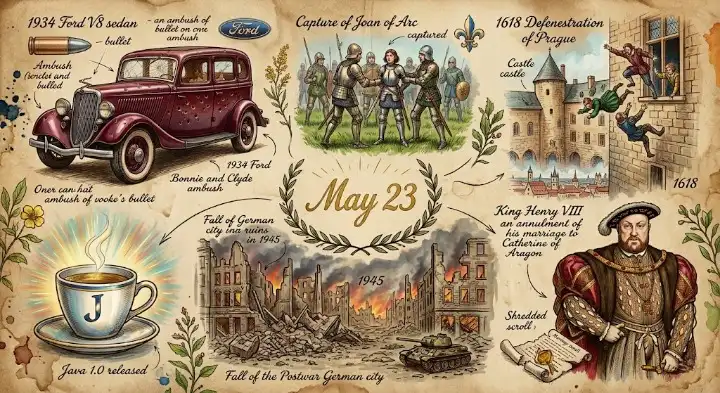
Texas Ranger Frank Hamer crouched in the Louisiana brush, his eyes locked on a dusty logging road as the roar of a Ford V8 engine grew louder in the morning heat. Bonnie Parker and Clyde Barrow had eluded law enforcement across multiple states, leaving a trail of robbed banks and dead officers behind them. Hamer and his posse did not call out a warning; instead, they opened fire with automatic rifles and shotguns, ending the couple’s violent run in a hail of 130 bullets. This dramatic ambush stands as one of the most famous events on this day in history May 23, marking the end of the Public Enemy era.
👶 Quick Facts — May 23 in History
| 📌 Category | 📖 Event / Detail |
|---|---|
| 🌟 Most Significant Event | The notorious American outlaw duo Bonnie Parker and Clyde Barrow are ambushed and killed by law enforcement officers in Bienville Parish, Louisiana (1934) |
| 🏆 Top 10 Key Events | • Joan of Arc is captured by the Burgundians at the Siege of Compiègne (1430) • Radical friar and reformer Girolamo Savonarola is executed in Florence (1498) • Archbishop of Canterbury Thomas Cranmer declares the marriage of King Henry VIII and Catherine of Aragon null and void (1533) • The Second Defenestration of Prague precipitates the Thirty Years’ War (1618) • John Churchill, Duke of Marlborough, defeats the French at the Battle of Ramillies (1706) • Siyyid ‘Alí Muḥammad Shírází declares himself the Báb, founding the Bábí faith (1844) • Italy declares war on Austria-Hungary, officially entering World War I (1915) • Nazi SS chief Heinrich Himmler commits suicide by cyanide while in British custody (1945) • The Federal Republic of Germany (West Germany) is established with the promulgation of its Basic Law (1949) • Anti-mafia prosecuting magistrate Giovanni Falcone is assassinated in the Capaci bombing by the Sicilian Mafia (1992) |
| ⚔️ Key Battles | Battle of Dandanaqan (1040); Battle of Inverurie (1308); Battle of Heiligerlee (1568); Battle of Ramillies (1706); Battle of Famars (1793) |
| 👤 Key Figures | Frank Hamer, Joan of Arc, King Henry VIII, Heinrich Himmler |
| 🌍 Observances | World Turtle Day, Students’ Day (Mexico), Constitution Day (Germany), Labour Day (Jamaica) |
Story of the Day: The Defenestration That Ignited Europe
Bohemian noblemen marched into the Chancellery of Prague Castle on May 23, 1618, furious over the Holy Roman Emperor’s suppression of their Protestant worship. Following a heated argument, the crowd seized two imperial regents and their secretary, shoving them bodily out of a high window. The men plummeted 70 feet into the castle moat, surviving only because they landed in a massive pile of stable manure. This bizarre act of violence shattered the fragile religious peace of the Holy Roman Empire, acting as the immediate catalyst for the catastrophic Thirty Years’ War.
Important Events That Happened On May 23 In History
1040 – Battle of Dandanaqan
Seljuk warriors led by Tughril Bey ambushed the massive Ghaznavid army in the desert sands near Merv. The mobile Seljuk horse archers cut off the enemy water supply, breaking the discipline of the heavily armored Ghaznavid troops. This decisive triumph shattered Ghaznavid dominance over Khorasan and allowed the Seljuks to establish their own vast empire. The victory fundamentally shifted the balance of power across the Middle East, paving the way for Seljuk rule over Persia and Anatolia.
1308 – Battle of Inverurie
Robert the Bruce rose from his sickbed to lead his loyal Scottish troops against his bitter domestic rival, John Comyn, Earl of Buchan. Despite his physical weakness, the King of Scots routed Comyn’s forces in the Aberdeenshire hills, forcing his enemy into a desperate retreat. This victory secured Bruce’s control over northern Scotland and allowed him to systematically destroy Comyn strongholds during the brutal Harrying of Buchan. The triumph unified Scottish resistance, setting the stage for his eventual showdown against the English crown.
1430 – Siege of Compiègne
Joan of Arc charged out of the gates of Compiègne to attack a Burgundian camp, only for her vanguard to be cut off and forced to retreat. As the drawbridge raised behind her to save the city, Burgundian soldiers surrounded the teenage warrior and dragged her from her horse. Her capture deprived the French of their most inspirational military leader during the Hundred Years’ War. Sold to the English months later, she would face a politically motivated trial that ended at the stake in Rouen.
1498 – Execution of Savonarola
Girolamo Savonarola walked to the center of Florence’s Piazza della Signoria, stripped of his clerical robes by order of the Pope. The radical friar, who had ruled Florence with his fiery sermons and “Bonfires of the Vanities,” was hanged alongside two followers before their bodies were burned. His death marked the collapse of his puritanical republic and restored the traditional political power of the Medici family. The execution highlighted the dangerous limits of religious extremism within the shifting politics of Renaissance Italy.
1533 – Annulment of Henry VIII’s First Marriage
Archbishop Thomas Cranmer sat in judgment at Dunstable Priory and officially declared King Henry VIII’s marriage to Catherine of Aragon null and void. This bold legal decree cleared the path for the king to marry Anne Boleyn, who was already pregnant with the future Queen Elizabeth I. By defying papal authority, Henry effectively severed England’s ties with the Catholic Church in Rome. The ruling triggered the English Reformation, fundamentally reshaping the religious landscape of the nation forever.
1568 – Battle of Heiligerlee
Louis of Nassau led an army of Dutch rebels into an ambush against Spanish loyalist forces in the swampy terrain of Groningen. The unexpected rebel victory resulted in the death of the Spanish commander and demonstrated that the imperial forces were vulnerable. This skirmish served as the opening engagement of the Eighty Years’ War, a generational struggle for Dutch independence. The triumph galvanized local resistance against Spanish rule, setting the stage for the birth of the Dutch Republic.
1609 – Second Virginia Charter Ratified
King James I signed the Second Virginia Charter, fundamentally restructuring the leadership and boundaries of the fledgling Jamestown colony. This legal document replaced the inefficient local council with a powerful governor who held absolute authority to maintain order. The charter extended the colony’s theoretical borders from the Atlantic coast all the way to the Pacific Ocean. This corporate reorganization stabilized the colony’s finances, ensuring the permanent survival of English settlement in North America.
1706 – Battle of Ramillies
John Churchill, Duke of Marlborough, launched a brilliant feint that shattered the French lines under Marshal Villeroy in the Spanish Netherlands. Marlborough shifted his cavalry hidden behind a ridge, completely overwhelming the French flank and forcing a chaotic retreat. The sweeping victory forced the French to abandon major cities like Brussels, Bruges, and Antwerp within weeks. This triumph altered the course of the War of the Spanish Succession, breaking French dominance in Flanders.
1788 – South Carolina Ratifies the Constitution
Delegates gathered in Charleston voted decisively to ratify the United States Constitution, making South Carolina the eighth state to join the newly formed union. The wealthy planter class strongly supported the document to protect their economic interests and secure federal military aid against potential slave rebellions. This ratification brought the nation within one state of the nine required to officially operationalize the new government. The decision cemented the political alignment of the American South within the federal system.
1793 – Battle of Famars
Allied British, Hanoverian, and Austrian forces advanced through thick fog to assault the entrenched French Republican positions near Famars. The fierce bayonet charges and heavy artillery fire forced the French troops to abandon their fortified camp under the cover of night. This tactical victory allowed the Coalition forces to lay siege to the strategic fortress city of Valenciennes. The engagement highlighted the bitter, bloody nature of the Flanders Campaign during the War of the First Coalition.
1829 – Accordion Patent Granted
Cyrill Demian secured an official patent in Vienna for his newly invented musical instrument, which he named the accordion. His compact design featured small bellows and a set of keys that allowed a musician to play complex chords with one hand. The portable, loud instrument quickly spread throughout European coffee houses and dance halls. Demian’s invention went on to reshape traditional folk music across the globe, from European polka to American zydeco.
1844 – Foundation of the Bábí Faith
Siyyid ʻAlí Muḥammad Shírází, a young merchant in Shiraz, announced to his first disciple that he was the promised spiritual messenger known as the Báb. His revolutionary teachings challenged the traditional religious establishment of nineteenth-century Persia by proclaiming the imminent arrival of a universal manifestation of God. This declaration triggered widespread spiritual renewal alongside fierce persecution from Islamic authorities. His movement served as the direct theological forerunner to the global Baháʼí Faith.
1846 – Mexican Declaration of War
President Mariano Paredes issued an unofficial declaration of war against the United States, responding to American troops occupying disputed territory along the Rio Grande. The announcement followed weeks of skirmishes, including the Thornton Affair, which had already spilled blood on the border. Paredes sought to rally a divided Mexican public to defend national sovereignty against American expansionism. This decree locked both nations into a bloody conflict that ultimately altered the map of North America.
1863 – General German Workers’ Association Founded
Ferdinand Lassalle met with labor delegates in Leipzig to establish the General German Workers’ Association, creating the first national labor party in Germany. The organization demanded universal suffrage and the creation of worker cooperatives through democratic political action. This historic meeting provided the foundational structure for what would eventually become the modern Social Democratic Party of Germany. The association marked the formal entry of the industrial working class into mainstream European politics.
1873 – North-West Mounted Police Created
Prime Minister Sir John A. Macdonald secured parliamentary approval to establish the North-West Mounted Police to enforce Canadian law along the western frontier. The government created this paramilitary force to expel American whiskey traders and establish peaceful relations with Indigenous nations before white settlement began. These red-coated officers quickly became iconic symbols of order across the vast Canadian prairies. This organization served as the direct institutional forerunner to the Royal Canadian Mounted Police.
1900 – William Harvey Carney Awarded Medal of Honor
Sergeant William Harvey Carney received the Congressional Medal of Honor for his extraordinary heroism during the assault on Fort Wagner 37 years earlier. Despite sustaining multiple severe wounds, Carney crawled across the battlefield while keeping the American flag upright, famously declaring it never touched the ground. His recognition made him the first African American soldier to receive the nation’s highest military decoration. This award highlighted the crucial, courageous service of Black regiments during the American Civil War.
1905 – Creation of the Ullah Millet
Sultan Abdul Hamid II officially announced the creation of the Ullah millet, granting recognized ethnic status to the Aromanian people within the Ottoman Empire. This imperial decree allowed Aromanians to maintain their own schools, perform religious services in their native language, and elect local councils. The decision infuriated Greek nationalist groups, sparking violent clashes over cultural dominance in the Macedonian region. This recognition is why May 23 is widely celebrated as Aromanian National Day.
1907 – First Finnish Parliament Convenes
Members of the newly elected, unicameral Parliament of Finland gathered in Helsinki for their historic first plenary session. This groundbreaking legislature included 19 women, marking the first time in global history that female lawmakers took seats in a national parliament. The assembly operated under a system of universal suffrage that had replaced the archaic system of estates. This session established Finland as an early pioneer of democratic equality long before it achieved full independence.
1911 – New York Public Library Dedicated
President William Howard Taft stood before a massive crowd to officially dedicate the New York Public Library on Fifth Avenue. The magnificent Beaux-Arts building, guarded by its iconic marble lions, opened as the largest marble structure ever completed in the United States. Visitors flooded the grand reading rooms on the first day, accessing over one million books collected for public use. This institution democratized learning, providing free access to knowledge for millions of immigrants and working-class New Yorkers.
1915 – Italy Enters World War I
King Victor Emmanuel III authorized a formal declaration of war against the Austro-Hungarian Empire, officially bringing Italy into World War I on the side of the Allies. This decision violated Italy’s previous defensive alliance with Germany and Austria, fulfilling secret promises made in the Treaty of London. The government hoped to secure disputed territories along the northern alpine border through military conquest. The declaration opened a brutal, stagnant mountain front that cost hundreds of thousands of Italian lives.
1919 – First Mahmud Barzanji Revolt
Sheikh Mahmud Barzanji arrested British political officers in Sulaymaniyah and raised his own flag, declaring an independent Kingdom of Kurdistan. The charismatic tribal leader rallied Kurdish fighters to revolt against the British occupation forces managing post-Ottoman Iraq. British authorities responded rapidly, deploying troops and aerial bombardment to crush the uprising within months. This initial rebellion marked the violent beginning of a modern, ongoing struggle for Kurdish autonomy in the Middle East.
1932 – MMDC Murders in São Paulo
Police opened fire on an angry crowd demonstrating against the dictatorial regime of Getúlio Vargas in São Paulo, killing four young students. The names of the victims—Martins, Miragaia, Dráusio, and Camargo—became encapsulated in the acronym MMDC, serving as a powerful rallying cry for resistance. The tragedy galvanized the public, transforming peaceful political protests into an armed insurrection weeks later. This confrontation ignited the Constitutionalist Revolution, a civil war fought to restore democracy to Brazil.
1934 – Battle of Toledo Culmination
Thirteen hundred troops of the Ohio National Guard fixed bayonets and advanced into a crowd of six thousand striking autoworkers outside the Electric Auto-Lite plant. The five-day battle involved bricks, tear gas, and live ammunition, resulting in the deaths of two strikers and injuries to hundreds more. The intense violence forced factory management to negotiate with the nascent United Automobile Workers union for the first time. This bitter confrontation established the legal right to strike for millions of industrial workers.
1939 – Sinking of the USS Squalus
The experimental U.S. Navy submarine USS Squalus suffered a catastrophic main induction valve failure during a test dive off the coast of New Hampshire. Sea water flooded the aft torpedo room, sending the vessel straight to the ocean floor in 240 feet of water and killing 26 men instantly. Navy rescuers rushed to the scene, utilizing a newly designed diving bell to extract the 33 survivors over the following hours. This tragic accident prompted significant advancements in submarine rescue technology and safety protocols.
1941 – Missiria Massacres in Crete
German paratroopers rounded up and executed dozen of Greek civilians in the village of Missiria following fierce resistance during the Battle of Crete. The Nazi high command ordered these brutal reprisals to terrify the local population and discourage partisan attacks against invading forces. Soldiers burned homes and executed men in fields, establishing a terrifying policy of collective punishment across the island. These killings marked the grim beginning of a brutal, years-long occupation of Greece.
1945 – Suicide of Heinrich Himmler
Heinrich Himmler bit down on a hidden cyanide capsule while undergoing a routine medical examination in a British interrogation camp at Lüneburg. The architect of the Nazi Holocaust had attempted to evade capture by disguising himself as a low-ranking military policeman with forged documents. His sudden death deprived the Allies of prosecuting one of the chief perpetrators of World War II atrocities at the Nuremberg trials. His body was buried in an unmarked, secret grave in the nearby forest.
1945 – Dissolution of the Flensburg Government
British infantry units entered the enclave of Flensburg, arresting Grand Admiral Karl Dönitz and his ministers inside their naval headquarters. This military raid effectively dissolved the short-lived Flensburg Government, which had attempted to rule Germany following Adolf Hitler’s suicide. The arrests ended the final, desperate illusion of an independent Nazi administration operating anywhere in Europe. This dissolution transferred supreme civil and military authority over the defeated nation directly into Allied hands.
1946 – Central United States Tornado Outbreak
A massive supercell weather system swept across the American Midwest, spawning fifteen destructive tornadoes over a chaotic forty-eight-hour period. The violent funnels obliterated rural communities across Texas, Oklahoma, and Kansas, leveling hundreds of farmsteads and killing over twenty people. Emergency services struggled to reach isolated areas due to downed telegraph lines and washed-out roads. This devastating outbreak prompted meteorologists to intensify research into developing the world’s first reliable tornado warning network.
1948 – Assassination of Thomas C. Wasson
Thomas C. Wasson, the United States Consul-General, was shot by a sniper while walking back to his consulate in Jerusalem shortly after a diplomatic meeting. The American diplomat died of his wounds the following day amidst the intense urban combat of the 1948 Arab-Israeli War. Wasson had been actively working with the United Nations Truce Commission to negotiate a ceasefire to protect civilians inside the holy city. His unsolved murder highlighted the extreme dangers faced by international diplomats during the conflict.
1949 – Basic Law Approved in Germany
Western Allied occupation authorities formally approved the Basic Law, establishing the Federal Republic of Germany with Bonn as its provisional capital. This constitutional document created a stable parliamentary democracy designed to prevent the rise of future totalitarian dictatorships. The declaration permanently solidified the political division of Germany into democratic West and communist East at the height of the Cold War. This historic event marked the birth of modern, democratic West Germany from the ashes of war.
1951 – Seventeen Point Agreement Signed
Tibetan delegates signed the Seventeen Point Agreement in Beijing under heavy political pressure, officially affirming Chinese sovereignty over Tibet. The document promised to maintain the local political system and respect the religious authority of the Dalai Lama in exchange for peaceful integration. Tibetan leaders claimed they signed the treaty under duress following the overwhelming military defeat of their army at Chamdo. This controversial agreement marked the formal end of Tibet’s de facto independence.
1960 – Hilo Tsunami Disaster
A succession of massive tsunami waves slammed into the coast of Hilo, Hawaii, triggered by the cataclysmic Valdivia earthquake in Chile the previous day. The thirty-five-foot wall of water crushed coastal businesses, overturned cars, and killed sixty-one residents who had ignored early warning sirens. The immense energy of the wave traveled thousands of miles across the Pacific Ocean before striking the islands with destructive force. This tragedy forced international authorities to overhaul and modernize the Pacific Tsunami Warning System.
1971 – Aviogenex Flight 130 Crash
An Aviogenex Tupolev Tu-134 passenger jet encountered severe turbulence and illusionary visual conditions while on final approach to Rijeka Airport. The aircraft struck the runway hard, causing a wing to rip off and igniting a catastrophic fuel fire that trapped passengers inside the cabin. Seventy-eight people perished in the toxic smoke, leaving only five survivors from the wreckage. This disaster led to stricter international regulations regarding aircraft cabin materials and emergency exit accessibility.
1971 – Intercontinental Hotel Bucharest Opens
Communist officials gathered in downtown Bucharest to celebrate the grand opening of the Intercontinental Hotel, the second-tallest building in Romania. The sleek, modern skyscraper stood as a rare architectural collaboration between a Western corporation and a Soviet-bloc regime. The hotel provided luxury accommodations for foreign journalists, diplomats, and wealthy tourists visiting the isolated capital city. This landmark later served as a vital observation post for international media during the bloody 1989 Romanian Revolution.
1978 – Tupolev Tu-144 Test Crash
An experimental Tupolev Tu-144 supersonic airliner suffered a severe mid-air fuel leak that ignited an engine fire during a routine acceptance flight. The crew executed a desperate emergency landing in a field near Yegoryevsk, crushing the forward fuselage and killing two flight engineers. This fatal crash forced Aeroflot to permanently cancel all commercial passenger operations for the problematic supersonic jet after only fifty-five flights. The accident effectively ended Soviet ambitions to compete with the Western Concorde.
1980 – The Shining Premieres
Director Stanley Kubrick premiered his psychological horror masterpiece The Shining on ten screens across New York City and Los Angeles over Memorial Day weekend. Audiences flocked to theaters to watch Jack Nicholson’s unsettling decent into madness inside the isolated Overlook Hotel. Early critical reviews were deeply divided, with many panning the film’s slow pacing and deviations from Stephen King’s bestselling novel. Over the decades, the movie evolved into an iconic cultural touchstone of American cinema history.
1991 – Aeroflot Flight 8556 Crash
An Aeroflot Antonov An-24 regional airliner stalled and plummeted into the ground while attempting to land at Pulkovo Airport in Saint Petersburg. The impact shattered the airframe, killing thirteen people on board and severely injuring the surviving crew members. Aviation investigators attributed the disaster to pilot error compounded by severe icing conditions that degraded the aircraft’s wing lift. This crash exposed deep systemic safety failures within the decaying Soviet civil aviation infrastructure.
1992 – Assassination of Giovanni Falcone
A half-ton of explosives packed beneath the highway near Capaci detonated, killing Italy’s premier anti-mafia judge Giovanni Falcone, his wife, and three bodyguards. The brutal attack was orchestrated by the Corleonesi clan to halt Falcone’s highly successful mass prosecutions of organized crime leaders. The public outrage over the assassination united the Italian nation and forced the government to deploy the military against the Mafia. This tragic loss became the ultimate turning point in Italy’s war against organized crime.
1995 – Java Programming Language Released
Sun Microsystems officially released the first public version of the Java programming language during a major technology conference. Developed by James Gosling, the language introduced a “Write Once, Run Anywhere” philosophy that allowed code to execute on any device equipped with a virtual machine. This flexibility made Java the ideal foundational tool for building early internet applications and interactive websites. The release permanently transformed global software development, driving the growth of the modern digital economy.
1998 – Good Friday Agreement Referendum
Voters across Northern Ireland flooded polling stations, with over seventy-five percent approving the historic Good Friday Agreement in a national referendum. This landmark political accord established a power-sharing government and outlined a peaceful framework to end three decades of sectarian violence known as the Troubles. A simultaneous vote in the Republic of Ireland overwhelmingly supported removing constitutional claims over northern territory. This democratic mandate secured a fragile, enduring peace for a fractured society.
2002 – Kyoto Protocol Milestone Reached
Iceland officially deposited its instruments of ratification for the Kyoto Protocol, fulfilling the critical “55 parties” clause required to advance the international climate treaty. This milestone meant that fifty-five nations had legally committed to mandatory reductions in greenhouse gas emissions to combat global warming. The agreement marked the first legally binding global framework designed to hold industrialized economies accountable for environmental degradation. This diplomatic breakthrough laid the foundation for all future international climate negotiations.
2006 – Mount Cleveland Eruption
The remote Alaskan stratovolcano Mount Cleveland experienced a sudden, violent explosion that sent a massive plume of ash three miles into the atmosphere. Satellite sensors detected the thermal anomaly, prompting aviation authorities to redirect international commercial flights away from the North Pacific corridor. The eruption occurred without warning due to the lack of local seismic monitoring equipment on the uninhabited island. This event highlighted the persistent, invisible dangers that active wilderness volcanoes pose to global air travel.
2008 – ICJ Territorial Dispute Ruling
The International Court of Justice delivered a binding verdict that awarded sovereignty of Middle Rocks to Malaysia and Pedra Branca to Singapore. The ruling successfully resolved a bitter, twenty-nine-year maritime border dispute centered on strategic rock formations in the Singapore Strait. Both Southeast Asian nations agreed to abide by the judicial decision, demonstrating a mutual commitment to peaceful international arbitration over military confrontation. The resolution stabilized diplomatic and economic relations within the vital shipping channel.
2013 – Skagit River Bridge Collapse
A commercial semi-truck carrying an oversized load struck the overhead framework of the Interstate 5 bridge spanning the Skagit River in Washington state. The structural impact caused an entire section of the steel truss freeway bridge to collapse into the icy waters below, plunging two passenger vehicles into the river. Rescuers pulled three people from the wreckage, miraculously avoiding any fatalities on the busy corridor. This high-profile collapse forced a national conversation regarding the critical state of aging American infrastructure.
2014 – Isla Vista Killings
A heavily armed twenty-two-year-old launched a coordinated knife and gun rampage near the campus of the University of California, Santa Barbara, killing six students and injuring fourteen others. The perpetrator posted an online manifesto detailing misogynistic motives before taking his own life inside his crashed vehicle. The tragedy sparked widespread national outrage, prompting intense debates over gun control regulations and the rise of radicalized online subcultures. The community gathered in massive vigils to mourn the lives cut short.
2015 – Plains Tornado and Flood Outbreak
A stagnant, severe weather system unleashed a torrent of historic rainfall alongside destructive tornadoes across Texas, Oklahoma, and northern Mexico. The extreme precipitation caused rivers to burst their banks, triggering catastrophic flash floods that swept away homes and killed at least thirty people. The high waters inundated major highway corridors and forced thousands of residents into emergency shelters. This multi-day environmental disaster stood as the wettest month in recorded history for the region.
2016 – Aden Army Recruitment Bombings
Two Islamic State suicide bombers targeted hundreds of young Yemeni military recruits waiting outside an army training camp and a commander’s home in Aden. The dual explosions ripped through the dense crowds, killing at least forty-five potential soldiers and wounding dozens of others. The terror group explicitly claimed responsibility, exploiting the security vacuum created by the ongoing Yemeni Civil War. This devastating assault highlighted the shifting, lethal threat posed by extremist factions operating within the region.
2016 – Syrian Coastline Bombings
Islamic State operatives coordinated a wave of eight synchronized suicide bombings and car attacks inside the government-controlled coastal cities of Jableh and Tartus. The blasts targeted busy bus stations, hospitals, and residential streets, killing one hundred eighty-four civilians in a matter of minutes. This horrific escalation brought the violence of the Syrian Civil War directly into a region that had previously escaped major insurgent attacks. The mass casualties overwhelmed local medical facilities, sparking widespread shock and grief.
2017 – Martial Law Declared in Mindanao
Philippine President Rodrigo Duterte placed the entire southern island region of Mindanao under martial law following a violent assault on the city of Marawi. Militants aligned with the Islamic State had seized buildings, taken hostages, and raised black flags, forcing thousands of civilians to flee. The declaration granted the military sweeping powers to conduct arrests and establish checkpoints to eliminate the insurgent threat. This decree initiated a brutal, five-month urban siege to reclaim the city.
2021 – Stresa-Mottarone Cable Car Crash
A passenger cable car plunged into the side of the Mottarone mountain near Lake Maggiore after a lead cable snapped during a routine ascent. The vehicle’s emergency brake failed to engage because service operators had deliberately deactivated it to prevent mechanical delays, killing fourteen people on impact. A five-year-old boy was the sole survivor of the horrific fall. The tragedy led to the immediate arrest of park officials and prompted global safety audits of alpine transport systems.
2021 – Ryanair Flight 4978 Diversion
Belarusian military authorities deployed a MiG-29 fighter jet to force a commercial Ryanair flight traveling through their airspace to land in Minsk under a false bomb threat. Once the aircraft touched down, state security agents entered the plane to arrest dissident journalist Roman Protasevich and his girlfriend. International leaders condemned the forced diversion as a state-sponsored hijacking and a blatant assault on press freedom. The incident resulted in immediate airspace sanctions levied against the Belarusian regime.
2022 – Anthony Albanese Sworn In
Anthony Albanese took the official oath of office to become the thirty-first Prime Minister of Australia, ending nine years of conservative coalition rule. The Australian Labor Party secured victory by campaigning on platform promises of accelerated climate action, enhanced social welfare benefits, and improved relations with Pacific neighbors. Albanese assumed power immediately to represent the nation at a critical international security summit in Tokyo. His election marked a significant shift in Australia’s domestic and foreign policy priorities.
Ready for more? Discover what happened on the previous day.
Famous People Born On May 23
| Name | Description | Date |
|---|---|---|
| Nicodemus Tessin the Younger | Swedish Baroque architect | May 23, 1654 – April 10, 1728 |
| Charles-Joseph, prince de Ligne | Belgian military officer and man of letters | May 23, 1735 – December 13, 1814 |
| Paul Moody | American inventor, co-designed first power loom in U.S. | May 23, 1779 – July 7, 1831 |
| Jules-Sébastien-César Dumont d’Urville | French explorer of South Pacific and Antarctic | May 23, 1790 – May 8, 1842 |
| Ignaz Moscheles | Czech pianist, outstanding virtuoso | May 23, 1794 – March 10, 1870 |
| Thomas Hood | English poet and humorist, “The Song of the Shirt” | May 23, 1799 – May 3, 1845 |
| Frances Auretta Fuller Victor | American writer and historian of western U.S. | May 23, 1826 – November 14, 1902 |
| Henry Brougham Loch, 1st Baron Loch | British colonial administrator in Southern Africa | May 23, 1827 – June 20, 1900 |
| Maria Konopnicka | Polish poet and short-story writer | May 23, 1842 – October 8, 1910 |
| Arabella Mansfield | First woman admitted to legal profession in U.S. | May 23, 1846 – August 2, 1911 |
| Otto Lilienthal | German aviation pioneer | May 23, 1848 – August 10, 1896 |
| Hermann Gunkel | German Old Testament scholar, form criticism pioneer | May 23, 1862 – March 11, 1932 |
| David George Hogarth | English archaeologist, director of Ashmolean Museum | May 23, 1862 – November 6, 1927 |
| Charles Robert Ashbee | English architect, Arts and Crafts Movement | May 17, 1863 – May 23, 1942 |
| Leo Baeck | German Reform rabbi and theologian | May 23, 1873 – November 2, 1956 |
| Alfred P. Sloan, Jr. | American industrialist, president of General Motors | May 23, 1875 – February 17, 1966 |
| Theodore Komisarjevsky | Russian theatrical director and designer | May 23, 1882 – April 17, 1954 |
| Corrado Gini | Italian statistician, Gini coefficient | May 23, 1884 – March 13, 1965 |
| Mabel Walker Willebrandt | American lawyer, assistant attorney general during Prohibition | May 23, 1889 – April 6, 1963 |
| Sir Dennis Holme Robertson | British economist | May 23, 1890 – April 21, 1963 |
| Morris Fisher | American rifle shooter, five Olympic gold medals | May 4, 1892 – May 23, 1968 |
| Georgios Grivas | Cypriot patriot, independence struggle leader | May 23, 1898 – January 27, 1974 |
| Artie Shaw | American clarinetist and big band leader | May 23, 1910 – December 30, 2004 |
| Margaret Wise Brown | American children’s author | May 23, 1910 – November 13, 1952 |
| John Payne | American actor, leading man in 1940s musicals | May 23, 1912 – December 6, 1989 |
| Jean Françaix | French neoclassical composer | May 23, 1912 – September 25, 1997 |
| William R. Bascom | American anthropologist, West African fieldwork | May 23, 1912 – September 11, 1981 |
| Barbara Ward, Baroness Jackson | British economist and writer | May 23, 1914 – May 31, 1981 |
| Edward Lorenz | American meteorologist, chaos theory pioneer | May 23, 1917 – April 16, 2008 |
| Joshua Lederberg | American geneticist, Nobel Prize (1958) | May 23, 1925 – February 2, 2008 |
Famous People Died On May 23
| Name | Description | Date |
|---|---|---|
| Henry V | Holy Roman emperor (1111–25), last of Salian dynasty | August 11, 1086 – May 23, 1125 |
| Ismāʿīl I | Shah of Iran, founder of Safavid dynasty | July 17, 1487 – May 23, 1524 |
| Sebastian Münster | German cartographer and cosmographer | January 20, 1488 – May 23, 1552 |
| James Otis | American political activist, pre-Revolutionary leader | February 5, 1725 – May 23, 1783 |
| Thomas Archer | British Baroque architect | c.1668 – May 23, 1743 |
| Mason Locke Weems | American clergyman, fabricated Washington cherry tree story | October 11, 1759 – May 23, 1825 |
| Franz Xaver von Baader | German Catholic mystical theologian | March 27, 1765 – May 23, 1841 |
| Géraud-Christophe-Michel Duroc, duke de Frioul | French general, close adviser to Napoleon | October 25, 1772 – May 23, 1813 |
| José de Espronceda y Delgado | Spanish Romantic poet, “Spanish Lord Byron” | March 25, 1808 – May 23, 1842 |
| Edward Livingston | American lawyer, legislator, and statesman | May 28, 1764 – May 23, 1836 |
| Ksawery Drucki Lubecki | Polish statesman, restored Congress Kingdom finances | December 28, 1779 – May 23, 1846 |
| John Wood the Elder | English architect and town planner of Bath | August 26, 1704 – May 23, 1754 |
| Augustin-Louis Cauchy | French mathematician, analysis and group theory | August 21, 1789 – May 23, 1857 |
| Henry Lytton Bulwer | British diplomat, Clayton–Bulwer Treaty | February 13, 1801 – May 23, 1872 |
| Janko Král’ | Slovak Romantic poet and revolutionary | April 24, 1822 – May 23, 1876 |
| Cyprian Norwid | Polish poet, playwright, and painter | September 24, 1821 – May 23, 1883 |
| Leopold von Ranke | German historian, scientific historiography pioneer | December 21, 1795 – May 23, 1886 |
| Franz Ernst Neumann | German mineralogist and physicist | September 11, 1798 – May 23, 1895 |
| José Asunción Silva | Colombian poet, melancholy lyricism | November 27, 1865 – May 23, 1896 |
| Mary Ashton Rice Livermore | American suffragist and reformer | December 19, 1820 – May 23, 1905 |
| Pierre-Émile Martin | French engineer, Siemens–Martin steel process | August 18, 1824 – May 23, 1915 |
| Tang Jiyao | Chinese warlord, military governor of Yunnan | 1881 – May 23, 1927 |
| Henri de Régnier | French poet | December 28, 1864 – May 23, 1936 |
| Herbert Austin, Baron Austin | British industrialist, founder of Austin Motor Company | November 8, 1866 – May 23, 1941 |
| William Aberhart | Canadian Social Credit premier of Alberta | December 30, 1878 – May 23, 1943 |
| Charles-Ferdinand Ramuz | Swiss French-language novelist | September 24, 1878 – May 23, 1947 |
| Minobe Tatsukichi | Japanese jurist, “emperor organ theory” | May 7, 1873 – May 23, 1948 |
| William Webster Hansen | American physicist, microwave technology pioneer | May 27, 1909 – May 23, 1949 |
| Georges Claude | French engineer, inventor of neon light | September 24, 1870 – May 23, 1960 |
| David Smith | American abstract expressionist sculptor | March 9, 1906 – May 23, 1965 |
Observances on May 23
- World Turtle Day: Established in 2000 by the American Tortoise Rescue, this global observance encourages people to protect turtles and tortoises from habitat destruction and illegal wildlife trade.
- Students’ Day (Mexico): Celebrated annually to honor the 1929 student strike at the National University of Mexico, a protest that successfully secured institutional autonomy for the university.
- Constitution Day (Germany): Marks the historic 1949 promulgation of the Basic Law, celebrating the foundation of modern democratic governance and human rights protections in Germany.
- Labour Day (Jamaica): Commemorates the historic 1938 labor rebellion that catalyzed Jamaica’s modern political development, focusing on community volunteer work and public improvement projects nationwide.
🚗 Frequently Asked Questions — May 23 in History
On May 23, 1934, the notorious American bank robbers Bonnie Parker and Clyde Barrow were ambushed and killed by law enforcement officers in Bienville Parish, Louisiana. A posse led by Texas Ranger Frank Hamer fired over one hundred rounds into the couple’s stolen car, ending their multi-year, violent crime spree across the Midwest.
The most significant event on May 23 is the 1934 police ambush that killed outlaws Bonnie and Clyde, which brought an end to the high-profile “Public Enemy” era of the Great Depression. In European history, the Third Defenestration of Prague on May 23, 1618, is equally vital as it directly triggered the devastating Thirty Years’ War.
Swedish botanist Carl Linnaeus was born on May 23, 1707, and went on to create the binomial nomenclature system used globally to classify plants and animals. American physician Thomas Welton Stanford, co-founder of Stanford University, was also born on this date in 1832.
On May 23, 1618, Protestant rebels threw imperial governors out of a window in Prague Castle, an act that directly precipitated the Thirty Years’ War. Additionally, on May 23, 1915, Italy officially entered World War I on the side of the Allied powers by declaring war against Austria-Hungary.
World Turtle Day is an annual observance celebrated on May 23 to raise public awareness about the conservation of turtles and tortoises. Founded by American Tortoise Rescue, the day focuses on preventing the disappearance of these ancient reptiles by protecting their natural habitats around the world.
On May 23, 2022, Anthony Albanese was sworn in as the 31st Prime Minister of Australia, ending nearly a decade of conservative government rule. One year prior, on May 23, 2021, Belarusian authorities sparked international outrage by forcing a commercial Ryanair flight to land in Minsk to arrest journalist Roman Protasevich.