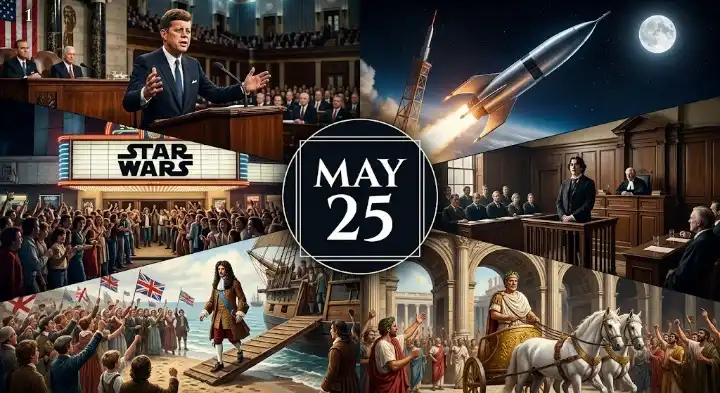
John F. Kennedy stood before a joint session of Congress on May 25, 1961, and issued a daring challenge that seemed straight out of science fiction. America, he declared, must commit to landing a man on the moon before the decade ended. The Soviet Union was winning the space race, and Washington was desperate for a triumph. Kennedy’s bold declaration galvanized the nation, ignited the Apollo program, and altered human technological development forever. This day in history May 25 stands as a masterclass in moments that redefined global culture, science, and politics.
👶 Quick Facts — May 25 in History
| 📌 Category | 📖 Event / Detail |
|---|---|
| 🌟 Most Significant Event | President John F. Kennedy delivers a special address to Congress, proposing the historic goal of landing a man on the Moon before the decade is out (1961) |
| 🏆 Top 10 Key Events | • King Servius Tullius celebrates a Roman Triumph for his victory over the Etruscans (567 BC) • First recorded perihelion passage of Halley’s Comet by Chinese astronomers (240 BC) • Alfonso VI of Castile captures Toledo, Spain, ending the Siege of Toledo (1085) • Emperor Charles V issues the Edict of Worms, declaring Martin Luther an outlaw (1521) • Rebel leader Li Zicheng opens the Shanhaiguan gate of the Ming Great Wall, letting the Manchu army into central China (1644) • The Declaration of Breda is read to Parliament, paving the way for King Charles II to restore the British monarchy (1660) • Playwright Oscar Wilde is convicted of “gross indecency” and sentenced to two years hard labor (1895) • Jesse Owens sets three world records and ties a fourth in less than an hour at the Big Ten championships (1935) • George Lucas’s cinematic masterpiece, “Star Wars” (A New Hope), premieres in theaters (1977) • The European Union’s General Data Protection Regulation (GDPR) officially takes effect (2018) |
| ⚔️ Key Battles | Siege of Toledo (1085), Battle of Carlow (1798), Battle of Boulogne (1940), Falklands War air strikes (1982) |
| 👤 Key Figures | King Servius Tullius, King Charles II, Oscar Wilde, President John F. Kennedy |
| 🌍 Observances | Africa Day, Geek Pride Day, Jordan Independence Day, Towel Day, Liberation Day (Lebanon) |
Story of the Day: The Galactic Gamble of 1977
George Lucas stood inside a Hollywood studio fearing his space opera would completely ruin his career. Studio executives expected a massive box office disaster, and theater owners initially refused to book the strange film named Star Wars. On May 25, 1977, the movie opened in just 32 American theaters to instant, unprecedented madness. Lines wrapped around city blocks, audiences cheered at the screen, and the cinematic landscape changed in a single afternoon. Lucas didn’t just create a successful summer blockbuster; he birthed a multi-generational mythology that fundamentally reshaped how movies are made, marketed, and loved worldwide.
Important Events That Happened On May 25 In History
567 BC – Servius Tullius Celebrates Triumph
Servius Tullius, the sixth king of Rome, rode through the city gates in a gilded chariot surrounded by captured wealth and prisoners. Etruscan forces had been utterly broken by Roman legions after months of fierce campaigning. This grand procession established Rome as the dominant, aggressive power in central Italy. The ritual cemented the military triumph format that future emperors would use to display absolute dominance over the ancient world.
240 BC – Halley’s Comet First Perihelion
Ancient Chinese astronomers looked up into the night sky and meticulously recorded a bright, sweeping streak of light passing closest to the sun. Humanity was unwittingly tracking Halley’s Comet for the very first time in written records. This precise observation proved that early civilizations possessed highly sophisticated systems for studying the cosmos. The data point allowed modern scientists centuries later to calculate the orbital mechanics of our solar system.
1085 – Alfonso VI Reclaims Toledo
Alfonso VI of Castile led his Christian knights through the gates of Toledo after a grueling, year-long siege. Moorish forces surrendered the vital strategic stronghold, ending centuries of Islamic governance over the ancient city. The victory shifted the entire balance of power in the Iberian Peninsula toward the Christian kingdoms. Toledo rapidly transformed into a vibrant cultural hub where scholars translated essential Arabic texts to spark the Western European Renaissance.
1420 – Henry the Navigator Appointed Governor
Prince Henry of Portugal accepted leadership of the wealthy and powerful Order of Christ from the Pope. The vast financial resources of this crusading order were now at the disposal of a man obsessed with maritime exploration. Henry used these funds to build advanced ships, design accurate maps, and finance risky expeditions down the African coast. His patronage launched the Age of Discovery, connecting isolated continents and initiating globalization through maritime trade.
1521 – The Edict of Worms
Charles V, Holy Roman Emperor, signed the Edict of Worms and officially branded Martin Luther a dangerous religious outlaw. Luther had refused to recant his revolutionary criticisms of the Catholic Church during a dramatic imperial trial. The decree made it a crime for anyone to shelter the rebellious monk or read his writings. Instead of crushing the Protestant Reformation, this harsh law forced northern German princes to protect Luther and permanently fractured Western Christianity.
1644 – Shaihaiguan Pass Opened
Wu Sangui, a desperate Ming dynasty general, opened the massive gates of the Great Wall of China at Shanhaiguan to his bitter enemies. Invading Manchu forces poured through the ancient stone barrier to help Wu defeat a local rebel army that had seized Beijing. The Manchus quickly betrayed their host, seized the imperial throne for themselves, and established the Qing Dynasty. This fateful choice ended centuries of Ming rule and reshaped Chinese borders for the next three hundred years.
1659 – Richard Cromwell Resigns
Richard Cromwell quietly stepped down as Lord Protector of England, unable to maintain control over a rebellious army and parliament. His father, Oliver Cromwell, had ruled with an iron fist, but the son lacked the political cunning needed to govern a fractured republic. The sudden resignation plunged the English Commonwealth into deep political chaos. Parliament realized the republican experiment was failing, setting the stage for the return of the exiled monarchy.
1660 – The Restoration of the British Monarchy
Charles II stepped onto the pebble beach at Dover to the deafening cheers of thousands of British citizens. The exiled prince had been invited back by Parliament to reclaim the throne after eleven years of strict, puritanical republican rule. This historic return marked the definitive end of the Commonwealth and reinstated the traditional royal line. The English Restoration completely revived the arts, reopened the public theaters, and reshaped the political balance between crown and parliament.
1738 – Conojocular War Ends
Guns fell silent along the disputed borders of Pennsylvania and Maryland as local authorities signed a formal peace treaty. Farmers and law enforcement officers from both colonies had spent years engaging in violent skirmishes over overlapping land grants. The agreement established a temporary boundary line and organized a vital exchange of captured prisoners. This early American conflict highlighted the intense colonial rivalries that eventually forced the creation of the accurate Mason-Dixon line.
1763 – Norway’s First Newspaper Launched
Printers in Oslo carefully pulled the very first issue of Norske Intelligenz-Seddeler from their manual wooden presses. Norway finally possessed a regular, independent newspaper dedicated to sharing local advertisements, official announcements, and international information. The small publication fundamentally altered how the Norwegian public engaged with commerce and community news. It established a continuous tradition of a free press that supported the nation’s growing cultural identity over the next century.
1787 – Constitutional Convention Convenes
James Madison and dozens of American statesmen gathered in the sweltering heat of Philadelphia after an eleven-day delay waiting for a quorum. Representatives from seven states finally arrived to form the official United States Constitutional Convention. The delegates abandoned their original plan to fix the weak Articles of Confederation and chose to build a completely new government structure. This historic meeting produced the American Constitution, establishing the oldest continuous federal republic on Earth.
1798 – Battle of Carlow
Irish rebels armed with crude pikes charged into the streets of Carlow town, hoping to overwhelm the local British garrison. Government forces ambushed the revolutionaries from fortified houses, turning the narrow roads into a horrific killing zone. Over six hundred United Irishmen were slaughtered within hours, followed by immediate, brutal executions of suspected sympathizers on local town greens. The disaster broke the back of the rebellion in the southern counties and deepened centuries-old sectarian divisions.
1807 – Kabakçı Mustafa Rebellion
Kabakçı Mustafa led an angry army of conservative Janissary troops into open mutiny against the Ottoman Sultan Selim III in Istanbul. The soldiers violently rejected the Sultan’s modern military reforms, which threatened their traditional privileges and power. This sudden palace coup resulted in the imprisonment of the ruler and the execution of his closest reformist advisors. The uprising successfully delayed the modernization of the Ottoman military by decades, weakening the empire against European rivals.
1809 – Chuquisaca Revolution
Patriot leaders in Chuquisaca, modern-day Bolivia, seized control of the royal palace and arrested the colonial governor. The courageous rebels openly defied the Spanish Empire, using Spain’s internal European political chaos to demand self-governance. This bold uprising became the absolute catalyst for freedom across the continent, sparking the Latin American wars of independence. The event earned the city the historical title of the cradle of South American liberty.
1810 – May Revolution in Buenos Aires
Armed citizens crowded into the central plaza of Buenos Aires and successfully forced Viceroy Baltasar Hidalgo de Cisneros to resign. The local population refused to take orders from a collapsed Spanish government that had been overrun by Napoleon’s armies. Leaders formed the Primera Junta, creating the very first autonomous government run by local Argentine citizens. This historic week of political rebellion directly initiated the Argentine War of Independence and altered South American geography.
1819 – Argentine Constitution Promulgated
The Congress of Tucumán formally published the Argentine Constitution of 1819 to govern the newly liberated territories. The document favored a highly centralized government based in Buenos Aires, which deeply angered the independent leaders of the outer provinces. This political tension caused immediate civil warfare across the country between federalists and unitarians. Though the constitution failed quickly, it laid the foundational legal arguments for Argentina’s ultimate federal structure.
1833 – Chilean Constitution Promulgated
President José Joaquín Prieto signed the Chilean Constitution of 1833 into law after years of intense political chaos. This robust legal framework established a highly conservative, centralized republic with an exceptionally powerful executive branch. The document provided Chile with an unprecedented era of political stability that contrasted sharply with the chaotic civil wars of neighboring nations. It remained the foundational law of the country for nearly a century, shaping modern Chilean politics.
1865 – Mobile Ordnance Explosion
A massive military ammunition depot in Mobile, Alabama, exploded with a deafening roar that shook the entire city. The facility held hundreds of tons of captured Confederate gunpowder and artillery shells that suddenly detonated due to careless handling by workers. The blast leveled eight city blocks, sank ships in the river, and killed over three hundred citizens. It ranks as one of the deadliest industrial accidents of the post-Civil War era, leaving a landscape of utter destruction.
1878 – H.M.S. Pinafore Premieres
The curtains rose at the Opera Comique in London for the very first performance of Gilbert and Sullivan’s comic opera, H.M.S. Pinafore. Audiences erupted with laughter at the sharp satirical jabs directed toward the British class system and the Royal Navy. The production became an immediate international sensation, playing for hundreds of consecutive nights and sparking massive unauthorized bootleg versions across America. The show revolutionized musical theater by proving that witty, intelligent comedy could achieve massive commercial success.
1895 – Oscar Wilde Convicted
A London judge sentenced celebrated playwright Oscar Wilde to two years of hard labor for committing acts of gross indecency. The literary icon had been subjected to an intense public trial that exposed his private life to a highly judgmental Victorian society. The harsh sentence completely destroyed Wilde’s health, bankrupted his finances, and led to the immediate cancellation of his popular theatrical plays. His conviction serves as a somber illustration of the severe legal persecution faced by LGBTQ+ individuals during the nineteenth century.
1895 – Republic of Formosa Formed
Tang Jingsong stood before a crowd of local leaders in Taipei and declared the creation of the independent Republic of Formosa. The island’s population refused to accept the Treaty of Shimonoseki, which traded Taiwan from China to the Empire of Japan. Local resistance fighters vowed to battle the incoming Japanese occupying forces to protect their land. The republic lasted only a few months before Japanese troops crushed the movement, beginning decades of colonial rule.
1914 – Irish Home Rule Bill Passes
Members of the British House of Commons voted to pass the contentious Irish Home Rule Bill after decades of intense political warfare. The legislation promised to grant Ireland its own regional parliament to manage domestic affairs while remaining inside the British Empire. This historic victory was immediately suspended due to the sudden outbreak of World War I in Europe. The delay deeply frustrated Irish nationalists, pushing many toward armed rebellion instead of peaceful politics.
1925 – John T. Scopes Indicted
A grand jury in Dayton, Tennessee, officially indicted high school teacher John T. Scopes for violating the state’s strict anti-evolution law. Scopes had deliberately taught Charles Darwin’s evolutionary theories to his biology class to challenge the state’s ban. The indictment set the stage for the infamous “Scopes Monkey Trial,” which captivated the global media. The courtroom battle became a symbolic cultural war between traditional religious fundamentalism and modern scientific education.
1926 – Symon Petliura Assassinated
Sholom Schwartzbard walked up to exiled Ukrainian leader Symon Petliura on a busy Paris street, drew a pistol, and fired five fatal shots. Schwartzbard claimed he assassinated the politician to avenge thousands of Jewish victims killed in horrific pogroms committed by Petliura’s military forces in Ukraine. A French jury eventually acquitted the shooter, viewing the act as justified retaliation for wartime atrocities. The assassination shocked European political circles and exposed the deep ethnic traumas of the Russian Civil War.
1933 – Three Little Pigs Premieres
Walt Disney’s colorful animated short cartoon, Three Little Pigs, debuted to delighted audiences at Radio City Music Hall. The film featured a catchy, upbeat song called “Who’s Afraid of the Big Bad Wolf?” that instantly captured the global public imagination. The musical tune became an anthem of hope for millions of families struggling to survive the economic hardships of the Great Depression. The short film proved that animation could deliver profound emotional resonance during times of severe national crisis.
1935 – Jesse Owens Breaks Four World Records
Jesse Owens stepped onto the track in Ann Arbor, Michigan, and delivered the greatest forty-five minutes in athletic history. The young Ohio State athlete broke three world records and tied a fourth during a single afternoon track meet while suffering from a severe back injury. Owens dominated the hundred-yard dash, the long jump, the 220-yard sprint, and the 220-yard hurdles. His historic performance shattered athletic boundaries and set the stage for his legendary triumph at the Berlin Olympic Games.
1938 – Alicante Bombing
Italian warplanes flying for the Spanish Nationalist faction dropped dozens of bombs onto a crowded central market in the city of Alicante. The surprise air strike killed over three hundred civilians, mostly women and children who were standing in long lines to purchase food. The attack targeted no military assets, aiming instead to spread terror throughout the Republican-held territory. The massacre remains one of the deadliest and most controversial aerial bombardments of the Spanish Civil War.
1940 – Battle of Boulogne Ends
Exhausted French and British soldiers surrendered to the German 2nd Panzer Division in the vital port city of Boulogne-sur-Mer. Nazi tanks had cut off the Allied forces from the south, trapping them against the English Channel after a brutal, multi-day street battle. The fall of this crucial port left the main Allied armies completely surrounded in northern France. The defeat forced the British military to initiate the emergency evacuation plans at nearby Dunkirk.
1946 – Independence of Transjordan
Amir Abdullah I stood before an enthusiastic crowd in Amman to accept the crown as the official King of the newly independent Hashemite Kingdom of Transjordan. The nation had formally severed its colonial status as a British mandate after ratifying the historic Treaty of London. British troops began withdrawing from the region, handing complete administrative control to the local Arab government. The declaration permanently altered the political borders and power dynamics of the modern Middle East.
1953 – First Nuclear Artillery Test
American military engineers fired a massive atomic shell from a specialized 280mm cannon across the desert sand at the Nevada Test Site. Code-named “Grable,” the experimental weapon detonated with a force of fifteen kilotons, creating a towering mushroom cloud over the test area. This event was the first and only time an artillery piece launched a live nuclear device. The test demonstrated the military’s terrifying capability to deploy tactical atomic weapons directly onto conventional European battlefields.
1953 – KUHT Begins Broadcasting
Technicians at the University of Houston flipped a series of master switches, allowing KUHT to become America’s very first public television station. The channel rejected commercial advertising, focusing its daily programming entirely on educational lectures, university courses, and community service broadcasts. This non-profit model provided a working blueprint for the future creation of the Public Broadcasting Service (PBS). The launch transformed television from a purely commercial entertainment medium into a powerful tool for public education.
1955 – Deadliest Kansas Tornado
A massive F5 tornado dropped out of a dark supercell storm and tore through the sleeping town of Udall, Kansas. The devastating winds leveled nearly every single home, business, and school in the community within minutes. The disaster killed eighty residents and injured hundreds more, making it the deadliest single tornado in Kansas history. The tragedy forced meteorologists to revolutionize their storm tracking methods and build better early warning radar systems for local communities.
1955 – First Ascent of Mount Kangchenjunga
British mountaineers Joe Brown and George Band took their final steps onto the icy summit of Mount Kangchenjunga, the third-highest mountain on Earth. The climbers deliberately stopped a few feet short of the actual peak to respect local religious traditions, fulfilling a sacred promise made to the rulers of Sikkim. They successfully navigated treacherous ice walls and severe oxygen deprivation without the benefit of modern high-tech gear. Their historic climb ranks as one of the greatest triumphs of the golden age of Himalayan exploration.
1963 – Organisation of African Unity Established
Leaders from thirty-two sovereign African nations gathered in Addis Ababa, Ethiopia, to sign a historic charter creating the Organisation of African Unity. Legendary leaders like Kwame Nkrumah and Haile Selassie championed the group to fight remaining European colonialism and support continental unity. The organization provided a collective political voice for newly independent nations navigating the dangerous geopolitics of the Cold War. It laid the foundational framework for modern African diplomacy and economic integration.
1966 – Explorer 32 Launches
A Delta rocket roared off the launchpad at Cape Canaveral, carrying the Explorer 32 satellite into Earth’s upper atmosphere. The pressurized steel spacecraft was designed specifically to measure the density, temperature, and composition of the fragile ionosphere. Scientists used the incoming satellite data to understand how solar radiation directly impacts global radio communications. The mission provided essential geophysical data that allowed engineers to develop dependable global satellite communications networks.
1968 – Gateway Arch Dedicated
Vice President Hubert Humphrey stood before an enthusiastic crowd in St. Louis, Missouri, to dedicate the majestic Gateway Arch. The stainless steel structure was built as a monument to the nineteenth-century pioneers who expanded American territory toward the Pacific Ocean. Architect Eero Saarinen designed the geometric arch, which took years of dangerous engineering work to complete. The monument transformed the city’s waterfront and became a universally recognized symbol of America’s westward expansion.
1971 – Joetha Collier Killed
A bullet fired from a passing car struck and killed Joetha Collier, a young Black high school graduate walking home in Drew, Mississippi. The senseless killing occurred just hours after her graduation ceremony, sparking massive outrage across a deeply segregated state. Civil rights leaders, including Ralph Abernathy, rushed to the town to lead protest marches and demand justice for the family. The tragedy focused national media attention on the persistent, deadly racial violence plaguing the American South.
1973 – Mutiny on the Velos
Captain Nikolaos Pappas anchored the Greek destroyer Velos off the coast of Italy and announced a full military mutiny against the ruling junta in Athens. The crew refused to return to Greece, choosing instead to seek political asylum and expose the brutal human rights abuses of their home country’s dictatorship to international journalists. This high-profile naval rebellion deeply embarrassed the military regime and proved that resistance existed inside the armed forces. The mutiny energized the democratic movement that eventually brought down the junta.
1977 – Shakespeare Ban Lifted in China
The Chinese government issued an official decree removing a strict, decade-old ban on the works of William Shakespeare. Red Guard factions had condemned Western literature as dangerous bourgeois propaganda during the chaotic Cultural Revolution, burning library books across the country. The restoration of the famous playwright’s work signaled a major political shift toward intellectual freedom and cultural openness under new national leadership. Theater companies across China immediately began staging classic plays to packed public audiences.
1978 – First Unabomber Attack
A security guard at Northwestern University picked up a suspicious wooden box left in a campus parking lot and suffered minor injuries when it suddenly detonated. This small explosion was the opening salvo in a terrifying, eighteen-year bombing campaign orchestrated by Ted Kaczynski, known to federal investigators as the Unabomber. The homemade device targeted academic institutions and technological researchers across America. The incident launched one of the longest and most expensive domestic terrorism investigations in FBI history.
1979 – Execution of John Spenkelink
Prison authorities in Florida strapped convicted murderer John Spenkelink into the electric chair and executed him. Spenkelink was the very first individual executed in Florida following the Supreme Court’s controversial reintroduction of capital punishment in 1976. The event sparked massive public protests from anti-death penalty activists who fought a fierce, unsuccessful legal battle to halt the execution. His death marked the beginning of the modern era of state-enforced capital punishment in the United States.
1979 – American Airlines Flight 191 Crashes
An engine tore away from American Airlines Flight 191 during takeoff from Chicago’s O’Hare International Airport, causing the wide-body plane to plunge into a nearby field. The horrific crash killed all 271 passengers on board and two individuals on the ground, making it the deadliest aviation accident in American history. Federal investigators discovered severe maintenance flaws and design vulnerabilities in the DC-10 aircraft fleet. The tragedy forced the government to implement strict new safety inspections and engineering standards for commercial aviation.
1981 – Gulf Cooperation Council Created
Leaders from Bahrain, Kuwait, Oman, Qatar, Saudi Arabia, and the United Arab Emirates gathered in Riyadh to sign a historic regional treaty. The statesmen created the Gulf Cooperation Council to build a unified political, economic, and military alliance in response to regional instability caused by the Iranian Revolution. The agreement established a powerful bloc that coordinated oil production, security policies, and trade across the Persian Gulf. This union fundamentally reshaped the modern geopolitical balance of the Middle East.
1982 – HMS Coventry Sunk
Argentine Skyhawk fighter jets streaked low over the ocean and struck the British destroyer HMS Coventry with several conventional bombs during the Falklands War. The warships’ defensive missile systems failed to lock onto the fast, low-flying targets before the impacts occurred. The vessel capsized and sank within twenty minutes, resulting in the tragic deaths of nineteen British sailors. The loss shocked the British public and demonstrated the vulnerability of modern surface fleets to aggressive, low-altitude air attacks.
1985 – Bangladesh Tropical Cyclone
A ferocious tropical cyclone roared out of the Bay of Bengal and slammed into the low-lying coast of Bangladesh with a massive storm surge. The wall of ocean water completely submerged entire island communities and destroyed thousands of primitive coastal homes. Approximately ten thousand citizens perished in the disaster, and millions were left homeless without access to clean water or food. The tragedy forced global aid organizations to invest heavily in building concrete storm shelters across the region.
1986 – Hands Across America
More than five million citizens joined hands across the United States to form a continuous human chain stretching from New York City to Long Beach, California. Participants paid a small fee to stand in the line, raising millions of dollars to combat domestic poverty and homelessness. Celebrities, politicians, and ordinary families stood shoulder-to-shoulder along highways and city streets for fifteen minutes. The massive event captured global media attention, showcasing a unique moment of national unity for a charitable cause.
1997 – Sierra Leone Military Coup
Major Johnny Paul Koroma led a violent faction of mutinous soldiers through the streets of Freetown, successfully overthrowing President Ahmad Tejan Kabbah. The rebel forces broke into the national prison, freed hundreds of inmates, and declared a new military ruling council. The sudden coup plunged the West African nation back into a brutal civil war and forced thousands of terrified civilians to flee across borders. The international community condemned the takeover, initiating years of diplomatic and military intervention to restore democracy.
1999 – Cox Report Released
The United States House of Representatives published a massive, declassified document known to the public as the Cox Report. The detailed congressional investigation revealed that Chinese agents had engaged in a systematic campaign of nuclear espionage against America for over two decades. The report alleged that stolen classified data helped China accelerate its own advanced missile development programs. The publication sparked intense political debates over national security, trade policies, and military technology transfers.
2000 – Israel Withdraws from Lebanon
Israeli military convoys rolled south across the border, completing a rapid evacuation from southern Lebanese territory after an eighteen-year occupation. Smiling Lebanese citizens poured into the abandoned security zone to celebrate the sudden departure of foreign troops. The withdrawal fulfilled a campaign promise made by Israeli Prime Minister Ehud Barak to end a costly, unpopular military deployment. The event shifted local power dynamics, allowing the Hezbollah political and militant group to seize control of the southern border region.
2001 – First Blind Man Climbs Everest
Erik Weihenmayer used specialized trekking poles and listened closely to the sound of bells attached to his teammates’ packs to navigate the treacherous Khumbu Icefall. He took his final steps onto the summit of Mount Everest, becoming the very first blind climber to conquer the world’s highest peak. Weihenmayer shattered global perceptions regarding the physical limitations of disabled athletes by surviving the deadly altitude of the death zone. His historic achievement inspired millions of individuals facing severe physical challenges worldwide.
2002 – China Airlines Flight 611 Disintegrates
A commercial Boeing 747 carrying 225 passengers disintegrated in mid-air and crashed into the deep waters of the Taiwan Strait just twenty minutes after taking off from Taipei. Investigators later discovered that a faulty metal patch repair made twenty-two years earlier had failed due to structural metal fatigue. The tragic accident emphasized the critical importance of rigorous, long-term structural maintenance inspections for older commercial aircraft. It led to sweeping changes in how international airlines track and repair aging jet liners.
2008 – Phoenix Lander Touches Down on Mars
NASA scientists erupted into cheers as the robotic Phoenix spacecraft successfully deployed its parachute and landed safely in the arctic northern plains of Mars. The lander used a specialized robotic arm to dig deep into the red soil, discovering bright sheets of subsurface water ice just days into the mission. This historic data confirmed that liquid water had existed on the Martian surface in the distant past. The mission provided essential clues regarding whether the planet could have supported microbial life.
2009 – North Korean Nuclear Test
Seismologists worldwide detected a powerful, artificial earthquake emanating from a remote underground testing facility deep inside North Korea. Pyongyang proudly announced it had successfully detonated its second experimental nuclear device, openly defying international treaties and UN sanctions. The rogue nation followed the underground blast by launching several short-range tactical missiles into the sea. The aggressive move heightened military tensions across East Asia and fundamentally altered global non-proliferation diplomacy.
2011 – Oprah Winfrey Airs Final Show
Oprah Winfrey walked onto her Chicago studio stage for the final time, ending the historic twenty-five-year run of her daily television talk show. Millions of viewers worldwide tuned in to see the media mogul deliver a deeply personal farewell address focused on gratitude, self-worth, and human connection. The iconic program had revolutionized daytime television by shifting focus toward emotional wellness, literature, and social issues. Her departure marked the definitive end of an era for traditional American broadcast television.
2012 – SpaceX Dragon Berths with ISS
Astronauts inside the International Space Station extended a robotic arm and successfully grabbed the uncrewed SpaceX Dragon cargo capsule. This historic maneuver marked the very first time a privately built commercial spacecraft rendezvoused and berthed with the orbital laboratory. The success proved that private enterprise could assume the vital logistics roles previously managed exclusively by government space agencies. The mission opened a new era of commercial spaceflight, lowering costs and accelerating orbital research.
2013 – Chhattisgarh Convoy Attack
Maoist insurgents detonated a massive roadside bomb and opened fire on a convoy of Indian National Congress politicians traveling through a dense jungle in Chhattisgarh. The ambush killed twenty-eight individuals, including prominent state political leaders and their security details. The violent assault was one of the deadliest actions carried out by the Naxalite rebel movement in years. The tragedy shocked the Indian political establishment and triggered immediate, massive military security operations throughout the region.
2018 – GDPR Enforceable in European Union
Millions of citizens across Europe woke up to find their email inboxes flooded with updated privacy notices as the General Data Protection Regulation took effect. This comprehensive legal framework forced global technology companies to obtain explicit user consent before tracking personal data online. Corporations faced massive financial penalties for failing to protect the digital privacy rights of European consumers. The law altered how the global internet operates, setting a new international standard for digital data protection.
2018 – Ireland Repeals Eighth Amendment
Irish citizens headed to polling stations in record numbers and voted overwhelmingly to repeal the Eighth Amendment of their national constitution. The historic referendum removed a decades-old constitutional ban on abortion, replacing it with legislation that legalized safe reproductive healthcare services. The landslide victory reflected a profound cultural shift away from traditional religious governance toward modern social liberalism. The vote transformed Ireland’s legal landscape and represented a major milestone for women’s rights in Europe.
Don’t stop now—see what history held for us yesterday.
Famous People Born On May 25
| Name | Description | Date |
|---|---|---|
| Saint Camillus of Lellis | Founder of Ministers of the Sick, patron of the sick | May 25, 1550 – July 14, 1614 |
| Carlo Dolci | Italian Baroque painter, Florentine school | May 25, 1616 – January 17, 1687 |
| Zhu Yujian | Emperor of Nan Ming dynasty | May 25, 1602 – 1646 |
| John Stuart, 3rd earl of Bute | Prime minister of Great Britain (1762–63) | May 25, 1713 – March 10, 1792 |
| Philip P. Barbour | Associate justice of U.S. Supreme Court (1836–41) | May 25, 1783 – February 25, 1841 |
| John Frost | British Chartist leader, Newport rising (1839) | May 25, 1784 – July 27, 1877 |
| Edward George Earle Bulwer-Lytton, 1st Baron Lytton | British novelist, “It was a dark and stormy night” | May 25, 1803 – January 18, 1873 |
| Henri-Alexis Brialmont | Belgian fortifications engineer | May 25, 1821 – June 21, 1903 |
| Danilo II | Prince of Montenegro (1852–60) | May 25, 1826 – August 13, 1860 |
| Tom Sayers | English bare-knuckle boxer, first international heavyweight match | May 25, 1826 – November 8, 1865 |
| John Alexander Dowie | American evangelist and faith healer, founded Zion City | May 25, 1847 – March 9, 1907 |
| Helmuth von Moltke | Chief of German General Staff at WWI outbreak | May 25, 1848 – June 18, 1916 |
| Louis-Félix-François Franchet d’Esperey | Marshal of France, drove Bulgaria out of WWI | May 25, 1856 – July 8, 1942 |
| James McKeen Cattell | American psychologist, mental testing pioneer | May 25, 1860 – January 20, 1944 |
| Heinrich Rickert | German Neo-Kantian philosopher | May 25, 1863 – July 28, 1936 |
| Pieter Zeeman | Dutch physicist, Nobel Prize (1902), Zeeman effect | May 25, 1865 – October 9, 1943 |
| Claude Buffier | French Jesuit philosopher | May 25, 1661 – May 17, 1737 |
| Philip Murray | American labor leader, United Steelworkers founder | May 25, 1886 – November 9, 1952 |
| Bennett Cerf | American publisher, co-founder of Random House | May 25, 1898 – August 27, 1971 |
| Gene Tunney | American heavyweight boxing champion | May 25, 1898 – November 7, 1978 |
| Sir Quintin Brand | British aviator, air vice-marshal | May 25, 1893 – March 7, 1968 |
| Heinrich Klüver | German-born American psychologist, brain-behavior studies | May 25, 1897 – February 8, 1979 |
| Alain Grandbois | French Canadian poet | May 25, 1900 – March 18, 1975 |
| Carl Wagner | German physical chemist and metallurgist | May 25, 1901 – December 10, 1977 |
| Jorge Barbosa | Cape Verdean poet | May 25, 1902 – January 6, 1971 |
| U Nu | Prime minister of Burma (1948–58, 1960–62) | May 25, 1907 – February 14, 1995 |
| Hal David | American lyricist, collaborator with Burt Bacharach | May 25, 1921 – September 1, 2012 |
| Jack Steinberger | German-born American physicist, Nobel Prize (1988) | May 25, 1921 – December 12, 2020 |
| Enrico Berlinguer | Italian Communist Party secretary-general (1972–84) | May 25, 1922 – June 11, 1984 |
| Rosario Castellanos | Mexican writer, important 20th-century woman author | May 25, 1925 – August 7, 1974 |
Famous People Died On May 25
| Name | Description | Date |
|---|---|---|
| Mieszko I | First historical ruler of Poland, introduced Christianity | c.930 – May 25, 992 |
| Alexander IV | Pope (1254–61) | 1199 – May 25, 1261 |
| Pedro Calderón de la Barca | Spanish Golden Age playwright | January 17, 1600 – May 25, 1681 |
| Gaspard Dughet | French Baroque landscape painter | June 15, 1615 – May 25, 1675 |
| Artamon Sergeyevich Matveyev | Russian diplomat and statesman | 1625 – May 25, 1682 |
| Marie-Madeleine, comtesse de La Fayette | French novelist, La Princesse de Clèves | March 18, 1634 – May 25, 1693 |
| Peter III | King consort of Portugal (1777–86) | July 5, 1717 – May 25, 1786 |
| Jean-Baptiste Lemoyne | French sculptor of portrait busts | February 15, 1704 – May 25, 1778 |
| Asmus Jacob Carstens | German Neoclassical painter | May 10, 1754 – May 25, 1798 |
| Johann Nestroy | Austrian comic dramatist | December 7, 1801 – May 25, 1862 |
| St. Madeleine-Sophie Barat | French nun, founder of Society of the Sacred Heart | December 12, 1779 – May 25, 1865 |
| Ramón Castilla | President of Peru (1845–51, 1855–62) | August 27, 1797 – May 25, 1867 |
| Charles Delescluze | French revolutionary, leader of Paris Commune (1871) | October 2, 1809 – May 25, 1871 |
| Sir Benjamin D’Urban | British general, colonial governor of Cape Colony | 1777 – May 25, 1849 |
| Peter Andreas Munch | Norwegian historian, nationalist school | December 15, 1810 – May 25, 1863 |
| Ahmed Cevdet Paşa | Turkish statesman and historian | March 22, 1822 – May 25, 1895 |
| Alexander Kohut | Hungarian-born American rabbi, Talmudic lexicon | April 22, 1842 – May 25, 1894 |
| Friedrich Müller | Austrian linguist | March 6, 1834 – May 25, 1898 |
| Emilio Castelar y Ripoll | President of the First Spanish Republic (1873–74) | September 7, 1832 – May 25, 1899 |
| Rosa Bonheur | French animal painter and sculptor | March 16, 1822 – May 25, 1899 |
| Vasily Osipovich Klyuchevsky | Russian historian | January 28, 1841 – May 25, 1911 |
| Alfred Redl | Austrian intelligence chief, Russian spy | March 14, 1864 – May 25, 1913 |
| Émile Combes | French premier (1902–05), separated church and state | September 6, 1835 – May 25, 1921 |
| Symon Petlyura | Ukrainian political leader | May 10, 1879 – May 25, 1926 |
| Khazʿal Khan | Arab sheikh of Moḥammerah, attempted independent Khūzestān | 1861 – May 25, 1936 |
| Winifred Sweet Black | American journalist, yellow journalism era | October 14, 1863 – May 25, 1936 |
| Henry Ossawa Tanner | American painter of biblical themes | June 21, 1859 – May 25, 1937 |
| Sir Frank Dyson | British astronomer, confirmed Einstein’s relativity | January 8, 1868 – May 25, 1939 |
| Joseph Duveen, Baron Duveen of Millbank | British art dealer | October 14, 1869 – May 25, 1939 |
| Demyan Bedny | Soviet poet | April 13, 1883 – May 25, 1945 |
Observances on May 25
- Africa Day: Commemorates the founding of the Organisation of African Unity in 1963, celebrating continental unity and freedom from colonial rule.
- Geek Pride Day: A quirky celebration of sci-fi, fantasy, and nerd culture, deliberately chosen to match the anniversary of the first Star Wars movie release in 1977.
- Jordan Independence Day: Celebrates the historic 1946 declaration of freedom from British mandate administration, marking the birth of the sovereign Hashemite Kingdom.
- Liberation Day (Lebanon): Honors the historic withdrawal of the Israeli military forces from southern Lebanon in 2000 after an eighteen-year occupation.
- Towel Day: Celebrated by science fiction fans worldwide who carry a towel to honor the memory and literary work of Hitchhiker’s Guide to the Galaxy author Douglas Adams.
✨ Frequently Asked Questions — May 25 in History
George Lucas released his epic space fantasy Star Wars in a small group of American theaters on this day. The film defied terrible studio expectations to become an immediate cultural phenomenon, breaking box office records and altering how Hollywood produced movies.
President John F. Kennedy’s historic 1961 speech to Congress challenging America to land a man on the moon before 1970 stands as the day’s most significant moment. This bold gamble mobilized the nation’s scientific resources, funded the Apollo program, and successfully resulted in the historic 1969 lunar landing.
Celebrated American philosopher and essayist Ralph Waldo Emerson was born on this day in 1803. Emerson became the leading voice of the Transcendentalist movement, championing individualism and civil liberty through his timeless literary works like Self-Reliance.
British forces lost the guided-missile destroyer HMS Coventry during the Falklands War when Argentine warplanes struck the vessel with conventional bombs. The warship capsized rapidly, resulting in nineteen deaths and highlighting the dangers faced by surface fleets against low-flying air strikes.
Africa Day commemorates the historic founding of the Organisation of African Unity on this date in 1963 in Ethiopia. The day is remembered across the world to celebrate the continent’s successful liberation from European colonial rule and to promote ongoing economic unity.
Ireland voted by a historic landslide margin to repeal the Eighth Amendment of its constitution, ending a decades-old ban on abortion services. The vote marked a major cultural transition for the country, replacing old religious restrictions with modern healthcare laws.