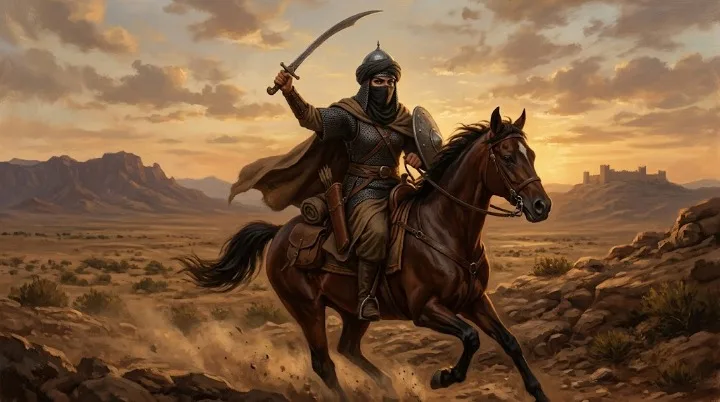

Khalid bin Walid died of natural causes in 642 CE in Homs, Syria, several years after being removed from overall military command by Caliph Umar. He did not die in battle — a fact tradition holds he found deeply frustrating, having survived more than 100 engagements without a scratch fatal enough to end him, only to be brought down by illness in his own bed. He was buried in Homs, where a mosque was later built around his tomb; that shrine suffered serious damage during the Syrian civil war in 2012–2013.
| Field | Detail |
|---|---|
| Date of death | 642 CE |
| Location | Homs (ancient Emesa), Syria |
| Cause | Natural causes / illness, not combat |
| Command status at death | Serving as a field commander, having been removed from overall command by Umar in 638 CE |
| Burial site | Homs, later enclosed within the Khalid ibn al-Walid Mosque |
| Condition of tomb today | Heavily damaged during the Syrian civil war (2012–2013); partially restored since |
The Man Who Survived Everything — Except Old Age
There’s something almost ironic about how Khalid bin Walid’s story ends. This was a commander who spent decades in the middle of the most dangerous fighting of the early Islamic conquests — cavalry charges, sieges, pitched battles against much larger armies — and came out the other side of all of it without ever losing. By the time he died, tradition says his body carried the marks of that career: old wounds, scars from swords, spears, arrows. And none of them killed him.
What did was something far more ordinary. He fell ill in Homs, in his own bed, and died there in 642 CE — years after his most famous victories, and years after he’d already been eased out of the top command by Caliph Umar.
His Last Words
The moment that’s stuck with people for centuries isn’t a battlefield speech — it’s what Khalid is said to have reflected on as he lay dying. According to the traditional account, he looked back on a life spent seeking what he considered an honorable death in battle, and found it almost bitter that after all of it, he was going to die quietly instead, the way an old man dies rather than a soldier. It’s the kind of detail that tells you more about how his contemporaries understood his identity than any battle report could — to them, and apparently to him, his whole sense of who he was ran through the battlefield.
It’s worth being upfront that, like most quoted last words from this period, this comes down to us through later narrative sources rather than a contemporaneous transcript. That doesn’t make it meaningless — it reflects how Khalid was remembered by the people closest to his legacy — but it’s not a verbatim recording in the modern sense.
Why He Wasn’t in Command When He Died
By the time of his death, Khalid was no longer the caliphate’s top general. Caliph Umar had removed him from overall command in 638 CE, a decision tied to concerns over how freely Khalid distributed the spoils of war, and a broader push to make sure victories were credited to the Muslim cause rather than to one general’s personal reputation. Khalid didn’t fight the decision. He kept serving as a field commander for the rest of his life, which is part of why historians tend to read his final years as a study in discipline rather than decline.
What Happened to His Grave
Khalid was buried in Homs, and over the centuries a mosque was built around his tomb — the Khalid ibn al-Walid Mosque, known for its twin minarets and domes, and long treated as a significant pilgrimage site.
That history took a hard turn during the Syrian civil war. In 2012 and 2013, the al-Khalidiyah neighborhood of Homs became an active battleground, and the mosque was caught in the fighting. Shelling brought down the minaret and damaged sections of the dome, and the tomb itself was partially destroyed. It became, for a time, one of the more visible symbols of the cultural cost of the war — a 1,300-year-old grave damaged in a 21st-century conflict. Restoration work has taken place in the years since, though the mosque bears the marks of what happened to it.
| Detail | Historical Status |
|---|---|
| Died in 642 CE in Homs | Well-attested across sources |
| Died of illness, not in battle | Well-attested |
| Had been removed from overall command years earlier | Well-attested |
| Specific final words as quoted in popular retellings | Traditional narrative, not a contemporaneous record |
| Tomb damaged during Syrian civil war | Documented by monitoring groups and journalists, 2012–2013 |
🛏️ Frequently Asked Questions — Passing and Legacy of Khalid ibn al-Walid
Khalid bin Walid died of natural causes — illness, not combat — in Homs, Syria, in 642 CE, several years after being removed from overall military command.
Tradition holds that he expressed regret at dying in bed rather than in battle, reflecting on a lifetime of combat wounds that never proved fatal, only to be taken down by illness in the end.
Yes. The shrine housing his tomb, inside the Khalid ibn al-Walid Mosque in Homs, was severely damaged by shelling during the Syrian civil war in 2012–2013, including the collapse of the minaret and parts of the dome. It has been partially restored since.
No. Despite surviving more than 100 battles without defeat, he died of illness in his own bed, not on the battlefield.
He’s buried in Homs, Syria, in a tomb that was later enclosed within the Khalid ibn al-Walid Mosque.
Sources
- Tabari, Tarikh al-Rusul wa’l-Muluk (History of the Prophets and Kings)
- Syrian Observatory for Human Rights, reporting on the 2013 destruction of the Khalid ibn al-Walid Mosque
- Contemporary news coverage (AFP, France 24, Syrian Observer) of damage to the shrine during the Syrian civil war