| Event Category | Key Historical Details |
|---|---|
| Most Significant Event | Louis Blériot completes the first flight across the English Channel in a heavier-than-air machine (1909) |
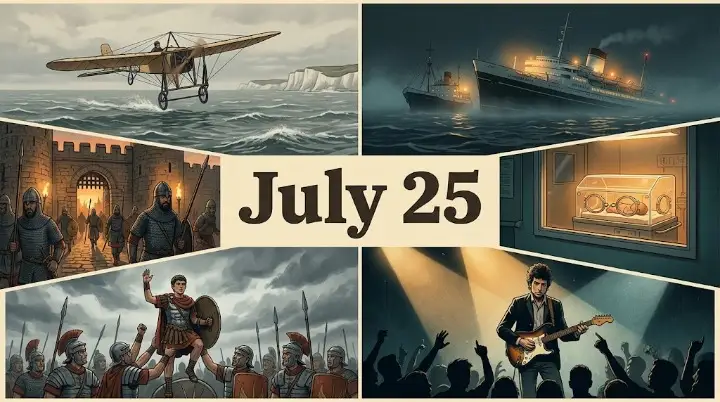
| Top 10 Key Events | Blériot’s Channel crossing (1909) • Byzantine recapture of Constantinople (1261) • Birth of Louise Joy Brown, first IVF baby (1978) • Constantine I proclaimed Roman emperor (306) • Battle of Ourique and birth of the Kingdom of Portugal (1139) • Assassination of Austrian Chancellor Engelbert Dollfuss (1934) • Sinking of the SS Andrea Doria (1956) • Mussolini forced from office (1943) • Bob Dylan goes electric at Newport (1965) • WikiLeaks publishes the Afghan War logs (2010) |
| Key Battles That Day | Battle of Ourique (1139), Battle of Molinella (1467), Battle of Abukir (1799), Operation Spring near Caen (1944), Seven-Day War / Operation Accountability in Lebanon (1993) |
| Key Figures Today | Constantine I, Louis Blériot, Louise Joy Brown, Bob Dylan, Rosalind Franklin |
| Observances | National Baha’i Day (Jamaica) Puerto Rico Constitution Day National Day of Galicia (Spain) Guanacaste Day (Costa Rica) International Afro-descendant Women’s Day Tenjin Matsuri (Osaka, Japan) |
Story of the Day: Louis Blériot Crosses the English Channel
At dawn on July 25, 1909, Louis Blériot climbed into a fragile monoplane he’d barely finished testing, his foot still bandaged from a burn suffered days earlier. He had no compass worth trusting and lost sight of land within minutes over open water. Twenty-three miles later, a gust nearly wrecked his landing near Dover Castle, but he walked away and into headlines around the world. Britain’s island isolation — its oldest military advantage — had just been erased in thirty-seven minutes.
Important Events That Happened On July 25 In History
306 – Constantine I Is Proclaimed Roman Emperor
At York, Roman soldiers surround the deathbed of Emperor Constantius Chlorus and turn to his son. Constantine is raised on a shield by his father’s legions, a soldier’s coronation with no Senate involved. The other claimants to the empire refuse to recognize him, setting off years of civil war. That contested afternoon in Britain eventually produces the man who legalizes Christianity across Rome.
315 – The Arch of Constantine Is Completed in Rome
Workers finish the massive triple archway beside the Colosseum, built to mark Constantine’s victory at the Milvian Bridge. Its carved panels recycle sculpture stripped from older monuments, patched together to flatter a new ruler in a hurry. Rome gets a permanent monument to a battle that decided who controlled the empire. Tourists still walk beneath it today, largely unaware they’re standing under recycled propaganda.
677 – The Siege of Thessalonica Reaches Its Climax
Slavic tribes hurl a three-day assault at the walls of Thessalonica, one of the Byzantine Empire’s largest cities. Siege engines batter gates that had held for years against smaller raids. The defenders hold the line, barely, and the city survives as a Byzantine stronghold. Its endurance keeps the empire’s grip on the northern Aegean intact for centuries longer.
864 – Charles the Bald Issues the Edict of Pistres
Charles the Bald orders new fortified bridges built across Frankish rivers, aimed squarely at slowing Viking longships. The edict forces towns to fund garrisons and construction, an unpopular tax dressed up as defense. Viking raids up French rivers become noticeably harder to pull off. It’s one of the earliest organized European responses to Viking incursions, rather than simple panic and ransom.
918 – Wang Geon Becomes King of Goryeo
A day after ousting the erratic ruler Gung Ye in a palace coup, Wang Geon accepts the throne of Goryeo. Generals who’d lost faith in Gung Ye’s brutal rule back the change without much resistance. Wang Geon founds a dynasty that will govern Korea for nearly five centuries. The kingdom’s name survives today in the word “Korea” itself.
1137 – Eleanor of Aquitaine Marries Prince Louis
Inside the Cathedral of Saint-André in Bordeaux, a teenage Eleanor of Aquitaine marries the future Louis VII of France. The marriage folds one of Europe’s richest duchies into the French crown overnight. It doesn’t last — their later divorce and Eleanor’s remarriage to Henry II reshape the map instead. Few weddings in medieval history end up rerouting so much territory twice over.
1139 – Battle of Ourique Creates a Kingdom
Prince Afonso Henriques leads his outnumbered forces against Almoravid troops under Ali ibn Yusuf at Ourique. His men win decisively, and soldiers on the field proclaim him king on the spot. Portugal’s origin story is built on that battlefield acclamation. The country traces its founding moment directly back to this one July afternoon.
1139 – Pope Innocent II Confirms Roger II’s Sicilian Holdings
In the Treaty of Mignano, Pope Innocent II formally recognizes the feudal rights of Roger II of Sicily’s sons. The pope abandons the barons who’d been fighting Roger, cutting them loose mid-rebellion. Roger’s Norman kingdom in southern Italy gains legitimacy it previously lacked. The peace lets Sicily consolidate into one of medieval Europe’s wealthiest states.
1261 – Constantinople Returns to Byzantine Hands
General Alexios Strategopoulos slips a small Nicaean force through an unguarded gate while most of Constantinople’s Latin garrison is away on campaign. The city falls back into Byzantine hands almost without a fight, ending nearly sixty years of Crusader occupation. Emperor Michael VIII Palaiologos enters in triumph soon after. The Byzantine Empire gets its capital back, though a weakened version that never fully recovers.
1278 – The Battle of Algeciras Plays Out at Sea
Fleets from Granada and the Marinid Dynasty clash with Castilian ships off Algeciras during the Reconquista. The Iberian and North African allies come out on top, denying Castile control of the strait. The naval defeat slows Castilian expansion into Muslim Spain for years. It’s a reminder that the Reconquista was fought on water as often as on land.
1441 – Henry VI Lays the Foundation of King’s College Chapel
At Cambridge, a teenage King Henry VI sets the first stone for what becomes King’s College Chapel. He personally drafts detailed instructions for its design, obsessing over a building he’ll barely live to see finished. Construction drags on for nearly a century after his death. The chapel’s fan-vaulted ceiling is still considered one of England’s great architectural achievements.
1467 – Firearms Reshape the Battle of Molinella
Rival Italian condottieri meet at Molinella in a battle notable less for who won than for how it was fought. Gunpowder weapons see heavy, organized use here for the first time on an Italian battlefield. Neither side gains a clear advantage despite the new technology. Warfare across the peninsula starts shifting away from pure cavalry and pikemen after this.
1536 – Sebastián de Belalcázar Founds Santiago de Cali
Chasing rumors of El Dorado’s gold, Spanish conquistador Sebastián de Belalcázar instead founds a settlement in the Cauca Valley. He names it Santiago de Cali, a garrison town rather than the treasure he’d been hunting. The city grows into modern-day Cali, Colombia’s third-largest. A search for a myth leaves behind a permanent metropolis.
1538 – Francisco de Orellana Founds Guayaquil
Conquistador Francisco de Orellana establishes a city on Ecuador’s coast, giving it the sprawling formal name Muy Noble y Muy Leal Ciudad de Santiago de Guayaquil. The port sits at a strategic river mouth ideal for trade. Guayaquil becomes Ecuador’s largest city and main commercial hub. Its founding date is still marked as a national holiday.
1547 – Henry II Is Crowned King of France
At Reims Cathedral, Henry II receives the crown following his father Francis I’s death. He inherits a kingdom deep in rivalry with the Habsburgs and immediately continues that fight. His reign later ends abruptly in a jousting accident that becomes one of history’s strangest royal deaths. The coronation itself, though, is a routine transfer of Valois power.
1554 – Mary I and Philip II Marry at Winchester
England’s Queen Mary I marries Philip II of Spain in a lavish ceremony at Winchester Cathedral. The match is deeply unpopular with English subjects wary of Spanish influence over the throne. Philip never gains real power in England and the marriage produces no heir. The union nonetheless ties English and Spanish politics together for the rest of Mary’s reign.
1567 – Diego de Losada Founds Caracas
Spanish captain Diego de Losada establishes Santiago de León de Caracas in a valley he’d fought local resistance to secure. The settlement grows slowly, hemmed in by mountains on nearly every side. Centuries later it becomes Caracas, the capital of Venezuela. Losada’s chosen valley still shapes the modern city’s cramped, elongated layout.
1591 – Maurice of Orange Defeats the Duke of Parma
Near Nijmegen, an Anglo-Dutch force under Maurice of Orange hands the Duke of Parma a rare defeat. Parma had been Spain’s most feared commander in the Dutch Revolt. The loss weakens Spanish momentum in the northern Netherlands at a critical moment. Dutch independence, still decades away, gains real breathing room from this one battlefield reversal.
1593 – Henry IV Converts to Catholicism
King Henry IV of France publicly abandons Protestantism and embraces Roman Catholicism before a watching court. He’s long been rumored to have said Paris is “worth a Mass,” and this conversion is exactly that calculation made real. The move ends much of the resistance to his rule among Catholic nobles. It paves the way for the Edict of Nantes just five years later.
1603 – James VI and I Is Crowned in Westminster Abbey
James VI of Scotland is crowned James I of England alongside his wife, Anne of Denmark, at Westminster Abbey. The coronation formally unites the Scottish and English crowns under one monarch for the first time. Plague raging through London forces the celebrations to stay unusually subdued. The Stuart line begins its turbulent century on the English throne this day.
1609 – The Sea Venture Runs Aground in Bermuda
Battered by a hurricane en route to Jamestown, the English ship Sea Venture is deliberately driven onto Bermuda’s reefs to keep it from sinking outright. Every passenger survives the wreck, stranded on an island no one had planned to settle. They build new ships from Bermuda cedar and salvaged parts. Their accidental colony becomes the basis for England’s permanent claim to Bermuda.
1668 – A Massive Earthquake Devastates Eastern China
A magnitude 8.5 earthquake tears through Shandong province, one of the most powerful ever recorded in China. Whole towns collapse within minutes, and landslides bury roads and farmland across the region. More than 43,000 people are killed. It remains among the deadliest earthquakes in recorded Chinese history.
1693 – Ignacio de Maya Founds Sabinas Hidalgo
Spanish settler Ignacio de Maya establishes Real Santiago de las Sabinas in what is now northeastern Mexico. The settlement takes root in an arid stretch of land bordering Indigenous territory. It survives as a modest agricultural town for centuries. Today it’s known as Sabinas Hidalgo, in Nuevo León.
1718 – Construction Begins on Kadriorg Palace
On Peter the Great’s orders, workers break ground on a palace in Tallinn dedicated to his wife, Catherine. The Baroque design is meant to project Russian imperial power on newly won Baltic territory. Construction stretches on for years under harsh coastal weather. Kadriorg Palace still stands in Tallinn as one of Estonia’s most visited landmarks.
1722 – Dummer’s War Begins
Fighting erupts along the Maine-Massachusetts frontier between English colonists and the Wabanaki Confederacy. Disputes over land and fishing rights had simmered for years before breaking into open conflict. The war drags on for roughly three years of raids and reprisals on both sides. It leaves colonial New England’s northern frontier unsettled well into the next generation.
1755 – Nova Scotia Orders the Deportation of the Acadians
Governor Charles Lawrence and the Nova Scotia Council order the forced removal of thousands of French-speaking Acadian settlers. Families are split apart and loaded onto ships bound for scattered colonies along the Atlantic coast. Homes and farms are burned behind them to prevent return. The expulsion, known as Le Grand Dérangement, becomes one of the era’s harshest acts of ethnic cleansing.
1759 – British Forces Capture Fort Niagara
After a hard siege during the French and Indian War, British troops force the surrender of Fort Niagara in western New York. The French abandon nearby Fort Rouillé rather than risk a similar fate. The loss cuts off French supply routes between Canada and the Ohio Valley. British control of the region tightens decisively in the war’s closing years.
1783 – The Siege of Cuddalore Ends the Revolutionary War
A preliminary peace agreement halts the Siege of Cuddalore in India, the final military action of the American Revolutionary War. British and French forces had kept fighting on the far side of the world even as American independence was being settled. News of peace arrives just as another assault was being planned. The war that began at Lexington finally goes silent on a battlefield thousands of miles from it.
1788 – Mozart Finishes His Symphony No. 40
Working at extraordinary speed, Wolfgang Amadeus Mozart completes his Symphony No. 40 in G minor. He’s deep in financial trouble at the time, writing masterpieces while begging friends for loans. The symphony’s restless, minor-key intensity sets it apart from his more cheerful work. It becomes one of the most performed symphonies in the classical repertoire.
1792 – The Brunswick Manifesto Threatens Paris
The Duke of Brunswick issues a manifesto warning Parisians of “military execution” if the French royal family is harmed. Meant to intimidate revolutionaries into protecting the king, it does the opposite. Parisians read it as proof foreign armies were coming to crush the revolution outright. Anger over the manifesto helps ignite the storming of the Tuileries Palace weeks later.
1797 – Nelson Loses His Arm at Tenerife
Leading a night assault on Santa Cruz de Tenerife, Horatio Nelson is struck by grapeshot and loses his right arm. The attack collapses in chaos, costing more than 300 British casualties. Nelson survives, evacuated by his own stepson under fire. He returns to duty scarred but undeterred, years before Trafalgar makes him a legend.
1799 – Napoleon Crushes an Ottoman Army at Abukir
Napoleon Bonaparte’s forces rout a much larger Ottoman army under Mustafa Pasha near Abukir Bay in Egypt. Ottoman troops are pushed back into the sea, suffering catastrophic losses. The victory temporarily restores French prestige after earlier naval defeats in the region. It becomes one of the battles Napoleon later boasts about most as proof of his tactical genius.
1814 – An American Attack on Canada Fails
During the War of 1812, American forces launch another push across the Canadian border and are turned back once again. British and Canadian militia hold their defensive lines despite repeated pressure. The failed attack adds to a long pattern of stalemate along the northern front. Neither side gains lasting ground in this stretch of the war.
1824 – Costa Rica Annexes Guanacaste
The province of Guanacaste votes to break from Nicaragua and join Costa Rica instead. Local landowners had grown closer economically to Costa Rica’s markets than Nicaragua’s. Costa Rica formally accepts the annexation, gaining valuable Pacific coastline. The date is still celebrated as Guanacaste Day, one of Costa Rica’s proudest civic holidays.
1835 – James Bowman Lindsay Demonstrates Electric Light
In Dundee, Scotland, inventor James Bowman Lindsay shows a public audience a constant electric light decades before Edison’s bulb. He reportedly tells onlookers he could “read a book at a distance of one and a half feet” by it. Lindsay never patents or commercializes the invention. His demonstration fades into obscurity while later inventors claim the credit history remembers.
1837 – The Electrical Telegraph Debuts in London
William Cooke and Charles Wheatstone successfully demonstrate the first commercial electrical telegraph in London. Messages that once took hours by courier now travel instantly along a wire. Railway companies are among the first to adopt the technology for signaling. It’s the opening act of a communications revolution that eventually spans continents.
1853 – Joaquin Murrieta Is Killed
California lawmen track down and kill Joaquin Murrieta, a bandit mythologized as the “Robin Hood of El Dorado.” His death comes amid a bounty campaign targeting Mexican-American outlaws during the Gold Rush era. Rangers reportedly display his severed head as proof to collect the reward. Murrieta’s story blurs quickly into legend, inspiring later folklore figures like Zorro.
1861 – Congress Passes the Crittenden–Johnson Resolution
Reeling from defeat at the First Battle of Bull Run, the U.S. Congress passes a resolution declaring the Civil War is fought to preserve the Union, not to end slavery. Lawmakers hope the framing will keep border states from joining the Confederacy. The resolution’s limits become obsolete as the war grinds on. Emancipation eventually becomes central to the Union cause anyway, despite this early disclaimer.
1866 – Grant Becomes the First General of the Army
Congress creates the rank of General of the Army specifically to honor Ulysses S. Grant’s Civil War leadership. Grant becomes the first officer to hold the rank in U.S. history. The promotion cements his status as the war’s most successful Union commander. Within three years, that reputation carries him straight into the presidency.
1868 – The Wyoming Territory Is Established
Congress formally organizes the Wyoming Territory out of land carved from neighboring territories. Its sparse population and railroad access make federal organization overdue. Wyoming later becomes the first territory to grant women the right to vote. That progressive streak earns it the nickname “the Equality State.”
1869 – Japanese Daimyōs Begin Returning Land to the Emperor
As part of the Meiji Restoration, Japan’s feudal lords start voluntarily surrendering their domains back to imperial authority. The move dismantles centuries of decentralized samurai rule in favor of a unified national government. Some daimyōs resist quietly, but the tide of reform proves unstoppable. Japan’s rapid modernization into an industrial power traces directly back to reforms like this one.
1894 – The First Sino-Japanese War Begins
Japanese naval forces open fire on a Chinese warship, triggering the First Sino-Japanese War. The conflict is fought largely over influence in Korea. Japan’s modernized military delivers a shocking, decisive defeat of Qing China within months. The war reshapes East Asian power balances and marks Japan’s arrival as a regional military power.
1897 – Jack London Sets Sail for the Klondike
A young, broke Jack London boards a ship bound for the Klondike gold rush, chasing fortune in the Yukon. He finds almost no gold but gathers material that will define his writing career. Stories drawn from that brutal winter become the foundation of his early literary success. A failed prospecting trip turns into one of American literature’s great origin stories.
1898 – The U.S. Invades Puerto Rico
American troops under General Nelson A. Miles land at Guánica, opening the U.S. invasion of Spanish-held Puerto Rico. Resistance is light compared to the fighting in Cuba during the same war. The island transfers from Spanish to American control within weeks. Puerto Rico’s political relationship with the United States, still debated today, begins on this beach landing.
1908 – Ajinomoto Is Founded
Chemist Kikunae Ikeda of Tokyo Imperial University isolates the flavor compound behind kombu soup stock’s savory taste. He identifies it as monosodium glutamate and patents a manufacturing process almost immediately. The Ajinomoto company is founded to commercialize the discovery. MSG becomes one of the most widely used flavor enhancers in food worldwide, and one of its most argued-over.
1909 – Louis Blériot Crosses the English Channel
(Covered in full above — see “Story of the Day.”) Blériot’s thirty-seven-minute flight from Calais to Dover makes him the first person to cross the Channel in a heavier-than-air aircraft. The stunt wins a £1,000 prize from a British newspaper and instant global fame. Aviation stops being a novelty and starts looking like the future of warfare and travel.
1909 – The Tragic Week Begins in Barcelona
Anger over troop mobilizations for Spain’s colonial war in Morocco explodes into riots across Barcelona. Workers and anarchists burn churches and clash with police over several chaotic days. The unrest, later called Setmana Tràgica, exposes deep class and colonial tensions in Spain. Harsh reprisals afterward only deepen the resentment that fueled it.
1915 – The British Capture Nasiriyah
British forces seize the city of Nasiriyah from Ottoman defenders during the Mesopotamian campaign. The advance is part of a broader push up the Tigris and Euphrates toward Baghdad. Ottoman troops fall back after fierce resistance in the surrounding marshland. The campaign later stalls disastrously at Kut, but this early win boosts British confidence.
1915 – Lanoe Hawker Earns the First Aviator’s Victoria Cross
RFC Captain Lanoe Hawker becomes the first British pilot awarded the Victoria Cross, for downing three German aircraft in a single sortie. Aerial combat is still brand new, fought with pistols and improvised weapons before purpose-built fighters exist. Hawker’s award signals that air power has become a serious front of the war. He’s later killed in a duel with the Red Baron in 1916.
1917 – Canada Introduces Its First Income Tax
Finance Minister Robert Borden introduces income tax in Canada, calling it a “temporary” wartime measure. Rates start at 4% for the lowest bracket and climb to 25% at the top. The tax is meant to fund Canada’s contribution to the First World War. It never actually goes away, becoming a permanent fixture of Canadian government finance.
1925 – TASS Is Established
The Soviet Union creates the Telegraph Agency of the Soviet Union, centralizing state news distribution. TASS becomes the primary filter through which the world receives Soviet-approved information. Its reports shape Cold War-era perceptions on both sides of the Iron Curtain. The agency still operates in Russia today under the same name.
1934 – Nazis Assassinate Austrian Chancellor Dollfuss
Austrian Nazi militants storm the chancellery in Vienna and shoot Engelbert Dollfuss during a failed coup attempt. Dollfuss, who had banned the Nazi party in Austria, is left to bleed out and denied medical care. The coup itself collapses within hours. His death foreshadows the far larger German annexation of Austria just four years later.
1940 – Switzerland Vows to Resist German Invasion
General Henri Guisan issues an order that the Swiss Army will fight rather than surrender if Germany invades. He makes capitulation a criminal offense for any Swiss commander. The declaration, delivered from the symbolic Rütli meadow, hardens national resolve during the war’s darkest early years. Germany never does invade, and Swiss neutrality survives the conflict intact.
1942 – The Norwegian Manifesto Calls for Resistance
Norwegian civic and religious leaders issue a manifesto urging nonviolent resistance to German occupation. It calls on citizens to refuse cooperation with Nazi-imposed institutions wherever possible. The document circulates secretly among churches, schools, and unions. Quiet noncompliance becomes one of occupied Norway’s most effective forms of pushback.
1943 – Mussolini Is Forced Out of Office
Italy’s Grand Council of Fascism turns on Benito Mussolini, and King Victor Emmanuel III dismisses him from power. Mussolini is arrested as he leaves the meeting, ending two decades of Fascist rule. Pietro Badoglio takes over and secretly begins negotiating with the Allies. Italy’s war effort effectively starts unraveling from this single afternoon.
1943 – German Troops Massacre Greek Civilians in Mousiotitsa
Soldiers of the German 1st Mountain Division kill 136 civilians in the small Greek village of Mousiotitsa. The massacre is part of a wider pattern of reprisal killings against villages suspected of aiding partisans. No meaningful resistance activity is found to justify the scale of the slaughter. The village remains a memorial site to one of the war’s lesser-known atrocities.
1944 – Operation Spring Devastates Canadian Troops Near Caen
Canadian forces launch Operation Spring against entrenched German positions south of Caen. Well-placed German armor and artillery inflict catastrophic Canadian casualties within hours. It becomes one of the bloodiest single days for the First Canadian Army in the entire war. The costly offensive nonetheless helps pin down German reserves ahead of the American breakout at Normandy.
1946 – The Crossroads Baker Test Detonates Underwater
The United States detonates the Crossroads Baker device beneath the waters of Bikini Atoll, the first underwater nuclear weapon test. The blast throws a column of radioactive water high into the air, dousing target ships in fallout. Scientists are stunned by how differently the bomb behaves underwater compared to airburst tests. The test reshapes understanding of nuclear contamination and naval vulnerability alike.
1956 – The Andrea Doria Collides with the Stockholm
In dense fog off Nantucket, the Italian liner Andrea Doria collides with the Swedish ship MS Stockholm. The Andrea Doria takes on water immediately, listing so badly that half its lifeboats become unusable. Fifty-one people die in the collision and its chaotic aftermath. The ship sinks the next morning, becoming one of the most famous maritime disasters of the 20th century.
1957 – Tunisia Abolishes Its Monarchy
Habib Bourguiba replaces Muhammad VIII al-Amin as Tunisia’s head of state, ending the monarchy entirely. The move follows closely on the heels of Tunisian independence from France the year before. Bourguiba declares Tunisia a republic and becomes its first president. His decades-long rule sets Tunisia’s modern political direction for generations.
1958 – The African Regroupment Party Holds Its First Congress
Pan-African political leaders gather in Cotonou for the first congress of the African Regroupment Party. The meeting aims to coordinate independence movements across French West Africa. Delegates debate how closely new nations should align with or break from France. The congress becomes a milestone in the broader wave of African decolonization sweeping the era.
1961 – Kennedy Links Berlin’s Defense to NATO
In a televised address, President John F. Kennedy declares that any Soviet move against West Berlin will be treated as an attack on NATO itself. The speech comes amid rising Cold War tension over the divided city. Kennedy’s firm language signals the U.S. won’t abandon Berlin under pressure. Weeks later, East Germany begins building the Berlin Wall regardless.
1965 – Bob Dylan Goes Electric at Newport
Bob Dylan plugs in an electric guitar at the Newport Folk Festival, breaking with the acoustic tradition his fans expected. Parts of the crowd boo loudly, feeling betrayed by the shift in sound. Dylan plays only a handful of songs before walking off amid the uproar. The performance becomes a defining moment in the collision between folk purism and rock’s rising dominance.
1969 – Nixon Announces the Nixon Doctrine
President Richard Nixon outlines a new policy stating that U.S. Asian allies must take greater responsibility for their own defense. The doctrine marks the start of “Vietnamization,” shifting combat duties onto South Vietnamese forces. American troop withdrawals from Vietnam accelerate in the following years. It reshapes U.S. foreign policy well beyond Vietnam, toward relying on regional partners generally.
1971 – The Sohagpur Massacre Is Carried Out
Pakistani soldiers kill dozens of men in the village of Sohagpur during the Bangladesh Liberation War. Most of the men in the village are rounded up and executed, leaving widows to rebuild the community alone. The massacre becomes emblematic of the war’s brutal targeting of civilians. Survivors’ accounts later help document the scale of the 1971 atrocities.
1973 – The Soviet Union Launches Mars 5
The Soviet Mars 5 probe lifts off, bound for the red planet as part of an ambitious exploration program. It later achieves partial success, returning valuable atmospheric and surface data before failing early. The mission is one piece of the intense Cold War-era space race beyond just the Moon. Its data quietly informs Mars exploration for decades afterward.
1976 – Viking 1 Captures the “Face on Mars”
NASA’s Viking 1 orbiter photographs a Martian mesa that, in low-resolution images, resembles a giant carved face. The image spreads rapidly and fuels years of conspiracy theories about ancient civilizations on Mars. Later, higher-resolution photos reveal it as an ordinary rock formation shaped by light and shadow. The “face” remains one of the internet era’s favorite pieces of space pseudoscience.
1978 – Police Shoot Nationalists in the Cerro Maravilla Killings
Puerto Rican police shoot and kill two young pro-independence activists at Cerro Maravilla, claiming self-defense. Later investigations reveal officers had lured the men into an ambush and lied about the circumstances. The case becomes a lasting symbol of government overreach against Puerto Rico’s independence movement. Convictions of the officers involved take years of pressure to secure.
1978 – Louise Joy Brown, the First IVF Baby, Is Born
(Covered in full above — see intro.) Her birth in Oldham, England proves in vitro fertilization can produce a healthy child, opening reproductive medicine to millions of future families. Researchers Robert Edwards and Patrick Steptoe, who developed the technique, face fierce ethical criticism at the time. Edwards later wins a Nobel Prize for the breakthrough. IVF eventually helps bring more than twelve million babies into the world.
1979 – Israel Begins Withdrawing from the Sinai
As part of the Egypt–Israel peace treaty, Israeli forces begin a phased withdrawal from the Sinai Peninsula. The pullback follows years of war and a landmark peace process brokered largely by the United States. Settlements and military installations are dismantled step by step over the following years. The withdrawal remains one of the rare full territorial handbacks in modern Middle East history.
1983 – The Welikada Prison Massacre Kills Tamil Prisoners
Sinhalese inmates at Sri Lanka’s Welikada high-security prison kill 37 Tamil political prisoners in a coordinated attack. The massacre unfolds during the wider anti-Tamil violence known as Black July. Prison authorities are widely accused of doing little to stop the killings. The bloodshed becomes one of the sparks that hardens the Sri Lankan civil war to come.
1984 – Svetlana Savitskaya Becomes the First Woman to Spacewalk
Aboard the Salyut 7 space station, Soviet cosmonaut Svetlana Savitskaya steps outside for humanity’s first female spacewalk. She spends over three hours conducting welding and metal-cutting experiments in open space. Her achievement comes nearly two decades after the first male spacewalk, highlighting how long women had been excluded. Savitskaya’s flight becomes a landmark moment for women in space exploration.
1993 – Israel Launches Operation Accountability in Lebanon
Israel begins a major military operation against targets in southern Lebanon, calling it Operation Accountability. Lebanese sources refer to the same week of fighting as the Seven-Day War. The offensive aims to pressure Hezbollah and displaces large numbers of civilians in the process. A U.S.-brokered understanding eventually halts the fighting, though tensions in the region remain far from resolved.
1993 – Gunmen Attack St. James Church in Cape Town
Armed attackers open fire inside St. James Church in Kenilworth, Cape Town, during a Sunday service. Eleven worshippers are killed and dozens more wounded in the assault. The attack, linked to the armed wing of the Pan Africanist Congress, shocks a country already gripped by apartheid-era violence. It becomes one of the most searing images of South Africa’s fraught transition years.
1994 – Israel and Jordan Sign the Washington Declaration
Israeli and Jordanian leaders sign the Washington Declaration, formally ending the state of war between the two nations dating back to 1948. The agreement paves the way for a full peace treaty signed later that year. It marks one of the Middle East’s clearer diplomatic successes of the decade. Israel and Jordan remain at peace under the terms established that day.
1995 – A Bombing Strikes the Paris Métro
A gas cylinder packed with explosives detonates at the Saint-Michel station on Paris’s RER line B. Eight people are killed and around 80 wounded in the crowded underground blast. The attack is tied to a wave of bombings linked to Algeria’s civil conflict spilling into France. Paris tightens security across its transit system in the aftermath.
1996 – A Coup Topples Burundi’s President
Major Pierre Buyoya seizes power in Burundi, deposing President Sylvestre Ntibantunganya in a military coup. The takeover comes amid escalating ethnic violence between Hutu and Tutsi factions. International sanctions follow quickly, isolating the new government. Buyoya’s return to power extends a cycle of instability that had gripped Burundi for years.
2000 – Concorde Flight 4590 Crashes Outside Paris
An Air France Concorde catches fire moments after takeoff from Charles de Gaulle Airport and crashes into a nearby hotel. All 109 people aboard and four on the ground are killed. Investigators trace the disaster to debris on the runway that shredded a tire and ruptured a fuel tank. The crash effectively ends the Concorde’s supersonic passenger era within a few years.
2001 – Phoolan Devi Is Assassinated
Phoolan Devi, a former bandit turned sitting member of India’s Parliament, is shot dead outside her home in New Delhi. Her life had already become legend, from a childhood of abuse to armed rebellion and eventual political redemption. Gunmen linked to old caste feuds are blamed for the killing. Her assassination closes one of modern India’s most dramatic personal stories.
2007 – Pratibha Patil Becomes India’s First Female President
Pratibha Patil is sworn in as President of India, becoming the first woman to hold the office. Her rise comes after decades in state and national politics, largely outside the national spotlight. The position is largely ceremonial, but the symbolism resonates across the country. Patil’s inauguration marks a milestone moment for women in Indian public life.
2010 – WikiLeaks Publishes the Afghan War Logs
WikiLeaks releases tens of thousands of classified U.S. military documents detailing the war in Afghanistan. The leak exposes previously unreported civilian casualties and details of the conflict kept from public view. It becomes one of the largest breaches of U.S. military secrecy in history. The fallout intensifies global debate over transparency, whistleblowing, and wartime accountability.
2018 – Coordinated Attacks Strike As-Suwayda, Syria
Militants carry out a series of coordinated assaults across the city of As-Suwayda in southern Syria. The attacks include suicide bombings and armed raids on civilian areas. Dozens are killed in one of the deadliest single days the region sees that year. The violence underscores how fractured and dangerous Syria’s civil war remains even years in.
2019 – Europe Sets Extreme Heat Records
The UK, Belgium, the Netherlands, and Germany each record their hottest temperatures ever measured on this date. The heat wave strains power grids, transport networks, and emergency services across the continent. Scientists link the extreme readings to broader climate change trends. The records mark one of the clearest early warnings of Europe’s changing summer extremes.
Curious about what happened yesterday? Click for the full story.
Famous People Born on July 25
| Name | Description | Date |
|---|---|---|
| Afonso I | First King of Portugal | 1109 – 1185 |
| Ibn Arabi | Andalusian Sufi mystic, philosopher, and poet | 1165 – 1240 |
| George Peele | English playwright and poet | 1556 – 1596 |
| Henry Knox | American Revolutionary War general and first U.S. Secretary of War | 1750 – 1806 |
| Thomas Eakins | American realist painter | 1844 – 1916 |
| Arthur Balfour | British Prime Minister and statesman | 1848 – 1930 |
| Jim Corbett | Indian hunter, conservationist, and author | 1875 – 1955 |
| Walter Brennan | American actor and three-time Academy Award winner | 1894 – 1974 |
| Gavrilo Princip | Bosnian Serb revolutionary whose assassination triggered World War I | 1894 – 1918 |
| Eric Hoffer | American philosopher and social critic | 1902 – 1983 |
| Elias Canetti | Nobel Prize-winning novelist and essayist | 1905 – 1994 |
| Rosalind Franklin | British scientist whose work advanced DNA research | 1920 – 1958 |
| John B. Goodenough | Nobel Prize-winning scientist and lithium-ion battery pioneer | 1922 – 2023 |
| Estelle Getty | American actress best known for The Golden Girls | 1923 – 2008 |
| Dolphy | Legendary Filipino actor and comedian | 1928 – 2012 |
| Paul J. Weitz | American NASA astronaut | 1932 – 2017 |
| Glenn Murcutt | Pritzker Prize-winning Australian architect | 1936 – Present |
| Colin Renfrew | British archaeologist and academic | 1937 – Present |
| Emmett Till | African American teenager whose murder became a civil rights catalyst | 1941 – 1955 |
| Rita Marley | Cuban-Jamaican reggae singer and philanthropist | 1946 – Present |
| Walter Payton | Hall of Fame American football player | 1953 – 1999 |
| Iman | Somali-born supermodel and actress | 1955 – Present |
| Frances Arnold | Nobel Prize-winning American engineer and chemist | 1956 – Present |
| Geoffrey Zakarian | American celebrity chef and restaurateur | 1959 – Present |
| Anne Applebaum | Pulitzer Prize-winning journalist and historian | 1964 – Present |
| Matt LeBlanc | American actor, known for Friends | 1967 – Present |
| Lauren Faust | American animator and creator of My Little Pony: Friendship Is Magic | 1974 – Present |
| Finn Bálor | Irish professional wrestler | 1981 – Present |
| Hasan Piker | American political commentator and streamer | 1991 – Present |
| Maria Sakkari | Greek professional tennis player | 1995 – Present |
Famous People Died on July 25
| Name | Description | Date |
|---|---|---|
| Constantius Chlorus | Roman Emperor | 250 – 306 |
| Thomas à Kempis | Christian mystic and author of The Imitation of Christ | 1380 – 1471 |
| Innocent VIII | Pope of the Catholic Church | 1432 – 1492 |
| Ferdinand I | Holy Roman Emperor | 1503 – 1564 |
| Isaac Luria | Influential Jewish rabbi and Kabbalist | 1534 – 1572 |
| Samuel Taylor Coleridge | English Romantic poet and philosopher | 1772 – 1834 |
| Charles Macintosh | Scottish inventor of the waterproof raincoat | 1766 – 1843 |
| François Coty | French businessman and founder of Coty | 1874 – 1934 |
| Engelbert Dollfuss | Chancellor of Austria | 1892 – 1934 |
| Vladimir Vysotsky | Russian singer-songwriter, actor, and poet | 1938 – 1980 |
| Big Mama Thornton | American blues singer-songwriter | 1926 – 1984 |
| Vincente Minnelli | Academy Award-winning film director | 1903 – 1986 |
| Judith Barsi | American child actress | 1978 – 1988 |
| Ben Hogan | American golf legend | 1912 – 1997 |
| John Schlesinger | Academy Award-winning British film director | 1926 – 2003 |
| Randy Pausch | American computer scientist and author of The Last Lecture | 1960 – 2008 |
| Vernon Forrest | American world champion boxer | 1971 – 2009 |
| Harry Patch | Last surviving British veteran of World War I trenches | 1898 – 2009 |
| Yasmin Ahmad | Malaysian film director and screenwriter | 1958 – 2009 |
| Michael Cacoyannis | Greek-Cypriot film director (Zorba the Greek) | 1922 – 2011 |
| Franz West | Austrian contemporary artist and sculptor | 1947 – 2012 |
| Walter De Maria | American sculptor and land artist | 1935 – 2013 |
| Tim LaHaye | American Christian minister and bestselling author | 1926 – 2016 |
| Sergio Marchionne | Italian-Canadian automotive executive | 1952 – 2018 |
| Beji Caid Essebsi | President of Tunisia | 1926 – 2019 |
| Regis Philbin | American television host | 1931 – 2020 |
| Peter Green | English guitarist and founder of Fleetwood Mac | 1946 – 2020 |
| Paul Sorvino | American actor | 1939 – 2022 |
| Martin Indyk | American diplomat and Middle East expert | 1951 – 2024 |
| Shafin Ahmed | Bangladeshi rock singer and bassist | 1961 – 2024 |
Observances on July 25
National Baha’i Day (Jamaica): A national observance recognizing and honoring the contributions and presence of the Baha’i community in Jamaica.
Puerto Rico Constitution Day (Puerto Rico): Commemorates the official proclamation of the Constitution of the Commonwealth of Puerto Rico in 1952.
National Day of Galicia (Galicia, Spain): An official holiday celebrating Galician culture, identity, and its patron saint, Saint James.
Guanacaste Day (Costa Rica): Marks the 1824 annexation of the Guanacaste province from Nicaragua to Costa Rica.
International Afro-descendant Women’s Day: A day dedicated to acknowledging the achievements, struggles, and rights of Afro-descendant women globally.
Tenjin Matsuri (Osaka, Japan): A famous traditional festival honoring Sugawara no Michizane, the deity of learning and scholarship, featuring land and river processions.
✈️ Frequently Asked Questions — July 25 in History
Louis Blériot completed the first flight across the English Channel in a heavier-than-air aircraft, flying from Calais to Dover in just thirty-seven minutes. The feat proved aviation could cross real geographic barriers, not just hop short distances. It’s still considered one of the founding moments of modern flight.
Several stand out, including the 1894 outbreak of the First Sino-Japanese War and the bloody 1944 Operation Spring near Caen during World War II. The 1993 Israeli offensive in Lebanon, known as Operation Accountability, also falls on this date. Each reflects a different era’s version of conflict, from imperial rivalry to modern asymmetric warfare.
Rosalind Franklin, the British scientist whose X-ray work was essential to discovering the structure of DNA, was born on July 25, 1920. Ibn Arabi, the influential Andalusian Sufi mystic, philosopher, and poet, is also associated with this date in some historical accounts. More names tied to July 25 appear in the key figures list above.
Most historians point to Louis Blériot’s 1909 Channel crossing as the single most consequential event tied to this date. It ended Britain’s centuries-old sense of island security and kicked off serious military and commercial interest in aviation. Few single flights have reshaped strategic thinking so quickly.
Guanacaste Day marks the 1824 annexation of Guanacaste province from Nicaragua into Costa Rica, following a local vote favoring closer ties with Costa Rica. It’s celebrated with parades, traditional dance, and regional pride across the province. The holiday reflects how a 19th-century land dispute still shapes Costa Rican identity today.
In 2019, several European countries including the UK, Germany, Belgium, and the Netherlands recorded their highest-ever temperatures on this date during a severe heat wave. The extreme readings strained infrastructure and renewed urgency around climate change discussions. It stands as one of the more recent entries in July 25’s long historical record.