Quick Facts — August 5 in History
| Category | Detail |
|---|---|
| Most Significant Event | First transatlantic telegraph cable completed (1858) |
| Top Key Events |
|
| Key Battles | Battle of Jaffa (1192), Battle of Petrovaradin (1716), Battle of Mobile Bay (1864) |
| Key Figures | Neil Armstrong, Guy de Maupassant, Cyrus Field, Richard Nixon, Nelson Mandela |
| Observances | July Mass Uprising Day (Bangladesh), Independence Day (Burkina Faso), Victory Day (Croatia) |
Story of the Day: The Tape That Broke a President
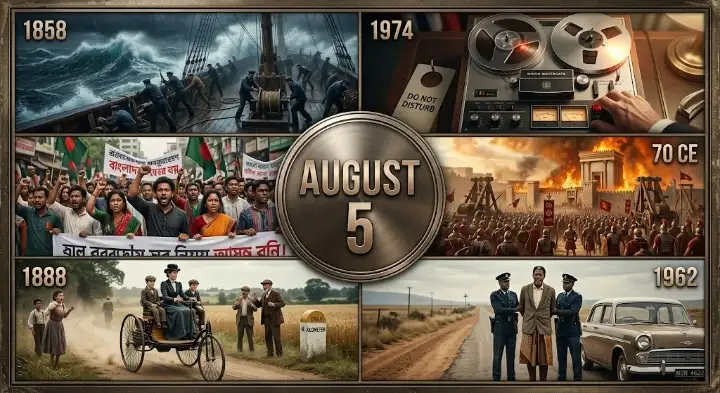
Richard Nixon sat in the Oval Office on August 5, 1974, knowing his presidency was over. The Supreme Court had forced him to release the audio reels from June 23, 1972—a recording that would become known as the “Smoking Gun” tape. On it, Nixon’s own voice clearly instructed the CIA to shut down the FBI’s investigation into the Watergate break-in. His political shield evaporated in hours as ally after ally abandoned him. Within four days, he became the first US president to resign, proving that even the most powerful man in the world couldn’t hide from his own words.
Important Events That Happened On August 5 In History
AD 25 – Guangwu Restores the Han Dynasty
Guangwu stood before his cheering troops and claimed the imperial throne, officially restoring the Han dynasty. The short-lived Xin dynasty had collapsed under economic turmoil and peasant revolts. By establishing the Eastern Han, Guangwu brought decades of stability back to China. His victory secured a golden age of trade and Chinese cultural advancement that lasted two centuries.
70 – Second Temple Fire Extinguished
Jerusalem’s ancient skyline lay in ruins as Roman soldiers finally put out the fires inside the destroyed Second Temple. General Titus had ordered the city crushed to break a fierce Jewish rebellion. The temple’s fall wiped away the political and religious core of Judea. It forced the Jewish people into a global diaspora that lasted nearly two millennia.
642 – Battle of Maserfield Claims King Oswald
Penda, the pagan King of Mercia, clashed with the Christian forces of Northumbria on the bloody field of Maserfield. King Oswald of Northumbria fought bravely but was surrounded and killed in the chaos. Penda dismembered the dead king’s body and displayed his limbs on wooden stakes. Oswald’s death delayed the spread of Christianity in northern England, turning him into an early Christian martyr.
910 – Anglo-Saxons Crush the Danes at Tettenhall
A massive Viking army marched across Mercia, pillaging towns before encountering the combined forces of Mercia and Wessex. King Edward the Elder trapped the raiding Danes near Tettenhall, cutting off their retreat. Thousands of Norse warriors fell in the brutal clash, including three of their high kings. This decisive defeat ended the last major Danish raid on English soil for nearly a century.
939 – Battle of Alhandic at Zamora
Emir Abd-ar-Rahman III led a massive Moorish army toward the walls of Zamora during the Spanish Reconquista. King Ramiro II of León ambushed the invading forces in a deep ravine known as Alhandic. The Muslim army suffered heavy casualties, forcing the Emir to flee for his life. The Christian victory halted Cordoban expansion northward and reshaped the military borders of medieval Spain.
974 – Caliph al-Muti Forced to Abdicate
Sabuktakin, a powerful Turkic general, marched into Baghdad and confronted Abbasid Caliph al-Muti. Weakened by paralysis and political chaos, the helpless caliph was stripped of his authority. Sabuktakin forced him to step down immediately in favor of his son, al-Ta’i. This palace coup highlighted how foreign military commanders had seized absolute control over the Islamic world’s capital.
1068 – Normans Lay Siege to Bari
Italo-Norman commander Robert Guiscard arrayed his army around the coastal city of Bari, the last Byzantine stronghold in Italy. The city’s defenders dug in behind thick stone walls, hoping for relief fleets from Constantinople. The grueling siege dragged on for nearly three years, starvation slowly crippling the garrison. When Bari finally fell, Byzantine rule vanished from Southern Italy forever.
1100 – Henry I Crowned King of England
Henry I walked into Westminster Abbey and claimed the crown while his older brother Robert was away fighting in the Crusades. Their brother King William Rufus had died in a suspicious hunting accident just three days earlier. Henry acted instantly to secure the royal treasury and win over the powerful Norman barons. His swift coronation laid the groundwork for a central royal administration that changed English law forever.
1192 – Battle of Jaffa Secures Crusader Coast
Saladin launched a surprise dawn attack against the coastal stronghold of Jaffa, surrounding the tiny garrison inside. King Richard I of England waded ashore through the waves, wielding his battleaxe alongside a handful of knights. Despite being vastly outnumbered, Richard’s desperate charge drove the Muslim forces back in confusion. The victory forced Saladin to sign a peace treaty that guaranteed Christian pilgrims safe access to Jerusalem.
1278 – Castilians Begin Siege of Algeciras
King Alfonso X of Castile ordered his fleet and army to blockade the crucial port city of Algeciras. The Castilians hoped to sever the sea route between the Emirate of Granada and its North African allies. Disease, food shortages, and furious Moorish counterattacks slowly wore down the besiegers over the next year. The enterprise ended in absolute failure, costing Castile its navy and securing Granada’s survival.
1305 – William Wallace Captured Near Glasgow
Sir John Stewart of Menteith, a Scottish noble loyal to England, ambushed Sir William Wallace at Robroyston. The famous leader of Scottish independence was dragged from his bed in chains and handed over to King Edward I. Eighteen days later, Wallace suffered a gruesome execution in London, being hung, drawn, and quartered. Rather than crushing the rebellion, his bloody death turned him into an eternal symbol of Scottish freedom.
1388 – Border Skirmish at Otterburn
Scottish troops led by James, Earl of Douglas, clashed with a fiery English army under Sir Henry “Hotspur” Percy near Otterburn. The night battle degenerated into hand-to-hand combat in total darkness under the moonlight. Douglas was killed in the fray, but his men rallied and captured Hotspur, winning a famous victory. The bloody encounter became immortalized for centuries in famous border ballads across Britain.
1460 – Scots Recapture Roxburgh Castle
King James II of Scotland brought heavy artillery to breach the stone walls of Roxburgh, one of the last English strongholds north of the border. During the siege, an iron cannon named the “Lion” exploded, instantly killing the Scottish king. Undeterred, his grieving queen urged the army onward, and the defenders surrendered days later. The Scots completely demolished the fortress so English forces could never use it again.
1506 – Lithuanians Rout Crimean Tatars at Kletsk
Grand Hetman Michael Glinski deployed his troops outside the town of Kletsk to intercept a massive Crimean Tatar raiding party. The Lithuanian army launched a surprise cavalry charge, smashing through the enemy lines and trapping them against the river. Thousands of raiders were killed, and thousands of captured local civilians were freed. The crushing defeat crippled Crimean military strength and secured Lithuania’s southern frontier.
1583 – First English Colony Declared in North America
Sir Humphrey Gilbert waded ashore at St. John’s, Newfoundland, and planted the English flag before a crowd of local fishermen. Reading from a royal patent issued by Queen Elizabeth I, he officially claimed the land for England. This modest settlement marked the very first attempt at British territorial expansion in North America. Though Gilbert died at sea on the return journey, his claim sparked the growth of the British Empire.
1600 – The Gowrie Conspiracy Unfolds
King James VI of Scotland arrived at Gowrie House under the impression he was meeting a man carrying stolen foreign gold. Instead, the young Earl of Gowrie and his brother trapped the king in a secluded upper room. A violent struggle erupted, and royal attendants rushed upstairs to slay both brothers before the king was harmed. The mysterious assassination attempt remains one of the most heavily debated political plots in Scottish history.
1620 – Mayflower Departs Southampton
The Mayflower set sail alongside its companion ship, the Speedwell, carrying dozens of English religious separatists toward the New World. Just a few miles into the English Channel, the Speedwell began taking on water rapidly, forcing both vessels to turn back to Dartmouth. The delay forced the crew to abandon the leaking ship and crowd everyone onto the Mayflower. This setback pushed their dangerous Atlantic crossing deep into the stormy autumn season.
1689 – Lachine Massacre Sweeps New France
Fifteen hundred Iroquois warriors launched a surprise dawn raid on the small settlement of Lachine outside Montreal. Fueled by anger over French trade expansion, the raiders burned homes and captured dozens of colonists. The attack threw New France into terror and crippled French fur-trading networks for years. It marked one of the deadliest episodes in the long-running Beaver Wars.
1716 – Battle of Petrovaradin Claims Grand Vizier
Prince Eugene of Savoy led an outnumbered Austrian army against 150,000 Ottoman troops near the Danube River. Utilizing superior discipline and devastating artillery fire, the Austrians smashed through the center of the Ottoman line. The Ottoman Grand Vizier, Silahdar Damat Ali Pasha, was killed in the desperate fighting alongside one-fifth of his army. The victory secured Christian control over Hungary and crippled Ottoman power in Central Europe.
1735 – Freedom of the Press Won in New York
John Peter Zenger stepped out of a Manhattan courtroom a free man after being acquitted of seditious libel against New York’s royal governor. Zenger had published scathing truths about the governor’s corruption, which colonial law previously considered illegal regardless of accuracy. His lawyer, Andrew Hamilton, successfully argued that truth is a defense against libel charges. The landmark verdict established the legal bedrock for freedom of the press in North America.
1763 – Battle of Bushy Run Saves Fort Pitt
British Colonel Henry Bouquet led a relief column into a deadly Native American ambush at Bushy Run during Pontiac’s War. Trapped on a hilltop without water, Bouquet feigned a retreat on the second day of fighting to draw the attackers into the open. The British counterattack scattered the coalition of native warriors and cleared the road to Fort Pitt. The victory saved the frontier garrison and halted Chief Pontiac’s offensive in the Ohio Country.
1772 – First Partition of Poland Signed
Diplomats representing Austria, Prussia, and Russia gathered in Saint Petersburg to sign three secret bilateral conventions. The great powers falsely accused the Polish-Lithuanian Commonwealth of political anarchy to justify annexing huge swathes of its territory. Within two months, Poland lost thirty percent of its land and millions of its citizens without a fight. This aggressive land grab set off the eventual destruction of the Polish state.
1781 – Second Battle of Dogger Bank
British and Dutch naval squadrons stumbled into each other in the North Sea while escorting large merchant convoys. The ships drew close and traded brutal broadsides for hours at point-blank range, damaging both fleets heavily. Neither side managed to sink an enemy warship, but both merchant fleets were forced to abandon their trade routes. The bloody engagement left the Dutch navy crippled for the remainder of the Fourth Anglo-Dutch War.
1796 – Napoleon Triumphs at Castiglione
General Napoleon Bonaparte executed a brilliant tactical maneuver against Austrian Field Marshal Dagobert von Wurmser at Castiglione. By concentrating his forces rapidly against the enemy’s exposed flank, Napoleon broke the Austrian lines and sent them retreating. The crushing victory forced the Austrians to abandon their siege relief of Mantua. It solidified Napoleon’s reputation as a military genius during his early Italian campaigns.
1816 – British Admiralty Rejects Electric Telegraph
Invention pioneer Francis Ronalds presented his working electric telegraph to the British Admiralty, demonstrating instant communication through underground wires. The High Lords of the Admiralty dismissed his groundbreaking device in a short letter, calling it “wholly unnecessary.” They insisted the navy was perfectly content using visual flag semaphores atop hilltops. Their shortsightedness delayed the adoption of electronic communication in Britain by nearly two decades.
1824 – Greek Fleet Victorious at Samos
Konstantinos Kanaris steered a Greek fleet into action against a massive Ottoman-Egyptian armada near the island of Samos. Utilizing small fire ships packed with explosives, Kanaris rammed and destroyed several large enemy warships in open water. Panic spread through the Ottoman fleet, forcing the surviving captains to abandon their planned invasion of the island. The bold naval victory saved thousands of Greek civilians from massacre during their War of Independence.
1858 – First Transatlantic Telegraph Cable Completed
Cyrus West Field and his engineering crew successfully laid the final section of telegraph cable across the bed of the Atlantic Ocean. The historic wire linked Valentia Island in Ireland directly to Heart’s Content in Newfoundland. Messages that previously took two weeks by ship could now be transmitted in a matter of minutes. Though the primitive cable broke down less than a month later, it proved global instant communication was possible.
1860 – Charles XV Crowned King of Norway
Charles XV stood inside the ancient Nidaros Cathedral in Trondheim to be crowned King of Norway. His accession highlighted the fragile union between Sweden and Norway, where both nations shared a single monarch. Charles was popular among locals due to his relaxed manner and love for artistic pursuits. His reign saw significant legislative reforms that granted greater political autonomy to the Norwegian parliament.
1861 – First US Income Tax Enacted
President Abraham Lincoln signed the Revenue Act of 1861 into law to raise desperate funds for the American Civil War. The legislation created the first-ever federal income tax in United States history, levying a 3% tax on incomes over $800. The government struggled to collect the funds efficiently, and the temporary measure was later rescinded in 1872. However, it set the historic precedent for modern federal taxation in America.
1861 – US Army Abolishes Flogging
The United States War Department officially banned flogging as a legal punishment across all branches of the US Army. Officers had routinely used the whip to discipline insubordinate soldiers since the Revolutionary War. The humanitarian reform aimed to modernize army discipline and boost morale as hundreds of thousands of volunteers enlisted for the Civil War. It marked a major shift away from harsh, corporal punishments in military culture.
1862 – Battle of Baton Rouge
Confederate Major General John C. Breckinridge launched a surprise land attack to recapture Baton Rouge from Union forces. Heavy fog engulfed the battlefield, causing friendly-fire incidents and chaos among both armies. Union troops fell back toward the Mississippi River, where armored Union gunboats opened fire on the Rebel lines. The devastating naval bombardment drove the Confederates back, keeping the Louisiana capital firmly under Northern control.
1864 – Admiral Farragut Wins Mobile Bay
Admiral David Farragut steamed a Union naval fleet straight into Mobile Bay through a dense field of Confederate underwater mines. When an ironclad exploded ahead of him, Farragut shouted his famous order to charge forward regardless of the danger. His ships destroyed the Confederate fleet and silenced the defensive forts guarding the harbor. The victory closed off one of the South’s last major blockade-running ports on the Gulf Coast.
1874 – Japan Launches Postal Savings System
Japan’s government officially launched its national postal savings system, modeled directly after similar programs operating in the United Kingdom. The initiative allowed citizens in rural villages to deposit money safely at local post offices. The vast pool of capital collected by the system funded massive state infrastructure and industrial projects across the country. It quickly grew into one of the largest financial institutions in the entire world.
1882 – Standard Oil Company Incorporated
John D. Rockefeller officially incorporated the Standard Oil Company of New Jersey to centralize his vast industrial empire. The corporate entity swallowed up regional refineries, pipelines, and shipping lines, establishing a virtual monopoly over American oil. Standard Oil grew so powerful that its aggressive tactics led directly to modern anti-trust laws. The historic monopoly was eventually ordered to break apart into dozens of independent energy companies in 1911.
1884 – Statue of Liberty Cornerstone Laid
Workers laid the massive fifteen-ton cornerstone for the Statue of Liberty’s pedestal on Bedloe’s Island in New York Harbor. Rain poured down on hundreds of onlookers as Masonic leaders conducted a traditional dedication ceremony. The pedestal took two full years to finish due to funding shortages across the United States. Its completion finally allowed French engineers to assemble the giant copper statue standing on top.
1888 – Bertha Benz Takes First Long Automobile Trip
Bertha Benz pushed her two sons into her husband Carl’s experimental three-wheeled motorcar without telling him, driving 65 miles from Mannheim to Pforzheim. She fixed blocked fuel lines with a hatpin, insulated worn ignition wires with a garter, and bought cleaning benzine from local pharmacies. Her daring journey proved to a skeptical public that the automobile was a practical invention for daily use. Her historic route is remembered today as an official industrial monument in Germany.
1901 – Peter O’Connor Sets World Long Jump Record
Irish athlete Peter O’Connor sprinted down the runway in Dublin and launched himself 24 feet, 11.75 inches into the record books. His incredible leap was officially recognized as the world’s very first long jump record by modern athletic bodies. O’Connor’s record stood unbroken for twenty years, an astounding feat in track and field history. His leap cemented his status as one of the greatest long jumpers of the early modern era.
1906 – Persian Constitutional Revolution Succeeds
Mozaffar ad-Din Shah Qajar, the ailing King of Iran, succumbed to massive public protests and signed a decree establishing a constitutional monarchy. The royal proclamation ended centuries of absolute autocratic rule in Persia and allowed for an elected parliament. Iranian citizens celebrated in the streets of Tehran as power shifted toward democratic governance. The historic victory paved the way for the drafting of Iran’s first formal constitution.
1914 – First Allied Naval Engagement of WWI
The German minelayer SS Königin Luise was slipping through the Thames Estuary when the British light-cruiser HMS Amphion intercepted her. The British ship opened fire, sinking the German vessel within hours and taking its surviving crew prisoner. Just a day later, HMS Amphion struck one of the mines laid by the German ship and sank with heavy loss of life. The tragic skirmish was the first naval battle of World War I.
1914 – First Allied Shot of World War I Fired
Artillerymen at the Point Nepean fort near Melbourne spotted the German merchant steamer SS Pfalz trying to slip out to sea. The ship’s captain was completely unaware that war had been declared just hours earlier. Australian gunners fired a warning shot across the vessel’s bow, forcing the captain to halt and surrender his ship. The shell was recorded as the very first Allied shot fired anywhere during World War I.
1914 – First Electric Traffic Light Installed
City officials in Cleveland, Ohio, installed the world’s first electric traffic light system at a busy downtown intersection. Designed by James Hoge, the red-and-green lights were wired to a control booth operated by a police officer. The system replaced dangerous manual signals and brought order to streets crowded with horses, streetcars, and automobiles. The simple innovation transformed urban traffic management across the globe.
1916 – Allied Victory at the Battle of Romani
General Archibald Murray led a combined force of British, Australian, and New Zealand troops against an Ottoman army invading the Sinai Peninsula. The Allied cavalry maneuvered through deep desert dunes, trapping the attacking forces near the Suez Canal. The crushing Allied victory inflicted heavy losses on the Ottoman units and forced them into a full retreat. The engagement permanently secured the vital Suez Canal shipping lanes for the Allies.
1925 – Plaid Cymru Formed in Wales
Welsh activists met at the National Eisteddfod in Pwllheli to found Plaid Cymru, a political party dedicated to preserving the Welsh language. The founders feared that English cultural dominance was rapidly driving their native tongue to total extinction. They organized grassroots campaigns, promoted Welsh literature, and advocated for political self-government. Their efforts eventually transformed the language into an official, thriving tongue across modern Wales.
1926 – Harry Houdini Survives 91 Minutes Underwater
Legendary magician Harry Houdini was sealed inside an air-tight zinc coffin and lowered to the bottom of a hotel swimming pool in New York. Critics predicted he would suffocate within minutes, but Houdini controlled his breathing through intense discipline. He remained submerged for an astounding 91 minutes before breaking out unharmed, beating the previous medical record. He proved to the world that controlled breathing could overcome extreme physical confinement.
1931 – Boxheim Documents Drafted by Nazis
Werner Best, a high-ranking Nazi party official and magistrate, drafted a series of secret papers known as the Boxheim Documents. The texts outlined a violent, detailed plan for a Nazi overthrow of the German government and the execution of political opponents. When the documents leaked to the public, they sparked national outrage over the NSDAP’s violent subversion. Despite the public scandal, German authorities failed to prosecute the leaders involved.
1939 – Francoist Forces Execute the “Thirteen Roses”
A Spanish firing squad executed thirteen young women, many of them teenagers, against the walls of a Madrid cemetery. The victims were members of the Unified Socialist Youth who had worked to support the republic during the Spanish Civil War. Dictator Francisco Franco’s military tribunal falsely accused them of participating in an assassination plot. The tragic execution made the “Thirteen Roses” enduring symbols of anti-fascist resistance across Spain.
1940 – Soviet Union Formally Annexes Latvia
The Supreme Soviet in Moscow passed a resolution formally annexing the Republic of Latvia into the USSR following a rigged election. Soviet troops had occupied the Baltic nation months earlier under the terms of a secret pact with Nazi Germany. Thousands of Latvian political leaders, military officers, and intellectuals were arrested and deported to Siberian labor camps. Latvia lost its independence for over five decades until the collapse of the Soviet state.
1944 – Cowra POW Breakout in Australia
Over eleven hundred Japanese prisoners of war launched a massive, coordinated escape attempt at a prison camp in Cowra, New South Wales. Armed with makeshift knives and baseball bats, the prisoners stormed the wire fences into a hail of gunfire. While hundreds made it into the surrounding bushland, all were eventually killed, recaptured, or took their own lives. It stands as one of the largest prison escapes in world military history.
1944 – Polish Insurgents Liberate Gęsiówka Camp
Soldiers of the Polish Home Army drove an armored vehicle into the gates of the Gęsiówka concentration camp during the Warsaw Uprising. The insurgents overwhelmed the SS guards in a fierce firefight, liberating 348 Jewish prisoners trapped inside. Many of the freed captives immediately picked up weapons and joined the insurgency against the German occupiers. It was one of the few instances where resistance forces successfully liberated a Nazi concentration camp.
1944 – Wola Massacre Begins in Poland
SS units and foreign auxiliary troops began a systematic execution of civilians across the Wola district of Warsaw. Nazi commanders ordered the complete destruction of the population to crush the outbreak of the Warsaw Uprising. Over the course of a single week, troops murdered upwards of fifty thousand innocent men, women, and children in cold blood. The event remains one of the single worst atrocities committed against civilians in European history.
1949 – Ecuadorian Earthquake Kills 6,000
A devastating 6.8 magnitude earthquake rocked the central Andes region of Ecuador, completely leveling fifty towns and villages. The city of Ambato bore the brunt of the destruction, with thousands of buildings collapsing into rubble within seconds. Landslides tore down mountainsides, blocking rivers and wiping out entire rural communities. The disaster claimed over six thousand lives and left tens of thousands homeless across the country.
1950 – Mann Gulch Fire Claims 13 Smokejumpers
A lightning strike ignited a raging wildfire inside a steep, remote canyon along the Missouri River in Montana. Fifteen elite Forest Service smokejumpers parachuted into Mann Gulch to contain the blaze, but sudden high winds blew the flames behind them. Trapped in a wall of fire, the crew ran uphill through high grass in a desperate attempt to reach the ridge. Thirteen firefighters were overtaken and killed in one of the darkest days in US forestry history.
1957 – American Bandstand Makes National Debut
Dick Clark stepped onto the set as American Bandstand broadcasted live across the United States on the ABC television network for the first time. The show featured teenagers dancing live in a studio to the newest rock-and-roll vinyl records. The program transformed teenage pop culture and turned small-town musicians into instant international superstars overnight. It redefined how the music industry marketed records to young baby boomers.
1960 – Upper Volta Gains Full Independence
The Republic of Upper Volta officially declared its independence, ending decades of French colonial administration in West Africa. President Maurice Yaméogo took the reins of the new nation as citizens celebrated the historic birth of their republic. The country faced immediate economic struggles and political instability in the post-colonial era. Decades later, the nation adopted the native name Burkina Faso to reflect its indigenous identity.
1962 – Nelson Mandela Arrested in South Africa
South African armed police stopped a vehicle near Howick and arrested anti-apartheid leader Nelson Mandela, who was disguised as a chauffeur. Mandela had been underground for months, organizing armed resistance against the racist government system. His capture led directly to the famous Rivonia Trial and a life sentence on Robben Island. He remained imprisoned for 27 long years before emerging to become South Africa’s first Black president.
1962 – Marilyn Monroe Found Dead
Hollywood was shaken to its core when legendary actress Marilyn Monroe was found dead inside her Los Angeles home at age 36. Police investigators ruled the cause of death as an acute barbiturate overdose, concluding it was a probable suicide. Her sudden passing triggered international grief and endless conspiracy theories regarding her high-profile political connections. Monroe remains an iconic, timeless cultural figure in cinema history.
1963 – Partial Nuclear Test Ban Treaty Signed
Diplomats from the United States, the United Kingdom, and the Soviet Union gathered in Moscow to sign a historical arms control agreement. The Partial Nuclear Test Ban Treaty outlawed all detonation testing of nuclear weapons in the atmosphere, outer space, and underwater. The agreement aimed to halt dangerous radioactive fallout from spreading across the globe during the height of the Cold War. It marked a critical first step toward international nuclear disarmament.
1964 – Operation Pierce Arrow Targets North Vietnam
US Navy aircraft launched from carriers USS Ticonderoga and USS Constellation bombed North Vietnamese torpedo boat bases and oil storage facilities. President Lyndon B. Johnson ordered the air strikes in direct response to the controversial Gulf of Tonkin Incident. The bombing campaign marked the first open, direct military attack by the United States against North Vietnamese territory. The strikes escalated the conflict into a full-scale regional war.
1965 – Indo-Pakistani War Begins
Thousands of undercover Pakistani soldiers crossed the Line of Control into Indian-administered Jammu and Kashmir dressed as local civilians. Code-named Operation Gibraltar, the secret infiltration aimed to spark an armed anti-India insurrection among the local population. Indian forces quickly discovered the movement and launched a major military counteroffensive across the border. The clashes rapidly exploded into a full-scale war between the two neighboring nuclear rivals.
1966 – Red Guards Murder Bian Zhongyun
A gang of radical teenage Red Guards at a Beijing high school turned brutally on their vice-principal, Bian Zhongyun. The students beat the educator to death with wooden sticks spiked with nails after falsely accusing her of counter-revolutionary ideals. The public murder was one of the very first physical fatalities of Mao Zedong’s Cultural Revolution. It signaled the start of a dark decade of mass violence against teachers and intellectuals in China.
1969 – Atlanta Police Raid Sparks Gay Liberation
Police officers raided the Ensemble Theatre in Atlanta during a screening of Andy Warhol’s controversial film Lonesome Cowboys. Officers harassed and photographed moviegoers, sparking intense public outrage across the city’s marginalized LGBTQ+ community. The aggressive raid served as a catalyst for local activists to organize politically for their basic civil rights. Days later, they officially established the Georgia Gay Liberation Front.
1971 – First Pacific Islands Forum Held
Leaders from independent South Pacific nations met in Wellington, New Zealand, to open the inaugural South Pacific Forum. Representatives from Fiji, Tonga, Western Samoa, Nauru, and Cook Islands gathered to discuss trade, shipping, and regional security. The coalition gave small island states a unified, powerful voice on the international political stage. Today, the organization continues to champion regional cooperation across the Pacific Ocean.
1973 – Soviet Union Launches Mars 6
Soviet engineers launched the Mars 6 space probe from the Baikonur Cosmodrome on a long voyage to explore the Red Planet. The spacecraft carried a sophisticated lander designed to descend into the Martian atmosphere and transmit atmospheric data. The lander successfully separated and entered the atmosphere months later, but a technical glitch cut off communications right before touchdown. Despite the loss, it provided crucial early atmospheric readings of Mars.
1974 – Nixon Releases “Smoking Gun” Tape
Under strict orders from the United States Supreme Court, President Richard Nixon released unedited tape recordings from June 23, 1972. The audio clearly caught Nixon approving plans to use the CIA to block the FBI’s investigation into the Watergate break-in. The undeniable proof destroyed his remaining support among congressional leaders who had previously defended him. The release made his immediate resignation from the presidency completely unavoidable.
1979 – Bala Hissar Uprising in Kabul
Maoist rebels and dissident military officers stormed the historic Bala Hissar fortress in Kabul to overthrow the Marxist government. The insurgents seized weapons and engaged in a fierce shootout with government forces occupying the citadel. The Soviet-backed Afghan military responded brutally, using heavy tanks and attack helicopters to crush the revolt within hours. The uprising foreshadowed the full-scale Soviet invasion of Afghanistan months later.
1981 – President Reagan Fires Striking Air Controllers
President Ronald Reagan carried out his ultimatum and fired 11,359 striking members of the Professional Air Traffic Controllers Organization. The controllers had walked off the job demanding safer working conditions and better pay, violating federal laws against government strikes. Reagan deployed military controllers to keep commercial flights moving safely across the country. His drastic action reshaped American labor relations and permanently broke the power of the union.
1984 – Biman Bangladesh Flight Crashes
A Biman Bangladesh Airlines Fokker F27 Friendship plummeted into a muddy swamp while attempting to land at Zia International Airport in Dhaka. Heavy rainstorms and thick clouds had severely reduced visibility for the pilots as they made their final approach. All 49 passengers and crew members perished in the tragic crash, making it the deadliest aviation accident on Bangladeshi soil at the time.
1995 – Croatian Army Recaptures Knin
Croatian military units marched into the strategic city of Knin during Operation Storm, breaking the hold of Serb rebel forces. The fall of the city marked the total collapse of the self-proclaimed Republic of Serbian Krajina after years of war. Thousands of Croatian citizens celebrated as the national flag was raised over the historic hilltop fortress. Today, Croatia commemorates the historic military victory every year as a national holiday.
2003 – Marriott Hotel Bombing in Jakarta
A suicide bomber detonated a powerful car bomb directly outside the JW Marriott Hotel in downtown Jakarta, Indonesia. The massive explosion blew out windows, set surrounding vehicles ablaze, and killed twelve people while injuring over 150 others. Terrorist network Jemaah Islamiyah claimed responsibility for the attack, targeting Western interest sites in the region. The tragedy led to a massive counter-terrorism crackdown across Southeast Asia.
2008 – New England Revolution Win SuperLiga
The New England Revolution edged out the Houston Dynamo in a thrilling final match to capture the 2008 North American SuperLiga trophy. After playing to a tense 2-2 draw through extra time, the match went into a high-stakes penalty shootout. New England’s goalkeeper made critical saves to secure a 6-5 victory on penalties. The international tournament win marked one of the most memorable club achievements in Major League Soccer history.
2010 – Copiapó Mining Disaster Traps 33 Miners
A massive cave-in trapped 33 Chilean miners inside the San José copper-gold mine, roughly 2,300 feet beneath the Atacama Desert. The miners fled to an underground emergency shelter with limited food, water, and air supplies. Relatives camped outside for days, praying for a sign that the men had survived the mountain’s collapse. The disaster launched an extraordinary 69-day international rescue mission that captured the attention of the world.
2010 – Nuristan Eye Camp Team Murdered
Ten members of an international medical team were ambushed and killed by unidentified gunmen in Badakhshan Province, Afghanistan. The group of doctors and eye specialists had spent weeks treating eye diseases in remote, impoverished mountain villages. The brutal attack sparked international condemnation and highlighted the growing danger faced by humanitarian aid workers in war zones. It severely disrupted foreign eye care programs across rural Afghanistan.
2012 – Wisconsin Sikh Temple Shooting
A white supremacist gunman opened fire inside a Sikh temple in Oak Creek, Wisconsin, killing six worshippers and critically wounding others. Heroic responding police officers engaged the shooter in the parking lot, where the gunman took his own life after being shot. The tragedy devastated the local Sikh community and sparked national conversations about hate crimes and gun violence. A seventh victim tragically succumbed to his injuries years later.
2015 – Gold King Mine Waste Water Spill
Environmental Protection Agency workers accidentally breached a dirt barrier at the abandoned Gold King Mine near Silverton, Colorado. The collapse unleashed three million gallons of toxic, heavy-metal-laden wastewater straight into the Animas River watershed. The river turned a terrifying bright orange hue, poisoning drinking water supplies and forcing agricultural closures across three states. The ecological disaster forced long-term environmental cleanups across tribal lands.
2019 – India Revokes Kashmir’s Special Status
Indian Prime Minister Narendra Modi’s government revoked Article 370 of the constitution, stripping Jammu and Kashmir of its semi-autonomous status. The government formally split the region into two union territories directly controlled by the central administration in New Delhi. High-speed internet was severed, political leaders were detained, and thousands of troops deployed to prevent mass protests. The controversial legal change permanently reshaped regional geopolitics in South Asia.
2021 – Victoria Enters Sixth COVID-19 Lockdown
Premier Daniel Andrews announced that Australia’s state of Victoria would enter its sixth lockdown after recording six new COVID-19 cases overnight. Authorities enforced strict stage-four restrictions statewide, shutting down non-essential businesses and imposing night curfews. The decision underscored the country’s aggressive pursuit of zero-COVID transmission during the pandemic. Residents spent months under strict stay-at-home orders as public health officials raced to vaccinate the population.
2024 – Sheikh Hasina Resigns and Flees Bangladesh
Bangladeshi Prime Minister Sheikh Hasina resigned her office and fled the country by helicopter following weeks of intense student-led protests. The non-cooperation movement had brought hundreds of thousands of citizens onto the streets of Dhaka demanding an end to her fifteen-year autocratic rule. Protesters stormed the royal palace shortly after her departure, celebrating the sudden end of her regime. The historic event was declared by activists as “36 July,” marking a turning point for democracy in Bangladesh.
Discover the stories you missed from yesterday’s history lesson.
Famous People Born on August 5
| Name | Description | Date |
|---|---|---|
| Neil Armstrong | American astronaut, first person to walk on the Moon | 1930 – 2012 |
| Guy de Maupassant | French novelist and master of the short story | 1850 – 1893 |
| Niels Henrik Abel | Norwegian mathematician and pioneer of modern algebra | 1802 – 1829 |
| John Huston | American film director, actor, and screenwriter | 1906 – 1987 |
| Kajol | Indian film actress | 1974 – Present |
| James Gunn | American filmmaker and screenwriter | 1966 – Present |
| Patrick Ewing | Jamaican-American Basketball Hall of Fame player | 1962 – Present |
| Gavi | Spanish footballer | 2004 – Present |
| Anthony Edwards | American NBA basketball player | 2001 – Present |
| Wassily Leontief | Russian-American economist, Nobel Prize winner | 1905 – 1999 |
| Ilya Repin | Russian realist painter | 1844 – 1930 |
| Joseph Justus Scaliger | French classical scholar and historian | 1540 – 1609 |
| Vitus Bering | Danish-Russian explorer of the Bering Strait | 1681 – 1741 |
| Guillaume Du Fay | Franco-Flemish Renaissance composer | 1397 – 1474 |
| Alexander Jagiellon | King of Poland and Grand Duke of Lithuania | 1461 – 1506 |
| Ladislaus IV of Hungary | King of Hungary | 1262 – 1290 |
| Deodoro da Fonseca | First President of Brazil | 1827 – 1892 |
| Harold Holt | 17th Prime Minister of Australia | 1908 – 1967 |
| Abbé Pierre | French Catholic priest and humanitarian | 1912 – 2007 |
| Shirley Ann Jackson | American physicist and university president | 1946 – Present |
| David Baldacci | American bestselling novelist | 1960 – Present |
| Mark Strong | English actor | 1963 – Present |
| Marine Le Pen | French politician | 1968 – Present |
| Wendell Berry | American novelist, poet, and environmentalist | 1934 – Present |
| Louis Wain | English artist famous for cat illustrations | 1860 – 1939 |
| Joseph Merrick | Englishman known as the “Elephant Man” | 1862 – 1890 |
| Mary Ritter Beard | American historian and women’s rights advocate | 1876 – 1958 |
| John Saxon | American actor | 1936 – 2020 |
| Pete Burns | English singer and frontman of Dead or Alive | 1959 – 2016 |
| Wang Yibo | Chinese actor, singer, and dancer | 1997 – Present |
Famous People Died on August 5
| Name | Description | Date |
|---|---|---|
| Marilyn Monroe | American actress and cultural icon | 1926 – 1962 |
| Friedrich Engels | German philosopher and co-author of The Communist Manifesto | 1820 – 1895 |
| Toni Morrison | American novelist and Nobel Prize winner | 1931 – 2019 |
| Soichiro Honda | Japanese engineer, founder of Honda Motor Company | 1906 – 1991 |
| Alec Guinness | English Academy Award-winning actor | 1914 – 2000 |
| Issey Miyake | Japanese fashion designer | 1938 – 2022 |
| Carmen Miranda | Portuguese-Brazilian singer and actress | 1909 – 1955 |
| Richard Burton | Welsh actor | 1925 – 1984 |
| Thomas Newcomen | English inventor of the atmospheric steam engine | 1664 – 1729 |
| Lord North | Prime Minister of Great Britain during the American Revolution | 1732 – 1792 |
| Millicent Fawcett | British suffragist and women’s rights leader | 1847 – 1929 |
| Sameera Moussa | Egyptian nuclear physicist | 1917 – 1952 |
| Hawa Abdi | Somali physician and human rights activist | 1947 – 2020 |
| Judith Durham | Australian singer, lead vocalist of The Seekers | 1943 – 2022 |
| Chavela Vargas | Costa Rican-Mexican singer | 1919 – 2012 |
| Ruth Asawa | American sculptor | 1926 – 2013 |
| Paul Brown | American football coach and Hall of Famer | 1908 – 1991 |
| Lala Amarnath | Indian cricket legend and first Test centurion for India | 1911 – 2000 |
| Arthur Meighen | 9th Prime Minister of Canada | 1874 – 1960 |
| Wilhelm Marx | Chancellor of Germany | 1863 – 1946 |
| Heinrich Otto Wieland | German chemist and Nobel Prize winner | 1877 – 1957 |
| George Butterworth | English composer | 1885 – 1916 |
| Oswald of Northumbria | Anglo-Saxon king and Christian saint | c. 604 – 642 |
| Stanislaus Hosius | Polish cardinal and Counter-Reformation leader | 1504 – 1579 |
| Richard Howe | British admiral of the Royal Navy | 1726 – 1799 |
| Spotted Tail | Brulé Lakota chief and Native American leader | 1823 – 1881 |
| Joan Robinson | British economist | 1903 – 1983 |
| Alan Rabinowitz | American zoologist and wildlife conservationist | 1953 – 2018 |
| Aziz Shavershian (Zyzz) | Australian bodybuilder and internet personality | 1989 – 2011 |
| Cherie Gil | Filipino actress | 1963 – 2022 |
Observances on August 5
- July Mass Uprising Day (Bangladesh): Celebrates the historic student-led movement that forced the resignation of Sheikh Hasina’s government in 2024.
- Independence Day (Burkina Faso): Marks the West African nation’s formal freedom from French colonial rule achieved back in 1960.
- Victory and Homeland Thanksgiving Day (Croatia): Honors the military veterans and the 1995 recapture of Knin during the Homeland War.
🗓️ Frequently Asked Questions — August 5 in History
President Richard Nixon released the unedited “Smoking Gun” tape recordings under Supreme Court orders. The audio proved he interfered with the FBI investigation into Watergate, making his resignation inevitable within days.
The Indo-Pakistani War of 1965 kicked off when covert Pakistani forces crossed into Kashmir. On this same date in 1864, Admiral David Farragut secured Mobile Bay for the Union Navy during the American Civil War.
Guy de Maupassant, French novelist and master of the short story, was born on this day in 1850, and Neil Armstrong, the first man to walk on the Moon, was born in 1930. More key figures and notable births are listed in the key events above.
The completion of the first transatlantic telegraph cable in 1858 stands out as a world-changing milestone. It linked North America and Europe across the ocean floor, transforming global communication overnight.
July Mass Uprising Day is a national holiday in Bangladesh honoring the 2024 student-led movement. The uprising forced Prime Minister Sheikh Hasina to resign and opened a new chapter for democracy in the country.
In 2024, Bangladeshi Prime Minister Sheikh Hasina resigned and fled the country following weeks of intense demonstrations. Back in 2019, India revoked the special autonomous status of Jammu and Kashmir.