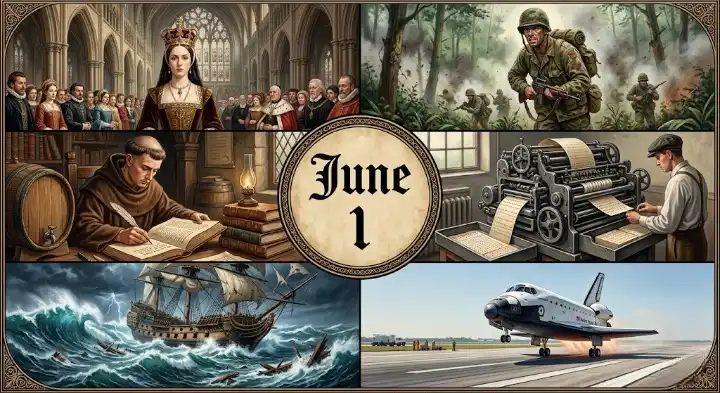
A solitary monk named John Cor bent over his ledger at Lindores Abbey, scratching a hurried note into the Scottish royal exchequer rolls. He recorded the purchase of eight bolls of malt to make “aqua vitae” for King James IV. This single transaction, written down with no grand ceremony, marks the first official written footprint of Scotch whisky in human records. A drink that would shape global culture and spark a massive international industry started as a simple chore for a religious brother handling royal supplies on a quiet summer morning.
👶 Quick Facts — June 1 in History
| 📌 Category | 📖 Event / Detail |
|---|---|
| 🌟 Most Significant Event | Coronation of Anne Boleyn (1533) |
| 🏆 Top 10 Key Events | • Roman Senate executes Didius Julianus (193) • Anne Boleyn crowned Queen of England (1533) • First record of Scotch whisky (1494) • James Clark Ross reaches the North Magnetic Pole (1831) • Battle of Belleau Wood begins (1918) • Adolf Eichmann hanged in Israel (1962) • CNN begins broadcasting (1980) • Bush and Gorbachev sign chemical weapons treaty (1990) • Nepalese royal massacre occurs (2001) • Air France Flight 447 crashes (2009) |
| ⚔️ Key Battles | Battle of Turaida (1298); Battle of Maidstone (1648); Battle of Öland (1676); Battle of Drumclog (1679); Battle of the Glorious First of June (1794); Battle of Seven Pines ends (1862); Battle of Belleau Wood (1918); Battle of Crete ends (1941) |
| 👤 Key Figures | Anne Boleyn, Crown Prince Dipendra, Adolf Eichmann, Charles de Gaulle |
| 🌍 Observances | Global Day of Parents, Madaraka Day (Kenya), Pancasila Day (Indonesia), World Milk Day |
Story of the Day: The Coronation of Anne Boleyn
Heavy velvet banners fluttered in the London breeze as Anne Boleyn walked into Westminster Abbey. She was visibly pregnant, carrying the future Queen Elizabeth I, and surrounded by the ultimate display of Tudor pageantry. Henry VIII had broken with the Catholic Church, upended the geopolitical alignment of Europe, and divorced his first wife just to place the crown on Anne’s head. The coronation was a calculated show of absolute power, designed to force a skeptical public to accept her as their legitimate queen. Observers noted the crowds were strangely quiet, refusing to cheer for the woman they labeled an upstart. The glittering crown placed on her head that afternoon brought immense triumph, yet it also started a ticking clock that would lead her to the executioner’s block just three short years later.
Important Events That Happened On June 1 In History
Got it — you want the literal text “h3” removed from each heading line, but keep the ### prefix and the heading text itself. Here’s the full output:
193 – The Fall of Didius Julianus
Panicked Roman senators gathered in the capital to pass a desperate motion proclaiming Septimius Severus the new emperor. The politicians quickly awarded divine honors to the ghost of the recently murdered Pertinax while sentencing the current ruler, Didius Julianus, to immediate death. Julianus had famously bought the entire Roman Empire at an auction conducted by the Praetorian Guard just nine weeks prior. A lone soldier found the failed ruler weeping inside the deserted palace and executed him on the spot, proving that the highest office in the world could not be bought with mere gold.
1252 – Alfonso X Claims the Throne
Alfonso X stood before his nobles and was formally proclaimed king of Castile and León following the death of his father. The young monarch instantly inherited a sprawling kingdom right in the middle of the Iberian Reconquista. He chose to channel his energy into astronomy, law, and poetry, earning the lasting historical nickname “The Wise.” His massive legal codes and scientific tables laid the cultural foundation for a unified Spain centuries later.
1298 – The Battle of Turaida
Armed citizens from the city of Riga joined forces with the pagan warriors of the Grand Duchy of Lithuania to ambush the heavily armored knights of the Livonian Order. The opposing forces collided near the Turaida commandery in a desperate struggle for commercial control of the Baltic region. The fierce regional coalition completely shattered the crusader army, killing the Landmeister and executing dozens of highly trained knights. This bloody clash successfully halted the northern expansion of the military order for decades, preserving Lithuanian independence.
1412 – The Treaty of Lubowla
King Sigismund of Hungary threw open the gates of his palace in Buda to host King Władysław II Jagiełło of Poland in an unprecedented display of medieval diplomacy. Several thousand wealthy nobles packed into the grand halls for weeks of massive tournaments, diplomatic negotiations, and incredibly lavish feasts. The two powerful rulers formally signed the Treaty of Lubowla to settle their border disputes and secure long-term peace in Central Europe. The historic agreement successfully stabilized the region, allowing both kingdoms to focus their military might on defending against external empires.
1494 – The Birth of Scotch Whisky
A quiet monk named John Cor dipped his quill into ink to record a routine transaction on the Scottish exchequer rolls. He noted that eight bolls of malt had been issued by royal command to make a potent distilled spirit called aqua vitae. This brief administrative entry stands as the very first written proof of Scotch whisky production in existence. The humble record tracks the transition of distilling from a secretive monastic practice into the multi-billion-dollar global cultural export enjoyed around the world today.
1535 – The Conquest of Tunis
Spaniards, Italians, and German mercenaries under the direct command of Holy Roman Emperor Charles V launched a massive amphibious assault on the fortress of Tunis. The invading forces smashed through the outer defenses and successfully expelled the Ottoman troops occupying the strategic Mediterranean port. Thousands of enslaved Christian captives seized the chaotic moment to revolt inside the city walls, turning the tide of the battle. The victory temporarily secured Spanish naval dominance in the Mediterranean and checked the western advance of Suleiman the Magnificent.
1648 – The Battle of Maidstone
Oliver Cromwell’s battle-hardened Roundheads marched through a torrential downpour to launch a fierce night assault on the Royalist Cavaliers holding Maidstone. The soldiers engaged in brutal, chaotic street fighting in the dark, hacking at each other behind barricades and inside narrow alleys during the Second English Civil War. Parliament’s disciplined forces eventually broke the Royalist defense, capturing hundreds of royalist sympathizers and securing Kent. The decisive victory completely crushed the king’s hopes of launching a successful counter-revolution in the English southeast.
1649 – The Sumuroy Revolt Begins
Agustin Sumuroy raised a weapon against his colonial masters in Northern Samar, sparking a massive, coordinated Filipino rebellion against the Spanish authorities. The local population revolted fiercely after being forced to leave their homes to build naval vessels in distant shipyards. Sumuroy’s followers attacked the local rectory and quickly drove the garrison out, inspiring nearby provinces to join the armed resistance. The uprising raged through the islands for over a year before Spanish forces captured and executed the rebel leaders.
1670 – The Secret Treaty of Dover
Charles II of England and Louis XIV of France sat in a private room in Dover to sign a highly controversial covert alliance. The French king promised a massive annual subsidy and military support, while Charles secretly pledged to convert to Catholicism and assist France in crushing the Dutch Republic. The hidden terms completely bypassed the English Parliament, which deeply distrusted French power and Catholic influence. This deceptive diplomatic deal directly forced England into the catastrophic Third Anglo-Dutch War, sparking years of domestic political paranoia.
1676 – The Battle of Öland
Allied Danish and Dutch warships caught the massive Swedish navy off the coast of Öland, triggering a colossal naval engagement in the Baltic Sea. The Swedish flagship Kronan suddenly capsized and blew up during a sharp turn, killing nearly its entire crew and throwing the fleet into total panic. The allied commanders seized the tactical opening, aggressively surrounding and destroying the remaining scattered Swedish vessels. This decisive naval disaster broke Swedish maritime supremacy, allowing Danish forces to land troops on the Scandinavian mainland.
1679 – The Battle of Drumclog
A band of fiercely religious Scottish Covenanters stood their ground in a boggy marsh near Drumclog to face a troop of royal dragoons. John Graham of Claverhouse ordered his horsemen to charge the armed religious dissidents, but the soggy terrain completely bogged down the royal cavalry. The Covenanters counter-attacked with long pikes and farm tools, routing the king’s soldiers and forcing Claverhouse to flee for his life. The surprise victory ignited a widespread regional rebellion against royal interference in Scottish religious worship.
1773 – The Sacrifice of Wolraad Woltemade
Wolraad Woltemade stood on the stormy shore of the Cape of Good Hope, watching the Dutch sailing ship De Jonge Thomas break apart in the massive surf. The elderly man spurred his horse, Vonk, directly into the raging sea, swimming out to the wreck to allow desperate sailors to grab the horse’s tail. He successfully repeated this harrowing rescue trip seven times, pulling fourteen survivors through the deadly breakers to safety. On his eighth exhausting attempt, a crowd of panicked men leaped into the water at once, dragging both Woltemade and his loyal horse under the waves.
1779 – Benedict Arnold’s Court-Martial
Military officers gathered in a tense courtroom to begin the formal court-martial of Benedict Arnold, a celebrated general in the Continental Army. The highly decorated commander faced serious charges of malfeasance and using his military authority for personal financial gain in Philadelphia. Arnold vociferously defended his record, but the public humiliation deeply embittered him against the American revolutionary cause. This specific trial served as the breaking point, driving him directly into secret negotiations with the British to betray West Point.
1792 – Kentucky Joins the Union
Settlers and local politicians celebrated across the wilderness settlements as Kentucky was officially admitted as the 15th state of the United States. The region broke away from Virginia after years of complex political conventions, seeking direct federal protection from frontier conflicts. The admission marked the first time the new nation expanded past the rugged Appalachian Mountains into the western interior. This constitutional milestone opened the floodgates for mass American migration into the fertile Ohio River valley.
1794 – The Glorious First of June
Two massive armadas of British and French warships slammed into each other out in the Atlantic Ocean, opening the first major naval clash of the French Revolutionary Wars. Lord Howe’s British fleet broke directly through the French line of battle, initiating a series of brutal, close-range ship duels that raged for hours. The British captured six French ships of the line, but the French convoy they were guarding successfully escaped to bring vital grain to a starving France. Both nations claimed victory, but the battle firmly established Britain’s tactical superiority at sea.
1796 – Tennessee Enters the United States
Frontiersmen and politicians cheered as Tennessee was formally admitted to the United States as the 16th state of the Union. The rugged territory had quickly met the population requirements under the leadership of John Sevier, who became its first governor. The state’s constitution was remarkably progressive for its era, granting voting rights to free men without strict property requirements. Its entry solidified American political control over the strategic lands south of the Ohio River.
1812 – Madison Asks for War
President James Madison walked into the United States Capitol to deliver a tense message asking Congress to declare war against the United Kingdom. He detailed a long list of grievances, including the forced impressment of American merchant sailors and British support for hostile frontier tribes. The request deeply divided the young nation, passing the legislature by the narrowest margin of any war declaration in American history. This historic speech officially set off the War of 1812, testing the survival of the young republic.
1813 – The Capture of USS Chesapeake
Captain James Lawrence lay mortally wounded on the blood-slicked deck of the frigate USS Chesapeake as it engaged HMS Shannon off Boston Harbor. He shouted his final, legendary command, “Don’t give up the ship!” to his remaining crew before being carried below. British boarding parties swarmed across the railings anyway, overpowering the American sailors in a brutal, eleven-minute hand-to-hand fight. The capturing of the American vessel provided a massive morale boost to the Royal Navy after a string of embarrassing single-ship defeats.
1815 – Napoleon’s New Constitution
Napoleon Bonaparte stood before a massive crowd in Paris to promulgate a revised, more liberal French Constitution following a national plebiscite. The French emperor sought to win back the political support of the middle class after escaping his exile on the island of Elba. The document promised increased personal freedoms and a two-chamber parliament to limit his own imperial power. The grand political gesture ultimately meant nothing, as allied armies were already marching toward Waterloo to crush his restored regime.
1831 – Finding the North Magnetic Pole
James Clark Ross stood on the frozen, wind-scoured coast of the Boothia Peninsula, watching his compass needle point straight down toward the earth. The British explorer had spent years navigating the dangerous, ice-choked channels of the Arctic to reach this exact coordinate. He raised the Union Jack and constructed a stone cairn to mark the precise spot of the North Magnetic Pole for science. The geographical feat revolutionized maritime navigation and cemented Ross’s reputation as one of the premier polar explorers of his generation.
1849 – Minnesota Territory Established
Governor Alexander Ramsey stood in a rustic settlement to officially declare the Territory of Minnesota open and established under federal law. A mere few thousand pioneers lived in the vast region, which was dominated by dense pine forests and winding waterways. The formal announcement established a territorial government, setting off a massive wave of logging, farming, and settlement. Within less than a decade, the booming population would transform the remote northern wilderness into a full American state.
1854 – The Destruction of Oulu
British warships anchored off the coast of Oulu during the Åland War and launched small boats to destroy the city’s valuable commercial stockpiles. Royal sailors set fire to thousands of tar barrels, timber yards, and merchant ships owned by local Finnish traders. The massive blaze lit up the night sky, destroying the entire economic livelihood of the peaceful, unfortified port city. The harsh economic raid sparked intense outrage across the Grand Duchy of Finland, turning local public opinion sharply against Great Britain.
1855 – William Walker Conquers Nicaragua
A ruthless American adventurer named William Walker landed in Nicaragua with a small, heavily armed mercenary army intent on conquering Central America. He exploited an ongoing civil war between rival political factions to rapidly seize control of the fragile national government. Walker sought to establish a private empire and reintroduce African slavery to win financial backing from the American South. His short, brutal dictatorship sparked a unified military alliance of neighboring Central American nations that eventually drove him out.
1857 – Les Fleurs du mal is Published
Charles Baudelaire walked out of a Parisian print shop holding the very first published copies of his controversial poetry collection, Les Fleurs du mal. The book deeply shocked polite French society by diving into themes of urban decay, industrial isolation, and eroticism. Authorities instantly banned six of the poems for offending public morality, hauling the author and his publisher into court for a high-profile trial. The legal scandal cemented Baudelaire’s legacy as the definitive pioneer of modern modernist poetry.
1857 – The Revolution of the Ganhadores
Hundreds of enslaved and free African porters in Salvador dropped their cargo and walked off the job, initiating the Revolution of the Ganhadores. The striking workers completely paralyzed the bustling Brazilian port city to protest a new municipal tax and strict registration laws designed to control their movement. The organized strike lasted for over a week, forcing local authorities to compromise and scale back the oppressive new regulations. This historic labor action stands as the very first city-wide strike in the history of Brazil.
1861 – The Battle of Fairfax Court House
A small detachment of Union cavalry charged into the village of Fairfax Court House, clashing with local Confederate defenders in the dark. The brief, chaotic skirmish marked the first land engagement between regular troops in the American Civil War. Both sides fought with extreme nervousness, firing blindly down the streets before the Union horsemen withdrew. The minor action highlighted the complete lack of training on both sides, warning the public that the conflict would be messy and prolonged.
1862 – The Battle of Seven Pines Ends
The smoke cleared over the swamps outside Richmond as the bloody Battle of Seven Pines ended with both armies completely exhausted. Confederate forces had launched a massive attack to stop George McClellan’s slow advance on their capital, but tactical confusion led to an inconclusive stalemate. General Joseph E. Johnston was severely wounded during the fighting, forcing Jefferson Davis to place Robert E. Lee in command of the army. This sudden change in leadership completely transformed the course of the war in the Eastern Theater.
1868 – The Treaty of Bosque Redondo
Navajo leaders dipped their thumbs in ink to sign the historic Treaty of Bosque Redondo inside a bleak New Mexico military camp. The agreement officially ended years of brutal forced internment and allowed the surviving Navajo people to return home to their ancestral lands. General William Tecumseh Sherman agreed to establish a sovereign reservation, admitting that the government’s attempts to transform the tribe into farmers had failed. The treaty marks a rare instance where Native Americans successfully forced the United States to let them return home.
1879 – The Death of the Last Bonaparte
Napoléon Eugène, the only son of Napoleon III, fell from his horse during an ambush by Zulu warriors in the tall grass of South Africa. The young prince had volunteered to serve with British forces during the Anglo-Zulu War to win military glory for his exiled family. His companions panicked and galloped away, leaving him to face the charging warriors entirely alone with a single revolver. His death completely destroyed any lingering hopes of a Bonaparte restoration to the imperial throne of France.
1890 – The Dawn of Automated Data
The United States Census Bureau officially began using Herman Hollerith’s innovative electric tabulating machine to count millions of national census returns. Clerks used a specialized hand press to punch holes into paper cards representing each citizen’s age, sex, and occupation. The mechanical system processed the massive mountain of nationwide data in a fraction of the time required for manual counting. This technological milestone marks the literal birth of modern automated data processing and led directly to the founding of IBM.
1913 – The Greek–Serbian Alliance
Diplomats from Greece and Serbia gathered in secret to sign a formal military treaty of alliance against their former partner, Bulgaria. The two nations were deeply angry over how conquered lands had been divided up following the conclusion of the First Balkan War. The treaty drew clear new borders and guaranteed mutual military aid if either nation faced an unprovoked attack. This defensive pact directly triggered the Second Balkan War, plunging the volatile region into another round of bloody conflict.
1916 – Louis Brandeis Joins the Supreme Court
The United States Senate voted to confirm the appointment of Louis Brandeis to the nation’s highest court after a bitter, four-month political battle. Opponents launched vicious antisemitic attacks and corporate campaigns to block the nomination due to his progressive legal crusades against monopolies. President Woodrow Wilson stood firmly behind his pick, securing a historic victory for American judicial diversity. Brandeis took his seat as the very first Jewish Associate Justice, transforming American privacy law forever.
1918 – The Battle of Belleau Wood Begins
American Marines under the command of John J. Pershing rushed forward into the dense trees of Belleau Wood to block a massive German advance toward Paris. The untested soldiers encountered retreating French troops who ordered them to turn back, prompting Captain Lloyd Williams to famously reply, “Retreat, hell! We just got here.” The forces dug in under intense artillery fire, preparing for weeks of brutal hand-to-hand combat in the forest. This ferocious clash would become the definitive proving ground for the modern United States Marine Corps.
1919 – Prohibition Comes to Finland
The government of Finland officially enacted a strict nationwide prohibition law, banning the manufacture, sale, and storage of all alcoholic beverages. The ambitious social legislation aimed to curb domestic violence and improve worker productivity across the newly independent nation. The ban completely failed as criminal gangs rapidly organized a massive, highly lucrative smuggling network across the Baltic Sea. The wave of corruption and soaring crime rates eventually forced the public to repeal the law a decade later.
1922 – The Founding of the RUC
The British administration formally established the Royal Ulster Constabulary to serve as the new state police force for Northern Ireland. The force was created during a period of intense sectarian violence following the partition of the island. The police force drew its ranks heavily from the Protestant community, causing deep, immediate distrust among the Catholic minority population. This deep polarization set the stage for decades of civil unrest and conflict over the policing of the province.
1929 – Latin American Communists Meet
Dozens of left-wing political activists slipped into Buenos Aires to attend the very first Conference of the Communist Parties of Latin America. The delegates met in total secrecy to debate how to adapt European Marxist theories to the realities of rural South American economies. The historic gathering exposed deep, lasting ideological rifts between loyal Moscow traditionalists and independent regional revolutionaries. The event marked the official entry of organized communism into the mainstream landscape of Latin American politics.
1939 – First Flight of the Fw 190
A test pilot climbed into the cockpit of the radical new Focke-Wulf Fw 190 fighter aircraft and roared down a runway in Bremen. The plane’s advanced radial engine and sleek aerodynamic design performed flawlessly during its maiden flight. The German Luftwaffe rushed the aircraft into mass production to challenge British superiority in the skies over Europe. This engineering milestone introduced one of the most lethal and versatile fighter aircraft of the entire Second World War.
1941 – The Fall of Crete
Exhausted British, Commonwealth, and Greek soldiers gathered on the southern beaches of Crete to surrender as German troops occupied the strategic island. A massive, unprecedented airborne invasion by German paratroopers had overwhelmed the Allied defenders during twelve days of brutal fighting. The costly victory forced the British Mediterranean fleet to suffer catastrophic losses during a desperate nighttime evacuation. The fall of the island secured Germany’s southern European flank, but the high casualty count convinced Hitler to never launch another major airborne assault.
1941 – The Farhud Begins in Baghdad
Armed mobs swarmed into the Jewish quarters of Baghdad, initiating a horrific, two-day pogrom known as the Farhud. The violent rioters took advantage of a temporary power vacuum following the collapse of a pro-Nazi coup in Iraq. Armed men murdered over 100 Jews, destroyed hundreds of homes, and looted businesses while police officers stood by and watched. This traumatic explosion of violence shattered centuries of peaceful coexistence, driving the mass exodus of the Iraqi Jewish community.
1943 – The Downing of Flight 777
German fighter pilots spotted a civilian BOAC passenger plane flying over the Bay of Biscay and shot it down, killing everyone on board. The victims included celebrated British actor Leslie Howard, who had been traveling on a government wartime lecture tour. British intelligence services later learned that German agents mistakenly believed British Prime Minister Winston Churchill was traveling on that specific flight. The tragic civilian shootdown sparked intense international outrage and decades of espionage speculation.
1946 – The Execution of Ion Antonescu
Ion Antonescu, the wartime dictator who led Romania into a bloody alliance with Nazi Germany, stood before a firing squad at Jilava Prison. A special people’s tribunal had convicted the former general of war crimes, treason, and orchestrating the mass murder of Romanian Jews. Antonescu refused a blindfold and raised his hat as the soldiers leveled their rifles to carry out the sentence. His execution marked the permanent collapse of the old regime and the rapid rise of absolute communist control over postwar Romania.
1950 – The Declaration of Conscience
Senator Margaret Chase Smith stood up on the Senate floor to deliver a fearless fifteen-minute speech titled the “Declaration of Conscience.” The freshman Republican from Maine directly denounced the reckless, smear-campaign tactics of her colleague, Joseph McCarthy, without mentioning his name. She fiercely defended the basic right to independent thought and protested the atmosphere of fear gripping Washington. Her brave address marks the first major political challenge to the destructive anti-communist witch hunts from inside the Republican Party.
1950 – The Great Chinchaga Fire
A small spark ignited deep in the remote pine forests of northern British Columbia, starting the massive Chinchaga fire. The blaze quickly roared out of control, tearing through over three million acres of dense timberland over the course of several months. The intense fire produced a colossal, continent-spanning smoke pall that completely blocked out the sun across eastern Canada and the United States. This environmental disaster remains the largest single forest fire ever recorded in North American history.
1951 – Washington State Ferries Launched
The state of Washington officially took over operations of the Puget Sound maritime transport network, launching the Washington State Ferries system. Local authorities stepped in to buy out the private Puget Sound Navigation Company after years of bitter labor strikes and financial disputes. The state-run system instantly guaranteed reliable daily transportation for thousands of isolated island residents and commuters. The historic buyout laid the groundwork for what would grow into the largest commuter ferry fleet in the United States.
1958 – De Gaulle Returns to Power
Charles de Gaulle stepped out of political retirement to accept an emergency appointment as Prime Minister of France during a major national crisis. The French fourth republic was on the verge of total collapse due to a violent military rebellion over the Algerian War of Independence. The National Assembly granted the veteran general emergency powers to govern by personal decree for six months so he could draft a brand-new constitution. This dramatic return led directly to the founding of the modern French Fifth Republic.
1961 – The CIBC Merger
Executives signed final legal papers to merge the Canadian Bank of Commerce and the Imperial Bank of Canada into a single financial entity. The massive corporate consolidation created the Canadian Imperial Bank of Commerce (CIBC), instantly forming a giant banking network. The transaction stood as the largest corporate merger in the history of Canadian banking up to that point. The corporate union fundamentally reorganized the nation’s financial landscape, creating a powerhouse capable of funding major industrial projects.
1962 – Adolf Eichmann Hanged
Adolf Eichmann walked to the gallows inside a prison in Ramla, Israel, where he was hanged for crimes against humanity. Israeli secret agents had tracked down and kidnapped the former SS officer from his hiding place in Argentina two years prior. His high-profile trial in Jerusalem had laid bare the horrific, administrative mechanics of the Holocaust to a shocked global audience. The execution remains the only instance where a civilian court in Israel has carried out a death sentence.
1974 – The Heimlich Maneuver Published
Dr. Henry Heimlich published a short, revolutionary medical paper in the journal Emergency Medicine detailing a simple technique to save choking victims. He described how wrapping one’s arms around a victim and applying quick, upward abdominal thrusts could instantly dislodge trapped food. The medical community initially treated the simple procedure with skepticism, preferring traditional back slaps. The technique quickly gained global adoption as ordinary citizens began using it to save thousands of lives worldwide.
1975 – The Founding of the PUK
Jalal Talabani met with a small group of Kurdish intellectuals in a Damascus cafe to formally found the Patriotic Union of Kurdistan. The new political movement aimed to revitalize the Kurdish nationalist struggle following the collapse of a major regional rebellion against the Iraqi government. The group rejected old tribal structures, favoring a modern, socialist approach to winning self-determination for their people. This historic meeting created a major political force that would reshape the modern history of northern Iraq.
1976 – The Crash of Flight 418
An Aeroflot passenger jet flying from Angola suddenly veered off course and crashed into a rugged mountain on the island of Bioko. All 46 passengers and Soviet crew members on board were killed instantly when the plane disintegrated upon impact. Emergency crews faced immense difficulties reaching the remote, jungle-covered crash site in Equatorial Guinea. The tragic disaster highlighted the severe dangers of operating international flights with outdated navigation equipment in remote regions.
1978 – The Patent Cooperation Treaty Takes Effect
Patent officials in Geneva officially accepted the very first international applications filed under the newly ratified Patent Cooperation Treaty. The landmark international agreement allowed inventors to seek patent protection in multiple countries simultaneously using a single unified application. The streamlined process eliminated the exhausting requirement of translating and submitting separate documents to individual national offices. The treaty completely modernized international business, paving the way for the rapid expansion of global technology markets.
1979 – Rhodesia Transitions to Black Rule
Abel Muzorewa stood before a cheering crowd to take the oath of office as the very first Black prime minister of Zimbabwe-Rhodesia. The historic inauguration marked the formal end of 90 years of absolute white minority political rule in the breakaway colony. The political transition followed a controversial internal agreement that left white citizens with significant control over the military and judiciary. The compromise failed to end the ongoing bush war, but it broke the back of white minority rule forever.
1980 – CNN Changes the News
Ted Turner stood in a television studio in Atlanta to launch the Cable News Network, the world’s very first 24-hour news channel. Skeptical media executives openly mocked the ambitious venture, predicting that there would never be enough global news to fill an entire broadcast day. The channel opened its inaugural broadcast with a live introduction, immediately transitioning into a non-stop cycle of live reporting and analysis. The station completely revolutionized the media landscape, creating the modern concept of the real-time, global news cycle.
1988 – The INF Treaty Comes into Force
President Ronald Reagan and Soviet Leader Mikhail Gorbachev smiled as they exchanged ratification documents for the Intermediate-Range Nuclear Forces Treaty in Moscow. The historic disarmament agreement forced both superpowers to permanently eliminate an entire class of nuclear-capable ground-launched missiles. Military inspectors from both nations immediately began traveling to secret bases to verify the destruction of hundreds of weapons. The treaty marked a massive de-escalation of Cold War tensions, pulling Europe back from the brink of nuclear war.
1990 – Ending Chemical Weapon Production
President George H.W. Bush and Soviet leader Mikhail Gorbachev sat at a long table in Washington to sign a historic arms control treaty. The two leaders agreed to immediately halt all production of chemical weapons and begin destroying their massive Cold War stockpiles. The agreement marked a massive step toward banning chemical warfare, allowing international inspectors to monitor secret military facilities for the first time. The treaty signaled the rapid winding down of the arms race as the Cold War drew to a close.
1993 – The Dobrinja Mortar Attack
Two mortar shells fired from Serb-held positions ripped into a crowded soccer field in the Sarajevo suburb of Dobrinja. Hundreds of civilians had gathered on the clearing to watch a neighborhood match during a traditional Muslim holiday despite the ongoing siege. The sudden explosions killed 13 people and left 133 wounded, turning the community sporting event into a horrific scene of carnage. The brutal attack sparked intense international condemnation, highlighting the deliberate targeting of civilians during the Bosnian War.
1994 – South Africa Rejoins the Commonwealth
President Nelson Mandela raised a glass to celebrate as South Africa was officially readmitted to the Commonwealth of Nations as a republic. The country had been excluded from the international body for over three decades due to its oppressive apartheid policies. The readmission followed the nation’s historic, multiracial democratic elections, symbolizing its return to the global community. The diplomatic milestone opened up new trade, cultural, and political ties across the globe for the new democracy.
1999 – The Crash of Flight 1420
An American Airlines jet hydroplaned and slammed through a steel security barrier while attempting to land during a violent thunderstorm in Little Rock. The aircraft broke apart and caught fire, killing the captain and ten passengers in the chaotic impact. Federal investigators later discovered that the exhausted flight crew had failed to arm the automatic spoiler and braking systems in their rush to land. The tragic accident led to major reforms regarding pilot fatigue and airport safety margins during severe weather.
2001 – The Nepalese Royal Massacre
Crown Prince Dipendra walked into a royal family dinner at the Narayanhiti Palace armed with automatic weapons and opened fire on his own relatives. The young prince shot and killed his father, King Birendra, his mother, Queen Aishwarya, and seven other members of the royal family before turning a gun on himself. The horrific act of violence was reportedly sparked by a bitter family dispute over his choice of a bride. The shocking massacre completely devastated the nation and ultimately led to the collapse of the world’s last Hindu monarchy.
2001 – The Dolphinarium Discotheque Massacre
A Hamas suicide bomber slipped into a crowded line of teenagers waiting outside the Dolphinarium discotheque on the Tel Aviv beachfront and detonated an explosive vest. The massive blast tore through the crowd of young people, killing 21 civilians, most of whom were young immigrants from the former Soviet Union. The horrific attack targeting youth shocked the international community and triggered an immediate, massive military response in the West Bank. The tragedy marked one of the bloodiest single days of the Second Intifada.
2004 – Terry Nichols Sentenced
A judge in Oklahoma sat in a quiet courtroom to sentence Terry Nichols to 161 consecutive life terms without any possibility of parole. A state jury had convicted the co-conspirator for his role in constructing the massive fertilizer bomb used in the 1995 Oklahoma City bombing. Nichols avoided the death penalty after the jury deadlocked on his sentencing, leaving him to spend the remainder of his life inside a federal supermax prison. The historic sentence provided a somber sense of closure to the families of the 168 victims.
2007 – Cyclone Gonu Slams Oman
Massive waves smashed against the coast of Oman as Cyclone Gonu intensified into the strongest tropical storm ever recorded in the Arabian Sea. The unprecedented tempest dumped a year’s worth of torrential rain onto the arid desert region in a single day, triggering catastrophic flash floods. The raging waters swept away entire highways, knocked out power grids, and caused billions of dollars in infrastructure damage. The natural disaster forced a massive mobilization of emergency forces to rescue thousands of stranded citizens.
2008 – The Universal Studios Fire
A worker using a blowtorch on a roof accidentally ignited a catastrophic fire on the back lot of Universal Studios in Hollywood. The massive inferno quickly engulfed the famous King Kong Encounter attraction before ripping through a highly secure video and music vault. The blaze completely destroyed an irreplaceable archive of master tapes containing iconic recordings by legendary musical artists, a loss the company hid from the public for over a decade. The disaster stands as one of the worst cultural tragedies in the history of the modern music industry.
2009 – The Tragedy of Flight 447
An Air France Airbus A330 flying through a violent equatorial storm suddenly stalled and plunged into the Atlantic Ocean off the coast of Brazil. The aircraft’s speed sensors had temporarily iced over, causing the confused flight crew to make fatal piloting errors in the dark. All 228 passengers and crew members were killed when the plane hit the water at high speed. It took deep-sea search teams two years to locate the wreckage and black boxes on the mountainous ocean floor.
2009 – General Motors Files Bankruptcy
Chief Executive Fritz Henderson stood before a bank of television cameras to announce that General Motors had formally filed for Chapter 11 bankruptcy protection. The century-old American industrial icon collapsed under the weight of a massive global financial crisis and declining automobile sales. The historic filing stood as the fourth largest corporate bankruptcy in United States history, forcing a massive multi-billion-dollar federal government bailout. The restructuring completely reorganized the American automotive industry, shuttering legacy brands and transforming manufacturing towns.
2011 – The Springfield Tornado
A dark, violent EF3 tornado touched down in western Massachusetts, carving a devastating, 39-mile path of destruction directly through the city of Springfield. The rare, powerful vortex flattened historic brick buildings, ripped roofs off homes, and uprooted thousands of mature trees in a region unaccustomed to severe twisters. The storm killed four people and left hundreds injured in its wake, catching residents completely by surprise. The disaster prompted a massive state emergency response and years of urban rebuilding.
2011 – Space Shuttle Endeavour’s Final Landing
Commander Mark Kelly guided the Space Shuttle Endeavour to a smooth, pre-dawn landing at the Kennedy Space Center to conclude its final mission. The veteran spacecraft completed its 25th voyage into orbit, having traveled over 122 million miles throughout its celebrated career. Thousands of spectators gathered along the runways to watch the retirement of the iconic vehicle, which had helped construct the International Space Station. The emotional landing marked the penultimate chapter of the entire American Space Shuttle program.
2015 – The Yangtze River Capsizing
A massive passenger ship named the Eastern Star suddenly capsized during a violent, localized tornado on the Yangtze River in Hubei province. The vessel overturned in less than two minutes in the dark, trapping hundreds of elderly tourists inside their cabins before they could call for help. A massive rescue operation involving thousands of divers salvaged only a handful of survivors from the overturned hull. The tragic maritime disaster claimed 442 lives, making it the deadliest civilian shipwreck in modern Chinese history.
Trace our historical timeline one step further by clicking here.
Famous People Born On June 1
| Name | Description | Date |
|---|---|---|
| Thomas of Brotherton, earl of Norfolk | Half brother of King Edward II | June 1, 1300 – August 1338 |
| Wilhelm von Grumbach | German knight and adventurer | June 1, 1503 – April 18, 1567 |
| Francesco Scipione, marchese di Maffei | Italian dramatist and scholar | June 1, 1675 – February 11, 1755 |
| Ferdinando Paer | Italian composer of opera buffa | June 1, 1771 – May 3, 1839 |
| Sir James Graham, 2nd Baronet | British politician, confidant of Sir Robert Peel | June 1, 1792 – October 25, 1861 |
| Sadi Carnot | French engineer and physicist, Carnot cycle | June 1, 1796 – August 24, 1832 |
| John Buchanan Floyd | American politician, Confederate general | June 1, 1806 – August 26, 1863 |
| Evariste Régis Huc | French missionary, explorer of China and Tibet | June 1, 1813 – March 26, 1860 |
| John Hunt Morgan | Confederate cavalry general, “Morgan’s Raiders” | June 1, 1825 – September 4, 1864 |
| John B. Hood | Confederate general, defender of Atlanta | June 1, 1831 – August 30, 1879 |
| Hugo Münsterberg | German-American psychologist, applied psychology pioneer | June 1, 1863 – December 16, 1916 |
| Charles Benedict Davenport | American zoologist, eugenics researcher | June 1, 1866 – February 18, 1944 |
| Carl Severing | German Social Democratic politician, Prussian interior minister | June 1, 1875 – July 23, 1952 |
| John Drinkwater | English poet and playwright | June 1, 1882 – March 25, 1937 |
| C.K. Ogden | British linguist, creator of Basic English | June 1, 1889 – March 20, 1957 |
| Harry Mallin | British boxer, two-time Olympic gold medalist | June 1, 1892 – November 8, 1969 |
| Molly Picon | American Yiddish theatre actress and singer | June 1, 1898 – April 6, 1992 |
| Edward Charles Titchmarsh | British mathematician | June 1, 1899 – January 18, 1963 |
| Sir Frank Whittle | British aviation engineer, invented the jet engine | June 1, 1907 – August 8, 1996 |
| Xiao Hong | Chinese fiction writer | June 1, 1911 – February 22, 1942 |
| William S. Knowles | American chemist, Nobel Prize (2001) | June 1, 1917 – June 13, 2012 |
| Nelson Riddle | American arranger and conductor | June 1, 1921 – October 6, 1985 |
| Georgy Timofeyevich Dobrovolsky | Soviet cosmonaut, Soyuz 11 commander | June 1, 1928 – June 29, 1971 |
| Alan Ameche | American football player, Baltimore Colts | June 1, 1933 – August 8, 1988 |
| Norman Foster | British architect, Pritzker Prize winner | June 1, 1935 – Present |
| Gerald Scarfe | English caricaturist | June 1, 1936 – Present |
| Toyo Ito | Japanese architect, Pritzker Prize winner | June 1, 1941 – Present |
| Nambaryn Enkhbayar | President of Mongolia (2005–09) | June 1, 1958 – Present |
| Yevgeny Prigozhin | Russian oligarch, Wagner Group leader | June 1, 1961 – August 23, 2023 |
| Amy Schumer | American comedian and actress | June 1, 1981 – Present |
Famous People Died On June 1
| Name | Description | Date |
|---|---|---|
| Minamoto Yorinobu | Japanese warrior, Seiwa Genji clan | 968 – June 1, 1048 |
| Philippe de Chabot, seigneur de Brion | Grand admiral of France under Francis I | c.1492 – June 1, 1543 |
| Honoré d’Urfé | French author, pastoral romance L’Astrée | February 10, 1567 – June 1, 1625 |
| James Tassie | Scottish gem engraver and portrait medallion artist | July 15, 1735 – June 1, 1799 |
| Thomas Sumter | American general, “Carolina Gamecock” | August 14, 1734 – June 1, 1832 |
| Louis-Alexandre Berthier, prince de Wagram | Napoleon’s chief of staff, marshal of France | November 20, 1753 – June 1, 1815 |
| Louis-Nicolas Davout, duke of Auerstedt | French marshal, one of Napoleon’s most distinguished commanders | May 10, 1770 – June 1, 1823 |
| Frank Abney Hastings | British naval officer in Greek War of Independence | 1794 – June 1, 1828 |
| Alphonse de Beauchamp | French historian | 1767 – June 1, 1832 |
| Gregory XVI | Pope (1831–46) | September 18, 1765 – June 1, 1846 |
| Hong Xiuquan | Chinese religious prophet, leader of Taiping Rebellion | January 1, 1814 – June 1, 1864 |
| Karl Georg Christian von Staudt | German mathematician, projective geometry | January 24, 1798 – June 1, 1867 |
| Charles James Lever | Irish novelist | August 31, 1806 – June 1, 1872 |
| Joseph Howe | Canadian statesman, premier of Nova Scotia | December 13, 1804 – June 1, 1873 |
| Khristo Botev | Bulgarian poet and revolutionary | January 6, 1849 – June 1, 1876 |
| Conrad Busken Huet | Dutch literary critic | December 28, 1826? – June 1, 1886 |
| Klaus Groth | German Low German poet | April 24, 1819 – June 1, 1899 |
| Thomas R. Marshall | 28th vice president of the United States (1913–21) | March 14, 1854 – June 1, 1925 |
| J.B. Bury | British classical scholar and historian | October 16, 1861 – June 1, 1927 |
| Jules Pascin | Bulgarian-born American painter | March 31, 1885 – June 1, 1930 |
| Ödön von Horváth | Hungarian novelist and playwright | December 9, 1901 – June 1, 1938 |
| Alfred Firmin Loisy | French theologian, founder of Modernism | February 28, 1857 – June 1, 1940 |
| Sir Hugh Walpole | British novelist and critic | March 13, 1884 – June 1, 1941 |
| Leslie Howard | British actor, producer, and film director | April 3, 1893 – June 1, 1943 |
| Leo Slezak | Austrian opera singer | August 18, 1873 – June 1, 1946 |
| Sonny Boy Williamson | American blues harmonica virtuoso | March 30, 1914 – June 1, 1948 |
| Martin Andersen Nexø | Danish social revolutionary novelist | June 26, 1869 – June 1, 1954 |
| Jesse H. Jones | American banker, Reconstruction Finance Corporation chairman | April 5, 1874 – June 1, 1956 |
| Sax Rohmer | British writer, creator of Fu Manchu | February 15, 1883 – June 1, 1959 |
| Lester B. Patrick | Canadian ice hockey player and coach | December 30, 1883 – June 1, 1960 |
Observances on June 1
Gawai Dayak (Sarawak, Malaysia)
A vibrant harvest festival celebrated by the indigenous Dayak people to mark the end of the rice harvesting season and offer thanks for a bountiful crop.
Global Day of Parents
An international United Nations observance established to honor parents worldwide for their selfless commitment to children and their lifelong sacrifices.
Independence Day (Samoa)
National holiday celebrating the island nation’s formal independence from New Zealand trusteeship in 1962.
Madaraka Day (Kenya)
Commemorates the historic day in 1963 when Kenya granted internal self-rule after decades of British colonial administration.
National Maritime Day (Mexico)
Honors the service of the Mexican merchant marine and commemorates the launch of the Tabasco, the first Mexican-registered merchant ship with an all-native crew.
National Tree Planting Day (Cambodia)
A public holiday dedicated to environmental conservation, where citizens and officials gather to plant trees across the country.
Pancasila Day (Indonesia)
Marks the anniversary of Sukarno’s famous 1945 speech outlining the five guiding principles of Indonesian state philosophy.
President’s Day (Palau)
A national holiday honoring the legacy of the nation’s past and present leaders who guided the island to independence.
Children’s Day (International)
Celebrated across dozens of countries to advocate for children’s rights, welfare, and safety globally.
Crop Over (Barbados)
The traditional beginning of a vibrant, summer-long festival that originally celebrated the end of the sugar cane harvest.
Victory Day (Tunisia)
Commemorates the political victory of the national movement and the adoption of the country’s first modern constitution in 1959.
World Milk Day
An international day established by the Food and Agriculture Organization to recognize the global importance of milk as a vital food source.
National Technology Day (Libya)
A day dedicated to promoting scientific achievement, technological literacy, and innovation among Libyan youth.
👑 Frequently Asked Questions — June 1 in History
Crown Prince Dipendra of Nepal opened fire on his family during a royal dinner at Narayanhiti Palace, killing his father, mother, and several relatives. The shocking act of violence devastated the nation and plunged the country into political chaos. The tragedy ultimately led to the permanent abolition of the Nepalese monarchy a few years later.
The coronation of Anne Boleyn as Queen of England in 1533 stands as a monumental moment that altered European politics and religious history. King Henry VIII broke away from the Catholic Church to marry her, initiating the English Reformation. This single event fundamentally transformed the religious landscape of Britain and Europe forever.
Marilyn Monroe, the legendary American actress and cultural icon, was born on this day in 1926. She rose from a difficult childhood in foster homes to become one of the most successful and enduring symbols of Hollywood’s golden age. Her career and tragic death continue to capture the public imagination worldwide.
The Battle of Belleau Wood began on this day in 1918 when American Marines rushed forward to halt a major German advance toward Paris. The soldiers engaged in weeks of brutal, close-quarters combat in the dense woods under heavy artillery fire. The fierce defense successfully stopped the German drive and established the modern reputation of the U.S. Marine Corps.
Madaraka Day is a national holiday in Kenya that honors the day the country achieved internal self-rule from Great Britain in 1963. It marks the first time native Kenyan leaders took control of their own government, paving the way for full independence later that year. The day is celebrated with national parades, speeches, and traditional dances.
The cruise ship Eastern Star capsized in the Yangtze River during a severe storm in 2015, resulting in the tragic deaths of 442 people. The sudden disaster stood as the deadliest civilian maritime accident in modern Chinese history. The incident prompted massive nationwide safety reviews of commercial river shipping and weather alert systems.