Emperor Cao Mao gripped his sword chariot on June 2, 260, leading a desperate, suicidal charge through the palace gates of Luoyang to reclaim his stolen throne from a tyrannical regent. That raw clash of power set a frantic tone for this exact calendar date across two millennia. From ancient imperial halls to the glare of mid-century television cameras, June 2 hosted events that permanently rewrote human laws, borders, and faiths. Understanding what happened on June 2 in history reveals how thin the line between triumph and disaster truly is.
👶 Quick Facts — June 2 in History
| 📌 Category | 📖 Event / Detail |
|---|---|
| 🌟 Most Significant Event | Coronation of Queen Elizabeth II (1953) |
| 🏆 Top 10 Key Events | • Sima Zhao regicide (260) • Vandals sack Rome (455) • First Crusade captures Antioch (1098) • Salem Witch Trials begin (1692) • Pontiac’s Rebellion trick (1763) • Italian Republic born (1946) • Surveyor 1 Moon landing (1966) • Pope John Paul II visits Communist Poland (1979) • Timothy McVeigh conviction (1997) • ESA Mars Express launch (2003) |
| ⚔️ Key Battles | Siege of Antioch, Battle of Palermo, Battle of Ridgeway |
| 👤 Key Figures | Queen Elizabeth II, Bridget Bishop, King Umberto II, Timothy McVeigh |
| 🌍 Observances | Festa della Repubblica (Italy), Telangana Day (India), International Sex Workers Day, Day of Hristo Botev (Bulgaria) |
Story of the Day: The Crowning of a New Era
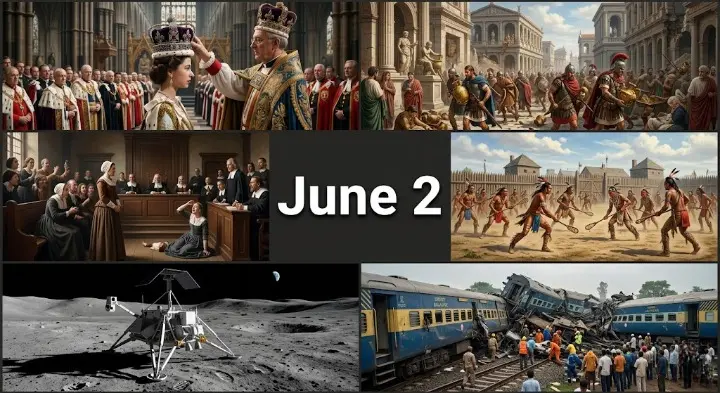
Archbishop of Canterbury Geoffrey Fisher raised the solid-gold St. Edward’s Crown high before lowering it onto the head of twenty-seven-year-old Elizabeth II inside Westminster Abbey. A heavy silence gripped the ancient stone building before the abbey erupted into shouts of “God save the Queen!” Outside, rain soaked millions of onlookers packed into London streets, while three million miles away, an unprecedented technological gamble was paying off.
For the first time, BBC cameras broadcasted a British coronation live, turning an ancient, insular royal ritual into an international living-room experience. This milestone transformed global mass media and unified a crumbling post-war empire around a young woman who would define the next seven decades.
Important Events That Happened On June 2 In History
260 – Sima Zhao’s regicide of Cao Mao
Cao Mao assembled his palace guards and personal servants for a desperate charge against his overbearing regent, Sima Zhao. The young emperor chose a public, honorable death over serving as a powerless puppet in his own court. Elite soldiers easily swarmed the royal chariot, killing the monarch in the streets of Luoyang. This bloody execution shocked the empire and cleared the final path for the Sima family to overthrow the Wei Dynasty entirely.
455 – Sack of Rome
Gaiseric led his Vandal fleet up the Tiber River and marched into the undefended streets of Rome without facing a single arrow. Pope Leo I convinced the invaders to spare the citizens’ lives and avoid burning buildings, leaving the city open to systematic plunder instead. Vandal soldiers stripped gold from the Temple of Jupiter and hauled thousands of Roman citizens away into slavery over fourteen agonizing days. This thorough devastation crippled the Western Roman Empire, making its ultimate collapse inevitable within a generation.
575 – Consecration of Pope Benedict I
Benedict I walked into the Basilica of St. Peter to accept his papal crown after waiting eleven agonizing months for permission. Devastating Lombard invasions had cut Rome off from the rest of Italy, making communication with the imperial court in Constantinople nearly impossible. The new Pope immediately redirected his focus toward distributing food to a starving populace trapped behind city walls. His ascension stabilized the Roman church during one of its bleakest dark-age isolation crises.
1098 – First Crusade captures Antioch
Bohemond of Taranto scaled the towering walls of Antioch under the cover of a midnight rainstorm after bribing a disgruntled tower guardsman named Firouz. Crusader forces poured through the opened gates, ending an grueling eight-month siege with a chaotic, vengeful slaughter of the Turkish garrison. The bloody victory was incredibly short-lived, as a massive Muslim relief army arrived just five days later to trap the conquerors inside the city. This desperate reversal forced the Crusaders to fight their way out, securing their road to Jerusalem.
1259 – Royal Wedding of Sicily and Byzantium
King Manfred of Sicily welcomed the teenage Byzantine princess Helena Angelina Doukaina into his court for a lavish political wedding. This union joined the Hohenstaufen dynasty with the elite nobility of Epirus, creating a powerful Mediterranean alliance designed to hold off hostile papal armies. Helena brought vast territorial lands as her dowry, expanding Sicilian influence across the Adriatic Sea. The marriage brought a brief moment of stability before French conquerors executed Manfred and threw Helena into a lifetime of imprisonment.
1608 – Virginia Colony Borders Expanded
King James I signed a sweeping new charter for the Virginia Company, extending the young colony’s borders across the entire continent from the Atlantic to the Pacific Ocean. English investors drew these massive boundary lines on maps with total disregard for the millions of Native Americans living in the interior. This legal document fueled aggressive westward expansion and established the legal framework for England’s permanent empire in North America. The broad “sea to sea” mandate shaped American geopolitical goals for the next two centuries.
1615 – Récollet Missionaries Arrive in Quebec
Denis Jamet and his fellow Récollet friars stepped off a wooden ship onto the muddy banks of Quebec City after an arduous Atlantic crossing from France. These Franciscan monks brought a strict devotion to poverty and an unyielding mission to convert indigenous populations to Catholicism. They built the very first chapel in New France, singing hymns in the wilderness to establish a permanent spiritual foothold. Their arrival permanently shaped the cultural, religious, and linguistic landscape of French Canada.
1676 – Battle of Palermo
Admiral Abraham Duquesne commanded the French naval fleet as it launched a devastating surprise attack on a combined Spanish and Dutch armada anchored at Palermo. French fireships drifted directly into the crowded harbor, igniting massive explosions that destroyed twelve major warships and killed thousands of sailors. This decisive victory gave France absolute control over the Mediterranean Sea for the remainder of the Franco-Dutch War. The triumph secured King Louis XIV’s reputation as an unmatchable global maritime superpower.
1692 – Salem Witch Trials Begin
Bridget Bishop stood before a tense courtroom in Salem, Massachusetts, as the first colonial citizen tried under a newly established court for witchcraft. Local girls collapsed into fits on the floor, screaming that Bishop’s spectral spirit was pinching and choking them in the courtroom. Despite her fierce declarations of innocence, the hysterical judges convicted her of dark magic before the sun set that afternoon. Her public hanging on Gallows Hill eight days later opened the floodgates for a deadly wave of paranoia.
1763 – Pontiac’s Rebellion at Fort Michilimackinac
Chippewa warriors gathered outside Fort Michilimackinac for a massive game of lacrosse, drawing British soldiers out to watch the athletic display. The players suddenly chased a stray ball toward the open fort gates, dropped their sticks, and grabbed concealed weapons from native women in the crowd. The warriors swarmed the surprised garrison, killing fifteen soldiers and capturing the strategic fur-trading outpost within minutes. This brilliant tactical trick marked one of the most successful indigenous resistance strikes against British rule.
1774 – Quartering Act Enacted
King George III signed the Quartering Act into law, stripping American colonists of the right to refuse British troops shelter in their private buildings. Royal governors gained the absolute power to seize uninhabited houses, barns, and outhouses to lodge thousands of incoming redcoats. This intrusive law was part of the Coercive Acts, designed to break the rebellious spirit of Boston after the Boston Tea Party. Instead, the direct violation of privacy infuriated the colonies and united them toward open revolution.
1780 – Gordon Riots Consume London
Lord George Gordon led a massive, angry crowd of 50,000 Protestants to Parliament to demand the repeal of the Papists Act. The peaceful protest quickly degenerated into a week of violent, anti-Catholic riots that tore through the heart of London. Rioters burned Catholic chapels, looted private homes, and attacked Newgate Prison to free incarcerated inmates. The military fired into the mobs to restore order, leaving up to 700 Londoners dead in the bloodiest civil unrest the city had ever seen.
1793 – Reign of Terror Set in Motion
François Hanriot marched his heavily armed Parisian National Guard to the National Convention, aiming eighty loaded cannons directly at the building’s exit doors. He demanded the immediate arrest of twenty-two moderate Girondin politicians who had been blacklisted by radical journalist Jean-Paul Marat. Terrified lawmakers capitulated to the armed mob, signing the arrest warrants and ending all moderate opposition in the French government. This fateful capitulation handed absolute power to Maximilien Robespierre, unleashing the bloodiest phase of the French Revolution.
1805 – Recapture of Diamond Rock
Captain Julien Cosmao maneuvered his Franco-Spanish fleet into position, unleashing a brutal artillery bombardment on the sheer cliffs of Diamond Rock. British sailors had turned this uninhabited volcanic island off Martinique into an unsinkable stone sloop, using it to blockade French shipping lanes for over a year. The French troops staged a daring amphibious assault, scaling the jagged rocks and forcing the parched, ammunition-depleted British garrison to surrender. This hard-fought victory reopened vital Caribbean trade routes for Napoleon’s empire.
1848 – Slavic Congress Opens in Prague
František Palacký gathered hundreds of Slavic activists, writers, and thinkers in Prague for the first Slavic Congress. These delegates represented fractured populations living under Austrian rule, seeking to unite Poles, Czechs, Slovaks, and Serbs into a cohesive political movement. They rejected total German dominance and demanded cultural autonomy within the Habsburg Empire. The historic assembly was cut short when Austrian troops bombarded the city, but it lit a fire of Slavic nationalism that eventually dismantled central European empires.
1866 – Battle of Ridgeway
Colonel John O’Neill led a paramilitary force of Irish-American Civil War veterans across the Niagara River, clashing with Canadian militia forces at Ridgeway. The battle-hardened Fenians executed a brilliant bayonet charge, breaking the inexperienced Canadian lines and forcing a chaotic retreat. This armed raid aimed to capture Canadian territory and hold it hostage to force Britain out of Ireland. United States authorities quickly blocked reinforcement lines, crushing the invasion but convincing Canada to unify into a single dominion for mutual defense.
1878 – Assassination Attempt on Kaiser Wilhelm I
Karl Nobiling hid near the crowded Unter den Linden boulevard in Berlin, aiming a double-barreled shotgun at the open carriage of Kaiser Wilhelm I. The anarchist fired two blasts of birdshot, wounding the eighty-one-year-old German Emperor in the face and arms before a furious crowd tackled him. Nobiling shot himself during the struggle, leaving behind an empire gripped by fear of radical socialist terrorism. Chancellor Otto von Bismarck used the public outrage to pass oppressive Anti-Socialist Laws, banning leftist organizations across Germany.
1896 – Marconi Patents the Wireless Telegraph
Guglielmo Marconi walked into the British Patent Office to file provisional specification number 12039 for a revolutionary system of transmitting electrical signals without wires. The twenty-two-year-old inventor used Hertzian waves to send telegraph code across open country, breaking the physical constraints of traditional copper cables. Skeptics dismissed his work as an impossible parlor trick, but his patent laid the foundational cornerstone for modern telecommunications. This breakthrough directly evolved into radio, television, radar, and cellular technology.
1909 – Alfred Deakin Becomes Prime Minister of Australia
Alfred Deakin assumed the office of Prime Minister for the third time after orchestrating an unprecedented fusion of rival conservative parties into the new Liberal Party. This strategic political alliance ended a volatile era of three-party instability in the young Australian parliament. Deakin used this stable majority to pass landmark legislation, building a national navy and establishing a compulsory defense training system. His political maneuvering created the modern two-party system that still governs Australian politics.
1910 – First Non-Stop Double Crossing of the English Channel
Charles Rolls climbed into his fragile Wright biplane at Dover, taking off into a thick evening mist toward the coastline of France. The co-founder of Rolls-Royce flew across the cold waters of the English Channel, dropped a French greeting card over Sangatte, and immediately turned back without touching French soil. He safely landed back in England ninety-five minutes later, shattering previous aviation records and proving airplanes could handle long-distance commercial travel. His historic flight demonstrated the practical, reliable future of global aviation.
1919 – Anarchist Bombings in Eight U.S. Cities
Followers of Italian anarchist Luigi Galleani detonated powerful pipe bombs simultaneously across eight separate American cities, targeting judges, politicians, and police officials. One explosion tore away the front facade of U.S. Attorney General A. Mitchell Palmer’s Washington home, killing the bomber instantly on the lawn. These coordinated attacks fueled intense public panic and suspicion toward foreign-born laborers. The federal government retaliated by launching the Palmer Raids, arresting and deporting thousands of suspected radicals without trial.
1924 – Indian Citizenship Act Signed
President Calvin Coolidge signed the Indian Citizenship Act into law, granting full United States citizenship to all Native Americans born within the country’s borders. This landmark legislation ended a long era of legal exclusion where indigenous peoples were treated as domestic foreigners on their ancestral lands. Over 125,000 Native Americans instantly gained federal civil rights, though many individual states used local poll taxes and literacy tests to block them from voting for decades. The law marked a major turning point in the legal status of indigenous Americans.
1941 – Massacres at Kondomari and Alikianos
General Kurt Student ordered elite German paratroopers to surround the isolated Cretan village of Kondomari, dragging out all male residents to an olive grove. The soldiers opened fire with machine guns, killing dozens of unarmed civilians in retaliation for fierce local resistance during the Battle of Crete. A similar war crime occurred simultaneously in nearby Alikianos, where locals were lined up against a wall and shot. These brutal actions were among the first organized mass executions of civilian populations in occupied Europe.
1946 – Birth of the Italian Republic
Millions of Italian citizens packed into polling stations for a historic referendum, voting decisively to abolish the monarchy and establish a democratic republic. Women voted for the first time in national history, joining men in rejecting King Umberto II due to the royal family’s shameful collaboration with Benito Mussolini’s fascist regime. The deposed king packed his bags and left for a permanent exile in Portugal just days later. This historic vote closed a dark chapter of totalitarianism and created modern democratic Italy.
1953 – Coronation of Queen Elizabeth II
Queen Elizabeth II rode through the rain-soaked streets of London in the four-ton Gold State Coach toward her official crowning at Westminster Abbey. While an elite crowd of international dignitaries watched inside, millions of families gathered around newly purchased black-and-white television sets across the globe. This historic broadcast transformed television from a novelty into a dominant mass medium. The young queen assumed her constitutional duties, beginning a record-shattering seventy-year reign over a rapidly modernizing world.
1955 – Belgrade Declaration Normalized Soviet-Yugoslav Relations
Nikita Khrushchev and Josip Broz Tito sat down in Belgrade to sign a joint declaration, officially ending a bitter seven-year ideological split between their nations. The Soviet leader publicly apologized for Joseph Stalin’s past attempts to destroy the Yugoslav government, acknowledging each socialist country’s right to forge its own path. Tito successfully preserved Yugoslavia’s independence while maintaining valuable economic ties to the West. This historic agreement shattered the illusion of a monolithic, single-minded Communist bloc during the Cold War.
1958 – Flight 111 Crash in Guadalajara
An Aeronaves de México Lockheed Constellation took off into a heavy rainstorm from Guadalajara International Airport, carrying forty-five passengers and crew. The aircraft encountered severe weather just minutes into the flight, losing altitude rapidly and slamming into the jagged slopes of the nearby Cerro del Colli mountain. Rescue workers navigated treacherous terrain only to find no survivors among the scattered wreckage. The tragic disaster forced Mexican aviation authorities to overhaul safety protocols and upgrade radar installations nationwide.
1962 – Battle of Santiago Football Match
English referee Ken Aston struggled to maintain order as Chilean and Italian football players clashed in a notoriously violent World Cup match in Santiago. Police intervened on the pitch multiple times, dragging off players who were throwing punches, kicking opponents, and breaking noses in front of shocked spectators. Italy finished the brutal game with only nine men on the field after two red cards, losing 2-0 to the host nation. The infamous display of unsportsmanlike violence forced FIFA to invent yellow and red penalty cards for future matches.
1964 – Palestine Liberation Organization Formed
Ahmad Shukeiri gathered hundreds of Palestinian delegates in Jerusalem to ratify a national charter, officially creating the Palestine Liberation Organization. This political body sought to unite scattered refugee populations and reclaim Palestinian territory through armed struggle. The charter established a national council and a central executive executive committee to operate as an independent government-in-exile. The creation of the PLO permanently altered Middle Eastern politics, creating a centralized entity for Palestinian nationalism on the global stage.
1966 – Surveyor 1 Lands on the Moon
Engineers at the Jet Propulsion Laboratory erupted into cheers as Surveyor 1 gently touched down in the basalt plains of Oceanus Procellarum. The fragile, three-legged spacecraft survived a treacherous descent to become the first American vehicle to soft-land on another world. It immediately transmitted thousands of crisp television pictures of the lunar surface back to Earth, proving the moon’s soil was firm enough to support a heavy manned spacecraft. This engineering triumph cleared the path for the Apollo 11 astronaut landings.
1967 – Last Pre-Furman Execution in the U.S.
Luis Monge sat strapped into a chair inside the gas chamber at the Colorado State Penitentiary as lethal cyanide pellets dropped into a vat of acid below him. The convicted murderer chose to drop all legal appeals, accepting his death sentence while his family watched through thick glass windows. His execution was the last carried out in the United States before courts imposed a temporary five-year moratorium on capital punishment. This execution marked the end of an era for traditional American death penalty laws.
1967 – Death of Benno Ohnesorg in West Berlin
Benno Ohnesorg joined a peaceful protest outside the West Berlin City Opera house, demonstrating against a state visit by the repressive Shah of Iran. Local police forces charged the crowd with batons, and an undercover officer named Karl-Heinz Kurras shot the unarmed student in the back of the head during the chaos. Ohnesorg’s death outraged German youth and radicalized student political movements across the nation. The tragic event inspired the founding of the militant, far-left terrorist organization known as the 2 June Movement.
1979 – Pope John Paul II Visits Poland
Pope John Paul II stepped off his airplane in Warsaw, kneeling to kiss the tarmac of his native soil as millions of Poles lined the streets to welcome him home. He became the first pontiff to visit a Communist nation, delivering powerful sermons that championed human rights, religious freedom, and individual dignity. His historic nine-day tour drew massive, disciplined crowds that realized their own collective strength against the secular state. This spiritual awakening fueled the rise of the Solidarity trade union, undermining Soviet control.
1983 – Air Canada Flight 797 Flashover
Captain Donald Cameron guided his smoke-filled McDonnell Douglas DC-9 down for a desperate emergency landing at Cincinnati/Northern Kentucky International Airport after an in-flight fire erupted in the rear lavatory. The pilots landed the plane safely, but a lethal flashover occurred just ninety seconds after the emergency doors opened, engulfing the interior in flames. Twenty-three passengers trapped inside died from toxic smoke inhalation before they could escape. The horrific accident forced global aviation authorities to mandate floor-level emergency lighting and smoke detectors.
1990 – Lower Ohio Valley Tornado Outbreak
A powerful weather system collided over the American Midwest, spawning sixty-six confirmed tornadoes that tore through Illinois, Indiana, Kentucky, and Ohio over twenty-four hours. Multi-vortex storms leveled entire neighborhoods, flipped vehicles, and stripped bark from trees, leaving twelve people dead and hundreds injured. The catastrophic outbreak caused hundreds of millions of dollars in property damage and flattened historic rural towns. This severe disaster prompted major upgrades to regional emergency siren networks and weather radar systems.
1997 – Timothy McVeigh Convicted of Oklahoma City Bombing
A federal jury in Denver found Timothy McVeigh guilty on eleven counts of murder and conspiracy for detonating a fertilizer bomb outside the Alfred P. Murrah Federal Building. The domestic terrorist had killed 168 innocent people, including nineteen children inside an on-site daycare center, in the deadliest attack on American soil at the time. McVeigh showed no emotion as the historic verdict was read aloud in the quiet courtroom. His conviction led directly to a federal execution by lethal injection four years later.
1998 – Space Shuttle Discovery Launches on STS-91
Commander Charles Precourt monitored the control panels as Space Shuttle Discovery roared off Launch Pad 39A at the Kennedy Space Center. This historic mission marked the final docking of an American shuttle with the aging Russian space station Mir, bringing a successful close to the phase-one Shuttle-Mir program. The international crew spent several days transferring tons of supplies and scientific data between the two spacecraft. This historic orbital partnership laid the operational engineering foundation for building the International Space Station.
2003 – Mars Express Mission Launched
A Russian Soyuz-Fregat rocket blasted off into the night sky over the Baikonur Cosmodrome, carrying Europe’s very first interplanetary spacecraft toward the red planet. The European Space Agency’s Mars Express probe carried a high-resolution stereo camera designed to map the Martian surface and search for subterranean water deposits. The spacecraft entered Martian orbit six months later, beginning a long scientific mission that transformed our understanding of the planet’s geology. The successful launch secured Europe’s status as a leader in deep-space exploration.
2010 – Cumbria Spree Shooting
Derrick Bird armed himself with a rifle and a shotgun, driving through the quiet rural county of Cumbria, England, on a calculated, twelve-mile shooting spree. The lone gunman targeted family members, colleagues, and random bystanders, killing twelve people and wounding eleven others before fleeing into local woods to end his own life. The horrific tragedy shocked a nation with some of the strictest firearm laws in the world. The disaster forced British authorities to tighten licensing requirements for private shotgun owners.
2012 – Hosni Mubarak Sentenced to Life Imprisonment
Judge Ahmed Refaat brought down his gavel in a Cairo courtroom, sentencing former Egyptian President Hosni Mubarak to life in prison. The ousted dictator sat in a hospital gurney inside a secure iron cage, listening as prosecutors convicted him for failing to stop the killing of peaceful protesters during the 2011 Arab Spring revolution. This unprecedented verdict marked the first time an Arab leader was tried and sentenced by his own citizens. The trial stood as a monumental turning point for legal accountability in the Middle East.
2014 – Telangana Formed as India’s 29th State
K. Chandrashekar Rao took the oath of office as Chief Minister as Telangana officially separated from Andhra Pradesh to become India’s newest state. This historic political reorganization came after decades of mass protests and political strikes by local activists demanding economic independence for their region. Hyderabad became the shared capital city for both states for a transition period. The creation of Telangana shifted regional political dynamics and fulfilled a sixty-year-old dream of regional self-determination.
2022 – United Nations Recognizes Name Change to Türkiye
Secretary-General António Guterres approved an official request from Ankara to change the Republic of Turkey’s international name to Türkiye across all United Nations platforms. The rebranding initiative aimed to better represent the nation’s rich cultural heritage, historical values, and authentic identity on the global stage. Diplomatic protocols, international maps, and official documents were updated immediately to reflect the new spelling. The change successfully eliminated confusing associations with the common North American bird.
2023 – Balasore Train Collision in Odisha
The Coromandel Express passenger train mistakenly switched onto a loop track near Balasore, India, crashing into a stationary iron-ore freight train at 80 miles per hour. The violent impact derailed several coaches, which smashed into an oncoming passenger train on the adjacent main line. The devastating pileup crushed passenger cars, resulting in 296 tragic deaths and leaving over 1,200 people injured in one of India’s worst rail disasters. The tragedy forced an immediate overhaul of national electronic railway signaling systems.
Journey back to yesterday’s events by following this link.
Famous People Born On June 2
| Name | Description | Date |
|---|---|---|
| Zenón de Somodevilla y Bengoechea, marquis de la Ensenada | Prime minister of Spain (1743–54) | June 2, 1702 – December 2, 1781 |
| Michel-Jean Sedaine | French dramatist, Le Philosophe sans le savoir | June 2, 1719 – May 17, 1797 |
| Alessandro, count di Cagliostro | Italian charlatan and adventurer | June 2, 1743 – August 26, 1795 |
| John Randolph | American statesman, states’ rights advocate | June 2, 1773 – May 24, 1833 |
| George Henry Corliss | American inventor, Corliss steam engine | June 2, 1817 – February 21, 1888 |
| Ion Brătianu | Premier of Romania (1876–88), architect of modern Romania | June 2, 1821 – May 16, 1891 |
| Sir Edward Albert Sharpey-Schafer | British physiologist, artificial respiration pioneer | June 2, 1850 – March 29, 1935 |
| Sir Edward Elgar | English composer, Enigma Variations | June 2, 1857 – February 23, 1934 |
| Helen Taft | American first lady, wife of William Howard Taft | June 2, 1861 – May 22, 1943 |
| Felix Weingartner, edler von Munzberg | Austrian conductor and composer | June 2, 1863 – May 7, 1942 |
| John Hope | American educator, advocate of liberal arts for Black students | June 2, 1868 – February 20, 1936 |
| Hjalmar Erik Fredrik Söderberg | Swedish novelist and critic | June 2, 1869 – October 14, 1941 |
| Charles Stewart Mott | American industrialist and philanthropist | June 2, 1875 – February 18, 1973 |
| Henry Joseph Round | British engineer, radio communications pioneer | June 2, 1881 – August 17, 1966 |
| John Martin | American dance critic, The New York Times | June 2, 1893 – May 19, 1985 |
| Géo Norge | Belgian poet | June 2, 1898 – October 25, 1990 |
| Johnny Weissmuller | American swimmer, five Olympic gold medals, Tarzan actor | June 2, 1904 – January 20, 1984 |
| Dorothy West | American Harlem Renaissance writer | June 2, 1907 – August 16, 1998 |
| Miklos Szentkuthy | Hungarian experimental novelist | June 2, 1908 – July 18, 1988 |
| Barbara Pym | English novelist, comedies of manners | June 2, 1913 – January 11, 1980 |
| Marcel Reich-Ranicki | German literary critic | June 2, 1920 – September 18, 2013 |
| Sir Sigmund Sternberg | Hungarian-born British philanthropist | June 2, 1921 – October 18, 2016 |
| Lloyd Shapley | American mathematician, Nobel Prize in Economics (2012) | June 2, 1923 – March 12, 2016 |
| Pete Conrad | American astronaut, Apollo 12 commander | June 2, 1930 – July 8, 1999 |
| Carol Shields | American-born Canadian author, The Stone Diaries | June 2, 1935 – July 16, 2003 |
| Constantine II | King of Greece (1964–74) | June 2, 1940 – January 10, 2023 |
| Marvin Hamlisch | American composer and conductor | June 2, 1944 – August 6, 2012 |
| Clarence Page | American journalist and columnist | June 2, 1947 – Present |
| Bert Vogelstein | American oncologist, cancer genetics pioneer | June 2, 1949 – Present |
| Kenneth Chenault | American businessman, CEO of American Express | June 2, 1951 – Present |
Famous People Died On June 2
| Name | Description | Date |
|---|---|---|
| Saint Eugenius I | Pope (654–57) | – June 2, 657 |
| Saint Nicephorus I | Greek Orthodox patriarch of Constantinople | c.758 – June 2, 829 |
| Álvaro de Luna | Constable of Castile, ruler under John II | c.1390 – June 2, 1453 |
| John Stewart, 2nd duke of Albany | Regent of Scotland during James V’s minority | c.1484 – June 2, 1536 |
| Thomas Howard, 4th duke of Norfolk | English noble, executed for intrigue against Elizabeth I | March 10, 1538 – June 2, 1572 |
| James Douglas, 4th earl of Morton | Scottish regent, overthrew Mary, Queen of Scots | c.1516 – June 2, 1581 |
| Henri II de Lorraine, 5th duke de Guise | French noble | April 4, 1614 – June 2, 1664 |
| John Bampton | English clergyman, founded Bampton lectures | 1690? – June 2, 1751 |
| Anne-Jean-Marie-René Savary, duc de Rovigo | French general, trusted aide of Napoleon | April 26, 1774 – June 2, 1833 |
| Manuel del Popolo García | Spanish tenor and composer | January 22, 1775 – June 2, 1832 |
| Lucas Alamán | Mexican conservative politician and historian | October 1792 – June 2, 1853 |
| Giuseppe Ferrari | Italian historian and political philosopher | March 7, 1811 – June 2, 1876 |
| Paul-Émile Littré | French lexicographer, Dictionnaire de la langue française | February 1, 1801 – June 2, 1881 |
| Giuseppe Garibaldi | Italian patriot and revolutionary, Redshirts leader | July 4, 1807 – June 2, 1882 |
| Sir George Burns, Baronet | Scottish shipping magnate, co-founder of Cunard Line | December 10, 1795 – June 2, 1890 |
| Sir John Hawkshaw | British civil engineer | 1811 – June 2, 1891 |
| Matsudaira Yoshinaga | Japanese politician, pre-Meiji Restoration | October 10, 1828 – June 2, 1890 |
| Gerhard Rohlfs | German explorer of North Africa | April 14, 1831 – June 2, 1896 |
| James A. Herne | American playwright | February 1, 1839 – June 2, 1901 |
| Samory Touré | West African Muslim ruler, resisted French colonialism | c.1830 – June 2, 1900 |
| Axel Olof Freudenthal | Finnish philologist, Swedish nationalist ideologue | December 12, 1836 – June 2, 1911 |
| Alfred Austin | English poet laureate (1896–1913) | May 30, 1835 – June 2, 1913 |
| Wang Guowei | Chinese scholar and historian | December 3, 1877 – June 2, 1927 |
| Otto Nordenskjöld | Swedish Antarctic explorer | December 6, 1869 – June 2, 1928 |
| T. Thomas Fortune | Leading black American journalist | October 3, 1856 – June 2, 1928 |
| Nathanael Greene Herreshoff | American yacht designer | March 18, 1848 – June 2, 1938 |
| Andrew Russell Forsyth | British mathematician | June 18, 1858 – June 2, 1942 |
| John Frank Stevens | American engineer, Panama Canal chief engineer | April 25, 1853 – June 2, 1943 |
| Alain (Émile-Auguste Chartier) | French philosopher | March 3, 1868 – June 2, 1951 |
| John Erskine | American educator and novelist | October 5, 1879 – June 2, 1951 |
Observances on June 2
Festa della Repubblica (Italy)
This national holiday commemorates the historic 1946 referendum where the Italian populace voted to abolish the monarchy and form a democratic republic. Grand military parades march down Rome’s Via dei Fori Imperiali, while elite pilots from the Frecce Tricolori streak across the sky, leaving long plumes of green, white, and red smoke.
Telangana Day (India)
Citizens across India’s newest state celebrate their hard-won statehood, achieved on this date in 2014. Public buildings are illuminated with colorful lights, national flags are hoisted in city centers, and cultural festivals showcase traditional local music, dance, and food.
International Sex Workers Day
This international observance honors the brave 1975 protest where over a hundred sex workers occupied the Saint-Nizier Church in Lyon, France, to protest police brutality and dehumanizing working conditions. Activists gather globally to demand equal labor rights, healthcare access, and legal protections against violence.
Day of Hristo Botev (Bulgaria)
Bulgarians pause in silence at exactly 12:00 PM as air raid sirens wail across the nation to honor the revolutionary poet Hristo Botev and all heroes who died fighting Ottoman rule. Citizens lay floral wreaths at historic monuments to remember those who sacrificed their lives for national liberation.
👑 Frequently Asked Questions — June 2 in History
Queen Elizabeth II was officially crowned at Westminster Abbey in a traditional ceremony that dated back nearly a thousand years. This event was the very first British coronation to be broadcasted live on television, drawing an international audience of over twenty million people. The broadcast transformed mass media and marked the beginning of a record-breaking seventy-year reign.
The coronation of Queen Elizabeth II in 1953 stands out due to its profound impact on twentieth-century mass communication and the British monarchy. It utilized the emerging power of television to connect an ancient royal institution with a modern global public. This broadcast set the standard for how major international events would be shared by humanity moving forward.
English novelist and poet Thomas Hardy was born on June 2, 1840, in a thatched cottage in Dorset. He penned classic literary works like Tess of the d’Urbervilles and Far from the Madding Crowd, challenging Victorian social norms through his realistic storytelling. His deep critiques of rural life and human tragedy earned him an enduring place in English literature.
Crusader armies successfully breached the outer defenses of Antioch on June 2, 1098, ending an grueling eight-month siege during the First Crusade. A knight named Bohemond bribed a guard to let his forces scale the stone walls in the middle of the night. This strategic victory opened the path for the crusaders to capture the city before their own lines were surrounded by a Turkish relief army.
Festa della Repubblica is Italy’s national day, celebrating the historic June 2, 1946, vote where citizens chose a democratic republic over a monarchy. Italians rejected the royal family due to its past compliance with Benito Mussolini’s fascist regime. The holiday honors the birth of modern Italian democracy and the first time Italian women voted in a national election.
The Balasore train collision occurred on June 2, 2023, in the eastern state of Odisha, India, resulting in 296 deaths and over 1,200 injuries. A high-speed passenger train switched onto the wrong track due to a signaling error, slamming directly into a parked freight train. This tragedy prompted an intense national investigation and immediate upgrades to India’s automated railway safety networks.