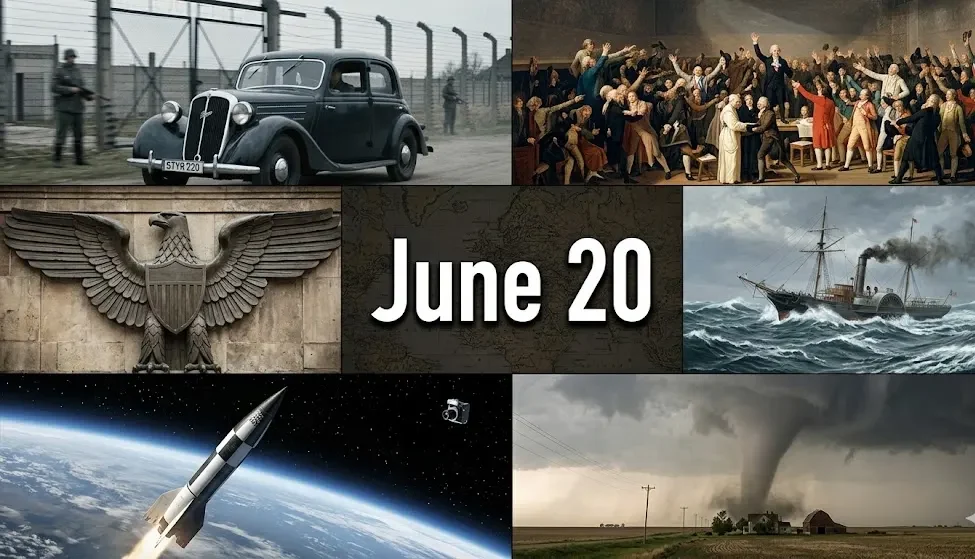
Four desperate men dressed in stolen Nazi uniforms sprinted toward a parked SS staff car inside the gates of Auschwitz on June 20, 1942. Kazimierz Piechowski felt his heart hammering against his ribs as he turned the ignition key, knowing that a single second of hesitation meant certain execution. This breathless race toward freedom is just one of the remarkable chapters that unfolded on this day in history June 20, a date packed with high-stakes defiance, geopolitical shifts, and groundbreaking human achievements. Understanding what happened on June 20 in history gives us a direct window into moments where ordinary people altered the trajectory of the modern world.
📅 Quick Facts — June 20 in History
| 📌 Category | 📖 Event / Detail |
|---|---|
| 🌟 Most Significant Event | Daring Auschwitz escape by Kazimierz Piechowski (1942) |
| 🏆 Top 10 Key Events | • Battle of Chalons (451) • Genpei War begins (1180) • Tennis Court Oath (1789) • Flight to Varennes (1791) • Queen Victoria ascends throne (1837) • Auschwitz escape (1942) • Great Marianas Turkey Shoot (1944) • V-2 rocket reaches space (1944) • Introduction of the Deutsche Mark (1948) • Watergate tape gap revealed (1972) |
| ⚔️ Key Battles | Battle of Chalons, First Battle of Uji, Battle of Höchst, Battle of the Philippine Sea |
| 👤 Key Figures | Flavius Aetius, Attila the Hun, King Louis XVI, Queen Victoria, Kazimierz Piechowski, Wernher von Braun |
| 🌍 Observances | World Refugee Day, Martyrs’ Day (Eritrea), West Virginia Day, Day of the National Flag (Argentina), Gas Sector Day (Azerbaijan) |
Story of the Day: The Great Auschwitz Escape of 1942
Kazimierz Piechowski knew his days were numbered inside the bleak wire fences of Auschwitz. Along with three fellow prisoners, he hatched a plan so audacious it bordered on madness: break into an SS warehouse, steal uniforms, and drive right out the front gate.
On the afternoon of June 20, 1942, the men donned crisp uniforms, filled a stolen Steyr 220 sedan with weapons, and approached the main checkpoint. As the gatekeeper hesitated, Piechowski leaned out and yelled orders at the guards to open up. The gate lifted, and they sped away into history, executing the most spectacular escape in the camp’s dark existence.
Important Events That Happened On June 20 In History
451 – Battle of Chalons
Flavius Aetius marched a fragile coalition of Roman soldiers and Visigothic allies onto the rolling plains of Gaul to halt the advance of Attila the Hun. The ensuing clash degenerated into a chaotic bloodbath that left thousands dead and forced Attila into a tactical retreat. Roman commanders immediately proclaimed a glorious victory despite losing a massive portion of their defensive force and failing to break the Hunnic army completely. This grueling stalemate ultimately marked the final major military campaign of the Western Roman Empire before its collapse.
1180 – First Battle of Uji
Prince Mochihito fled Kyoto with a small band of warrior monks as rival Taira forces chased them to the banks of the Uji River. The defenders tore up the planks of the bridge to slow the advance, forcing an intense archery duel across the rushing water. Taira samurai eventually found a shallow spot to ford the river, quickly overwhelming the outnumbered defenders and forcing the prince into a fatal retreat. This dramatic clash ignited the legendary Genpei War, a conflict that fundamentally reshaped Japanese medieval society and birthed the first shogunate.
1210 – Treaty of Venice and Epirus
Michael I Komnenos Doukas watched Venice expand its maritime empire across the fragmented remnants of the Byzantine world. Desperate to protect his newly formed Despotate of Epirus, the Greek ruler signed a formal pact with the Republic of Venice. He officially became a vassal of the powerful trading republic, surrendering territorial privileges in exchange for crucial military security. This strategic submission allowed Epirus to survive as a bastion of Byzantine culture during decades of foreign occupation.
1295 – Treaty of Anagni
Pope Boniface VIII brought representatives from Aragon, France, and Naples together in a grand palace to settle the bloody War of the Sicilian Vespers. The signing of the Treaty of Anagni attempted to peacefully transfer control of Sicily back to the house of Anjou. Local Sicilians completely rejected the foreign diplomacy, refusing to submit to French rule and choosing to crown their own independent king instead. The diplomatic failure proved how little medieval populations cared for papal dictates when their regional autonomy was on the line.
1622 – Battle of Höchst
Christian of Brunswick led his Protestant army toward a vital river crossing while Catholic League forces under Count Tilly moved rapidly to cut them off. The Protestant troops found themselves pinned against the water, sparking a desperate, bloody breakout attempt across a fragile bridge. Hundreds of panicking soldiers drowned in the river while Tilly’s cavalry systematically dismantled the remaining rearguard. The devastating Catholic triumph secured absolute control over the region during the opening phases of the Thirty Years’ War.
1631 – Sack of Baltimore
Barbary slave traders dropped anchor in the dead of night outside the quiet Irish fishing village of Baltimore. Led by a Dutch captain turned pirate, the raiders burst into homes, capturing over one hundred men, women, and children from their beds. The captives were packed into dark cargo holds and shipped off to North African slave markets, never to see Ireland again. The terrifying raid left the village completely abandoned for generations as traumatized survivors fled inland to escape the coast.
1652 – Appointment of Tarhoncu Ahmed Pasha
Sultan Mehmed IV elevated Tarhoncu Ahmed Pasha to the position of Grand Vizier during a time of crippling financial ruin within the Ottoman Empire. The new vizier immediately took a radical path by creating the empire’s first modern balanced budget, attacking corruption by seizing unearned wealth from elite officials. His aggressive spending cuts infuriated powerful palace insiders who preferred to exploit the state treasury for personal gain. His reforming zeal ultimately cost him his life, ending the empire’s best chance at economic renewal before his ideas could take deep root.
1685 – Monmouth Rebellion
James Scott, the Duke of Monmouth, gathered a crowd of enthusiastic locals in the marketplace of Bridgwater and boldly declared himself the rightful King of England. The Protestant duke hoped to rally the nation against his Catholic uncle, King James II, by launching an immediate armed uprising. His poorly trained peasant army lacked the heavy weapons and professional coordination needed to challenge the royal forces sent to crush them. The rebellion collapsed within weeks, leading directly to the duke’s execution and a brutal wave of royal retributions.
1756 – Black Hole of Calcutta
Siraj ud-Daulah forced the surrender of the British East India Company garrison at Fort William after a fierce siege. Troops crowded over one hundred British prisoners into a tiny, unventilated guardroom on a night of intense summer heat. By morning, suffocating conditions and a total lack of water left only a fraction of the captives alive. The tragic incident became a powerful propaganda weapon, fueling British fury and justifying a massive military campaign that conquered Bengal.
1782 – Adoption of the Great Seal
Members of the Continental Congress gathered in Philadelphia to approve the official design for the Great Seal of the United States. After years of disagreements and rejected drafts, they chose a striking bald eagle holding an olive branch and arrows to represent the young nation’s character. The design established a permanent visual identity for American federal power, stamping official authority onto treaties and state documents. The iconic image remains a symbol of American governance across the globe.
1787 – Naming the United States
Oliver Ellsworth stood before delegates at the Constitutional Convention in Philadelphia and offered an important structural motion. He requested that the gathering drop the phrase “national government” from their working documents, replacing it with the formal title “United States.” The subtle shift emphasized that the new federal framework was a voluntary union of sovereign states rather than a single centralized regime. His successful motion permanently locked the official name into the preamble of the founding document.
1789 – Tennis Court Oath
Deputies of the French Third Estate found themselves locked out of their official meeting hall by order of King Louis XVI. Refusing to scatter, they marched through the rain to a nearby indoor tennis court to hold an emergency session. Every delegate swore a solemn oath never to separate until they had written a formal constitution for the kingdom. This open act of political defiance shattered the absolute authority of the monarchy, marking the true point of no return for the French Revolution.
1791 – Flight to Varennes
King Louis XVI slipped out of the Tuileries Palace disguised as a humble valet while his family huddled in a waiting carriage. The royal family hoped to reach a loyal military stronghold on the northern border to launch a counter-revolution. A suspicious postmaster recognized the king’s face from a coin, leading to their dramatic arrest in the small town of Varennes. The failed escape destroyed any remaining public trust in the monarchy, turning the population against the king and setting the stage for his trial.
1819 – Arrival of the SS Savannah
Crew members aboard the American vessel SS Savannah cheered as the ship pulled into the harbor of Liverpool after a historic Atlantic crossing. The innovative craft became the very first steam-propelled vessel to complete the long ocean journey from the United States. Engineers relied on traditional sails for most of the trip, running the coal-powered steam engine for just a fraction of the voyage. The experiment proved that steam power could handle deep-ocean travel, accelerating the global transition away from sailing ships.
1837 – Ascension of Queen Victoria
King William IV breathed his last breath at Windsor Castle, ending a reign marked by deep political transition. The crown passed immediately to his eighteen-year-old niece, Victoria, who woke up to find she was now the ruler of a global empire. She vowed to be a constitutional monarch, steering her country through decades of rapid industrial growth, social reform, and imperial expansion. Her arrival on the throne marked the start of the Victorian Era, a period that altered global culture.
1840 – Morse Patents the Telegraph
Samuel Morse walked into the patent office to secure legal rights for his revolutionary electromagnetic telegraph system. His design used a simple arrangement of electrical clicks to transmit complex messages across miles of wire almost instantly. The invention replaced months of postal delays with immediate long-distance communication, linking distant cities together for the first time. His system created the blueprint for the global communication networks we rely on today.
1862 – Assassination of Barbu Catargiu
Prime Minister Barbu Catargiu rode through the crowded streets of Bucharest after delivering an intense political speech against land redistribution. An unknown assassin stepped from the crowd, fired a pistol at point-blank range, and vanished into the chaos. The conservative leader died instantly, shocking the young Romanian state and throwing the parliament into complete disarray. The killing underscored the dangerous, violent divisions that plagued eastern European politics during the struggle for modernization.
1863 – West Virginia Becomes a State
President Abraham Lincoln officially welcomed West Virginia into the Union as the 35th state on this day in history June 20. The rugged mountain counties had broken away from Virginia after the old state chose to join the Confederacy. The historic admission bypassed traditional constitutional steps, creating a brand new state from the territory of an active wartime enemy. The creation of West Virginia provided a vital strategic and psychological boost to the Union war effort.
1877 – First Commercial Telephone Service
Alexander Graham Bell traveled to Hamilton, Ontario, to oversee the installation of the world’s first commercial telephone line. The new service connected a local bakery directly to its suppliers, turning speculative science into a practical business tool. Customers watched in disbelief as human voices traveled instantly down a thin metal wire across the town. The modest commercial network launched a global telecommunications industry that would eventually shrink the physical distance between human beings to nothing.
1893 – Lizzie Borden Acquitted
Jurors stepped back into a packed Massachusetts courtroom after deliberating for just over an hour on the state’s most notorious murder trial. The foreman announced that Lizzie Borden was not guilty of the brutal axe murders of her father and stepmother. The shocking verdict delighted a public obsessed with the case, though it left the gruesome crimes entirely unsolved. The trial remains an enduring mystery, cementing Lizzie’s name into American folklore and true-crime history.
1895 – Opening of the Kiel Canal
Kaiser Wilhelm II stood aboard his royal yacht to lead a grand procession of ships through the newly completed Kiel Canal. Thousands of laborers spent eight years cutting the artificial waterway across the base of the Jutland peninsula to link the North Sea with the Baltic. The canal allowed the German navy to bypass the dangerous waters around Denmark, shortening commercial shipping times by days. It quickly became the busiest artificial waterway in the world, transforming European trade and naval strategy.
1900 – Siege of the Legations Begins
Imperial Chinese soldiers and Boxer rebels surrounded the foreign legation quarter in Beijing, opening fire on the diplomatic compounds. The attack trapped hundreds of foreign diplomats, civilians, and Chinese Christians inside a makeshift defensive perimeter. The defenders held out against overwhelming odds during a grueling 55-day siege as food and ammunition dwindled away. The desperate standoff ended only when an international military alliance marched into the city to break the siege.
1900 – Departure of the Zarya
Baron Eduard Toll waved goodbye to crowds gathered on the docks of Saint Petersburg as the polar explorer ship Zarya drifted into the channel. The scientific expedition set course for the icy, uncharted waters of the Arctic Ocean to locate legendary lost northern lands. The brutal polar environment trapped the ship in pack ice, forcing Toll and a small team to explore on foot across the frozen wastes. The baron vanished into the Arctic winter, leaving behind a legacy of tragic sacrifice.
1921 – Buckingham and Carnatic Mills Strike
Thousands of textile workers walked away from their looms at the Buckingham and Carnatic Mills in Chennai, launching a massive strike. The laborers demanded better pay, safer working conditions, and formal recognition for their newly organized union. The strike dragged on for four bitter months, triggering intense clashes with colonial police and deepening local political divisions. The historic standoff became a cornerstore of the early labor movement in India, proving the power of organized resistance.
1926 – International Eucharistic Congress
Over 250,000 spectators lined the streets of Chicago to watch the spectacular opening procession of the 28th International Eucharistic Congress. The massive gathering marked the first time the global Catholic event took place in the interior of the United States. Cardinal legates and international pilgrims packed local stadiums, showcasing the growing social and political influence of Catholic immigrant communities in America. The historic event transformed the city into a temporary global center of religious devotion.
1943 – Detroit Race Riot
Tensions boiled over on a hot summer evening as altercations between groups of residents erupted into violence on Belle Isle in Detroit. The conflict spread into the city’s residential neighborhoods, leading to three days of widespread looting, arson, and street fighting. Federal troops finally marched into the city with fixed bayonets to restore order after dozens of citizens lost their lives. The tragedy highlighted the intense racial friction building inside American wartime industrial centers.
1943 – Operation Bellicose
Royal Air Force crews climbed into their Avro Lancaster bombers and took off on the first shuttle bombing raid of World War II. The path took the bombers directly over Germany to damage the V-2 rocket production facilities at the Zeppelin Works before flying onward to North Africa. The clever shuttle strategy caught German radar defenses completely off guard, avoiding the deadly return trip over occupied Europe. The successful strike slowed the production of Hitler’s secret weapons during a critical phase of the war.
1944 – Battle of the Philippine Sea Concludes
American naval pilots returned to their carriers after securing a total victory over the Imperial Japanese Navy. The lopsided air battle ended with the destruction of hundreds of Japanese aircraft, earning the nickname the “Great Marianas Turkey Shoot.” The devastating loss effectively eliminated Japan’s carrier-based air power for the rest of the war, leaving their fleet defenseless against future invasions. The victory cleared a direct path for the American liberation of the western Pacific.
1944 – Soviet Demand to Finland
Soviet commanders launched the massive Vyborg–Petrozavodsk Offensive, rolling over defensive lines and demanding an unconditional surrender from Finland. The Finnish government flatly refused the terms, choosing to rally their remaining forces for a desperate defensive stand. Finnish soldiers successfully slowed the Soviet advance in subsequent battles, forcing Moscow to abandon their demand for total submission. The stubborn resistance allowed Finland to negotiate a peace treaty that preserved its national independence.
1944 – First Object in Space
German engineers watched their experimental MW 18014 V-2 rocket scream off the launchpad at Peenemünde and disappear into the sky. Instruments confirmed the rocket reached an altitude of 176 kilometers, crossing the boundary line of outer space. The launch marked the first time a man-made object ever left the Earth’s atmosphere, turning a weapon of war into a technical breakthrough. The achievement laid the foundational engineering groundwork for the entire modern space age.
1945 – Transfer of Wernher von Braun Approved
The United States Secretary of State signed official documents approving the secret transfer of Wernher von Braun and his elite team of rocket scientists to America. Operating under Operation Paperclip, the secret program bypassed immigration restrictions to secure Germany’s advanced military technology before Soviet forces could grab it. The scientists transitioned directly from designing Nazi weapons to building the American space program. The controversial decision ultimately enabled the United States to win the race to the moon.
1948 – Introduction of the Deutsche Mark
Allied occupation authorities distributed crates of crisp new Deutsche Mark banknotes across the western zones of Germany to replace the worthless old currency. The sudden economic reform wiped out the black market instantly, filling shop windows with consumer goods within days. Soviet officials viewed the separate currency launch as a hostile act designed to divide the country permanently. The Kremlin responded four days later by cutting off all land access to Berlin, triggering the historic Berlin Blockade.
1956 – Super-Constellation Ocean Crash
A Venezuelan Super-Constellation airliner climbed into the night sky from New York before experiencing severe engine trouble over the coast. The flight crew attempted to return to the airport, dump fuel, and maintain altitude, but the aircraft lost control and plunged into the Atlantic Ocean off Asbury Park. The violent impact killed all 74 passengers and crew members on board, marking one of the worst commercial aviation disasters of the decade. The tragedy forced international airlines to adopt much stricter safety maintenance protocols.
1959 – Gulf of St. Lawrence Hurricane
A powerful, unseasonal storm caught fishing fleets completely by surprise as it roared into Canada’s Gulf of St. Lawrence. The hurricane-force winds capsized dozens of small wooden boats that lacked modern weather radio equipment to warn them of the danger. The disaster claimed the lives of 35 fishermen, leaving coastal villages in New Brunswick devastated by the sudden loss. The tragedy prompted Canadian authorities to completely overhaul their maritime storm warning systems.
1960 – Independence of the Mali Federation
French officials signed final transfer documents in Paris, granting full national independence to the newly formed Mali Federation. The young West African state united the territories of Senegal and the Sudanese Republic into a single sovereign nation. The political marriage proved incredibly short-lived, dissolving within months due to deep disagreements over central governance and leadership. Both regions split apart to become the independent nations of Mali and Senegal we know today.
1963 – Establishment of the Red Telephone
American and Soviet diplomats signed an agreement in Geneva to install a direct communication link between Washington, D.C., and Moscow. The decision followed the terrifying brinkmanship of the Cuban Missile Crisis, where communication delays nearly triggered an accidental nuclear war. The “red telephone” link used an encrypted teletype system to allow immediate contact between the world’s two superpowers during international emergencies. The line provided a vital safety valve to prevent nuclear misunderstandings during the Cold War.
1972 – Watergate Tape Gap Revealed
White House lawyers informed federal investigators that an 18-and-a-half-minute gap existed inside a critical tape recording. The erased section covered a private conversation between President Richard Nixon and his top advisers just days after the Watergate break-in arrests. The mysterious silence raised immediate suspicion that the administration was actively destroying evidence to cover up illegal operations. The revelation turned the political scandal into a full-blown constitutional crisis that shattered Nixon’s presidency.
1973 – Ezeiza Massacre
Millions of expectant citizens crowded the access roads near the Ezeiza Airport in Buenos Aires to welcome exiled leader Juan Perón back to Argentina. The joyous celebration turned into a warzone as hidden right-wing Peronist snipers opened fire on left-wing factions marching with banners. At least 13 people were killed and over 300 suffered injuries during the chaotic gun battle around the speaker platforms. The sudden violence exposed deep, bloody cracks within the political movement that tore the nation apart.
1973 – Aeroméxico Flight 229 Crash
A Douglas DC-9 operating as Aeroméxico Flight 229 initiated its final approach through thick cloud cover toward the airport in Puerto Vallarta. The aircraft drifted off course during the instrument descent, slamming directly into the rugged side of a nearby mountain range. The catastrophic impact destroyed the plane instantly, taking the lives of all 27 people on board. Investigators blamed the tragedy on pilot navigation errors during difficult nighttime landing conditions.
1975 – Jaws Released in Theaters
Universal Pictures opened a film called Jaws in hundreds of American movie theaters on this day in history June 20. Backed by an unprecedented television advertising campaign, the gripping thriller about a man-eating shark terrified audiences and generated massive lines around city blocks. The movie smashed box office records within weeks, becoming the highest-grossing film of its era. The massive success changed Hollywood’s business model forever, inventing the modern concept of the summer blockbuster.
1979 – Assassination of Bill Stewart
ABC News correspondent Bill Stewart approached a military checkpoint in Managua to interview Nicaraguan National Guard forces. A soldier ordered the journalist to lie face down on the pavement before shooting him at point-blank range. A hidden camera crew captured the entire brutal execution on tape, smuggling the footage out of the country to broadcast it on global news. The shocking television footage sparked immediate international outrage, destroying global support for the Somoza dictatorship.
1982 – International Conference on the Holocaust and Genocide
Scholars and activists filled an auditorium in Tel Aviv for the opening session of a groundbreaking international conference on mass atrocities. The event moved forward despite intense pressure from the Turkish government, which tried to force a cancellation because the program included presentations on the Armenian genocide. Israeli organizers refused to alter the academic schedule, choosing to defend historical truth over geopolitical convenience. The gathering established a major milestone for the field of modern genocide studies.
1982 – Falklands War Concludes
Royal Marine commandos landed on the remote, icy shores of Southern Thule to accept the formal surrender of the Argentine Corbeta Uruguay base. The brief, bloodless encounter marked the final military operation of the bitter Falklands War. British forces dismantled the base and re-established control over the distant South Atlantic islands, ending weeks of intense combat. The quiet surrender solidified Britain’s total victory and led to the collapse of the military junta in Buenos Aires.
1988 – Haitian Coup d’État
Lieutenant General Henri Namphy ordered armored vehicles to surround the presidential palace in Port-au-Prince, forcing President Leslie Manigat out of office. The rapid military coup ended a brief four-month experiment with civilian democratic rule following decades of dictatorship. Namphy immediately dissolved the national parliament, suspended the constitution, and declared himself the absolute ruler of the island nation. The takeover plunged Haiti back into a cycle of military instability and economic isolation.
1990 – Discovery of Asteroid Eureka
Astronomers working at the Palomar Observatory noticed a faint, moving point of light while studying deep-space photographic plates. The discovery, named Asteroid Eureka, proved to be the very first confirmed Martian trojan asteroid sharing Mars’s orbit around the sun. The space rock sits in a stable gravitational pocket, tracking behind the red planet like a permanent cosmic companion. The find gave scientists critical clues about the formation and stability of our solar system.
1990 – Manjil–Rudbar Earthquake
A massive 7.4 magnitude earthquake struck the northern regions of Iran near midnight, catching millions of families asleep in their homes. The intense shaking leveled entire towns, destroying thousands of fragile mud-brick buildings across the mountainous countryside. The disaster claimed between 35,000 and 50,000 lives while leaving more than half a million citizens completely homeless. The tragedy triggered a massive international relief effort and forced a complete revision of local building codes.
1991 – Berlin Reclaims Capital Status
Members of the German Bundestag engaged in an intense, twelve-hour debate regarding the political future of their newly reunified nation. Lawmakers voted to move the seat of government from the quiet, western city of Bonn back to the historic capital of Berlin. The historic decision symbolized the definitive end of Cold War divisions, healing a wound that had split the country since World War II. The massive relocation project transformed Berlin into the political heart of modern Europe.
1994 – Imam Reza Shrine Bombing
A powerful bomb hidden inside a briefcase tore through a crowded prayer hall at the historic Imam Reza shrine in Mashhad, Iran. The explosion ripped through hundreds of worshippers gathered for a holy day, killing at least 25 people and wounding hundreds more. The horrific attack on one of the holiest sites in Shia Islam shocked the entire nation and triggered widespread security crackdowns. The government blamed regional militant groups, exposing deep sectarian conflicts within the region.
1996 – Space Shuttle Columbia Launches
Engineers at the Kennedy Space Center watched Space Shuttle Columbia roar into the sky on mission STS-78. The orbiter carried a specialized Spacelab module into orbit, packed with international experiments focused on human biology and microgravity physics. The crew spent over sixteen days conducting research to understand how long-term space travel affects the human skeletal and muscular systems. The successful flight set a new endurance record for the shuttle fleet, paving the way for future space station missions.
2003 – Wikimedia Foundation Founded
Jimmy Wales signed corporate charter documents in Florida to officially establish the Wikimedia Foundation as a non-profit entity. The new organization took over legal and financial responsibility for managing Wikipedia, ensuring the online encyclopedia would remain free and open to everyone. The move protected the collaborative platform from commercial exploitation, keeping knowledge accessible to anyone with an internet connection. The modest foundation grew into an international force that changed how humanity shares information.
2011 – RusAir Flight 9605 Crash
A regional jet operating as RusAir Flight 9605 clipped trees during a low-visibility approach to the Petrozavodsk Airport in northern Russia. The aircraft crashed onto a nearby highway and burst into flames, taking the lives of 47 passengers and crew members on board. Investigators discovered that the flight crew attempted to land below safe visibility limits without proper ground instrumentation. The tragic accident forced Russian transport authorities to quickly retire several aging Soviet-era passenger planes.
2019 – Drone Shot Down over Hormuz
Iran’s Air Defense Forces launched a surface-to-air missile over the strategic Strait of Hormuz, destroying an American Global Hawk surveillance drone. Iranian officials claimed the aircraft violated their national airspace, while Washington insisted the drone was operating over international waters. The high-altitude shootdown pushed both nations to the absolute brink of direct military conflict during a period of intense regional friction. The crisis highlighted the growing risk of robotic warfare in highly contested shipping lanes.
2025 – Enderlin EF5 Tornado
A monstrous, multi-vortex tornado touched down near Enderlin, North Dakota, tearing across the landscape with winds exceeding 200 miles per hour. The violent storm completely leveled sturdy brick structures and swept clean the foundations of several homes, marking the first confirmed EF5 tornado in twelve years. Advanced meteorological tracking systems allowed local residents to find shelter before impact, preventing any loss of life despite the incredible physical devastation. The rare event provided scientists with invaluable data on extreme storm development.
Dig deeper into our timeline of past events right here.
Famous People Born On June 20
| Name | Description | Date |
|---|---|---|
| Ali az-Zahir | Fatimid Caliph of Egypt | 1005 – 1036 |
| John of Lancaster | 1st Duke of Bedford | 1389 – 1435 |
| Gian Galeazzo Sforza | Duke of Milan | 1469 – 1494 |
| Sigismund III Vasa | King of Poland & Sweden | 1566 – 1632 |
| Jacob De la Gardie | Swedish soldier & statesman | 1583 – 1652 |
| Charles Emmanuel II | Duke of Savoy | 1634 – 1675 |
| Adam Ferguson | Scottish philosopher | 1723 – 1816 |
| Tokugawa Ieharu | Shōgun of Japan | 1737 – 1786 |
| Wolfe Tone | Irish revolutionary leader | 1763 – 1798 |
| Thomas Douglas | Earl of Selkirk & philanthropist | 1771 – 1820 |
| Jacques Offenbach | Composer & cellist | 1819 – 1880 |
| Gina Krog | Norwegian women’s rights activist | 1847 – 1916 |
| Charles W. Chesnutt | Novelist & short-story writer | 1858 – 1932 |
| Frederick Gowland Hopkins | Nobel Prize-winning biochemist | 1861 – 1947 |
| Jean Moulin | French Resistance hero | 1899 – 1943 |
| Lillian Hellman | Playwright & screenwriter | 1905 – 1984 |
| Errol Flynn | Australian-American actor | 1909 – 1959 |
| Chet Atkins | Guitarist & record producer | 1924 – 2001 |
| Audie Murphy | War hero & actor | 1925 – 1971 |
| Martin Landau | American actor | 1928 – 2017 |
| Olympia Dukakis | Academy Award-winning actress | 1931 – 2021 |
| Brian Wilson | Musician, songwriter & producer | 1942 – 2025 |
| Anne Murray | Canadian singer | 1945 – Present |
| Lionel Richie | Singer-songwriter | 1949 – Present |
| John Goodman | American actor | 1952 – Present |
| Vikram Seth | Indian novelist & poet | 1952 – Present |
| Nicole Kidman | Australian-American actress | 1967 – Present |
| Robert Rodriguez | Film director & producer | 1968 – Present |
| Frank Lampard | English footballer | 1978 – Present |
| Kalidou Koulibaly | Senegalese footballer | 1991 – Present |
Famous People Died On June 20
| Name | Description | Date |
|---|---|---|
| Louis the Pious | Carolingian Emperor | 778 – 840 |
| Willem Barentsz | Dutch explorer & cartographer | 1550 – 1597 |
| William IV | King of the United Kingdom | 1765 – 1837 |
| Manuel Belgrano | Argentine general & statesman | 1770 – 1820 |
| Hijikata Toshizō | Japanese military commander | 1835 – 1869 |
| John Neal | American writer & critic | 1793 – 1876 |
| Johannes Zukertort | Chess master | 1842 – 1888 |
| Josef Breuer | Physician & psychologist | 1842 – 1925 |
| Bugsy Siegel | American mobster | 1906 – 1947 |
| Kurt Alder | Nobel Prize-winning chemist | 1902 – 1958 |
| Bernard Baruch | Financier & political adviser | 1870 – 1965 |
| Georges Lemaître | Physicist; Big Bang pioneer | 1894 – 1966 |
| Bishnu Prasad Rabha | Indian artist & politician | 1909 – 1969 |
| Mark Robson | Film director & producer | 1913 – 1978 |
| Emil Cioran | Philosopher & essayist | 1911 – 1995 |
| Clifton Fadiman | Author & television personality | 1902 – 1999 |
| Erwin Chargaff | Biochemist & genetic researcher | 1905 – 2002 |
| Jack Kilby | Inventor of the microchip | 1923 – 2005 |
| Ryan Dunn | Television personality | 1977 – 2011 |
| LeRoy Neiman | Painter & illustrator | 1921 – 2012 |
| Andrew Sarris | Film critic | 1928 – 2012 |
| Ingvar Rydell | Swedish footballer | 1922 – 2013 |
| Angelo Niculescu | Romanian football manager | 1921 – 2015 |
| Miriam Schapiro | Painter & feminist artist | 1923 – 2015 |
| Prodigy | Rapper (Mobb Deep) | 1974 – 2017 |
| Caleb Swanigan | Basketball player | 1997 – 2022 |
| Donald Sutherland | Canadian actor | 1935 – 2024 |
| Taylor Wily | Actor & former sumo wrestler | 1968 – 2024 |
| Axel von Fersen the Younger | Swedish statesman | 1755 – 1810 |
Observances on June 20
- World Refugee Day: This international day honors the strength and courage of millions of people forced to flee their homelands due to conflict or persecution.
- Martyrs’ Day (Eritrea): Citizens gather across the nation to pay solemn tribute to the thousands of fighters who sacrificed their lives during the long war for independence.
- West Virginia Day: Local communities celebrate the unique culture and heritage of the mountain state, marking its official separation from Virginia during the American Civil War.
- Day of the National Flag (Argentina): The country honors the creation of its blue-and-white banner, commemorating the anniversary of the passing of its designer, Manuel Belgrano.
- Gas Sector Day (Azerbaijan): This professional holiday recognizes the industrial contributions of energy workers who drive the nation’s economic infrastructure.
🎾 Frequently Asked Questions — June 20 in History
Four daring prisoners executed a brilliant escape from the Auschwitz concentration camp on this day by stealing SS uniforms and a staff car. Led by Kazimierz Piechowski, the men successfully tricked the gate guards and drove to freedom. The spectacular exploit remains one of the most audacious acts of resistance recorded during the Holocaust.
The Tennis Court Oath of 1789 stands out as the most significant event because it directly triggered the collapse of absolute monarchy in France. By refusing to separate until they created a constitution, ordinary citizens seized political power from the king. This single act of defiance set off a wave of global democratic revolutions.
Hollywood icon Nicole Kidman was born on this day in 1967, going on to become one of the most celebrated actresses of her generation. Her versatile career across independent films and major studio blockbusters earned her numerous accolades, including an Academy Award. She remains a prominent figure in global cinema and cultural philanthropy.
The Battle of the Philippine Sea concluded on this day in 1944 with a decisive naval victory for the United States. Known popularly as the Great Marianas Turkey Shoot, the clash resulted in the destruction of hundreds of Japanese aircraft. This devastating blow permanently crippled Japan’s carrier fleet for the remainder of World War II.
World Refugee Day is an international observance held to honor the resilience of individuals forced to flee their home countries due to violence or persecution. It raises global awareness about the plight of displaced populations and advocates for their human rights and safety. The day encourages communities to support refugees as they rebuild their lives.
A rare and violent EF5 tornado struck the town of Enderlin, North Dakota, in 2025, obliterating local infrastructure with extreme winds. The catastrophic event marked the first time an EF5 tornado occurred anywhere in the United States in twelve years. Early warnings saved lives, though the landscape suffered historic damage.