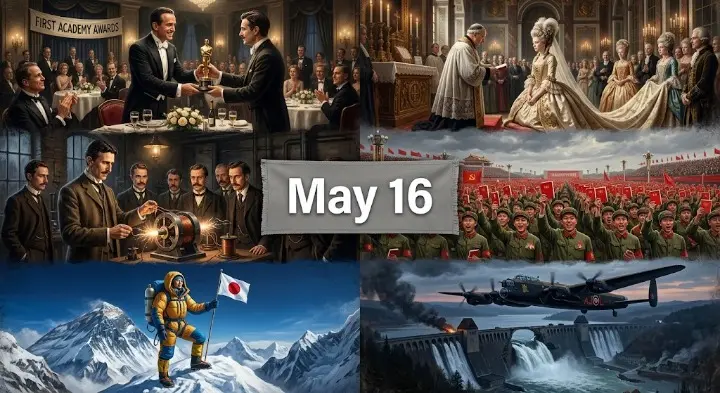
In the dimly lit blossom room of Hollywood’s Roosevelt Hotel on May 16, 1929, 270 actors, directors, and moguls clinked glasses over a quiet dinner. Within fifteen minutes, the entire ceremony was over, changing the entertainment landscape forever by handing out the very first Academy Awards. On that exact same date across different centuries, a teenage Marie Antoinette walked down the aisle toward her doom, and China sparked a decade of political terror. This day in history May 16 chronicles the incredible range of human triumph and tragedy.
📅 Quick Facts — May 16 in History
| 📌 Category | 📖 Event / Detail |
|---|---|
| 🌟 Most Significant Event | The inaugural Academy Awards ceremony takes place in Hollywood (1929) |
| 🏆 Top 10 Key Events | • Suzaku abdicates in Japan (946) • Thomas More resigns (1532) • Mary, Queen of Scots flees (1568) • Marie Antoinette marries (1770) • Battle of Albuera (1811) • Andrew Johnson acquitted (1868) • Nikola Tesla details AC power system (1888) • Sykes-Picot Agreement signed (1916) • China launches Cultural Revolution (1966) • Junko Tabei summits Mount Everest (1975) |
| ⚔️ Key Battles | Battle of Merv (999), Battle of Cocherel (1364), Battle of Vasai (1739), Battle of Alamance (1771), Battle of Albuera (1811), Battle of Asseiceira (1834), Battle of Champion Hill (1863) |
| 👤 Key Figures | Douglas Fairbanks, Chairman Mao Zedong, Marie Antoinette, Nikola Tesla |
| 🌍 Observances | Mass Graves Day (Iraq), Teachers’ Day (Malaysia), National Day (South Sudan) |
Story of the Day: The Birth of the Oscars
Douglas Fairbanks stepped onto the stage at the Hollywood Roosevelt Hotel on May 16, 1929, holding a handful of five-pound golden statuettes. The silent film era was drawing to a close, and the newly formed Academy of Motion Picture Arts and Sciences wanted a way to legitimize their growing industry. Unlike the suspenseful television spectacles of modern times, the winners had been announced three months prior, transforming the event into an intimate banquet. The sweeping epic Wings took home the top prize for Outstanding Picture. This brief, untelevised meeting established a cultural benchmark that still defines cinematic achievement worldwide.
Important Events That Happened On May 16 In History
946 – The Abdication of Emperor Suzaku
Emperor Suzaku walked away from the Chrysanthemum Throne of Japan, voluntarily stepping down in favor of his younger brother, Murakami. This transition marked a delicate shift in imperial politics during the peaceful Heian period, where behind-the-scenes family dynamics dictated national leadership. Murakami officially assumed power as the 62nd emperor of Japan immediately following the ceremony. The move reinforced the tradition of early retirement among Japanese monarchs, allowing former rulers to wield influence without administrative burdens.
999 – The Battle of Merv
Mahmud of Ghazni led his charging cavalry across the dusty plains of Merv to clash directly with the forces of Samanid Emir Mansur II. The rebel Turkish warlord used superior tactical mobility to shatter the opposing lines and claim a total victory on the battlefield. This clash completely broke the regional power of the fading Samanid Empire in Central Asia. Mahmud secured his path to establishing the vast Ghaznavid Empire, turning his capital into a major center of Islamic culture.
1003 – The Selection of Pope John XVII
John Crescentius, a powerful patrician who had seized physical control of Rome, marched into the papal quarters to install his hand-picked candidate onto the throne. The newly chosen Pope John XVII took office entirely under the shadow and influence of this Roman military dictator. This forced appointment highlighted the volatile political corruption of medieval Italy, where noble families treated the papacy as a personal prize. The new pope survived only a few months in office before dying, leaving Rome in continuous political chaos.
1204 – The Crowning of Baldwin IX
Baldwin IX, Count of Flanders, stood before the high altar of the Hagia Sophia to be crowned as the first leader of the new Latin Empire. Western crusaders had just brutally sacked the Christian city of Constantinople, forcing out the Byzantine rulers and dividing the territory among themselves. This coronation solidified a deep, permanent fracture between Eastern and Western Christianity. Baldwin’s fragile empire faced immediate rebellion from surrounding states and dissolved entirely within a few generations.
1364 – The Battle of Cocherel
Bertrand du Guesclin outmaneuvered the veteran Anglo-Navarrese army of Charles the Bad in the rolling fields of Cocherel. The brilliant French commander used a feigned retreat to lure his enemies out of their strong defensive positions before crushing them. This decisive victory restored French military prestige during a dark phase of the Hundred Years’ War. The triumph secured the upcoming coronation of King Charles V, shifting the balance of power back toward Paris.
1426 – The Ascension of King Thado
Governor Thado of Mohnyin marched into the royal capital of Ava to claim the vacant throne for himself. The ambitious ruler successfully united warring factions after a period of intense palace assassinations and regional instability. His coronation brought a brief period of centralized authority to the multi-ethnic Kingdom of Ava. His descendants maintained control over Upper Burma for over a century, shaping the region’s cultural identity.
1527 – The Second Expulsion of the Medici
Angry Florentine citizens filled the public squares, demanding the immediate removal of the powerful Medici family from their city. Growing resentment over papal influence and heavy taxes boiled over into an open, bloodless revolt that sent the rulers fleeing into exile. Florence immediately re-established its traditional republican government, celebrating the return of citizen-led rule. The restored republic lasted only three years before imperial troops returned the Medici to power by force.
1532 – The Resignation of Thomas More
Sir Thomas More handed the Great Seal of England back to King Henry VIII, officially stepping down as Lord Chancellor. More chose to sacrifice his career and prestige rather than endorse the king’s plan to divorce Catherine of Aragon and break from the Catholic Church. This quiet resignation marked a point of no return in the tumultuous English Reformation. More’s steadfast refusal to sign the Oath of Supremacy eventually led him straight to the executioner’s block.
1568 – The Flight of Mary, Queen of Scots
Mary, Queen of Scots, stepped into a small fishing boat and fled across the Solway Firth to seek safety in England. She left her homeland behind forever after her forces suffered a devastating defeat at the Battle of Langside. Mary mistakenly believed her cousin, Queen Elizabeth I, would offer her sanctuary and an army to reclaim her throne. Instead, Elizabeth placed Mary under immediate house arrest, beginning nineteen years of captivity that ended in execution.
1584 – Santiago de Vera Takes Command
Santiago de Vera officially assumed office as the sixth governor-general of the Philippines in the growing colonial capital of Manila. Sent by the Spanish crown to reform local administration, he brought strict legal structures and established the first royal court in the islands. His arrival deepened European colonial control over the indigenous populations and lucrative trade routes of Southeast Asia. His infrastructure projects, including building the first stone fortresses, shaped the defensive layout of Manila for centuries.
1739 – The Battle of Vasai Concludes
Maratha soldiers launched a final, overwhelming assault against the heavily fortified Portuguese garrisons at Vasai. Chimaji Appa led the Indian forces through a brutal, multi-week siege that ended with the complete surrender of the European army. This victory severely restricted Portuguese colonial ambitions to a small coastal pocket in Goa. The Maratha Empire proved it could successfully defeat standard European military fortifications using coordinated artillery and infantry.
1770 – The Royal Wedding of Marie Antoinette
Fourteen-year-old Marie Antoinette walked down the aisle of the royal chapel at Versailles to marry the fifteen-year-old French Dauphin. This high-stakes political union was arranged to seal a fragile diplomatic alliance between the rival empires of Austria and France. The grand celebrations masked deep-seated financial trouble and growing public anger toward the excessive lifestyle of the monarchy. Within two decades, the young couple would face the fury of the French Revolution and die on the guillotine.
1771 – The Battle of Alamance
Royal Governor William Tryon ordered his disciplined North Carolina militia to open fire on a disorganized camp of local rebels. The frontiersmen, calling themselves the “Regulators,” had taken up arms to protest corrupt taxes and unfair court fees imposed by wealthy coastal elites. The brief, bloody clash ended in a total rout of the poorly equipped backcountry farmers. This battle crushed the regional regulation movement but planted early seeds of armed resistance against British authority.
1777 – The Gwinnett-McIntosh Duel
Lachlan McIntosh raised his pistol and fired a single shot across a pasture near Savannah, striking Button Gwinnett in the thigh. The bitter political rivalry between the Continental Army officer and the signer of the Declaration of Independence had boiled over into a formal duel. Gwinnett’s wound turned gangrenous, causing his agonizing death just three days later. The fatal encounter shocked the young American government and deprived Georgia of one of its earliest revolutionary leaders.
1811 – The Battle of Albuera
Marshal Soult led his veteran French battalions into a ferocious, close-quarters clash against a combined force of British, Spanish, and Portuguese troops. The chaotic fighting in the mud of Albuera turned into the bloodiest encounter, relative to numbers, of the entire Peninsular War. Neither side could secure a decisive breakthrough, leaving over ten thousand soldiers dead or wounded on the field. The French failed to lift the siege of Badajoz, stalling their momentum across the Iberian Peninsula.
1812 – The Treaty of Bucharest
Imperial Russian and Ottoman diplomats gathered in a Bucharest guesthouse to sign a comprehensive peace treaty ending their six-year war. Facing an imminent invasion by Napoleon, Russia quickly compromised, while the Turks ceded the strategic eastern half of Moldavia. This agreement officially handed the region of Bessarabia over to the control of the Russian Empire. The newly drawn borders shifted regional dynamics in Eastern Europe, creating a geopolitical flashpoint that persisted into modern times.
1822 – The Fall of Souli
Ottoman troops stormed the mountain strongholds of Souli, finally capturing the legendary Greek resistance base after a brutal siege. The local Souliote warriors had defended their territory for months, fighting fiercely as part of the wider Greek War of Independence. This victory allowed the Ottoman forces to temporarily secure the Epirus region and turn their attention south. The defenders’ heroic stand became a powerful symbol of national sacrifice, inspiring Greek revolutionaries across the mainland.
1832 – The Discovery at Chañarcillo
Juan Godoy stopped his mule in the arid hills of Chañarcillo and noticed a strange, rich outcrop of exposed silver ore. The humble woodcutter had stumbled upon one of the wealthiest silver deposits on the planet, changing his life instantly. This accidental find sparked a massive Chilean silver rush, drawing thousands of prospectors to the Atacama Desert. The resulting mining boom funded Chile’s early railway systems, built modern ports, and transformed the young nation’s economy.
1834 – The Battle of Asseiceira
General António José de Ávila rallied his liberal constitutionalist troops to break the defensive lines of the absolutist army at Asseiceira. This fierce confrontation ended in a total victory for the forces supporting Queen Maria II. The decisive battle brought an immediate end to the bloody Liberal Wars that had torn Portugal apart for six years. King Miguel was forced into permanent exile, ensuring a constitutional monarchy would guide the nation’s future.
1842 – The First Oregon Trail Wagon Train
One hundred hopeful pioneers guided their heavy wagons out of the Elm Grove encampment in Missouri, turning their faces toward the Pacific Northwest. Led by Elijah White, this organized group formed the first major, multi-family wagon train to attempt the grueling journey across the continent. They braved thousands of miles of uncharted plains, swollen rivers, and rugged mountain passes to find cheap land. This successful trek proved the route was viable, opening a massive wave of westward migration.
1863 – The Battle of Champion Hill
Ulysses S. Grant launched a fierce, multi-pronged assault that drove John C. Pemberton’s Confederate forces off the high ground of Champion Hill. The bloody Union victory forced the Southern army to abandon the field and retreat directly into their fortifications at Vicksburg. This clash was the tactical climax of the wider Vicksburg campaign during the American Civil War. By cutting off the Confederates from reinforcement, Grant secured the eventual capture of the vital Mississippi River.
1866 – The Creation of the United States Nickel
Members of the United States Congress voted to authorize the minting of a new five-cent coin made entirely from a copper-nickel alloy. The nation faced a severe shortage of silver coins following the financial disruptions of the Civil War, making a cheap base-metal alternative essential. This legislative act permanently introduced the modern “nickel” into the American monetary system. The durable coin quickly replaced fractional paper currency and became a staple of daily commerce.
1868 – The Acquittal of Andrew Johnson
Chief Justice Salmon P. Chase read aloud the vote count on the high floor of the United States Senate, revealing that the impeachment conviction of Andrew Johnson had failed by a single vote. Radical Republicans fell just short of the required two-thirds majority needed to remove the president from office over his reconstruction policies. This tense constitutional crisis established a high legal standard for removing a sitting American chief executive. Johnson served out the remainder of his term, though his political power was permanently broken.
1874 – The Mill River Flood
A poorly constructed earthen dam in Massachusetts collapsed early in the morning, sending a wall of water crashing down the narrow Mill River valley. The roaring torrent obliterated four manufacturing villages, destroying factories, homes, and bridges within minutes. The disaster claimed the lives of 139 people and left thousands completely homeless. This tragedy forced state legislators to enact the nation’s very first strict safety laws governing dam construction and reservoir inspection.
1877 – The May 16 Crisis in France
President Patrice de MacMahon dismissed the popular prime minister and dissolved the National Assembly, triggering a fierce constitutional showdown. The conservative president attempted to assert executive control over a newly elected republican majority that favored a secular government. This dramatic political gamble backfired completely when voters soundly rejected royalist candidates in the following October elections. The crisis permanently established France as a parliamentary republic where the prime minister, not the president, held supreme power.
1888 – Tesla’s Alternating Current Lecture
Nikola Tesla stepped up to the podium at the American Institute of Electrical Engineers to deliver a detailed technical presentation on his new polyphase alternating current system. He demonstrated how his custom-built induction motors and transformers could safely transmit high-voltage electricity over immense distances. This landmark lecture caught the attention of industrialist George Westinghouse, who bought the patents to challenge Thomas Edison. The presentation effectively won the “War of the Currents,” establishing the electrical framework that powers the modern world.
1891 – The International Electrotechnical Exhibition
Engineers in Frankfurt, Germany, flipped a massive master switch to illuminate thousands of light bulbs using electricity generated 109 miles away in Lauffen. This public demonstration featured the world’s first successful long-distance transmission of high-power, three-phase alternating current. The exhibition proved that remote rivers could be harnessed to power distant industrial cities efficiently. This technological breakthrough laid the foundation for the standard power grids used across the globe today.
1916 – The Signing of the Sykes-Picot Agreement
Sir Mark Sykes and François Georges-Picot quietly signed a secret wartime pact partitioning the vast territories of the fading Ottoman Empire between Britain and France. The two diplomats drew arbitrary lines across the map of the Middle East, allocating future control over modern-day Iraq, Syria, Jordan, and Lebanon. This covert arrangement completely ignored local tribal, ethnic, and religious realities on the ground. The artificial borders established by the accord created deep geopolitical instability that still impacts the region.
1918 – The Passage of the Sedition Act
United States lawmakers approved the Sedition Act of 1918, making it a federal crime to utter, print, or write any disloyal or abusive language about the government or military during wartime. The Wilson administration used the strict law to target anti-war activists, union leaders, and immigrant communities during the height of World War I. This legislation triggered a major national debate over the limits of free speech during a national emergency. Congress repealed the controversial act less than two years after the conflict ended.
1918 – The Finnish White Guard Parade
General Carl Gustaf Emil Mannerheim rode at the head of a massive military parade through the streets of Helsinki to celebrate victory in the Finnish Civil War. The conservative White Guard had successfully crushed the socialist Red forces with direct military assistance from imperial Germany. This public triumph marked the formal end of a brutal internal conflict that left the young nation deeply divided. The anniversary was celebrated as Flag Day for decades before being moved to June.
1919 – The First Transatlantic Flight Departs
Commander Albert Cushing Read taxied his large Curtiss NC-4 navy seaplane out of the harbor at Trepassey, Newfoundland, heading out into the open Atlantic. He and his crew aimed to achieve the first multi-stage flight across the ocean to Europe via the Azores. Navigating through thick fog and treacherous storms, the aircraft safely completed the historic journey two weeks later in Lisbon. This pioneer flight proved that long-range aviation over open oceans was technically possible.
1920 – The Canonization of Joan of Arc
Pope Benedict XV looked out over a packed St. Peter’s Basilica in Rome and officially declared Joan of Arc a saint of the Catholic Church. Five centuries after she was burned at the stake as a heretic by an English court, the French peasant girl who led armies was formally exonerated. This event helped mend diplomatic relations between the Vatican and the post-war French Republic. Joan became a unifying national icon for a generation recovering from the horrors of the First World War.
1925 – The Revival of Monteverdi’s Opera
Musicians in Paris took to the stage to perform Claudio Monteverdi’s Il ritorno d’Ulisse in patria, marking its first modern production. The 17th-century baroque masterpiece had sat forgotten in archives for centuries before musicologists reconstructed the surviving scores. This performance sparked a major international renaissance of early opera, proving these ancient works could still captivate modern audiences. The revival permanently returned Monteverdi to the center of the global operatic canon.
1929 – The First Academy Awards Ceremony
A small crowd gathered for a private banquet at the Hollywood Roosevelt Hotel to see the presentation of the first Academy Awards. The event lasted just fifteen minutes, with winners having been announced three months prior to the dinner. The silent aviation epic Wings took home the top honor for Outstanding Picture. This modest gathering laid the foundation for the massive global media event known today as the Oscars.
1943 – The End of the Warsaw Ghetto Uprising
SS General Jürgen Stroop ordered his troops to detonate the Great Synagogue of Warsaw, marking the brutal end to the Warsaw Ghetto Uprising. For nearly a month, a few hundred poorly armed Jewish resistance fighters had held off a massive, heavily equipped Nazi military force. The desperate insurgents chose to fight back rather than face quiet deportation to death camps. The Germans systematically burned the ghetto block by block, killing or capturing tens of thousands of residents.
1943 – Operation Chastise Launched
Nineteen specially modified Avro Lancaster bombers roared down British runways to launch Operation Chastise against the industrial heart of Germany. Wing Commander Guy Gibson led the famous “Dambusters” squad using revolutionary “bouncing bombs” designed to skip across water to avoid torpedo nets. The daring low-level raids successfully breached the Möhne and Eder dams, sending catastrophic floods tearing through the Ruhr Valley. The attack destroyed vital power stations and disrupted Nazi steel production for months.
1945 – The Outbreak of the Levant Crisis
French troops in Syria opened fire on large nationalist crowds demanding immediate independence from colonial rule. This violent crackdown in Damascus triggered the Levant Crisis, causing deep diplomatic tensions between wartime allies Britain and France. British Prime Minister Winston Churchill threatened direct military action, ordering troops to march from Transjordan to restore order. Faced with an ultimatum, French forces backed down and withdrew, clearing the path for full Syrian sovereignty.
1951 – The First Scheduled Transatlantic Commercial Flight
An El Al Israel Airlines Lockheed Constellation lifted off from New York’s Idlewild Airport, heading east toward London Heathrow. This journey marked the beginning of regular, scheduled transatlantic commercial service connecting Israel directly to Western Europe and North America. The route signaled the rapid post-war expansion of global aviation networks. It allowed regular passengers to cross the Atlantic in less than twenty hours, replacing long ocean voyages.
1954 – The Kengir Uprising Begins
Thousands of political prisoners inside the Kengir Gulag camp in Kazakhstan turned on their guards, seizing complete control of the entire facility. The inmates, camp survivors of brutal forced labor, organized a sophisticated internal government with their own defense forces and propaganda departments. They demanded an immediate end to arbitrary guard violence and a full review of their sentences. The desperate rebellion held out for forty days before Soviet authorities sent in tanks to crush the uprising.
1959 – The Tritons’ Fountain Is Activated
Engineers in Valletta, Malta, turned on the master pumps of the Tritons’ Fountain for the first time, sending water cascading over its massive bronze figures. Designed by local sculptor Vincent Apap, the monument featured three sea gods supporting a large central basin outside the city gates. The grand unveiling celebrated the modernization of Malta’s public spaces and water infrastructure following the destruction of World War I. The fountain became an iconic landmark for the Mediterranean island nation.
1960 – The First Working Laser Operation
Theodore Maiman focused a high-intensity flash lamp onto a synthetic ruby rod at the Hughes Research Laboratories in California, generating a thin, bright beam of coherent light. This marked the world’s first successful operation of an optical laser. Many contemporary scientists initially dismissed the invention as a clever laboratory toy looking for a practical problem to solve. Today, laser technology forms the backbone of modern global telecommunications, precision medicine, and industrial manufacturing.
1961 – The May 16 Coup in South Korea
General Park Chung Hee led disciplined army units across the Han River bridges into Seoul, swiftly overthrowing the democratic Second Republic of South Korea. The military junta claimed the takeover was necessary to halt growing civil unrest and prevent a communist infiltration from the north. This coup ended a brief experiment with parliamentary democracy and established a strict military dictatorship. Park’s subsequent decades of authoritarian rule initiated a massive economic transformation that turned South Korea into an industrial powerhouse.
1966 – The Launch of the Cultural Revolution
The Chinese Communist Party issued the secret “May 16 Notice” under direct orders from Chairman Mao Zedong, warning that bourgeois elements had infiltrated the government and military. This official decree triggered the launch of the decade-long Cultural Revolution across China. Mao mobilized millions of radical young Red Guards to destroy traditional culture and attack his political rivals. The resulting chaos led to widespread purges, economic ruin, and the deaths of over a million citizens.
1969 – Venera 5 Enters Venusian Atmosphere
The Soviet space probe Venera 5 detached its heavy entry capsule and plunged directly into the thick, opaque atmosphere of Venus. The reinforced instrument pod broadcasted vital scientific data about temperature, pressure, and gas composition for 53 minutes as it descended. The immense atmospheric pressure finally crushed the hull just before it touched the scorched volcanic surface. This mission provided humanity with its first accurate profile of the hostile greenhouse conditions on our sister planet.
1972 – The Svetlogorsk Kindergarten Disaster
An Antonov An-24 military transport plane clipped trees in thick fog and crashed directly into a crowded kindergarten building in Svetlogorsk. The tragic impact and subsequent fuel fire killed 35 people, including 24 young children who were eating lunch inside. Soviet authorities immediately placed the entire resort city under military lockdown and cut telephone lines to prevent news of the disaster from spreading. The entire site was cleared and turned into a public park overnight to cover up the accident.
1974 – Tito Appointed President for Life
Members of the Yugoslav Federal Assembly voted unanimously to elect Josip Broz Tito as President for Life under the terms of a newly drafted constitution. The aging wartime partisan leader had held absolute power over the communist federation since the end of World War II. This political appointment aimed to ensure national stability among the country’s competing ethnic republics. Tito’s death six years later left a massive power vacuum that eventually led to the violent dissolution of Yugoslavia.
1975 – The First Woman Summits Mount Everest
Junko Tabei crawled through deep snow and hauled herself onto the highest point on Earth, becoming the first woman to successfully summit Mount Everest. The Japanese mountaineer led an all-female expedition, overcoming a devastating avalanche that had buried her camp just days earlier. Her achievement shattered deep-seated gender barriers in the male-dominated world of high-altitude climbing. Tabei used her historic platform to advocate for alpine environmental preservation until her death.
1888 – The Surgeon General’s Report on Nicotine
Surgeon General C. Everett Koop stepped before reporters in Washington to release a comprehensive 618-page medical report on tobacco use. The landmark study concluded definitively that the addictive properties of nicotine are identical to those of heroin and cocaine. This official government declaration completely transformed the legal and public health landscape surrounding tobacco marketing. The findings provided the scientific foundation for modern anti-smoking campaigns and strict indoor smoking bans.
1991 – Queen Elizabeth II Addresses Congress
Queen Elizabeth II walked up to the podium of a joint session of the United States Congress, breaking centuries of royal tradition. She became the first British monarch in history to address the assembled American lawmakers, using her speech to celebrate the close alliance during the recent Gulf War. The historic address signaled the modern, close diplomatic ties between the two nations. Congress welcomed the queen with a standing ovation, cementing a partnership forged through two world wars.
1997 – The Flight of Mobutu Sese Seko
Mobutu Sese Seko boarded a private transport plane and fled his palace in Zaire as rebel forces led by Laurent Kabila closed in on the capital. The clearing of the capital ended 32 years of kleptocratic rule defined by economic ruin, systemic corruption, and human rights abuses. The fleeing dictator left behind a bankrupt nation that had been completely stripped of its natural wealth. Kabila took control of the government the following day, renaming the country the Democratic Republic of the Congo.
2003 – The Casablanca Terrorist Attacks
Twelve suicide bombers coordinated a series of near-simultaneous explosions across five civilian targets in Casablanca, Morocco. The blasts ripped through a busy Spanish restaurant, an international hotel, and a Jewish community center, killing 33 innocent people. This coordinated assault marked the deadliest terrorist incident in the modern history of Morocco. The government responded with immediate security crackdowns and sweeping anti-terror legislation to dismantle extremist cells.
2005 – Kuwait Grants Women’s Suffrage
Members of the Kuwaiti National Assembly voted 35 to 23 to pass a historic amendment granting women full voting and political rights. This landmark legislative decision allowed female citizens to vote in elections and run for public office for the first time in the nation’s history. The victory followed decades of organized campaigning by Kuwaiti women’s rights activists. The change fundamentally altered the political fabric of the Gulf state, leading to the election of the first female lawmakers four years later.
2011 – The Final Launch of Endeavour
Space Shuttle Endeavour cleared the launch pad at Kennedy Space Center, roaring into the morning sky on mission STS-134. Commander Mark Kelly guided the spacecraft on its 25th and final flight to deliver the Alpha Magnetic Spectrometer to the International Space Station. This launch marked the beginning of the end for NASA’s iconic thirty-year Space Shuttle program. Endeavour safely returned to Earth two weeks later, retiring to a public museum after logging over 122 million miles in space.
2014 – The Gikomba Market Bombings
Two improvised explosive devices detonated in quick succession inside the crowded Gikomba market area of Nairobi, Kenya. The shrapnel-filled blasts ripped through packed stalls and minibus terminals, killing twelve shoppers and wounding scores more. Authorities blamed the extremist group Al-Shabaab for the coordinated assault, which aimed to destabilize the Kenyan economy. The tragedy forced regional governments to implement stricter security protocols in public transport hubs and markets.
2025 – The St. Louis Tornado Disaster
A massive EF3 tornado touched down in the western suburbs of St. Louis, carving a continuous path of destruction through residential neighborhoods and commercial strips. The violent winds killed five people and caused more than one billion dollars in property damage within minutes. This disaster highlighted the growing vulnerability of major midwestern urban centers to extreme weather events. Emergency crews worked for months to clear debris and rebuild ruined local infrastructure.
2025 – The Southeast Kentucky Tornado Outbreak
A violent EF4 tornado ripped through Southeast Kentucky, directly striking the vulnerable towns of Somerset and London. The catastrophic storm system claimed nineteen lives, leveled hundreds of homes, and obliterated local businesses along its path. Emergency services faced massive challenges reaching survivors due to blocked mountain roads and severed communication grids. The deadly event stood as one of the worst tornado disasters in the state’s modern history.
Stay curious—explore our past daily entries here.
Famous People Born On May 16
| Name | Description | Date |
|---|---|---|
| Maria Gaetana Agnesi | Italian mathematician, first woman to achieve reputation in mathematics | May 16, 1718 – January 9, 1799 |
| Nicolas-Louis Vauquelin | French chemist, discovered chromium and beryllium | May 16, 1763 – November 14, 1829 |
| John Sell Cotman | English watercolourist, Norwich school | May 16, 1782 – July 24, 1842 |
| Elizabeth Palmer Peabody | American educator, opened first English-language kindergarten in U.S. | May 16, 1804 – January 3, 1894 |
| Sir Alexander Burnes | British explorer and diplomat in Central Asia | May 16, 1805 – November 2, 1841 |
| Pafnuty Chebyshev | Russian mathematician, founder of St. Petersburg school | May 16, 1821 – December 8, 1894 |
| E. Kirby-Smith | Confederate general, commander west of Mississippi | May 16, 1824 – March 28, 1893 |
| Levi Morton | 22nd vice president of the United States (1889–93) | May 16, 1824 – May 16, 1920 |
| Norman Jay Colman | U.S. commissioner of agriculture, elevated to cabinet level | May 16, 1827 – November 3, 1911 |
| David Hughes | British-American inventor of carbon microphone | May 16, 1831 – January 22, 1900 |
| Philip Danforth Armour | American entrepreneur, meatpacking magnate | May 16, 1832 – January 6, 1901 |
| Sir John Hare | English actor-manager, greatest character actor of his day | May 16, 1844 – December 28, 1921 |
| Victor Alexander Bruce, 9th earl of Elgin | British viceroy of India (1894–99) | May 16, 1849 – January 18, 1917 |
| Ernest Watson Burgess | American sociologist, family research | May 16, 1886 – December 27, 1966 |
| Douglas Southall Freeman | American historian of the Confederacy | May 16, 1886 – June 13, 1953 |
| Laura Wheeler Waring | American painter of African American subjects | May 16, 1887 – February 3, 1948 |
| Anne Elizabeth O’Hare McCormick | American journalist, first woman on NYT editorial board | May 16, 1882 – May 29, 1954 |
| Richard Tauber | Austrian-British operatic tenor | May 16, 1892 – January 8, 1948 |
| Walter Yust | American editor in chief of Encyclopædia Britannica (1938–60) | May 16, 1894 – February 29, 1960 |
| H.E. Bates | English novelist and short-story writer | May 16, 1905 – January 29, 1974 |
| Studs Terkel | American oral historian and author | May 16, 1912 – October 31, 2008 |
| Ephraim Katzir | Fourth president of Israel (1973–78) | May 16, 1916 – May 30, 2009 |
| Liberace | American flamboyant pianist and entertainer | May 16, 1919 – February 4, 1987 |
| Martine Carol | French film actress, 1950s sex symbol | May 16, 1922 – February 16, 1967 |
| Sir Dawda Kairaba Jawara | First president of The Gambia (1970–94) | May 16, 1924 – August 27, 2019 |
| Nancy Grace Roman | American astronomer, “Mother of Hubble” | May 16, 1925 – December 25, 2018 |
| Billy Martin | American baseball player and manager | May 16, 1928 – December 25, 1989 |
| John Conyers, Jr. | Longest-serving African American U.S. representative | May 16, 1929 – October 27, 2019 |
| Adrienne Rich | American poet and feminist | May 16, 1929 – March 27, 2012 |
| Betty Carter | American jazz singer | May 16, 1930 – September 26, 1998 |
Famous People Died On May 16
| Name | Description | Date |
|---|---|---|
| John I | King of Aragon (1387–95) | December 27, 1350 – May 16, 1395 |
| Jacob Leisler | Colonial militia captain, Leisler’s Rebellion in New York | 1640 – May 16, 1691 |
| Jan Tarnowski | Polish military commander and political activist | 1488 – May 16, 1561 |
| Pietro da Cortona | Italian Baroque painter and architect | November 1, 1596 – May 16, 1669 |
| Giovanni Carlo Maria Clari | Italian composer of vocal music | September 27, 1677 – May 16, 1754 |
| Joseph Hilarius Eckhel | Austrian numismatist, standard coin classification system | January 13, 1737 – May 16, 1798 |
| Button Gwinnett | Signer of Declaration of Independence | c.1735 – May 16, 1777 |
| Casimir Perier | French banker and statesman, premier under Louis-Philippe | October 21, 1777 – May 16, 1832 |
| Joseph Fourier | French mathematician, Fourier series and heat equation | March 21, 1768 – May 16, 1830 |
| Felicia Dorothea Hemans | English poet, popular Romantic themes | September 25, 1793 – May 16, 1835 |
| Charles Chubb | British lockmaker, founder of Chubb & Son | – May 16, 1845 |
| John Stevens Henslow | British botanist, mentor of Charles Darwin | February 6, 1796 – May 16, 1861 |
| Yakub Beg | Muslim adventurer, ruler of Kashgaria | 1820 – May 16, 1877 |
| Konstantin Petrovich Kaufmann | Russian general, conquered Central Asia for Russia | March 2, 1818 – May 16, 1882 |
| Ion Brătianu | Premier of Romania (1876–88), architect of modern Romania | June 2, 1821 – May 16, 1891 |
| William Pember Reeves | New Zealand statesman, labour reformer | February 10, 1857 – May 16, 1932 |
| Joselito | Spanish matador, revolutionized bullfighting | May 8, 1895 – May 16, 1920 |
| Levi Morton | 22nd vice president of the United States | May 16, 1824 – May 16, 1920 |
| Sir Edmund Gosse | English critic and translator of Ibsen | September 21, 1849 – May 16, 1928 |
| George Foot Moore | American Old Testament scholar | October 15, 1851 – May 16, 1931 |
| Joseph B. Strauss | American civil engineer, builder of Golden Gate Bridge | January 9, 1870 – May 16, 1938 |
| Stephen Fairbairn | British oarsman and coach | August 25, 1862 – May 16, 1938 |
| George Ade | American playwright and humorist, Fables in Slang | February 9, 1866 – May 16, 1944 |
| Sir Frederick Gowland Hopkins | British biochemist, Nobel Prize for discovery of vitamins | June 20, 1861 – May 16, 1947 |
| Django Reinhardt | Roma jazz guitarist, European jazz pioneer | January 23, 1910 – May 16, 1953 |
| Nicolae Rădescu | Prime minister of Romania (1944–45) | March 30, 1876 – May 16, 1953 |
| James Agee | American novelist and film critic | November 27, 1909 – May 16, 1955 |
| Eliot Ness | American crime fighter, leader of “Untouchables” | April 19, 1903 – May 16, 1957 |
| Edward W. Gifford | American anthropologist | August 14, 1887 – May 16, 1959 |
| Bronisław Malinowski | Polish-born British anthropologist, founder of social anthropology | April 7, 1884 – May 16, 1942 |
Observances on May 16
- Mass Graves Day (Iraq): This day commemorates the victims of political violence and mass executions carried out under past dictatorial regimes in Iraq. Communities gather to remember the missing and support ongoing efforts to identify remains found in hidden burial sites across the country.
- Teachers’ Day (Malaysia): Schools across Malaysia host special events and ceremonies on this date to honor the vital contributions of educators to national development. Students participate in performances and present tokens of appreciation to their teachers.
- National Day (South Sudan): This holiday marks the historical founding of the Sudan People’s Liberation Movement in 1983, a milestone on the road to independence. Citizens celebrate with public parades, cultural dances, and official political speeches in the capital.
🎬 Frequently Asked Questions — May 16 in History
The very first Academy Awards ceremony took place during a private dinner at the Hollywood Roosevelt Hotel. The event lasted fifteen minutes and honored the best films of 1927 and 1928, with the silent epic Wings winning the top prize.
The launch of the Chinese Cultural Revolution in 1966 ranks as the most significant event due to its immense global political impact and the millions of lives it altered. The issuance of the May 16 Notice initiated a decade of deep social upheaval, internal purges, and cultural destruction across China.
Liberace, the legendary American pianist and vocalist known for his flamboyant costumes and grand stage presence, was born on this date in 1919. Actor Henry Fonda, an icon of Hollywood’s golden era, was also born on this date in 1905.
The Battle of Albuera took place during the Peninsular War in 1811, pitting allied British, Spanish, and Portuguese forces against a veteran French army. It became the bloodiest clash of the entire conflict relative to the number of soldiers involved on the field.
Mass Graves Day is an official observance in Iraq that honors the thousands of victims secretly executed and buried by past authoritarian regimes. It provides a formal space for national mourning and raises awareness for ongoing forensic efforts to identify human remains.
A pair of severe tornadoes struck the United States in 2025, causing immense destruction across multiple states. An EF3 tornado caused over a billion dollars in damage in St. Louis, while a devastating EF4 tornado claimed nineteen lives in Southeast Kentucky.