
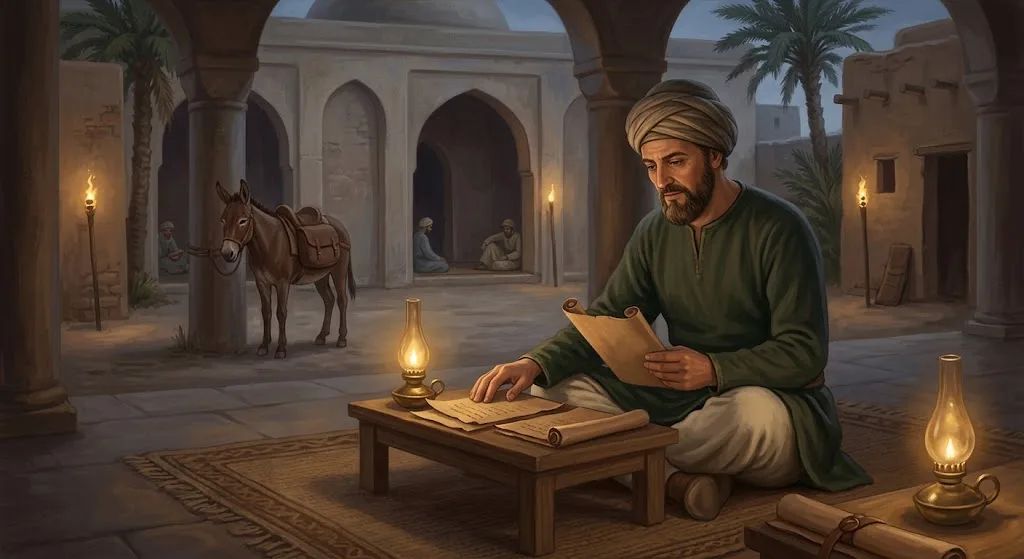
Umar bin Abdul Aziz (682–720 CE) was the eighth Umayyad caliph and is widely regarded by historians as the most just ruler of the dynasty. In a reign of just over two years, he reversed decades of administrative corruption, restored confiscated property, and reformed taxation — a record that led generations of scholars to count him among the “Rightly Guided” caliphs, a status otherwise reserved for the four who ruled immediately after the Prophet Muhammad.
Umar ibn Abdul Aziz — sometimes written Umar bin Abdulaziz, or simply referred to by his regnal name Umar II — ruled from 717 to 720 CE. This guide covers his background, his brief but consequential reign, the reforms that defined it, and the disputed circumstances of his death.
Did You Know: Around the same decades that Umar was reforming the caliphate’s administration from Damascus, generals like Muhammad bin Qasim and Tariq ibn Ziyad were still expanding its borders — a reminder of how differently the same empire could be shaped by a single ruler’s priorities.
Quick Facts
| Fact | Detail |
|---|---|
| Full name | Umar ibn Abdul Aziz ibn Marwan |
| Regnal name | Umar II |
| Born | 682 CE (61 AH), Madinah |
| Died | 720 CE (101 AH), near Aleppo, Syria |
| Age at death | 38 |
| Reign | 717–720 CE (2 years, 5 months) |
| Dynasty | Umayyad Caliphate |
| Predecessor | Sulayman ibn Abdul-Malik |
| Known for | Administrative reform, restoring confiscated property, fair taxation |
| Cause of death | Poisoning |
Family Background and Lineage
Umar’s great-great-grandfather was Umar ibn al-Khattab, the second caliph of Islam — a lineage later chroniclers treated as more than coincidence, given how closely Umar bin Abdul Aziz’s own reputation for austerity and fairness would come to echo his ancestor’s. His father, Abdul Aziz ibn Marwan, served as governor of Egypt, and his uncle, Abdul Malik ibn Marwan, held the caliphate itself during much of his childhood — placing Umar at the center of Umayyad political life from birth.
Early Life and Rise Through Umayyad Administration
Umar was born in Madinah around 682 CE and raised amid considerable wealth. He was married to Fatima, daughter of Caliph Abdul Malik, cementing his position within the ruling family. After Abdul Malik’s death, his son Al-Walid I became caliph and appointed Umar governor of Madinah, and later of Ta’if.
His time governing Madinah stood out from the norm: he established a consultative council to resolve disputes locally, reducing the volume of complaints reaching the capital in Damascus so noticeably that it drew attention. It also drew opposition — Al-Hajjaj ibn Yusuf, the powerful and famously harsh governor of Iraq, complained that people were fleeing to Madinah specifically to escape his rule, and Umar was recalled to Damascus as a result.
Back at court, Umar became a trusted advisor to Caliph Al-Walid I and later to Al-Walid’s brother and successor, Caliph Sulayman, pushing for reforms such as requiring court approval before death sentences could be carried out. By the time Sulayman fell ill, Umar had spent more than two decades in senior administrative posts — a far longer apprenticeship in governance than most Umayyad caliphs had before taking the throne.
Becoming Caliph
On his deathbed, Sulayman named Umar as his successor, breaking with the usual pattern of direct hereditary succession within the ruling line. Umar’s public response to the appointment became one of the most repeated episodes of his biography: rather than accept the caliphate as a matter of course, he addressed the assembled crowd in the mosque, framing the role as a burden placed on him rather than a right he had sought, and offering to step aside if the people wished to choose someone else. The crowd insisted he remain, and he accepted on the condition that they hold him to account if he strayed from what was right.
He turned down the ceremonial mounts and the newly built caliphal palace offered to him, choosing instead to keep his own modest mule and remain in a small house near the mosque — a pattern of personal austerity that continued throughout his reign.
Reforms and Governance
Umar’s brief rule is remembered less for any single achievement than for a broad, sustained reversal of Umayyad-era abuses that had built up over decades:
- Property and taxation: He ordered the return of land and wealth that earlier rulers had confiscated without legal right, cancelled unjust taxes, and equalized tax obligations between Arab and non-Arab Muslims — a significant shift, since non-Arab converts had often continued to be taxed as though they were not Muslim.
- Non-Muslim subjects: He reversed a practice, notably in Cyprus, where new converts to Islam had still been forced to pay the jizya (a tax specifically levied on non-Muslims), which some earlier governors had kept charging simply to protect tax revenue as conversions increased. He also reinstated state stipends for non-Muslim subjects.
- Personal wealth: On taking office, he sold off the luxury items, perfumes, and household extravagances he had personally accumulated, donating the proceeds — a sum later sources put at roughly 23,000 dinars — toward public needs. He is also recorded as having reclaimed jewelry his wife had received as gifts from her father, the previous caliph, asking her to return it to the public treasury rather than keep it as a personal possession.
- Corruption controls: He banned the practice of governors and officials accepting gifts, a common channel for influence and bribery under previous administrations, and dismissed officials known for corruption or cruelty in favor of capable, honest replacements.
Personal Life and Character
Later biographers consistently describe Umar as a ruler who treated the public treasury as something held in trust rather than personal property, to the point of near-obsessive caution about using state resources for his own family. Anecdotes recorded by early biographers describe him declining better transportation and housing than he already had, and admonishing one of his own sons for an expensive purchase, insisting the money be redirected to feeding the poor instead.
He surrounded himself with scholars, appointed learned and trustworthy men to administrative posts, and was known for weeping openly during recitations of the Quran and in private prayer — details that later writers frequently paired with his reputation for personal humility rather than treating them as separate from his political record.
One frequently retold episode describes an official sent to negotiate with the Byzantine court discovering a blind Muslim captive being forced to work as a laborer, having lost his sight rather than renounce his faith. On hearing the report, Umar is said to have been moved to tears and to have sent a direct warning to the Byzantine emperor demanding the man’s release — after which the captive was returned. As with several of the more dramatic anecdotes attached to his reign, this account comes from later biographical compilations rather than a contemporary record, and is best treated as part of his traditional legacy rather than independently verified history.
Death
Umar’s reforms made him powerful enemies within his own family — relatives who had lost confiscated grants and privileges under his policies. According to early biographical sources, he was poisoned, reportedly by a servant who had been paid by members of his own extended family to carry it out. Umar is said to have forgiven the man on learning what had happened and urged him to flee before the wider Umayyad family could retaliate.
He died near Aleppo in 720 CE at around 38 years old, having ruled for two years and five months — coincidentally the same length as the reign of the first caliph, Abu Bakr. He left behind seventeen children and, according to tradition, declined to leave them any specific inheritance, saying that if they were righteous, provision would come to them regardless.
His reign was short enough that later historians sometimes debate how much of his reputation reflects sustained policy versus a brief burst of reform cut off by his death — but the breadth of the changes attributed to him, and how consistently later sources across different eras describe them the same way, is part of why his memory has endured as it has.
Legacy
Several early Islamic scholars, including later compilers of caliphal histories, are recorded as counting Umar bin Abdul Aziz among the “Rightly Guided” caliphs — a designation that otherwise applies only to Abu Bakr, Umar ibn al-Khattab, Uthman, and Ali, the four who led the Muslim community immediately after the Prophet’s death. That a ruler from a different, later dynasty received this recognition at all reflects how sharply his brief reign contrasted with both his predecessors and much of what followed him. His reforms around equal taxation and non-Muslim stipends are also frequently cited in later Islamic administrative and legal writing as an early reference point for just governance.
🕌 Frequently Asked Questions — Umar bin Abdul Aziz (Umar II)
He was the eighth Umayyad caliph, ruling from 717 to 720 CE, and is widely regarded as the dynasty’s most just ruler. His reforms — restoring confiscated property, equalizing taxation, and removing corrupt officials — led some scholars to count him among the “Rightly Guided” caliphs, a distinction otherwise reserved for the four who led the Muslim community immediately after the Prophet Muhammad.
He ruled for two years and five months, from 717 to 720 CE.
His cousin, Caliph Sulayman ibn Abdul-Malik, named him as successor on his deathbed, breaking from the usual pattern of direct succession within the ruling line. Umar accepted the role publicly on the condition that the people hold him accountable if he governed unjustly.
He restored property confiscated by earlier rulers, equalized taxation between Arab and non-Arab Muslims, ended the practice of taxing new converts as non-Muslims, banned gifts to officials as a corruption control, and personally gave up his own household luxuries.
He is given the regnal number II to distinguish him from Umar ibn al-Khattab, the second caliph of Islam and his great-great-grandfather, whose reputation for justice he was frequently compared to.
Umar ibn al-Khattab, the second caliph of Islam, was Umar bin Abdul Aziz’s great-great-grandfather. Later chroniclers frequently noted the resemblance between the two in their reputations for personal austerity and strict justice.
His wife was Fatima bint Abdul Malik, daughter of Caliph Abdul Malik. She is recorded as having agreed to return jewelry gifted to her by her father to the public treasury at Umar’s request after he became caliph.
Umar bin Abdul Aziz occupies an unusual position in Shia sources compared to other Umayyad rulers. He is credited with ending the practice, instituted by earlier Umayyad caliphs, of publicly cursing Ali ibn Abi Talib from the pulpit during Friday sermons, and with treating Ali’s descendants more fairly than his predecessors had. This has earned him relatively more favorable treatment in some Shia historical writing, even though he is not recognized within the Shia tradition’s own line of Imams.
He was poisoned, reportedly by a servant paid by relatives who had lost property and privileges under his reforms. He died near Aleppo in 720 CE at around 38 years old.
References & Further Reading
Ibn Sa’d — The Men of Madina (Volume II), trans.
Britannica
Tarikh al-Khulafa (History of the Caliphs)