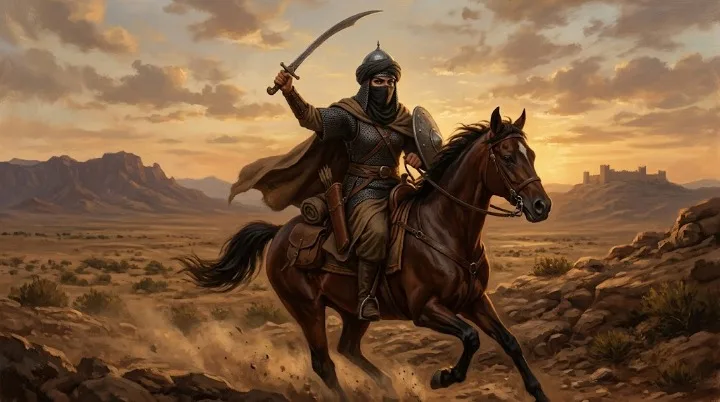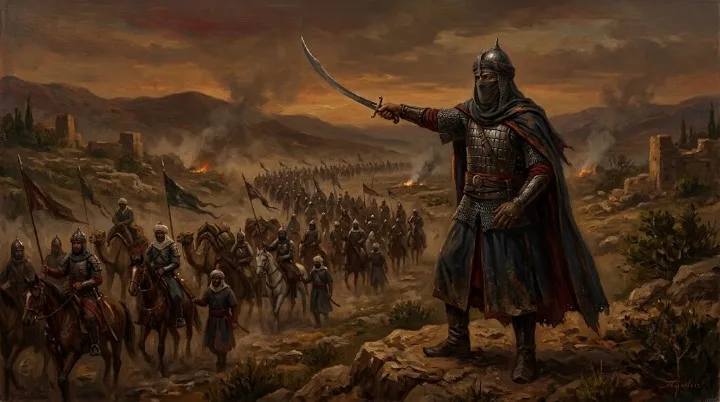
Muhammad bin Qasim (695–715 CE) was a 17-year-old Umayyad general who conquered Sindh, in present-day Pakistan, between 711 and 712 CE. His campaign against the local ruler Raja Dahir opened the first lasting Muslim presence in South Asia, though his own career ended abruptly in political disgrace three years later.
Muhammad ibn al-Qasim al-Thaqafi — usually written Muhammad bin Qasim — remains one of the youngest commanders in early Islamic history to lead a successful province-scale conquest. This guide covers his background, the campaign itself, his administration of Sindh, the disputed circumstances of his death, and how historians separate the documented record from later legend.
Did You Know? Around the same years Muhammad bin Qasim was securing Sindh, another young Umayyad commander, Tariq ibn Ziyad, was crossing into Spain — together, their campaigns marked the furthest eastward and westward reach of the Umayyad Caliphate’s expansion.
Quick Facts
| Fact | Detail |
|---|---|
| Full name | Muhammad ibn al-Qasim al-Thaqafi |
| Born | c. 695 CE (75 AH), Ta’if |
| Died | 715 CE (96 AH), aged around 20 |
| Age at start of campaign | 17 |
| Era | Umayyad Caliphate (Caliphs Al-Walid I, then Sulayman) |
| Tribe | Banu Thaqif |
| Patron / uncle | Al-Hajjaj ibn Yusuf, governor of Iraq |
| Key battles / sieges | Debal, Rawar, Brahmanabad, Multan |
| Main opponent | Raja Dahir, ruler of Sindh |
| Legacy | First lasting Muslim foothold in South Asia |
Early Life and Background
Muhammad bin Qasim was born around 695 CE into the Banu Thaqif tribe of Ta’if. His father died while he was young, and his most consequential relationship became the one with his paternal uncle, Al-Hajjaj ibn Yusuf, the powerful Umayyad governor of Iraq and the eastern provinces. Recognizing his nephew’s ability, Al-Hajjaj appointed him governor of Shiraz in Persia while still a teenager — a senior post that gave Muhammad real administrative experience before he ever commanded an army, and a strong indication his later career was built on demonstrated competence rather than name alone.
The Catalyst: Pirates of Debal
The invasion of Sindh began as a diplomatic dispute, not a war of conquest.
Around 708–710 CE, a ship carrying gifts for Caliph Al-Walid I — along with Muslim women and children of deceased Arab merchants returning home from Ceylon (modern Sri Lanka) — was attacked by pirates near the port of Debal, on the Sindh coast. The passengers were killed or taken captive, and the cargo looted.
Al-Hajjaj demanded that Raja Dahir, the Hindu ruler of Sindh’s Brahmin dynasty, secure the captives’ release and punish those responsible. Dahir refused, claiming the pirates operated beyond his control — a response Al-Hajjaj treated as an act of hostility in its own right.
Route of escalation:
Ceylon merchant ships carrying gifts & returning Muslim families
Pirates raid the ships near Debal
Al-Hajjaj demands captives’ release
Raja Dahir refuses
Two punitive expeditions fail
Full campaign launched under Muhammad bin Qasim
Two earlier expeditions sent to resolve the matter by force were both defeated — commanders Ubayd Allah and Budail ibn Tahfa were killed, in part because Sindhi war elephants unsettled the Arab cavalry. Only after these failures did Al-Hajjaj commit serious resources, placing his 17-year-old nephew in command.
The Sindh Campaign: Route and Strategy
Muhammad bin Qasim marched from Shiraz with around 6,000 Syrian cavalry and a comparable force of camel-mounted troops, supported by a naval detachment sailing from Basra with siege equipment — including a large catapult remembered in later tradition as al-Arus (“the bride”).
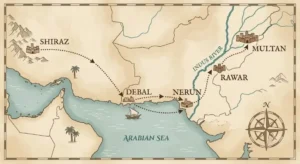
Siege of Debal (711 CE): Qasim’s forces besieged the fortified port, using the catapult to break its defenses before taking the city — securing his supply line before advancing inland.
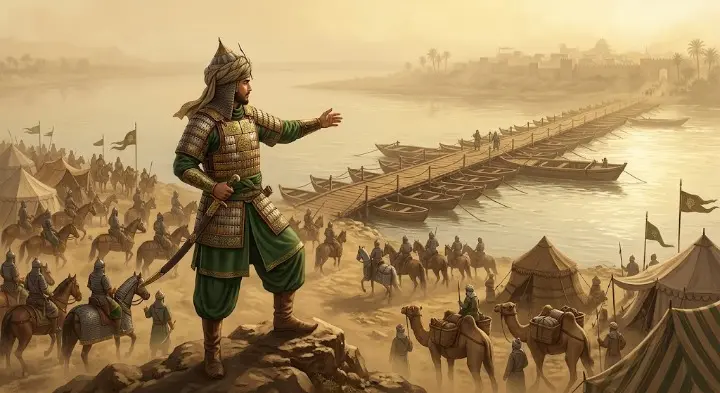
Crossing the Indus and the Battle of Rawar (712 CE): Dahir massed his main force, including war elephants, on the river’s eastern bank to block the crossing. Rather than force a contested crossing, Qasim’s engineers lashed boats into a pontoon bridge after weeks of preparation. In the battle that followed, Dahir was killed after being separated from his mount, breaking his army’s cohesion. Later tradition holds that his queen and her attendants died by self-immolation (jauhar) rather than face capture — a practice recorded in later chronicles rather than confirmed by contemporary sources.
Brahmanabad, Aror, and Multan: Dahir’s son Jai Singh attempted to continue resistance at Brahmanabad before the city fell. Aror, the old Sindhi capital, surrendered under terms guaranteeing protection for its people. Multan — wealthy enough to be remembered as the “House of Gold” — was the last major city to submit, after its water supply was cut in 713 CE.
By the campaign’s end, Muhammad bin Qasim controlled the lower Indus Valley from the coast to Multan.
Administration, Religion, and Family Life
Qasim’s government of Sindh was notably pragmatic. Hindu and Buddhist communities were extended protections comparable to those given to Jews, Christians, and Zoroastrians elsewhere in the caliphate: temples were largely left standing, local Brahmin officials were retained to help administer taxation, and non-Muslim residents paid the jizya rather than facing forced conversion.
On marriage: Later chronicles — most notably the Chachnama, a Persian-language account of the conquest compiled centuries after the events — record that Qasim married Ladi, the widow of Raja Dahir, as part of consolidating control over the territory. This detail is widely repeated, but it’s worth being precise about its status: the Chachnama blends documented history with courtly narrative, and no independent contemporary source confirms the marriage or the political-advisory role sometimes attributed to Ladi afterward. Readers should treat it as a traditional account rather than settled fact.
The Tragic End: History vs. Legend
Muhammad bin Qasim’s downfall, at around age 20 in 715 CE, has two very different explanations in the historical record.
The documented account — a political purge: Al-Hajjaj died in 714 CE. The following year, Caliph Al-Walid I also died and was succeeded by his brother, Sulayman ibn Abdul-Malik, with whom Al-Walid had a bitter succession rivalry. Sulayman moved quickly against Al-Walid’s allies, including Al-Hajjaj’s surviving family and appointees — among them Muhammad bin Qasim and the Central Asian commander Qutayba ibn Muslim. Qasim was recalled from Sindh by the new Iraqi governor, imprisoned at Wasit, and died in custody — a casualty of caliphal succession politics rather than any failure in Sindh.
Documented Account
- Al-Hajjaj dies, 714 CE
- Caliph Al-Walid I dies, 715 CE
- Sulayman succeeds — purges Al-Walid/Al-Hajjaj’s allies
- Qasim recalled, imprisoned at Wasit
- Dies in custody, political casualty
Chachnama Legend
- Dahir’s daughters sent to caliph’s court
- Falsely accuse Qasim of dishonoring them
- Caliph orders his execution
- Deception revealed too late
- Compiled centuries after the events
The legend — the Chachnama account: A more dramatic version, found in the Chachnama, holds that Raja Dahir’s two daughters, sent to the caliph’s court, falsely accused Qasim of dishonoring them in revenge for their father’s death — and that the caliph, on realizing the deception too late, could only mourn the consequences.
Why historians favor the political explanation: The Chachnama was compiled roughly five centuries after the events it describes, mixing genuine historical material with later courtly storytelling. The political-purge account, by contrast, is independently attested by the broader historical record of Sulayman’s succession and his documented actions against Al-Hajjaj’s faction. The two versions aren’t strictly incompatible — the purge is the explanation the documented record supports, while the daughters’ story reflects how later generations reshaped and personalized it. Any specific claim about which named modern historians have weighed in on this debate should be checked against the actual source before publishing, rather than asserted without a citation.
Legacy and Historical Impact
Muhammad bin Qasim’s brief campaign gave the Umayyad Caliphate its first durable territorial presence in South Asia, opening a corridor for trade, migration, and intellectual exchange between the Islamic world and the Indian subcontinent that continued well into the Abbasid era. His conquest is often treated, particularly in Pakistani historiography, as the founding chapter of Muslim presence in the region — a framing that carries different weight in Indian historical writing, where it’s more often read as one of several early medieval regional incursions rather than a singular founding event. Both readings agree on the underlying facts; they differ on long-term significance.
🕌 Frequently Asked Questions — Muhammad bin Qasim & the Conquest of Sindh
He was 17 when Al-Hajjaj ibn Yusuf appointed him to lead the campaign in 711 CE, and around 20 when he died in 715 CE.
Later chronicles, particularly the Chachnama, record that he married Ladi, the widow of Raja Dahir, after the conquest — though this comes from a source compiled centuries later and isn’t independently confirmed.
Pirates near Debal attacked an Arab ship carrying gifts for Caliph Al-Walid I and Muslim women and children returning from Ceylon, taking captives. When Raja Dahir refused to secure their release or punish those responsible, and two earlier punitive expeditions failed, Al-Hajjaj authorized a full campaign under his nephew’s command.
He is remembered as the young Umayyad general who conquered Sindh in 711–712 CE at age 17, bringing the first lasting Muslim presence into the Indian subcontinent.
He was recalled to Iraq and imprisoned after the deaths of his uncle Al-Hajjaj and Caliph Al-Walid I, when the new caliph, Sulayman, purged Al-Hajjaj’s allies from power. He died in custody around 715 CE as a result of this political struggle, not a military defeat.
Yes. His campaign targeted Sindh, then part of the Indian subcontinent and now part of Pakistan, making him one of the earliest Muslim commanders to establish control in the region.
He was around 20 years old when he died in captivity in 715 CE.
Yes. Between 711 and 713 CE he conquered Debal, Rawar, Brahmanabad, and Multan, bringing the Indus Valley region of Sindh under Umayyad control.
His main opponent was Raja Dahir, the Hindu ruler of Sindh’s Brahmin dynasty, whom he defeated at the Battle of Rawar in 712 CE after Dahir refused to punish pirates who had raided an Arab ship near Debal.
After his recall and death, Sindh remained under Umayyad governors appointed from Iraq, though local control gradually weakened and later fragmented amid changing Umayyad and Abbasid administration — a detail worth confirming against a source before stating a specific named successor, since accounts vary.
References & Further Reading
- Al-Baladhuri (892 AD). Kitab Futuh al-Buldan (The Origins of the Islamic State).
- Mir Ali Kufi (1216 AD). Chachnama (Persian translation of early Arabic histories of Sindh).
- Kennedy, Hugh (2007). The Great Arab Conquests: How the Spread of Islam Changed the World We Live In. Da Capo Press.